

Complete Ohata Board Grade Classification
The Ohata Board Scrap Classification System organizes printed circuit boards into nine grades based on their original application, physical construction, component configuration, recoverable-material characteristics, completeness, and condition.
The system progresses from SS Grade, which covers qualifying high-value electronic boards, through the computer-board grades and into Appliance Board A and Appliance Board B.
A board’s source, manufacturer, size, or age may help with identification, but none of these factors determines the grade by itself. The complete board must be compared with the current Ohata classification requirements and approved examples.
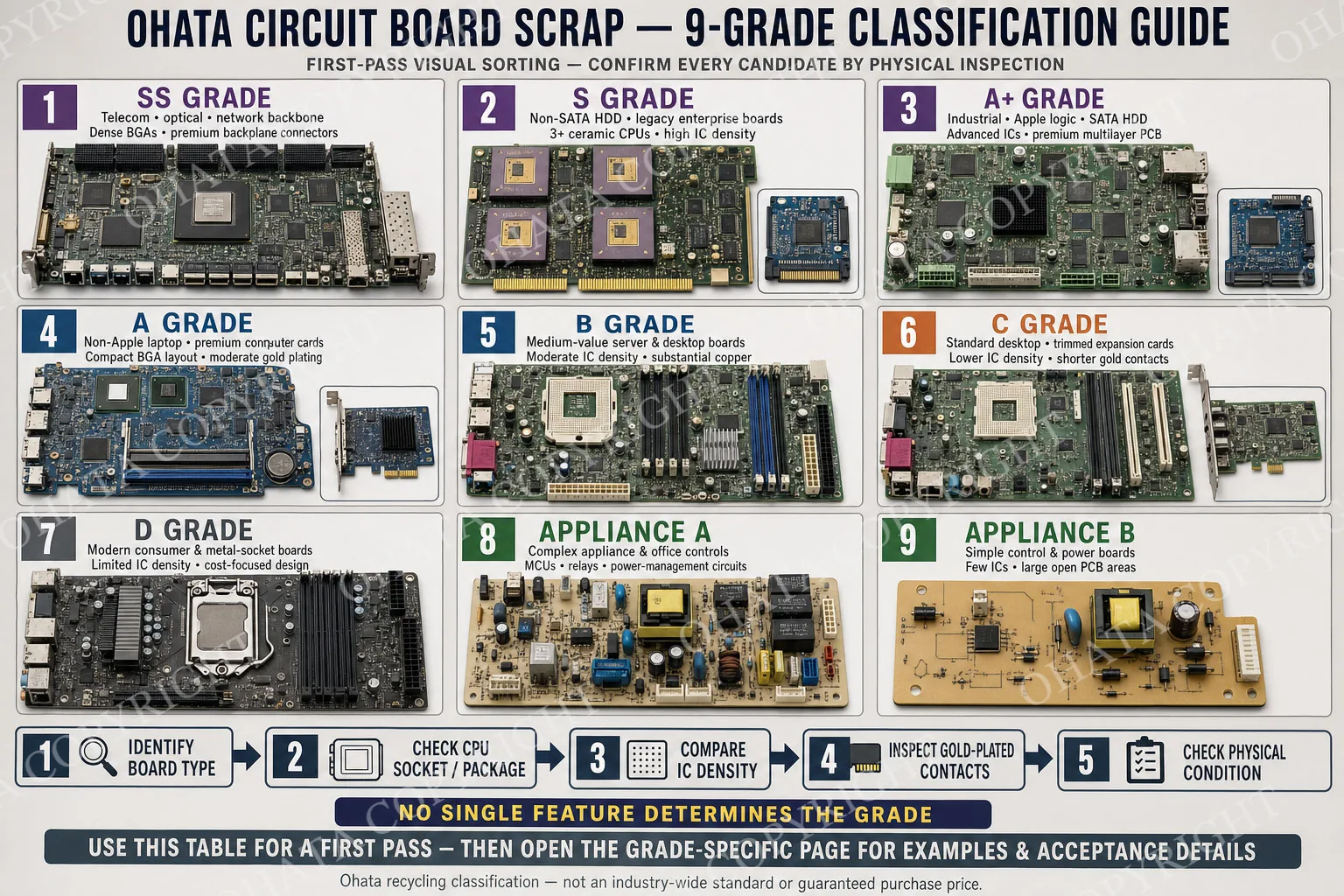
The Ohata Circuit Board Scrap Classification is SS Grade, S Grade, A+ Grade, A Grade, B Grade, C Grade, D Grade, Appliance A Grade and Appliance B Grade.
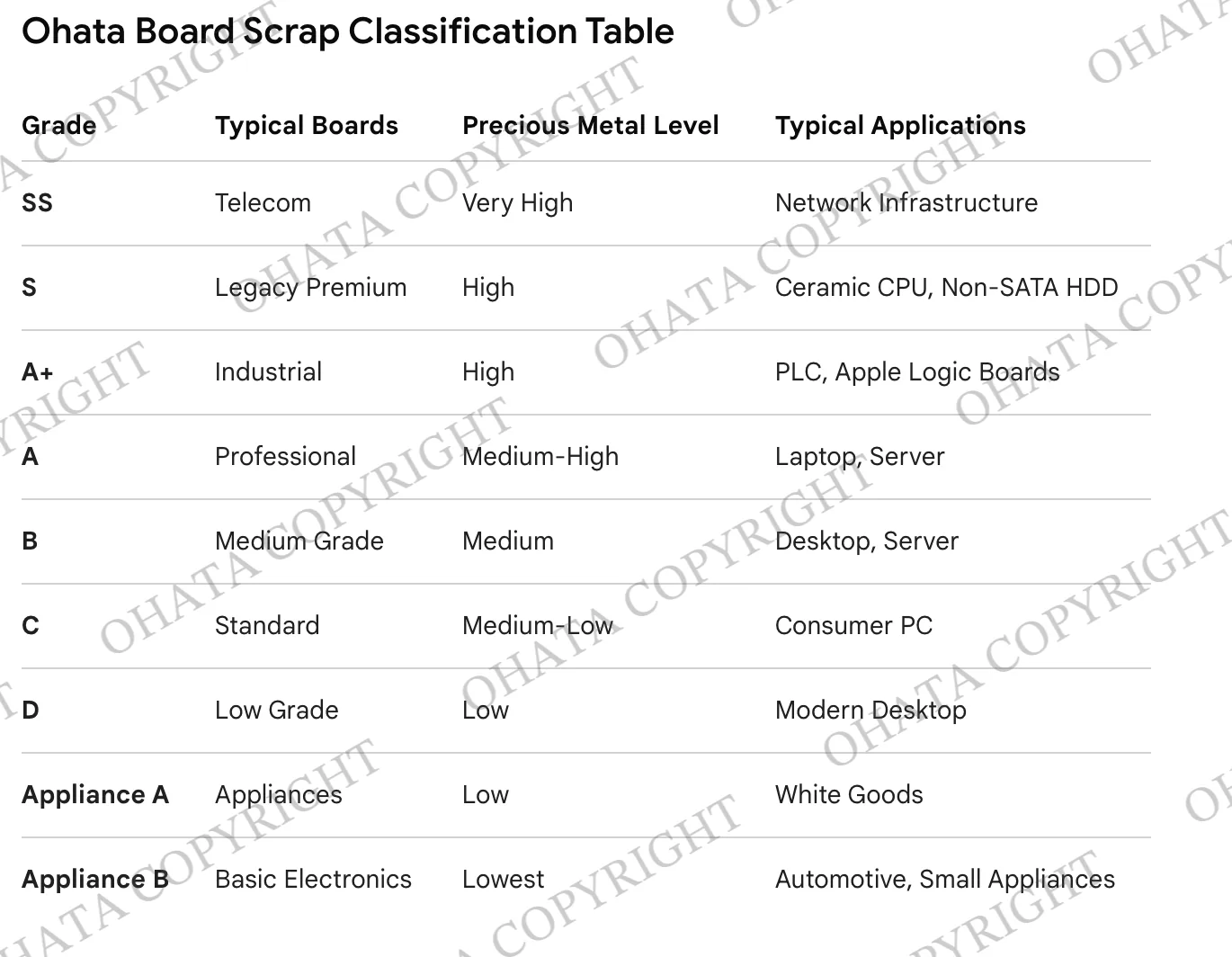
Printed circuit boards are found in nearly every modern electronic product, including Hard Disk Drive (HDD) Board, desktop computers, laptop computers, enterprise servers, telecommunications equipment, industrial automation systems, medical devices, networking hardware, gaming consoles, automotive electronics, and household appliances. Although these products may appear similar, the materials used in their construction vary significantly. Some boards contain extensive gold plating, dense integrated circuits, ceramic components, and high-grade connectors, while others contain relatively small amounts of recoverable precious metals.
History of Circuit Board Recycling
The history of printed circuit board recycling mirrors the rapid development of the global electronics industry. During the early decades of electronic manufacturing, most equipment relied on point-to-point wiring instead of printed circuit boards. As PCB technology became commercially viable in the 1950s and 1960s, manufacturers rapidly adopted it because it improved reliability, reduced production costs, and simplified assembly.
Initially, electronic products were expensive and often repaired rather than discarded. Obsolete equipment was commonly stored or reused, and organized electronic recycling was relatively uncommon. As personal computers, telecommunications equipment, industrial controllers, and consumer electronics became widely available during the 1970s and 1980s, the number of discarded circuit boards increased dramatically.
Early computer motherboards and telecommunications equipment often contained relatively large amounts of gold plating, ceramic processors, and socketed integrated circuits. These designs unintentionally created highly valuable electronic scrap because many of the materials used for reliability also possessed significant precious metal value.
During the 1990s and early 2000s, rapid technological innovation accelerated product replacement cycles. Desktop computers, laptops, mobile phones, gaming consoles, networking equipment, and industrial electronics were replaced more frequently, creating one of the world's fastest-growing waste streams. At the same time, advances in metallurgical processing enabled refiners to recover gold, silver, palladium, copper, and other valuable materials from electronic scrap more efficiently than ever before.
Environmental awareness further accelerated the growth of electronic recycling. Governments introduced regulations promoting responsible recycling, safe handling of hazardous materials, and recovery of valuable resources. Electronic recycling evolved into a sophisticated global industry supported by mechanical separation, hydrometallurgical processing, pyrometallurgical refining, and advanced material recovery technologies.
As the industry matured, one challenge became increasingly apparent: inconsistent terminology and grading practices. Similar boards were described differently by different buyers, creating confusion in international trade and pricing. These challenges highlighted the need for classification systems capable of evaluating boards according to objective technical characteristics rather than subjective descriptions.
The Ohata PCB Scrap Classification System represents the next stage in this evolution by providing a comprehensive methodology for identifying and grading electronic boards based on their construction, component density, precious metal content, and industrial application.
Why Board Classification Matters
Accurate board classification is fundamental to an efficient electronic recycling industry. Every circuit board contains a unique combination of electronic components, metals, and construction techniques that directly influence its recycling value. Without grading, buyers may overpay or underpay for materials, suppliers may receive inconsistent pricing, and refiners may encounter mixed loads that reduce recovery efficiency.
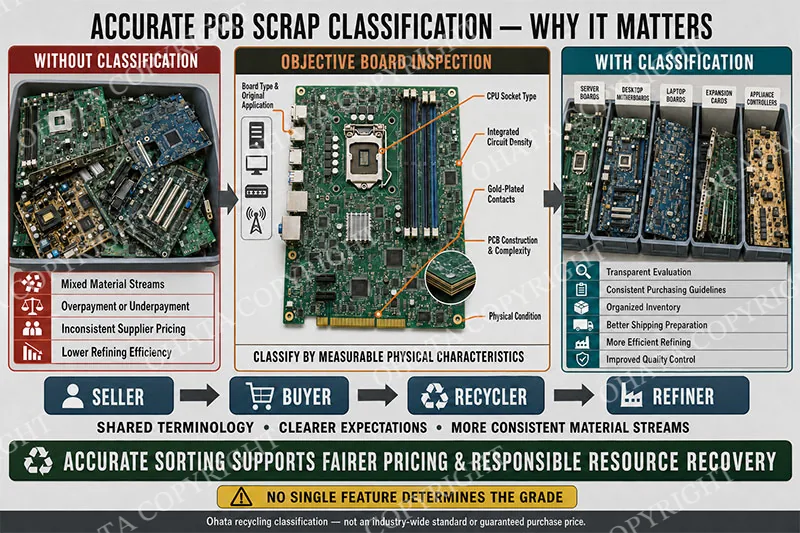
A classification system creates transparency throughout the supply chain. Sellers understand how their material is evaluated, buyers can establish consistent purchasing guide, and recyclers can process materials more efficiently. Proper classification also improves inventory management, shipping preparation, downstream refining, and quality control.
The Ohata Board Classification System promotes consistency by evaluating boards using objective characteristics such as integrated circuit density, gold-plated connectors, CPU socket type, board complexity, and intended industrial application. This approach reduces subjectivity while supporting fair pricing, operational efficiency, and responsible recycling practices.
Precious Metals Found in Circuit Boards
Printed circuit boards are valuable because they contain concentrated amounts of recoverable metals used to ensure electrical conductivity, corrosion resistance, heat management, and long-term reliability. Although the exact composition varies by manufacturer, application, and production period, most circuit boards contain a combination of base metals and precious metals that contribute to their recycling value.
Gold is the most recognized precious metal used in electronic equipment. Manufacturers commonly apply gold plating to edge connectors, CPU contacts, memory sockets, telecommunications connectors, and integrated circuit bonding wires because gold resists oxidation while maintaining excellent electrical conductivity. Boards with long gold fingers, gold-plated pins, or numerous gold bond wire integrated circuits generally possess higher recycling value.
Silver is widely used in solder alloys, thick-film conductors, switches, and electrical contacts. Although less visible than gold, silver contributes significantly to the overall recoverable value of many industrial and telecommunications boards.
Palladium is frequently found in multilayer ceramic capacitors, specialized connectors, and high-performance electronic assemblies. Palladium provides excellent corrosion resistance and electrical stability, making it valuable for advanced electronic applications.
Copper represents the largest recoverable metal by weight in most printed circuit boards. Copper forms conductive traces, power planes, internal PCB layers, transformers, coils, and wiring. High-layer-count boards typically contain greater copper content than simpler consumer electronics.
Additional recoverable materials include nickel, tin, aluminum, steel, and, in specialized applications, trace amounts of platinum-group metals. The concentration of these materials depends on board complexity, manufacturing technology, intended industry, and performance requirements.
The Ohata PCB Scrap Classification Principle
The Ohata Board Scrap Classification is founded on the principle that every printed circuit board should be evaluated using objective, repeatable, and technically meaningful criteria rather than subjective opinions or temporary market fluctuations. The purpose is to establish a consistent internal and public identification framework for Ohata purchasing, sorting and educational use.
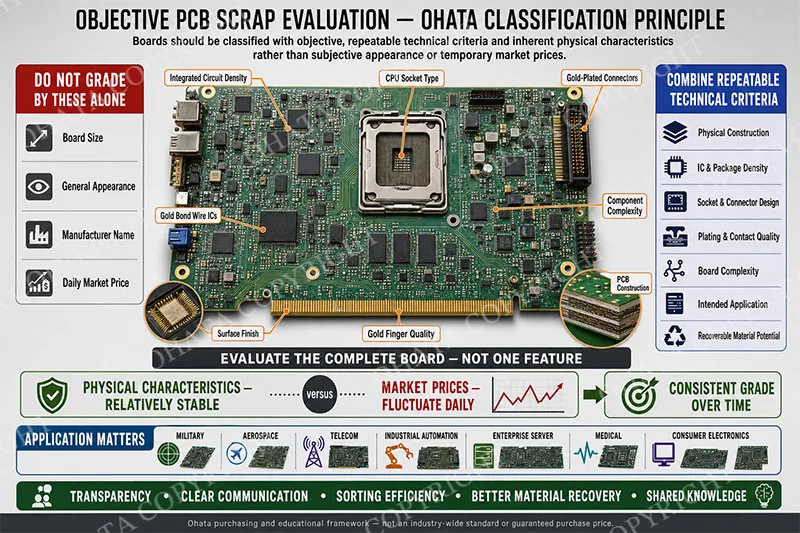
Unlike traditional grading methods that rely primarily on board size or general appearance, the Ohata methodology considers the complete construction of a circuit board. Each board is evaluated according to several key factors, including integrated circuit (IC) density, CPU socket type, gold finger quality, gold-plated connectors, gold bond wire chips, component complexity, PCB construction, surface finish, industry application, and overall recoverable precious metal value. By combining these technical characteristics, the system provides a more accurate assessment of recycling potential.
Ultimately, the Ohata PCB Classification System seeks to improve transparency, simplify communication, increase sorting efficiency, maximize precious metal recovery, and establish a comprehensive knowledge base for the global electronic scrap industry.
Learn how to read model numbers, revision codes, connector labels, and compliance symbols found on motherboards and other printed circuit boards.
How to Read Motherboard and PCB Markings: What the Letters & Numbers Mean
SS Grade – High Value Telecommunications and Enterprise Boards
SS Grade includes qualifying high-value circuit boards used in advanced telecommunications infrastructure and enterprise network systems. Common sources may include carrier switching systems, cellular base stations, optical transport equipment, network-backbone systems, enterprise network switches, and other large-scale communication equipment.
These boards may contain dense surface-mounted components, multiple large BGA packages, numerous integrated circuits, high-quality connectors, extensive component coverage, and complex multilayer PCB construction. However, the equipment type or manufacturer does not determine the grade by itself. Telecommunications and enterprise systems may also contain power boards, fan controllers, backplanes, and lower-density interface boards that belong to other Ohata classifications.
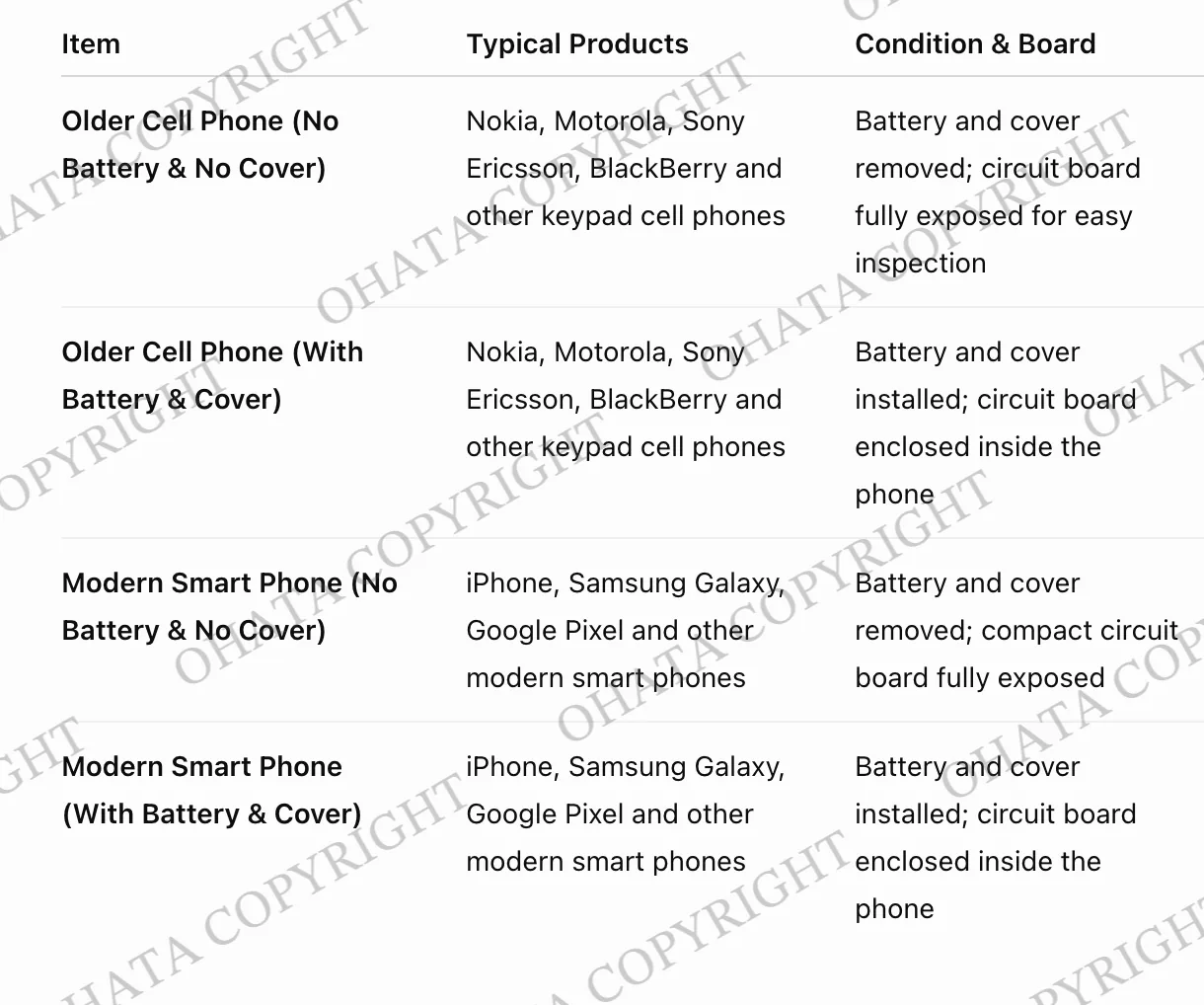
Manufacturers such as Cisco, Juniper, Arista, Nokia, and Ericsson produce many different types of equipment and circuit boards. Each board must therefore be evaluated individually according to its original function, processor and integrated-circuit configuration, connector construction, PCB complexity, completeness, condition, and comparison with current Ohata SS Grade examples.
Consumer mobile devices such as iPhones, BlackBerry phones, and other smartphones should be checked against Ohata’s applicable phone-specific purchasing categories rather than automatically classified as SS Grade.
S Grade – Premium Computer and Legacy High-Value Boards
S Grade consists primarily of premium computer boards with high integrated circuit density and significant precious metal content. Boards in this category commonly feature HDD Board Non-SATA, Server motherboard with three or more Large BGA Ceramic CPUs (Purple) , abundant gold edge connectors, and numerous high-value semiconductor packages.
Legacy Server motherboards equipped with three or more BGA ceramic CPUs, older enterprise computer boards, HDD Board Non-SATA, and specialized computer hardware frequently qualify for this grade. These products often originate from earlier generations of computing equipment, when manufacturers used larger quantities of precious metals than are typically found in modern consumer electronics.
Although these boards generally contain fewer advanced networking components than SS Grade, they remain highly valuable because of their gold-plated connectors and high-quality electronic construction.
A+ Grade – Advanced Industrial and Enterprise Boards
A+ Grade includes a wide variety of advanced electronic boards used in industrial automation, enterprise computing, and professional electronic systems. Typical examples include Apple logic boards, HDD SATA Board, Server motherboard with two Large BGA Ceramic CPUs (Purple) , industrial control boards, PLC CPU modules, CNC controller boards, robotics controllers, medical equipment control boards, high-grade telecommunications equipment.
Boards assigned to A+ Grade usually exhibit high integrated circuit density, large BGA CPU sockets, quality connectors, premium PCB construction, and extensive semiconductor coverage. Many industrial manufacturers, including Siemens, Allen-Bradley, Mitsubishi Electric, Fanuc, Honeywell, ABB, Rockwell Automation, Omron, Schneider Electric, and Yaskawa, produce equipment commonly classified within this category.
These boards balance high technical complexity with strong recoverable material value, making them important contributors to industrial electronic recycling.
A Grade – High Grade Computer Boards
A Grade represents high-quality computer hardware and expansion boards that contain valuable electronic components but generally possess lower precious metal concentrations than A+ Grade.
Look for Any laptop motherboards (Non-Apple logic boards), Server motherboard with three or more Large Plastic PGA CPU sockets, Server motherboard with two Large Plastic PGA CPU sockets and two Medium BGA chips with gold tabs, clean gold finger expansion cards, CD/DVD drive controller boards, NEC desktop motherboards in 1990s-2000s, and backplane expansion boards.
Boards within this category usually feature good integrated circuit density, quality capacitors, substantial copper content, and moderate gold plating. Removing unnecessary attachments such as heatsinks, cooling fans, or metal brackets before recycling often improves processing efficiency.
B Grade – Medium Grade Electronic Boards
B Grade includes medium-value electronic boards that contain useful recoverable materials but lower overall precious metal concentrations. Examples include Server motherboard with two Large Plastic PGA CPU sockets, Server motherboard with one Large Plastic PGA CPU socket and two Medium BGA chips with gold tabs, lower-grade telecommunications equipment, peripheral interface boards, Desktop Motherboards with PGA Plastic CPU Socket No. 1, 3, 5, or 8 (Non-Metal)
Although these boards remain suitable for precious metal recovery, they generally contain fewer high-value semiconductor packages, smaller gold-plated connectors, and lower integrated circuit density than higher classifications.
Proper sorting of B Grade material remains important because mixing with lower-grade appliance boards may reduce overall recovery efficiency.
C Grade – Standard Grade Electronic Boards
C Grade primarily consists of standard desktop motherboards, trimmed expansion cards, connector-end boards, and graphics or interface cards that retain moderate recoverable value but limited precious metal content.
Many boards within this category include Server motherboard with one Large Plastic PGA CPU socket, Server motherboard with 1 BGA chips with gold tabs, Desktop motherboard with one Large Plastic PGA CPU socket, reduced integrated circuit density, shorter gold fingers, Desktop Motherboards with PGA Plastic CPU Socket No. 2, 4, 6, 7, or 9 (Non-Metal).
While still valuable for copper recovery and component processing, they generally contain fewer premium electronic materials than higher-grade computer boards.
Accurate separation of C Grade boards helps maintain purchasing consistency while improving downstream refining performance.
D Grade – Low Grade Computer Boards
D Grade includes lower-value computer motherboards and peripheral electronics that contain relatively small amounts of recoverable precious metals. Typical examples include Any desktop motherboards with limited integrated circuit density, modern consumer motherboards using later-generation socket designs, AMD AM and FM platform boards, and peripheral cards with oversized heatsinks or cooling systems.
Although D Grade boards remain recyclable, their construction emphasizes cost efficiency rather than premium materials. Consequently, recoverable precious metal content is generally lower than earlier computer generations or industrial electronics.
These materials continue to contribute significant copper recovery and should remain separated from appliance-grade electronics whenever practical.
Appliance Board A
Appliance Board A consists of mixed electronic control boards commonly removed from household appliances, office equipment, consumer electronics, and light industrial devices. These boards typically contain moderate component density, integrated circuits, power management electronics, and conventional connectors.
Although precious metal concentrations are relatively modest compared with computer or telecommunications equipment, Appliance Board A remains suitable for recycling because of its recoverable copper, aluminum, and electronic components.
Typical sources include washing machines, microwave ovens, air conditioners, printers, vending machines, office equipment, and similar consumer products.
Appliance Board B
Appliance Board B represents the lowest board category within the Ohata Board Scrap Classification System. These boards generally contain basic electronic control circuits with relatively low integrated circuit density and minimal precious metal content.
This grade usually comes from automotive control boards, simple appliance controllers, low-grade consumer electronic boards, timer circuits, and basic power management modules.
Although these boards possess lower recycling value than higher classifications, they remain important sources of recoverable copper, base metals, plastics, and electronic materials. Proper separation of Appliance Board B from higher-grade materials ensures more accurate pricing, improved refining efficiency, and consistent inventory management throughout the recycling process.
Together, these ten classifications create a practical and scalable framework for evaluating electronic scrap. By emphasizing objective technical characteristics rather than temporary market prices, the Ohata Board Scrap Classification System promotes consistent grading, transparent transactions, and efficient resource recovery across the global electronic recycling industry.
Desktop Motherboard Classification
Desktop motherboards are classified by their CPU socket or package, board construction, components, completeness, and condition. Manufacturer, processor generation, and original price do not determine the grade.
A CPU PGA Large Plastic Socket is Ohata’s term for a removable plastic PGA socket measuring at least 5 cm × 5 cm across the outside of the socket body. Heatsink brackets and nearby components are not included in the measurement.
Qualifying boards must have a removable processor, a plastic socket without a metal load plate, and a complete, identifiable desktop, server, or workstation motherboard. Laptop boards, soldered BGA processors, metal CPU sockets, and smaller plastic sockets do not qualify.
Desktop Motherboard Grades
B or C Grade: Qualifying desktop motherboards with large plastic PGA CPU sockets. The final grade depends on the socket configuration and comparison with current Ohata reference examples.
D Grade: Qualifying desktop motherboards with a metal CPU load plate or retention frame, including many Intel LGA platforms.
S Grade: Qualifying server motherboards with three or more large purple ceramic processor packages.
A+ Grade: Qualifying server motherboards with two large purple ceramic processor packages and qualifying Apple iMac logic boards.
A Grade: Qualifying legacy NEC desktop motherboards that match current Ohata examples.
Identify the board type, determine whether the processor is removable or soldered, check for PGA, LGA, or BGA construction, and compare the complete board with the current Ohata classification references.
Laptop Motherboard Classification
Laptop motherboards, often referred to as logic boards, differ significantly from desktop motherboards in both design and construction. Because portable computers require compact layouts, laptop boards typically contain a much higher concentration of surface-mounted components within a smaller physical area. This dense construction often increases the complexity of recycling and influences their classification.
The Ohata Board Scrap Classification System distinguishes between Apple logic boards and non-Apple laptop motherboards. Apple logic boards frequently contain premium electronic components, high-density integrated circuits, sophisticated power management systems, and complex multilayer PCB construction. As a result, many Apple boards qualify for A+ Grade.
Non-Apple laptop motherboards generally fall within A Grade, although exceptionally dense industrial or workstation laptop boards may receive higher evaluations. Classification considers integrated circuit density, BGA processor count, gold-plated connectors, board condition, and overall recoverable material value rather than brand name alone. Missing processors or memory modules usually have limited impact on grading, while extensive physical damage, corrosion, or removed integrated circuits may reduce classification.
Server Motherboard Classification
Server motherboards are classified according to CPU type, socket configuration, chipset complexity, and recoverable precious metal content. This grading framework uses objective physical characteristics to ensure consistent identification and buying standards.
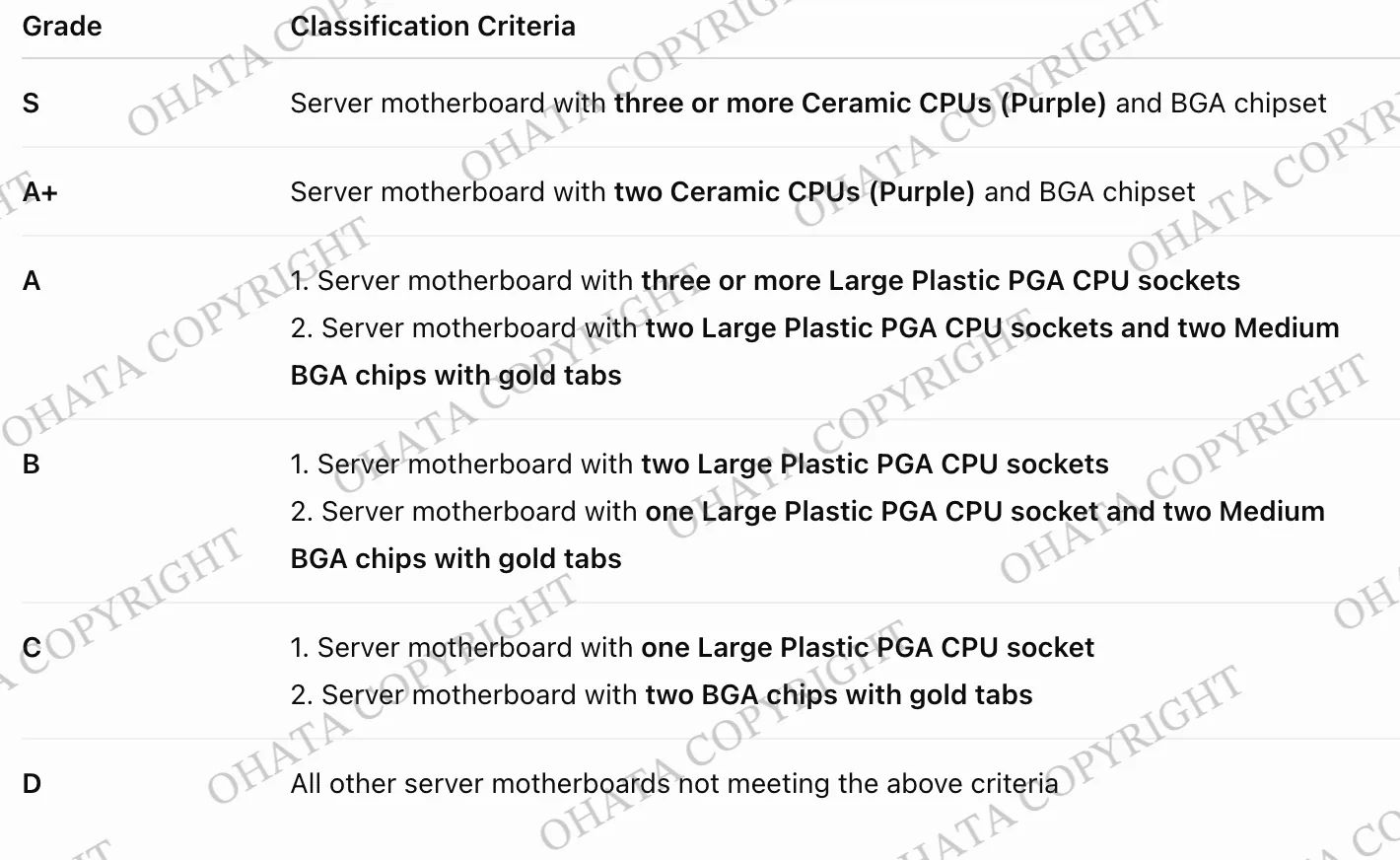
Classification Guidelines
Ceramic CPU (Purple): Legacy ceramic processor packages with high precious metal content.
Large Plastic PGA CPU Socket: Plastic CPU socket with external dimensions of at least 5 cm × 5 cm, as defined by the Ohata CPU Large Socket Rule.
Medium BGA with Gold Tab: Medium-sized BGA chipset accompanied by visible gold-finger edge connectors (gold tabs).
Boards should be classified according to the highest applicable grade.
Classification is based on the physical characteristics of the motherboard, not the manufacturer, model, or original market value.
Telecom Board Classification
Telecommunications boards are among the most valuable categories within the Ohata Board Scrap Classification System because they support mission-critical communication infrastructure and often contain exceptionally dense electronic assemblies. These boards are commonly found in network switches, enterprise routers, fiber optic transmission systems, optical transport equipment, cellular base stations, digital switching systems, and high-capacity communication servers.
Telecom boards typically contain numerous BGA processors, advanced communication chipsets, high-quality connectors, gold-plated contacts, multilayer PCB construction, and extensive integrated circuit coverage. Their sophisticated design reflects the reliability requirements of large-scale communication networks.
High-end networking equipment manufactured by companies such as Cisco, Juniper Networks, Arista, Nokia, Ericsson, Huawei, and similar enterprise manufacturers frequently qualifies for SS Grade because of its high precious metal content and complex electronic architecture. Lower-density telecommunications boards may be classified as A+ Grade depending on component count and construction quality.
Proper identification requires evaluating connector types, communication interfaces, processor density, optical modules, and overall board complexity rather than relying solely on product labels or manufacturer names.
Industrial Control Board Classification
Industrial control boards are used in programmable logic controllers, CNC equipment, robotics, factory automation, motor controls, process-control equipment, and industrial communication systems.
These applications often require durable and specialized electronics, but industrial equipment can contain boards with very different constructions. A dense processor or communication board may receive a different classification from a relay, power, display, or basic interface board removed from the same system.
Industrial origin does not automatically establish A+ Grade. Classification depends on the particular board’s processor configuration, integrated circuits, connectors, PCB construction, completeness, condition, and comparison with the current Ohata examples.
Medical Equipment Boards
Medical equipment boards are designed for diagnostic, monitoring, imaging, laboratory, and treatment systems where reliability, precision, and long service life are essential. These boards are commonly found in MRI scanners, CT scanners, ultrasound systems, X-ray equipment, patient monitoring devices, laboratory analyzers, surgical systems, and other healthcare technologies. They typically feature high-density integrated circuits, premium capacitors, multilayer PCB construction, and industrial-grade connectors. Due to their advanced electronic design and high component quality, medical boards are generally classified as A+ Grade within the Ohata Board Scrap Classification System. Their sophisticated construction and recoverable precious metals make them valuable materials for electronic recycling.
Network Equipment Boards
Network equipment boards provide the foundation for enterprise communication systems and data infrastructure. Common examples include Ethernet switches, enterprise routers, server backplanes, firewall appliances, wireless controllers, and network interface modules. These boards usually contain multiple communication processors, high-speed memory, premium connectors, multilayer PCB construction, and numerous integrated circuits. Manufacturers such as Cisco, Juniper, Arista, HP Enterprise, and Dell commonly produce network hardware that falls within SS Grade or A+ Grade, depending on component density and design complexity. Proper classification ensures accurate valuation while supporting efficient precious metal recovery and downstream electronic recycling.
Graphics Cards & Expansion Cards
Graphics cards and expansion cards include GPU boards, RAID controllers, network interface cards, sound cards, storage controllers, video capture cards, and various PCI or PCI Express expansion boards. Their classification depends primarily on gold finger quality, integrated circuit density, PCB complexity, and attached components. Clean expansion cards with long gold fingers and no heatsinks are generally assigned A Grade, while cards with attached cooling assemblies or trimmed edge connectors may fall into C Grade. Premium workstation graphics cards and specialized enterprise accelerator boards often contain higher-value semiconductor packages, increasing their overall recycling value within the Ohata Board Scrap Classification System.
Game Console Board Classification
Game console boards include motherboards removed from systems such as Sony PlayStation, Microsoft Xbox, Nintendo Switch, Nintendo Wii, GameCube, Sega Dreamcast, and other gaming platforms. These boards typically contain high-performance graphics processors, memory controllers, multimedia chipsets, and compact multilayer PCB designs. Classification varies according to console generation, component density, and construction quality. Earlier generations with larger integrated circuits and higher-quality materials may receive higher grades than modern cost-optimized designs. Proper identification of console boards helps recyclers maintain consistent sorting while maximizing recovery of valuable electronic materials and precious metals.
Hard Drive & SSD PCB Classification
Hard drive and solid-state drive controller boards are compact electronic assemblies responsible for storage management and data communication. Older non-SATA hard drive PCBs generally contain higher-value integrated circuits and may qualify for S Grade or A+ Grade, while lower-grade SATA controller boards are commonly classified as A+ Grade. SSD controller boards feature advanced flash memory controllers, power management circuits, and high-density surface-mounted components. Although physically small, these boards contain valuable semiconductor devices and recoverable metals. Proper separation from complete storage devices improves recycling efficiency and supports more accurate classification.
CPU Socket Identification Guide
The Ohata Board Scrap Classification distinguishes between CPU PGA Plastic Large Sockets and Metal CPU Sockets according to their physical construction, not the processor generation, manufacturer, or original retail value.
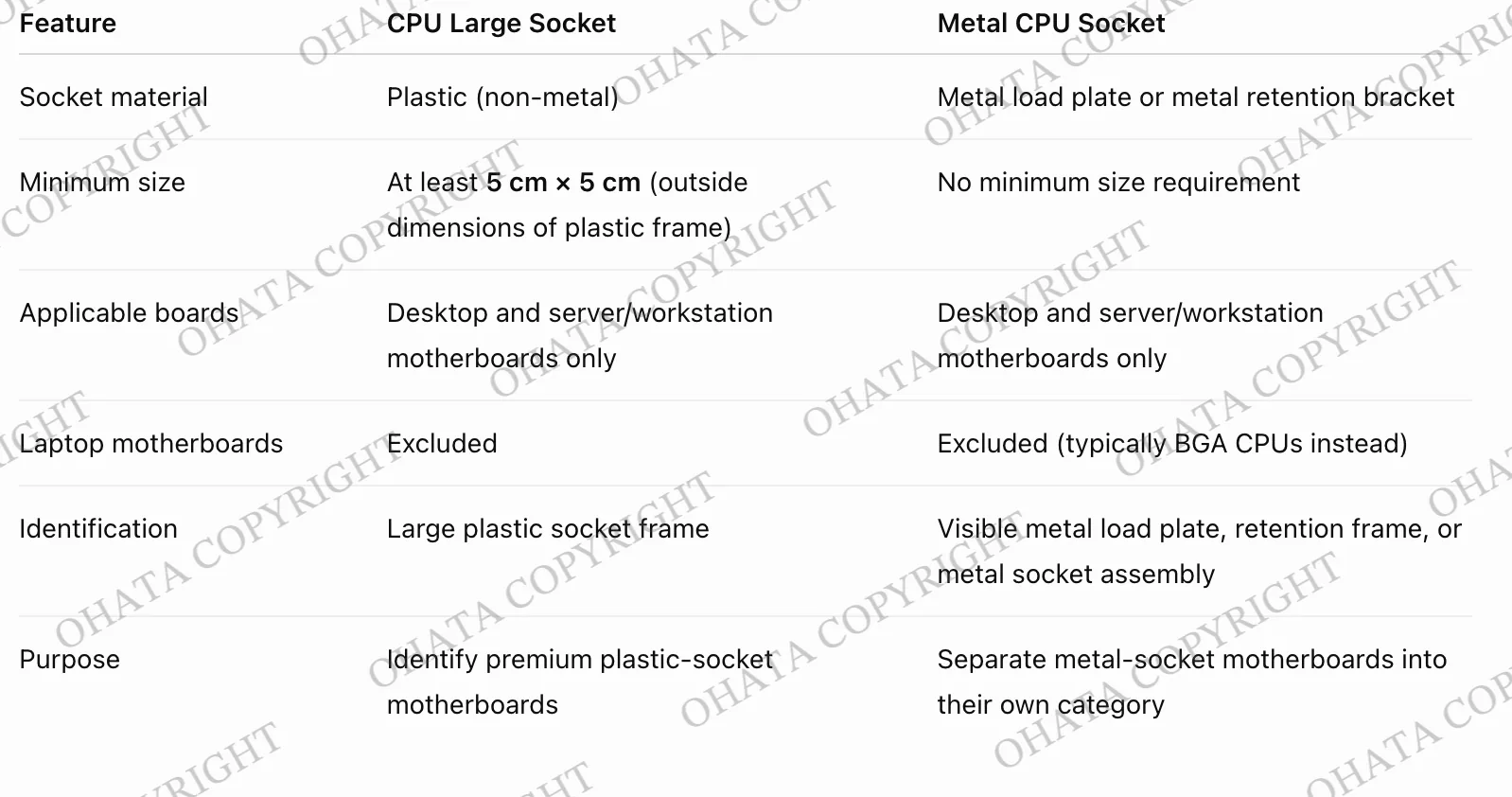
CPU PGA Plastic Large Socket
A motherboard qualifies when it has:
an identifiable desktop, server, or workstation motherboard
a removable processor in a plastic PGA socket
no metal load plate
a plastic socket body measuring at least 5 cm × 5 cm
a socket complete enough for identification
Measure across the outside edges of the plastic socket body. Do not include heatsink brackets, retention frames, PCB dimensions, or nearby components. Laptop motherboards and other boards with soldered BGA processors do not qualify.
Typical examples include older Intel PGA boards, AMD Socket A, 754, 939, AM2, and AM3 motherboards, and older server boards with large plastic processor sockets.
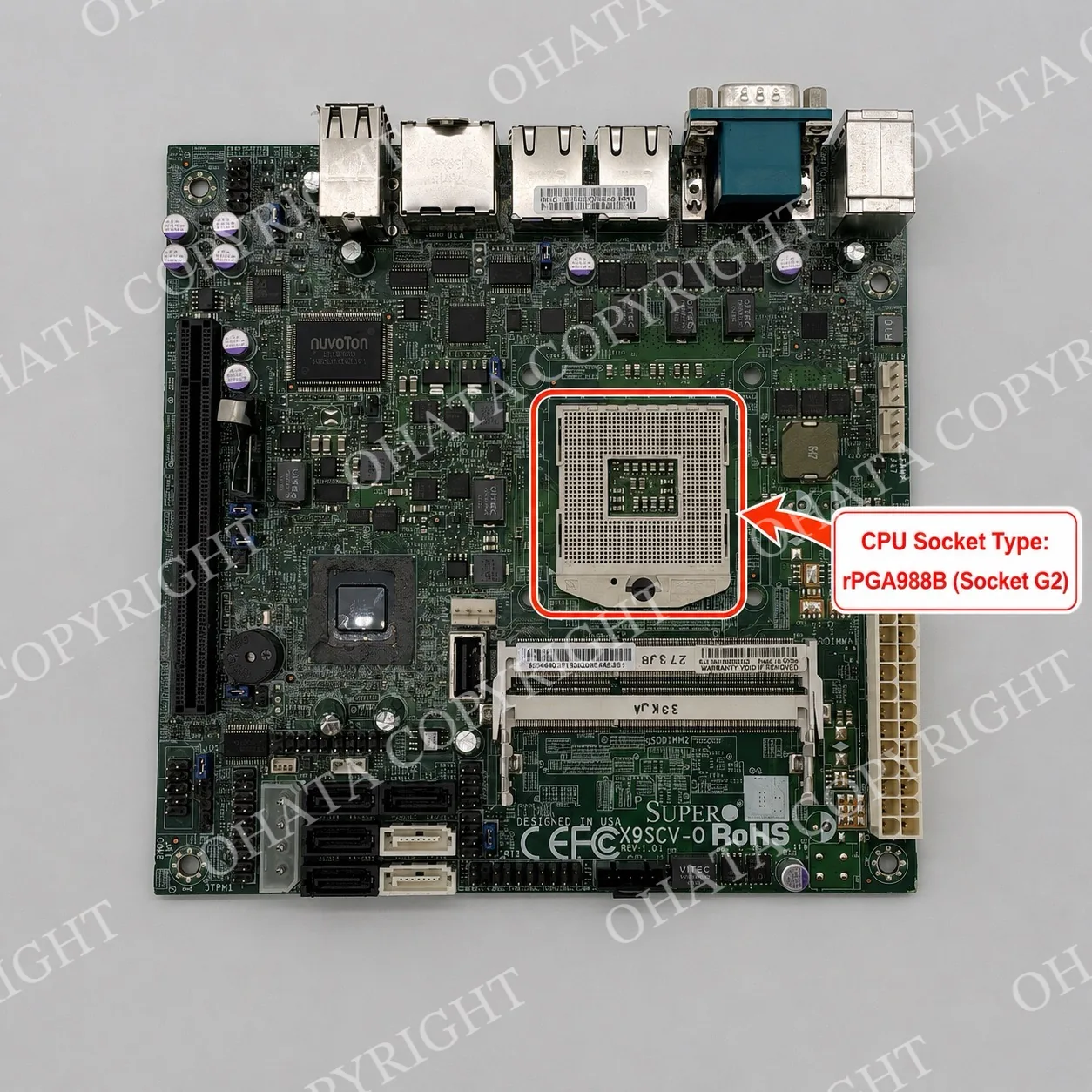
Metal CPU Socket
A Metal CPU Socket has a visible metal load plate, retention frame, or locking assembly around the processor position. The metal structure, rather than the socket size, is the defining feature.
Examples include Intel LGA775, LGA1156, LGA1155, LGA1150, LGA1200, and LGA1700, as well as many modern Xeon server sockets.
Metal CPU Sockets are classified separately from CPU PGA Plastic Large Sockets under the Ohata system. A nearby metal heatsink bracket should not be mistaken for part of the CPU socket.
Gold Finger Identification
Gold fingers are the gold-plated edge connectors located along the edge of many printed circuit boards. They provide reliable electrical contact between the board and expansion slots or backplanes while resisting corrosion and wear from repeated insertion and removal. Within the Ohata Board Scrap Classification System, the length, thickness, and quality of gold fingers are important indicators of recycling value. Clean, full-length gold fingers generally indicate higher-grade boards such as expansion cards, server boards, and telecommunications equipment. Trimmed, damaged, or heavily worn gold fingers typically reduce a board's classification because they contain less recoverable gold and may indicate lower overall material value.
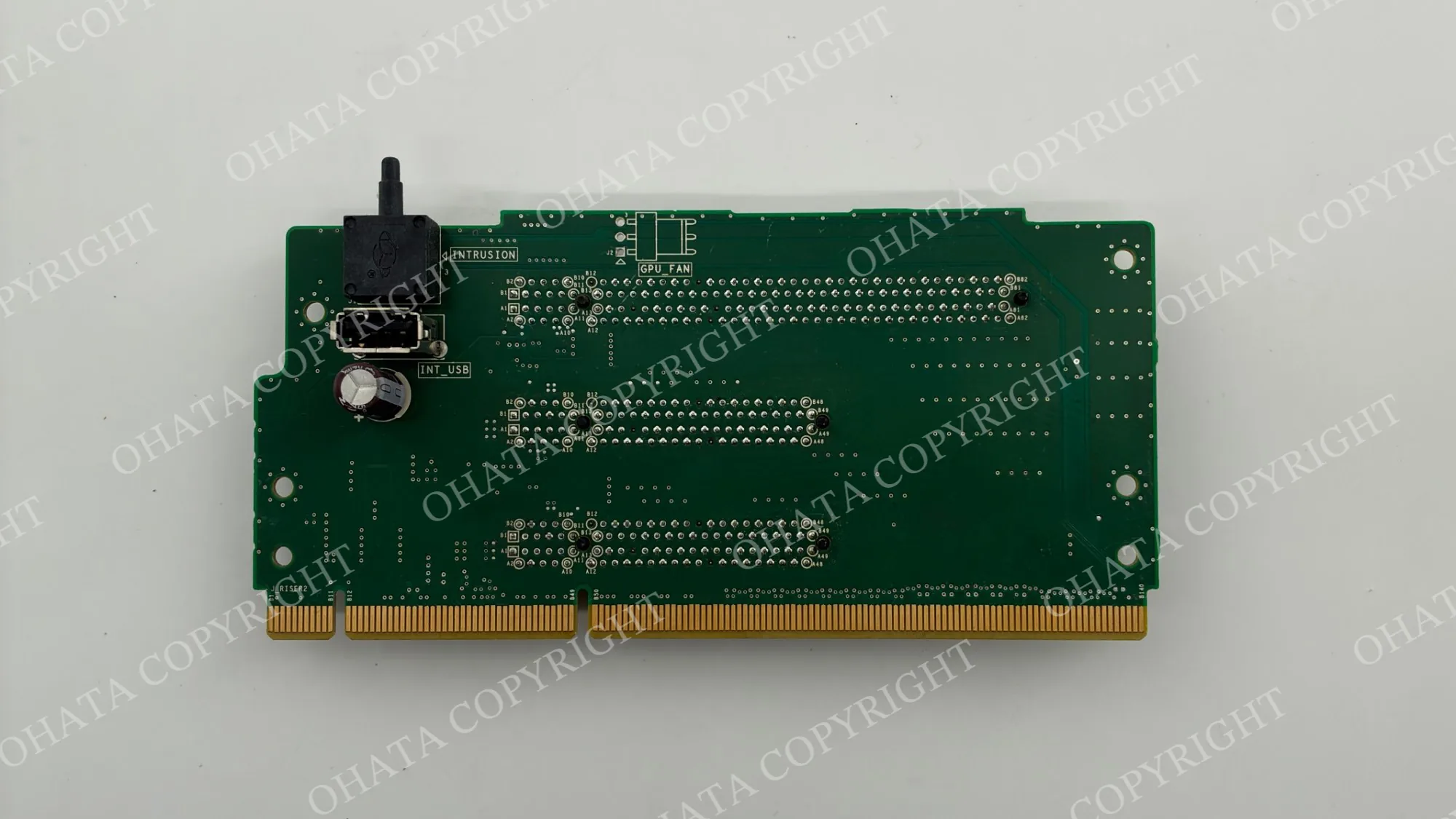
Gold Bond Wire Identification
Gold bond wires are extremely fine wires that connect a semiconductor chip to its package leads inside integrated circuits. Because gold offers excellent electrical conductivity, corrosion resistance, and long-term reliability, it has historically been used in high-performance semiconductor packaging. Although modern chip packaging technologies vary, many legacy and industrial integrated circuits still contain recoverable gold bond wires. Boards populated with numerous gold bond wire ICs generally possess greater precious metal value than boards using lower-cost packaging methods. The presence of high-density gold bond wire chips is therefore an important factor when evaluating premium electronic boards within the Ohata Board Scrap Classification System.
IC Chip Density Analysis
Integrated-circuit density is a useful feature when examining a circuit board, but classification requires more than counting black packages.
Evaluators should consider the number, size, package type, location, and likely function of the ICs. Large BGA processors, memory packages, FPGAs, ASICs, and communication controllers may indicate a complex board, while numerous small support components may have a different effect on its classification.
A square black package is not automatically a CPU. BGA describes how a component is packaged and attached to the PCB, not what the component does. Component density should be evaluated together with the board’s original application, processor or socket configuration, connectors, PCB construction, completeness, and condition. Visual inspection can support classification, but it cannot measure the board’s exact precious-metal content.
Circuit Board Scrap Acceptable Condition Guideline
Physical condition can affect classification because severe damage, contamination, or component removal may reduce recoverable value and interfere with safe processing.
Normal wear, light dust, cosmetic scratches, ordinary contact marks, missing removable CPUs, and missing removable RAM may be acceptable. These conditions do not necessarily change the underlying board category.
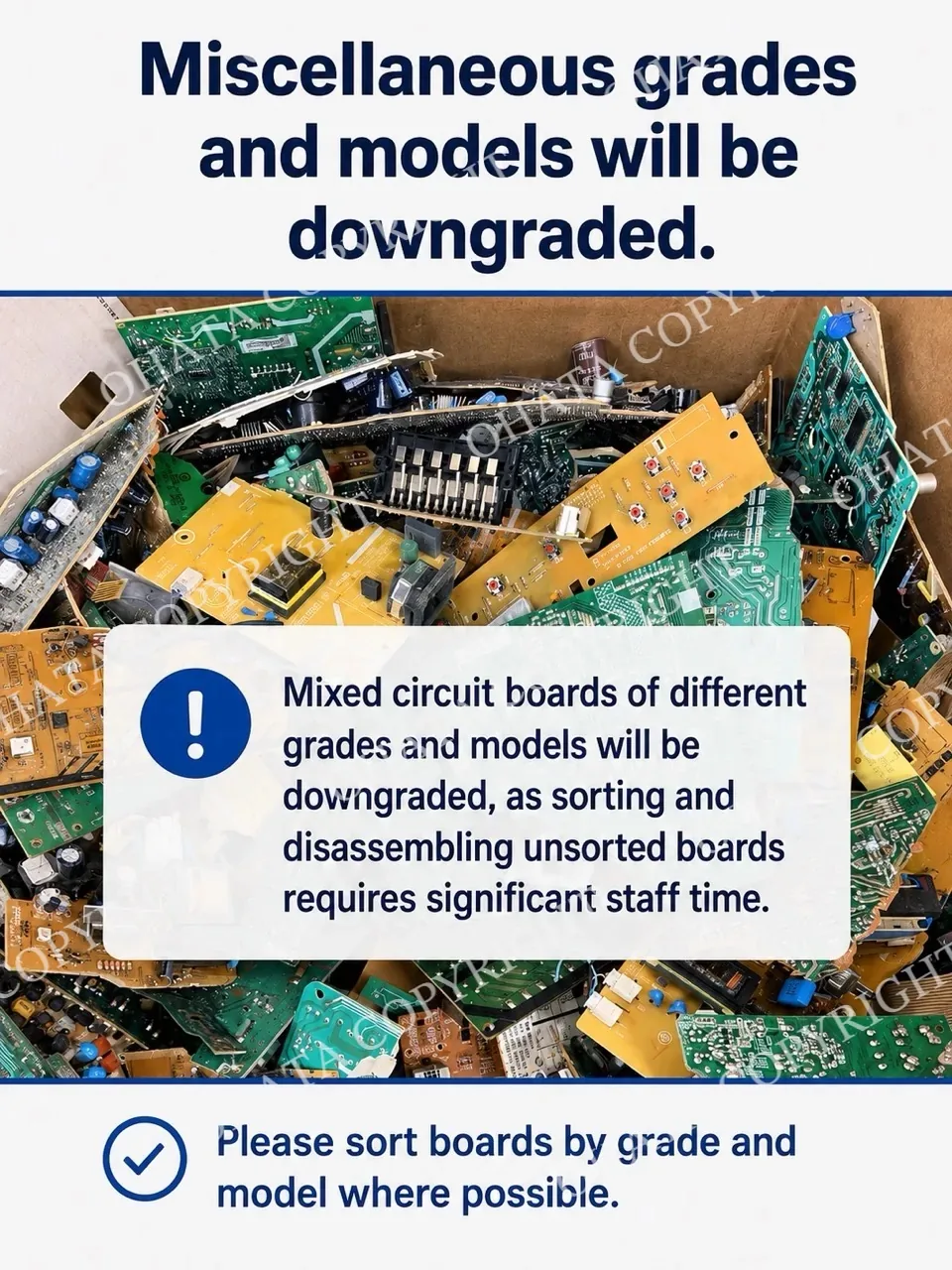
Conditions that may cause a downgrade or rejection include:
severe corrosion
extensive burning or heat damage
battery leakage
chemical or biological contamination
broken or cut PCBs
trimmed gold fingers
missing major PCB sections
removed soldered processors or integrated circuits
heavy dirt, oil, or unrelated material
unsafe batteries or energy-storage components
The effect depends on the type, location, and severity of the damage. A final decision may require physical inspection.
Do not remove heatsinks, fans, brackets, or other attachments unless the applicable buying instructions require it. Unnecessary dismantling can damage the PCB or its components. Batteries should never be punctured, crushed, bent, burned, or forcibly removed when doing so would be unsafe.
Related References Resources
Readers may also find the following Ohata Board classification resources helpful :