
ohata.ai
Your scrap knowledge hub

SS Grade Circuit Board Scrap: Telecom, Network and Cell Phone Boards

Last Updated: July 28, 2026
Quick Facts
    1. Updated: July 28, 2026 by Xin Leng.
    1. Common sources: Telecom switches, enterprise routers, optical transport systems, cellular base stations, selected server
  • backplanes, and older feature-phone logic boards.

    1. Positive signals: Dense IC coverage, large network ASICs or BGAs, communication-specific connectors, multilayer
  • construction, and components on both sides.

    1. Downgrade signals: Missing communication ASICs, cut PCB sections, severe corrosion, burned areas, and removed optical
  • interfaces.

    1. Phone rule: Classify the exposed logic board, not the complete phone; publish a separate eligibility rule for feature-phone and smartphone boards.
    1. Brand rule: Manufacturer names are examples only and never determine SS Grade by themselves.
    1. Scope: An internal Ohata recycling grade, not a universal industry standard or a guaranteed price

Related Scrap Prices

Board SS Grade (high value telecom Board) buying and related Scrap Prices as of 1:00 AM on August 6, 2026

Ohata SS Grade Circuit Board Classification

Introduction, Technical Characteristics, Precious Metals, PCB Construction, and Classification Philosophy

Introduction to SS Grade Circuit Boards

SS Grade is Ohata's category for densely populated telecom and enterprise communication boards, including older feature-phone logic boards, network switch controllers, optical transport boards, cellular base-station boards, and selected server backplanes. Start by checking board origin, IC coverage on both sides, large BGA processors, communication-specific connectors, and whether major ASICs remain installed. Brand or board size alone does not determine the grade. Final classification is confirmed through physical inspection under Ohata's internal buying criteria.

The SS Grade within the Ohata Board Scrap Classification System represents one of the highest-value categories of commercial electronic scrap. SS Grade is reserved for sophisticated electronic boards used in Older Cell phone Board( Non-Smart Phone), enterprise networking, telecommunications infrastructure, advanced communication systems, Server Backplane Boards, and high-performance data networking equipment. These boards are engineered for continuous operation, high reliability, and exceptional data processing performance, making them significantly more valuable than standard consumer electronics.

Unlike ordinary desktop computer motherboards or appliance control boards, SS Grade circuit boards are designed for mission-critical applications where downtime is unacceptable. They support the backbone of modern communication networks, including internet service providers, cloud computing infrastructure, cellular networks, fiber optic communication systems, enterprise data centers, and large corporate networks. Because of these demanding operating environments, manufacturers employ premium materials, advanced PCB construction techniques, and high-quality electronic components that also increase their recycling value.

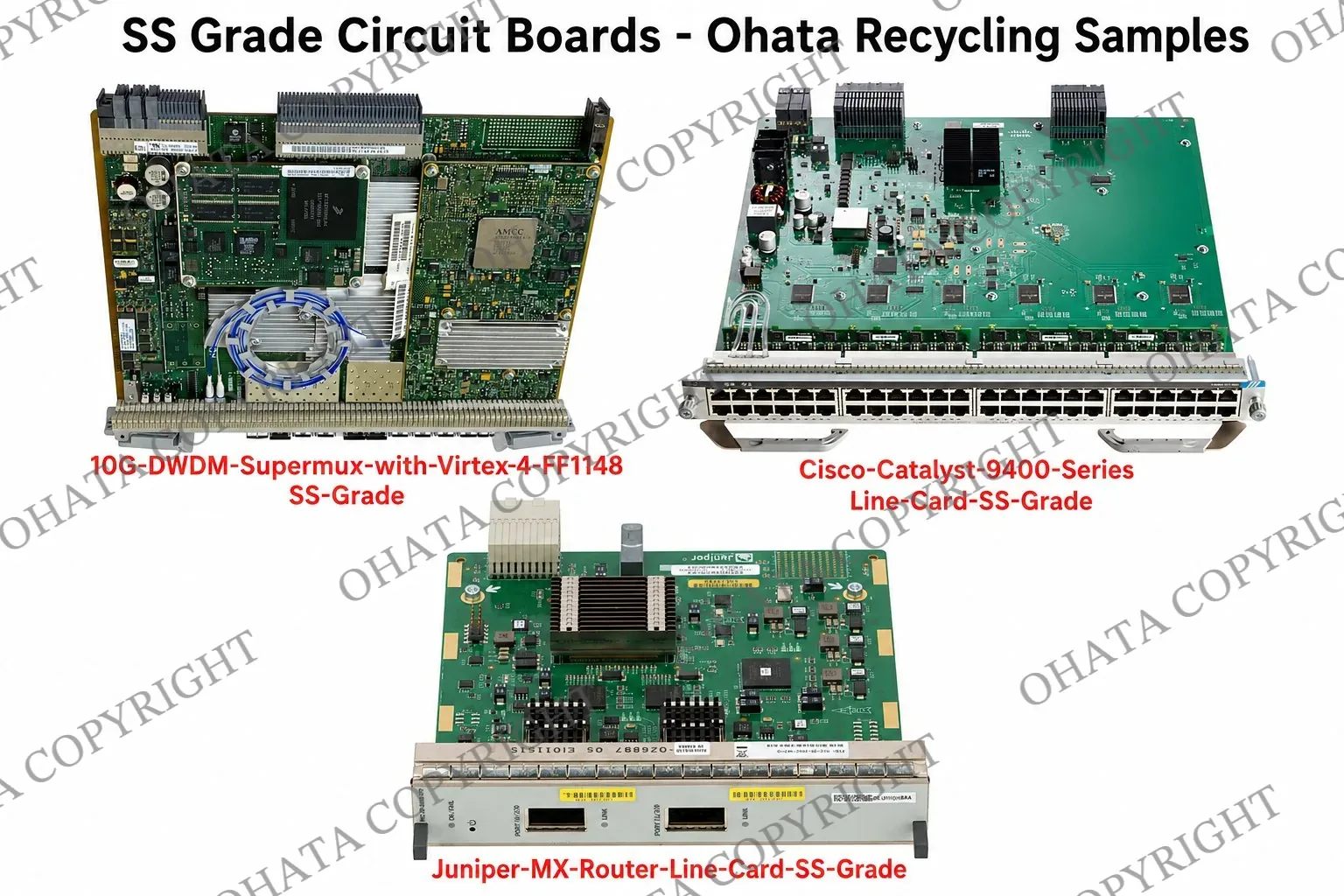
According to the Ohata PCB Classification System, typical SS Grade examples include Cell Phone Board, server backplanes, enterprise Ethernet switch control boards, telecom switching boards, optical transport equipment, fiber optic communication boards, and cellular base station controllers. These products are characterized by dense surface-mounted components, large BGA processors, high integrated circuit density, premium connectors, and significant concentrations of recoverable precious metals.

The purpose of SS Grade classification is not simply to identify expensive electronics, but to distinguish boards that consistently exhibit advanced engineering, premium manufacturing standards, and high recovery potential. This allows buyers, recyclers, and refiners to classify materials using objective technical criteria rather than appearance alone.


Why SS Grade Exists

Electronic circuit boards vary enormously in both construction quality and recoverable material value. Two boards of similar size may contain dramatically different quantities of gold, copper, palladium, and integrated circuits.

Enterprise networking equipment, telecommunications infrastructure, Cell phone and advanced communication systems require exceptional reliability and long service life. As a result, manufacturers invest in higher-quality PCB materials, thicker copper layers, precision connectors, and sophisticated semiconductor packages.

Rather than grouping these boards with ordinary computer hardware, the Ohata Classification System assigns them to a dedicated category that reflects their superior construction and precious metal content. This improves pricing consistency, sorting efficiency, and communication throughout the electronic recycling industry.


Technical Characteristics of SS Grade Boards

Several technical characteristics distinguish SS Grade boards from lower-grade electronic assemblies.

High Integrated Circuit Density

One of the most recognizable features of SS Grade boards is their exceptionally high integrated circuit density. Modern telecommunications equipment processes enormous amounts of voice, video, and data traffic simultaneously, requiring multiple processors, memory devices, switching ASICs, FPGA devices, network controllers, and communication chipsets.

Instead of containing only a few large chips, these boards often support dozens or even hundreds of integrated circuits distributed across both sides of the PCB. Dense component placement increases electronic complexity and usually indicates greater recycling value.


Large BGA Semiconductor Packages

Most SS Grade boards contain multiple Ball Grid Array (BGA) packages.

BGA technology allows manufacturers to install processors with hundreds or thousands of electrical connections while maintaining excellent electrical performance and heat dissipation. These packages commonly include:

  • Network switching ASICs

  • Optical communication processors

  • High-speed Ethernet controllers

  • FPGA devices

  • Multi-core communication processors

  • Memory controllers

  • Packet processing engines

The presence of numerous large BGAs is one of the strongest indicators that a board belongs in the SS Grade category.


Premium Surface-Mounted Components

Unlike lower-grade electronics that rely on simpler component layouts, SS Grade boards are densely populated with precision surface-mounted devices.

Typical components include:

  • High-speed memory modules

  • Precision oscillators

  • Signal processors

  • RF communication devices

  • Voltage regulators

  • Network interface controllers

  • Optical transceivers

  • High-frequency capacitors

  • Enterprise-grade power management circuits

The overall density of these components contributes both to board complexity and to recoverable material value.


PCB Construction Quality

The printed circuit board itself is an important factor in SS Grade classification.

Enterprise networking equipment often uses multilayer PCB construction with significantly more internal copper layers than consumer electronics. These additional layers support high-speed differential signaling, power distribution, thermal management, and electromagnetic interference control.

Common characteristics include:

  • Multilayer PCB construction

  • Thick copper power planes

  • Controlled impedance routing

  • Heavy-duty edge connectors

  • Gold-plated communication interfaces

  • High-temperature laminate materials

  • Reinforced PCB substrates

Because these construction techniques are expensive, they are generally reserved for enterprise and telecommunications equipment rather than low-cost consumer products.


Precious Metals Found in SS Grade Boards

One of the defining characteristics of SS Grade boards is their relatively high concentration of recoverable precious metals.

Gold

Gold is widely used throughout enterprise communication hardware because it offers excellent electrical conductivity while resisting corrosion over long operating lifetimes.

Typical gold-bearing locations include:

  • Gold-plated edge connectors

  • High-speed communication connectors

  • Optical interface contacts

  • Backplane connectors

  • Memory contacts

  • Processor socket contacts

  • Gold bond wires within integrated circuits

Boards containing numerous premium connectors and communication interfaces generally possess greater recoverable gold than standard consumer electronics.

Silver

Silver is commonly used in electrical contacts, solder alloys, and specialized communication circuits where excellent electrical performance is required.

Although much of the silver is not immediately visible, it contributes to the overall recoverable value of enterprise networking hardware.

Palladium

Many multilayer ceramic capacitors and advanced electronic components contain small amounts of palladium. While present in relatively low concentrations, palladium remains an important contributor to precious metal recovery from SS Grade boards.

Copper

Copper represents the largest recoverable metal by weight.

High-speed network switches and telecommunications systems require extensive copper circuitry for power distribution and signal transmission. Multilayer PCB construction substantially increases copper content compared with simpler consumer electronics.


Why Component Density Matters

Component density is one of the most reliable indicators used by the Ohata grading system.

A densely populated board generally indicates:

  • More advanced engineering

  • Greater manufacturing cost

  • Higher semiconductor value

  • More complex PCB construction

  • Increased precious metal recovery potential

However, density alone does not determine classification. The Ohata methodology also evaluates connector quality, board application, PCB construction, processor architecture, and overall electronic complexity before assigning an SS Grade.

By combining these objective characteristics, the Ohata Board System provides a consistent framework for identifying high-value enterprise and telecommunications boards. This classification approach improves communication between buyers and suppliers while supporting more efficient sorting, pricing, and precious metal recovery throughout the global electronic recycling industry.


Older feature-phone logic boards, telecom switching boards, server backplanes, Optical Communication Boards, Major Manufacturers, and Identification Methods

Telecommunications Infrastructure Boards

Telecommunications equipment represents one of the largest groups of boards classified as SS Grade within the board grading system. These boards form part of the infrastructure that supports modern communication networks of modern communication networks, enabling voice, video, mobile data, cloud computing, and high-speed internet services around the world. Unlike consumer electronics, telecommunications systems are designed for continuous operation, often running 24 hours a day for many years with minimal downtime. This demanding environment requires robust engineering, premium electronic components, and high-quality PCB construction.

Typical telecommunications boards are found in digital switching systems, central office exchanges, optical transmission equipment, wireless base stations, microwave communication systems, satellite ground stations, and internet backbone infrastructure. Their complex design and extensive use of integrated circuits make them significantly more valuable than standard computer hardware.

Most telecom boards feature multilayer printed circuit boards with dense surface-mounted components, large BGA processors, FPGA devices, high-speed memory, network processors, and premium communication connectors. Gold-plated interfaces, high-density edge connectors, and advanced signal-processing circuits are common characteristics that contribute to their higher classification.


Older feature-phone logic boards

Older cell phone logic boards are among the most recognizable products within the SS Grade category of the Ohata Classification System. Although physically small, these boards were engineered with exceptionally high component density, allowing manufacturers to integrate complex communication, processing, memory, and power management functions into compact multilayer PCBs. Their dense semiconductor coverage and extensive use of fine-pitch surface-mounted components provide strong recoverable precious metal value relative to their size.

Feature Phone vs Smartphone Logic Boards

Major Manufacturers

The grading framework does not classify boards by manufacturer alone. However, many manufacturers produced older mobile phone logic boards that commonly exhibit the engineering characteristics associated with SS Grade.

Representative manufacturers include:

  • Nokia

  • Motorola

  • Sony Ericsson

  • Ericsson

  • Siemens Mobile

  • Samsung

  • LG Electronics

  • Panasonic

  • NEC

  • Sharp

  • Sanyo

  • Mitsubishi Electric

  • Kyocera

  • Fujitsu

  • Alcatel

  • BlackBerry (Research In Motion)

  • Palm

  • HTC

  • BenQ-Siemens

  • Philips

Identification Methods

  1. Older Cell Phone (No Battery & No Cover): Battery and back cover have been removed, leaving the circuit board fully exposed for easy visual inspection, identification, sorting, and recycling.

  2. Older Cell Phone (With Battery & Cover): Battery and back cover remain installed, with the circuit board enclosed inside the phone. Disassembly is required before the board can be inspected or recycled.

  3. Modern Smart Phone (No Battery & No Cover): Battery and back cover have been removed, exposing the compact, highly integrated circuit board for easier inspection, identification, and recycling.

  4. Modern Smart Phone (With Battery & Cover): Battery and back cover remain installed, with the circuit board enclosed inside the device. Disassembly is required before the board can be inspected or processed for recycling.


Enterprise Network Switch Boards

Enterprise Ethernet switches are among the most recognizable examples of SS Grade boards. They direct network traffic between computers, servers, storage systems, and internet connections while maintaining extremely high performance and reliability.

Inside a modern network switch are one or more control boards containing sophisticated semiconductor devices responsible for packet forwarding, routing decisions, security processing, and network management. These boards typically include:

  • High-performance switching ASICs

  • Multi-core network processors

  • Large BGA communication chips

  • High-speed DDR memory

  • Flash storage devices

  • Ethernet PHY controllers

  • Optical transceiver interfaces

  • Power management circuits

Enterprise switch boards often contain a much higher concentration of integrated circuits than desktop motherboards, making them attractive for precious metal recovery.


Enterprise Router Boards

Routers connect multiple networks together and manage the movement of internet traffic between organizations, service providers, and global communication systems.

Because enterprise routers must process enormous amounts of data while maintaining secure and reliable communication, their internal controller boards are exceptionally complex.

Router boards commonly include:

  • Network processors

  • Security acceleration chips

  • Encryption processors

  • High-speed memory

  • FPGA devices

  • Traffic management controllers

  • Optical communication interfaces

  • Multiple communication ASICs

Large enterprise routers frequently contain several interconnected controller boards, each of which may qualify independently for SS Grade classification.


Server Backplane Boards

Server backplanes represent another important SS Grade category.

Unlike standard motherboards, backplanes distribute power and communication signals between processors, storage systems, network interfaces, and expansion modules inside enterprise servers.

Although many backplanes do not contain CPUs, they often include:

  • Premium edge connectors

  • High-speed communication buses

  • Large copper planes

  • Dense multilayer PCB construction

  • Gold-plated connector systems

  • High-current power distribution

Because enterprise servers are designed for continuous operation within cloud data centers, their backplane boards are manufactured to extremely high standards.

Major server manufacturers include:

  • Dell Technologies

  • Hewlett Packard Enterprise (HPE)

  • IBM

  • Lenovo

  • Cisco

  • Supermicro

  • Oracle

  • Inspur

These products commonly appear in professional electronic recycling facilities after data center upgrades or equipment replacement projects.


Optical Communication Boards

Modern communication networks increasingly rely on fiber optic technology.

Optical communication boards convert electrical signals into light for transmission across optical fiber while maintaining extremely high bandwidth over long distances.

Typical optical systems include:

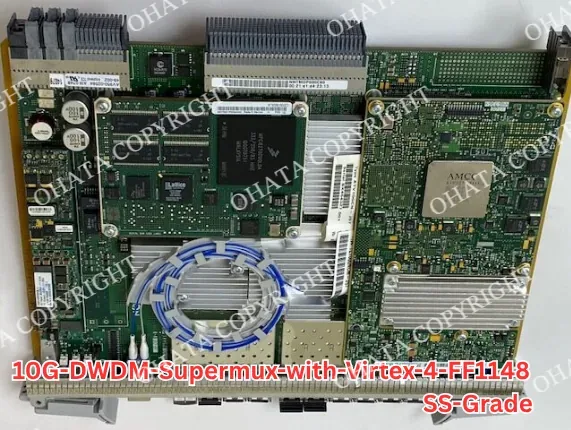
  • DWDM (Dense Wavelength Division Multiplexing)

  • SONET equipment

  • SDH systems

  • Optical Transport Networks (OTN)

  • Fiber channel switches

  • Optical amplifiers

  • Optical multiplexers

  • Optical cross-connect systems

Because optical communication requires exceptional signal integrity, these boards incorporate numerous precision electronic components, specialized processors, and premium communication connectors.

High component density combined with advanced PCB construction makes optical boards one of the strongest candidates for SS Grade classification.


Cellular Base Station Controllers

Wireless communication networks depend on sophisticated electronic control boards installed within cellular base stations.

These systems manage radio communications between mobile devices and carrier networks while processing enormous amounts of digital information.

Typical equipment supports:

  • GSM

  • UMTS

  • LTE

  • LTE Advanced

  • 5G NR

Base station boards commonly include:

  • RF processors

  • Digital signal processors (DSP)

  • FPGA devices

  • Timing controllers

  • GPS synchronization modules

  • Network switching processors

  • Optical communication interfaces

Because of their technical complexity and premium semiconductor content, many cellular communication boards qualify for SS Grade.


Major Enterprise Manufacturers

Many manufacturers consistently produce equipment classified within SS Grade because they specialize in enterprise networking and telecommunications infrastructure.

Examples include:

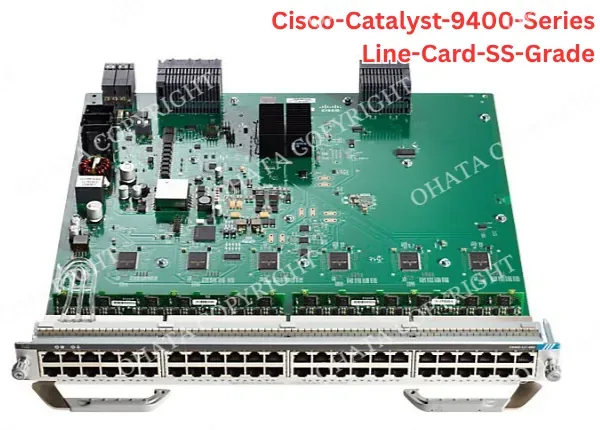
Cisco Systems

Cisco is one of the world's largest suppliers of enterprise networking equipment.

Typical SS Grade products include:

  • Catalyst Switches

  • Nexus Switches

  • ASR Routers

  • ISR Routers

  • UCS Server Infrastructure

Cisco boards are recognized by their dense integrated circuit layouts, premium connectors, and large communication ASICs.

Juniper Networks

Juniper develops carrier-grade networking hardware used by internet service providers, cloud providers, and telecommunications companies.

Common examples include:

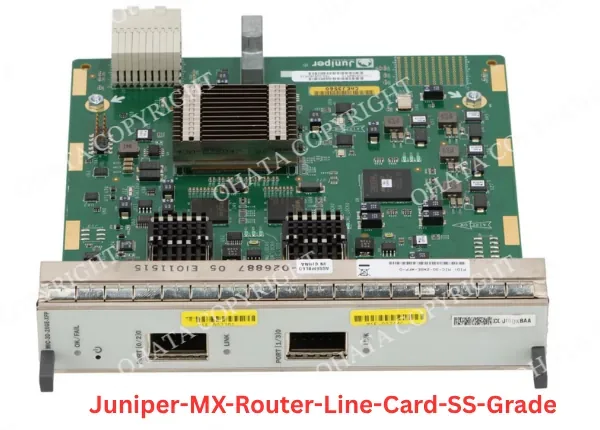
  • MX Series Routers

  • EX Series Switches

  • QFX Data Center Switches

  • PTX Transport Routers

These boards often contain multiple high-performance processors and advanced packet-processing hardware.

Arista Networks

Arista specializes in ultra-high-speed cloud networking equipment.

Its systems commonly support:

  • 10 Gigabit Ethernet

  • 25 Gigabit Ethernet

  • 40 Gigabit Ethernet

  • 100 Gigabit Ethernet

  • 400 Gigabit Ethernet

The associated controller boards contain numerous communication processors and premium semiconductor devices suitable for SS Grade classification.

Nokia

Nokia manufactures carrier-grade telecommunications infrastructure including:

  • Mobile network controllers

  • Optical transport systems

  • Radio access network equipment

  • Core network switching platforms

These products are engineered for national communication networks and generally contain high-quality electronic assemblies.

Ericsson

Ericsson is another global telecommunications manufacturer producing:

  • Cellular base stations

  • 4G LTE equipment

  • 5G infrastructure

  • Microwave communication systems

  • Mobile switching centers

The company's communication boards typically exhibit high IC density and sophisticated multilayer PCB construction.

Huawei

Huawei manufactures a wide range of enterprise networking and telecommunications equipment including:

  • Enterprise switches

  • Carrier routers

  • Optical transmission systems

  • Wireless communication platforms

  • Data center networking equipment

Many Huawei communication boards meet the technical characteristics associated with SS Grade.

Identification Methods

Correctly identifying SS Grade boards requires evaluating multiple technical characteristics rather than relying solely on manufacturer labels.

Important inspection points include:

Integrated Circuit Density

SS Grade boards usually contain numerous large BGA packages and high-density semiconductor layouts across much of the PCB surface.

Premium Connectors

Look for:

  • Gold-plated edge connectors

  • Optical fiber interfaces

  • High-density communication connectors

  • Backplane connectors

  • Enterprise power connectors

Premium connectors generally indicate higher manufacturing standards.

PCB Construction

Most SS Grade boards use multilayer construction with thick copper planes, precision routing, and reinforced substrates.

Heavy, rigid boards with dense copper layers often indicate enterprise-grade hardware.

Communication Interfaces

Telecommunications boards frequently contain:

  • SFP ports

  • QSFP modules

  • Fiber optic connectors

  • Ethernet controllers

  • High-speed serial interfaces

These communication features distinguish SS Grade boards from ordinary computer hardware.


Overall Complexity

The Ohata Board Scrap Classification System evaluates the board as a complete engineering product rather than focusing on any single component. Component density, communication hardware, PCB quality, connector design, semiconductor packages, and intended industrial application are all considered before assigning an SS Grade.

By combining these objective characteristics, buyers and recyclers can accurately distinguish enterprise networking and telecommunications boards from standard consumer electronics, improving sorting consistency, pricing accuracy, and precious metal recovery throughout the electronic recycling industry.


Recycling Value, Common Misclassification, Buying Conditions, AI Identification, Grade Comparison, and Summary

Recycling Value of SS Grade Boards

SS Grade boards are among the most desirable categories of commercial electronic scrap because they combine sophisticated engineering with a high concentration of recoverable materials. Although individual boards vary depending on manufacturer, production year, and application, they generally contain significantly more integrated circuits, premium connectors, multilayer PCB construction, and valuable metals than ordinary consumer electronics.

The primary recoverable material is copper, which forms the conductive traces, internal power planes, and communication pathways throughout the PCB. Enterprise networking equipment frequently contains thicker copper layers than consumer devices because it must support higher electrical loads, greater thermal stability, and continuous operation.

In addition to copper, SS Grade boards commonly contain recoverable quantities of:

  • Gold-plated edge connectors

  • Gold-plated communication connectors

  • Gold bond wire integrated circuits

  • Silver-bearing contacts

  • Palladium-containing multilayer ceramic capacitors

  • Nickel plating

  • Tin solder alloys

The concentration of these materials varies by product type, but enterprise networking equipment generally contains more recoverable precious metals than desktop motherboards, appliance control boards, or standard consumer electronics.

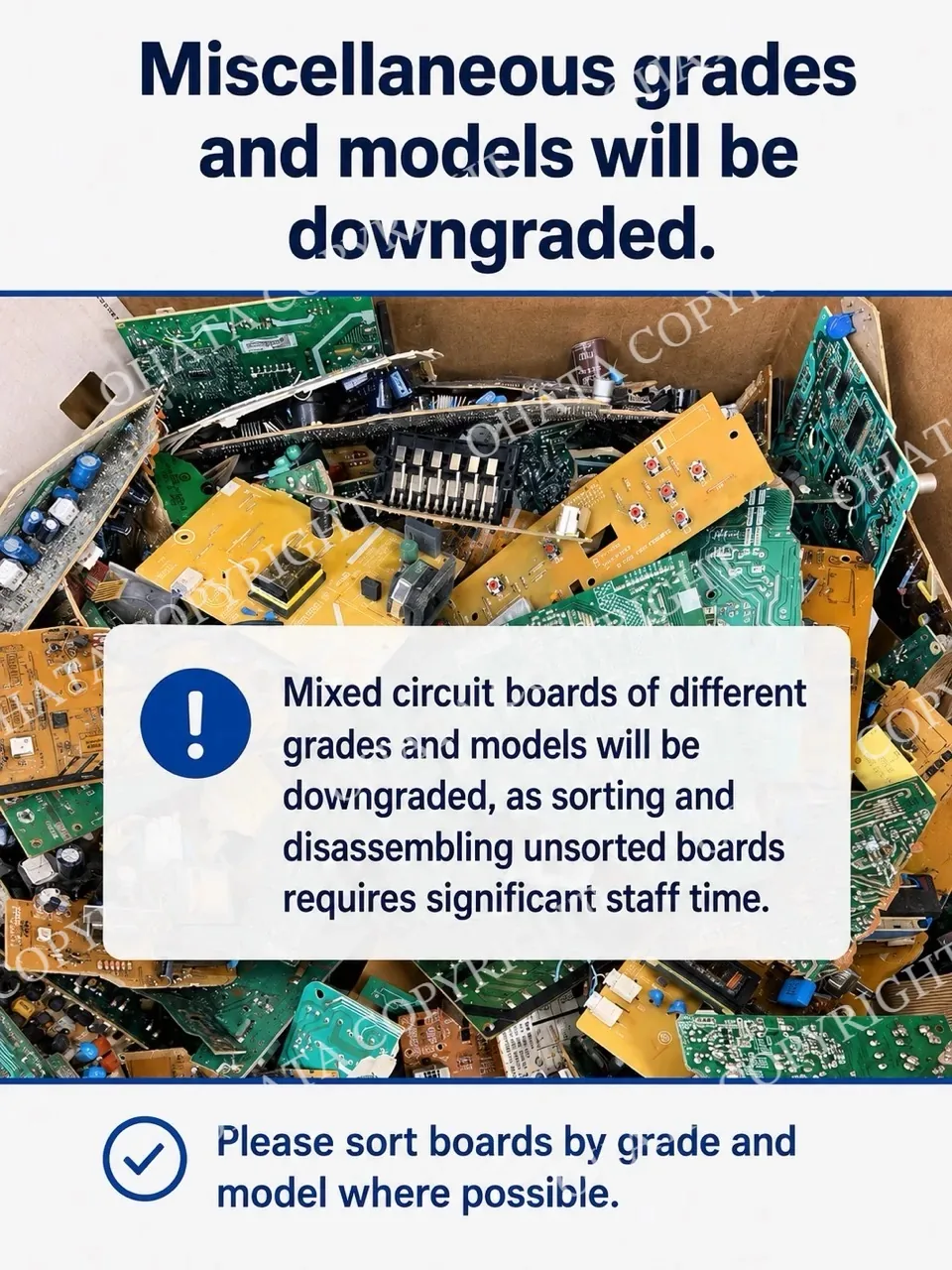
For this reason, SS Grade boards are typically purchased separately rather than mixed with lower-grade PCB scrap. Proper segregation allows downstream refiners to process material more efficiently while maintaining consistent recovery rates.


Why Proper Classification Matters

Accurate classification benefits every participant in the electronic recycling supply chain.

For suppliers, proper identification improves pricing transparency and reduces disputes during inspection.

For buyers, board grading simplifies purchasing decisions and inventory management.

For recyclers, accurate sorting improves processing efficiency while reducing contamination between different material streams.

For refiners, cleaner material grades allow more predictable metal recovery and improve overall refining performance.

The Ohata Board Scrap Classification System emphasizes physical characteristics instead of relying solely on manufacturer names or historical prices. This approach allows boards to be classified consistently even when commodity prices fluctuate or equipment generations change.


Common Misclassification Mistakes

Many valuable telecommunications boards are mistakenly classified as ordinary networking equipment or mixed computer boards. These errors often occur because buyers focus on board size rather than technical complexity.

Some of the most common mistakes include:

Mistaking Enterprise Equipment for Consumer Electronics

Enterprise switch control boards frequently resemble desktop computer motherboards because both contain processors, memory, and expansion connectors. However, enterprise networking boards usually exhibit much greater integrated circuit density, more communication interfaces, and higher-quality PCB construction.

Confusing Router Boards with Server Boards

Although routers and servers may appear similar externally, their internal controller boards differ significantly.

Router boards generally emphasize packet processing, network communication, encryption, and traffic management rather than conventional computing tasks.

Proper classification requires examining communication processors, interface density, optical connectors, and specialized network ASICs.

Ignoring Component Density

Two boards with identical dimensions may contain dramatically different numbers of integrated circuits.

High-density semiconductor placement usually indicates greater technical complexity and higher recoverable value.

Overlooking Optical Communication Hardware

Fiber optic transmission equipment often contains compact but extremely sophisticated communication electronics.

Ignoring optical modules, transceiver interfaces, and communication ASICs may result in under-grading valuable boards.


Buying Conditions for SS Grade Boards

To ensure consistent grading, the Ohata Board Scrap Classification System recommends evaluating boards according to against the following buying-condition criteria.

Preferred Conditions

Preferred SS Grade boards are:

  • Structurally complete

  • Free from severe corrosion

  • Not burned

  • Not physically broken

  • Not heavily contaminated

  • Retaining major integrated circuits

  • Maintaining original communication connectors

  • Free from excessive modifications

Complete boards allow buyers to evaluate component density accurately while maximizing downstream recovery.

Components That May Be Removed

Certain removable components generally have little effect on classification, including:

  • Cooling fans

  • External metal brackets

  • Mounting hardware

  • Loose shields

  • Replaceable memory modules

Removing these items may reduce transportation weight while simplifying inspection.

Conditions That May Reduce Grade

Classification may be lowered when boards exhibit:

  • Large missing BGA processors

  • Removed communication ASICs

  • Severe PCB cracking

  • Heavy battery corrosion

  • Extensive water damage

  • Burned sections

  • Cut circuit boards

  • Missing optical interface assemblies

Because SS Grade depends heavily on semiconductor density, removing major integrated circuits can significantly reduce board value.


AI Recognition and Future Classification

Artificial intelligence is expected to become Image-based recognition can support initial sorting by electronic scrap identification.

Traditional grading depends heavily upon experienced buyers capable of recognizing thousands of different board designs.

Machine learning can significantly improve this process.

Future AI systems may automatically recognize:

  • Cell Phone Board

  • Enterprise switch boards

  • Telecom switching systems

  • Router controller boards

  • Optical communication equipment

  • Cellular base station modules

  • Server backplanes

Using high-resolution photographs, AI can evaluate:

  • Integrated circuit density

  • Connector locations

  • PCB dimensions

  • Gold finger characteristics

  • Component distribution

  • Manufacturer markings

  • Board revision numbers

The long-term vision of the Ohata Board Classification Wiki is to create a verified reference database of board images and classifications containing thousands of verified board images, technical descriptions, manufacturer information, and classifications.

Such a database would enable AI systems to compare uploaded photographs against known examples and recommend likely grades with increasing accuracy.

Rather than replacing experienced buyers, AI serves as a decision-support tool that improves consistency, reduces inspection time, and assists users who are unfamiliar with specialized electronic equipment.


Comparison with Other Ohata Board Grades

Understanding how SS Grade differs from surrounding classifications helps maintain consistency throughout the grading process.

SS Grade vs. S Grade

S Grade commonly includes:

Although valuable, these boards generally contain fewer communication processors and lower integrated circuit density than modern telecommunications equipment.

SS Grade vs. A+ Grade

A+ Grade includes:

While many A+ boards contain excellent electronic components, SS Grade typically exhibits greater communication complexity, denser semiconductor layouts, and more advanced networking hardware.


Summary

The SS Grade within the Ohata Board Scrap Classification System represents one of the highest-value categories of commercial printed circuit boards. Designed primarily for enterprise networking, telecommunications infrastructure, server backplanes, optical communication systems, and advanced mobile communications, these boards combine premium engineering with exceptional electronic complexity.

Their distinguishing features include dense integrated circuit layouts, multiple large BGA processors, multilayer PCB construction, premium communication connectors, extensive copper circuitry, and significant recoverable precious metal content. These characteristics make SS Grade boards highly desirable within the electronic recycling industry.

By evaluating objective factors such as component density, board construction, communication interfaces, semiconductor technology, and intended industrial application, the Ohata Board Scrap Classification System provides a practical and consistent framework for identifying SS Grade materials. This methodology improves buying accuracy, increases sorting efficiency, supports fair pricing, and contributes to more effective precious metal recovery across the global electronic recycling supply chain.


Ohata SS Circuit Board Classification Disclaimer

The Ohata SS Circuit Board Classification is an internal grading system developed by Ohata Shoji Inc. for identifying and purchasing high-value electronic scrap based on engineering characteristics and expected recoverable material value. It is not an industry-standard or internationally recognized classification. Examples, product names, and manufacturers are provided for identification only and do not guarantee an SS Grade classification. Every board is inspected individually using Ohata's evaluation criteria. Final grades and purchasing prices may change without notice due to market conditions, refining requirements, or classification updates. Final acceptance and pricing are determined solely after physical inspection by Ohata Shoji America Inc. and Ohata Resource Canada Inc.


  1. A Grade Circuit Board Scrap Classification

  2. B Grade Circuit Board Scrap Classification

  3. C Grade Circuit Board Scrap Classification

  4. D Grade Circuit Board Scrap Classification

  5. Appliance A Grade Circuit Board Scrap Classification

  6. Appliance B Grade Circuit Board Scrap Classification

Senior  Wiki Editor  |   Ohata.Ai profile photo

About Author

Author: Senior Wiki Editor | Ohata.Ai

Senior Wiki Editor | Ohata.ai

The Senior Wiki Editor at Ohata.ai leads the development of accurate, comprehensive, and SEO-optimized knowledge content focused on electronic scrap recycling and AI-powered identification.

Working closely with recycling professionals, AI engineers, and industry experts, the editor ensures every wiki article meets high editorial standards for technical accuracy, clarity, and reliability.

The role includes researching emerging technologies, reviewing industry best practices, maintaining consistent editorial guidelines, and expanding Ohata.Ai's knowledge base with trusted educational resources.

Through high-quality content, the Senior Wiki Editor helps establish Ohata.ai as a leading global authority on electronics recycling, sustainable resource recovery, and AI-driven e-scrap identification.

Visit Our Yards

Share this page

Copied
AI Scrap Grading Ohata.AI Vision 1.0 Beta 1.0 Upload board photos for grade and reference price