

Changing How We See E-Scrap and Recycling
Ohata.AI Vision 1.0 Beta 1.0 is an AI-assisted identification and preliminary classification service for electronic equipment and e-scrap.
Users can upload photographs of a circuit board, motherboard, mobile phone, or other currently supported item. Ohata.AI Vision then reviews the visible evidence and produces a structured report that may include the likely item type, observed components and condition, a preliminary Ohata classification, and an eligible current reference price for the United States or Canada.
The product is part of ohata.ai, an AI-Powered C2B E-Scrap Recycling Platform developed by Ohata Shoji Inc.
Electronic products can still have value after their original use ends. Some may be refurbished and returned to use as complete equipment, while others may support repairs, parts recovery, or material recycling.
Understanding which path makes sense can require detailed knowledge of the item, its condition, construction, visible components, and market for reuse or recovery.
Ohata.AI Vision makes that knowledge easier to access.
It gives recyclers, suppliers, dismantlers, businesses, and members of the public a practical way to begin identifying electronic materials before they arrive at an Ohata facility.
The easier it becomes to identify e-scrap wherever and whenever it is found, the easier it becomes to keep usable equipment, valuable components, and recoverable materials out of the waste stream.
Ohata.AI Vision provides a digital starting point. Physical inspection remains essential for confirming the exact item, acceptance, weight, grade, and final purchasing value.
Try Ohata.AI Vision
Why Ohata.AI Vision Was Created
Circuit board classification often begins with a simple but difficult question:
What exactly is this item?
A person may recognize a circuit board without knowing whether it came from a desktop computer, server, laptop, storage device, industrial system, appliance, or communication product.
Boards that appear similar may have different functions, component structures, connector types, purchasing classifications, and preparation requirements. Damage, corrosion, removed components, attached batteries, heat sinks, brackets, or other materials may also affect how an item should be handled.
The required knowledge is often spread across manufacturer records, technical documents, repair databases, product listings, purchasing standards, and the practical experience of professional recyclers.
Ohata.AI Vision was created to organize the first stage of that work.
The system combines image-based recognition, visible-component review, Ohata classification criteria, condition observations, educational guidance, and current price retrieval in one report.
It is not intended to replace experienced employees.
It is intended to make their knowledge easier to reach before material is delivered, shipped, or separated into recycling categories.
What Ohata.AI Vision Currently Does
Ohata.AI Vision currently provides preliminary image-based identification and classification for supported electronic scrap categories.
Supported Countries
Users can select:
US — United States
CA — Canada
The selected country determines the eligible market and price route used by the system.
If no country is selected, the system may use the United States as the labeled default.
Supported Items
The current beta supports:
General populated circuit boards
Desktop motherboards
Server motherboards
Laptop motherboards
HDD SATA controller boards
HDD non-SATA controller boards
Selected industrial and appliance control boards
Expansion, network, telecom, and similar populated boards
Older cell phones
Modern smartphones
Exposed mobile-phone boards
Standalone CPU and RAM classification is currently paused while the latest applicable criteria are being confirmed.
Preliminary Recognition Report
Depending on the item and the visible evidence, the report may include:
Selected country
Identified item type
Board type or mobile-phone category
Manufacturer, model, part number, or visible markings
Likely original application
Visible sockets, connectors, ICs, BGAs, and other components
Visible condition and completeness
Attached non-board materials
Preliminary Ohata classification
Image-based implementation assessment
One preliminary final grade or phone category
Eligible current reference price
Important limitations
Recommended additional photographs
The system does not force a result when the evidence is insufficient.
When the submitted images do not support a registered classification, the report may return Unknown or request clearer photographs.
How to Use Ohata.AI Vision
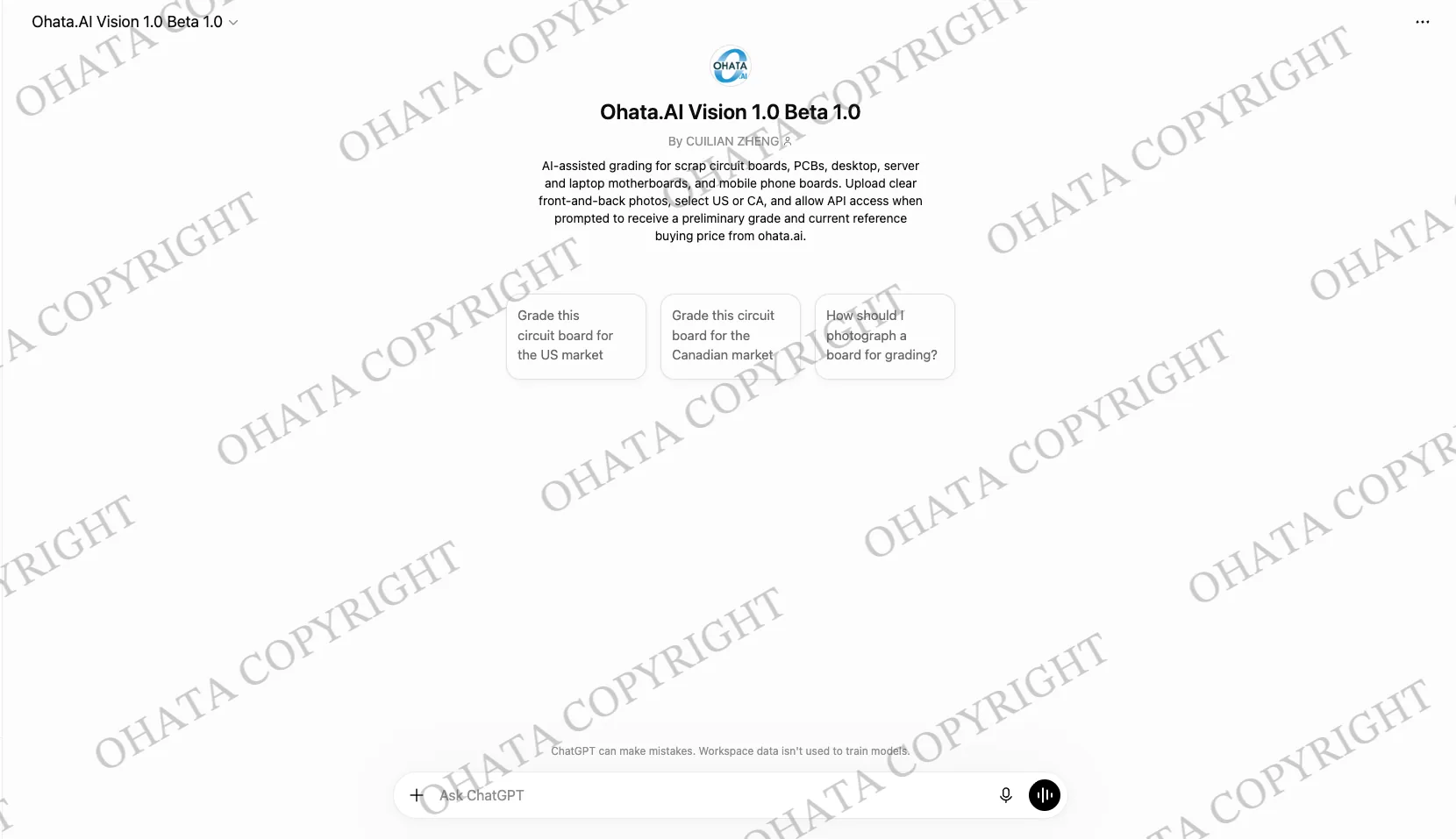
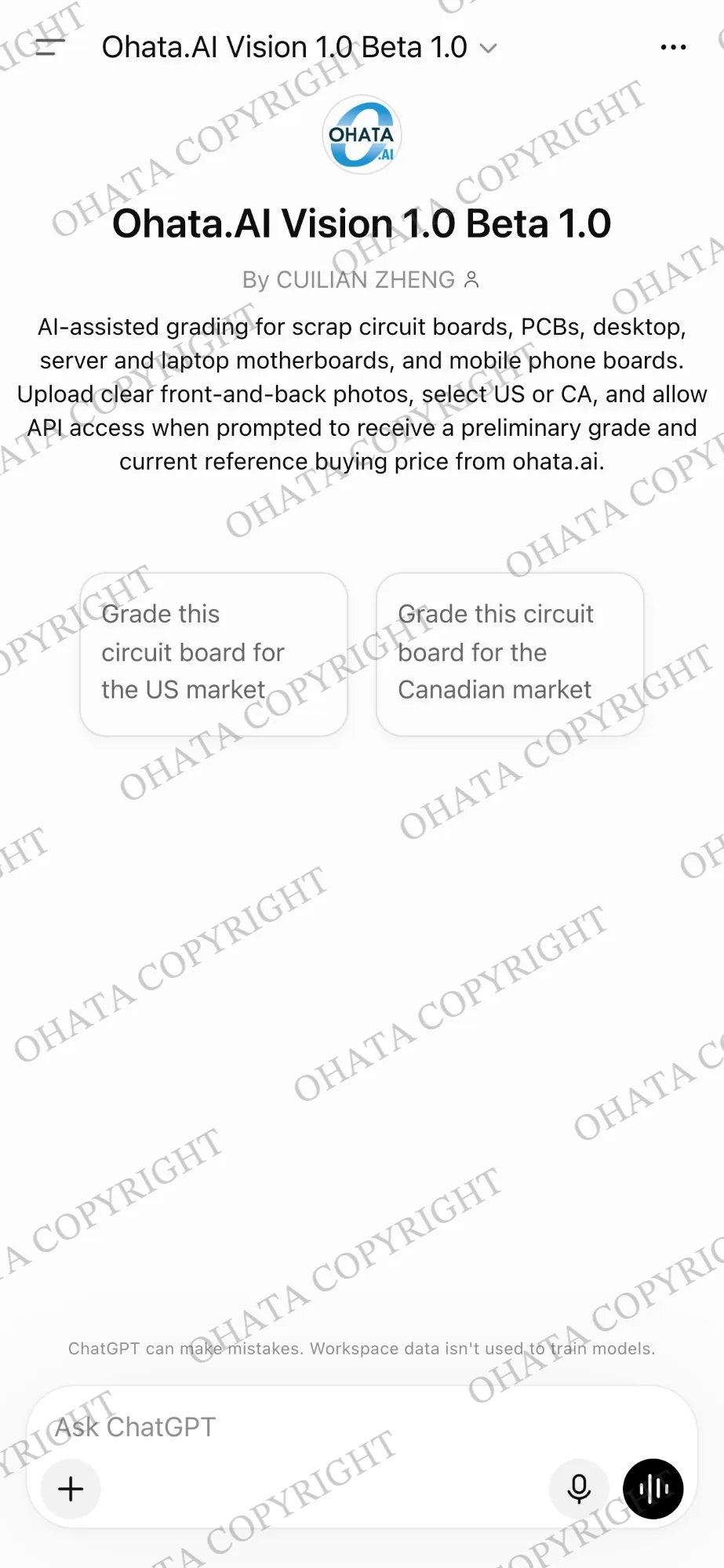
Step 1: Open Ohata.AI Vision
Open the current public Ohata.AI Vision tool.
Step 2: Choose the Target Country
Select US or CA.
The country selection determines which eligible reference-price route the system uses after the preliminary classification has been established.
The country does not determine the grade. Classification is based on the item and visible evidence.
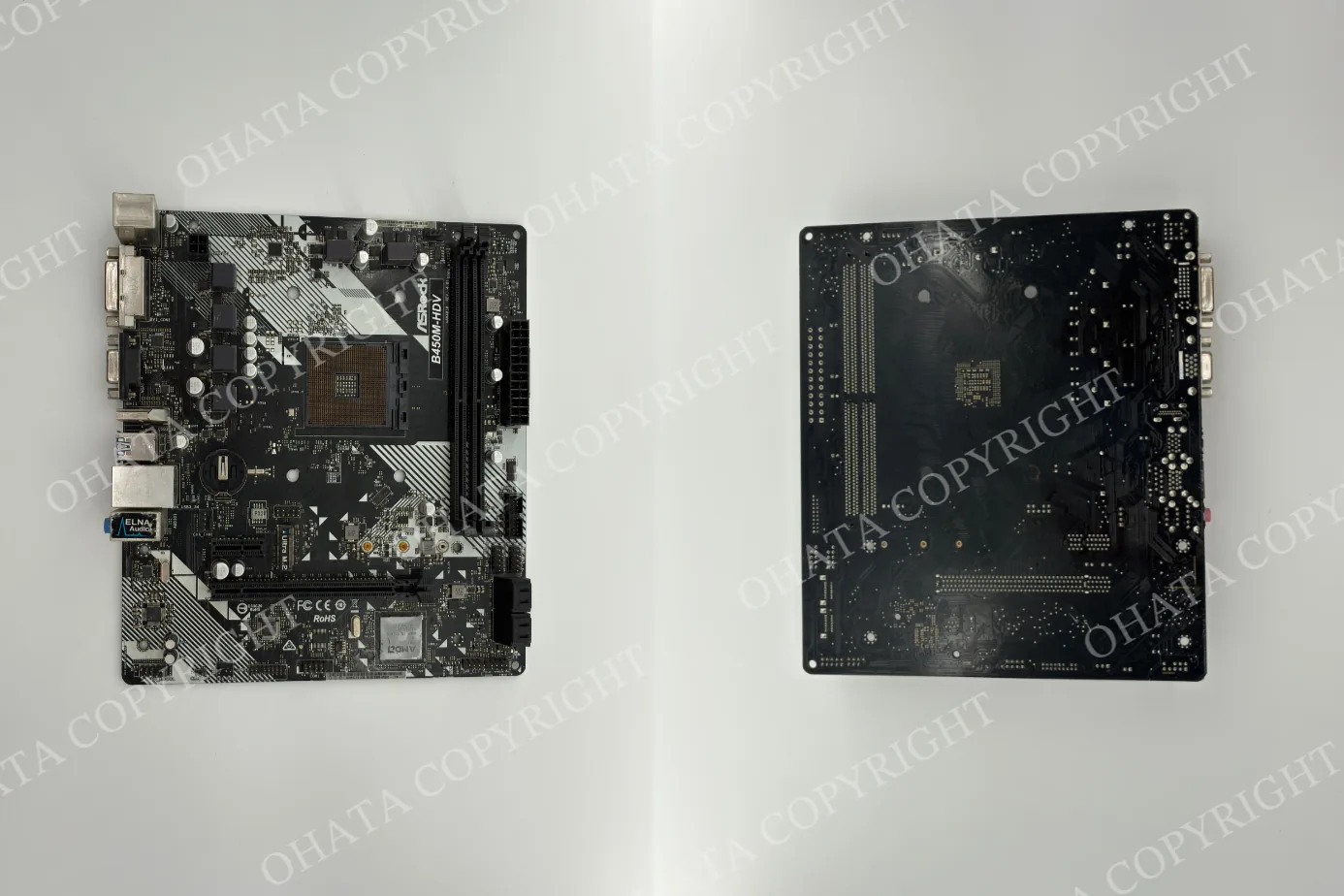
Step 3: Photograph One Item Clearly
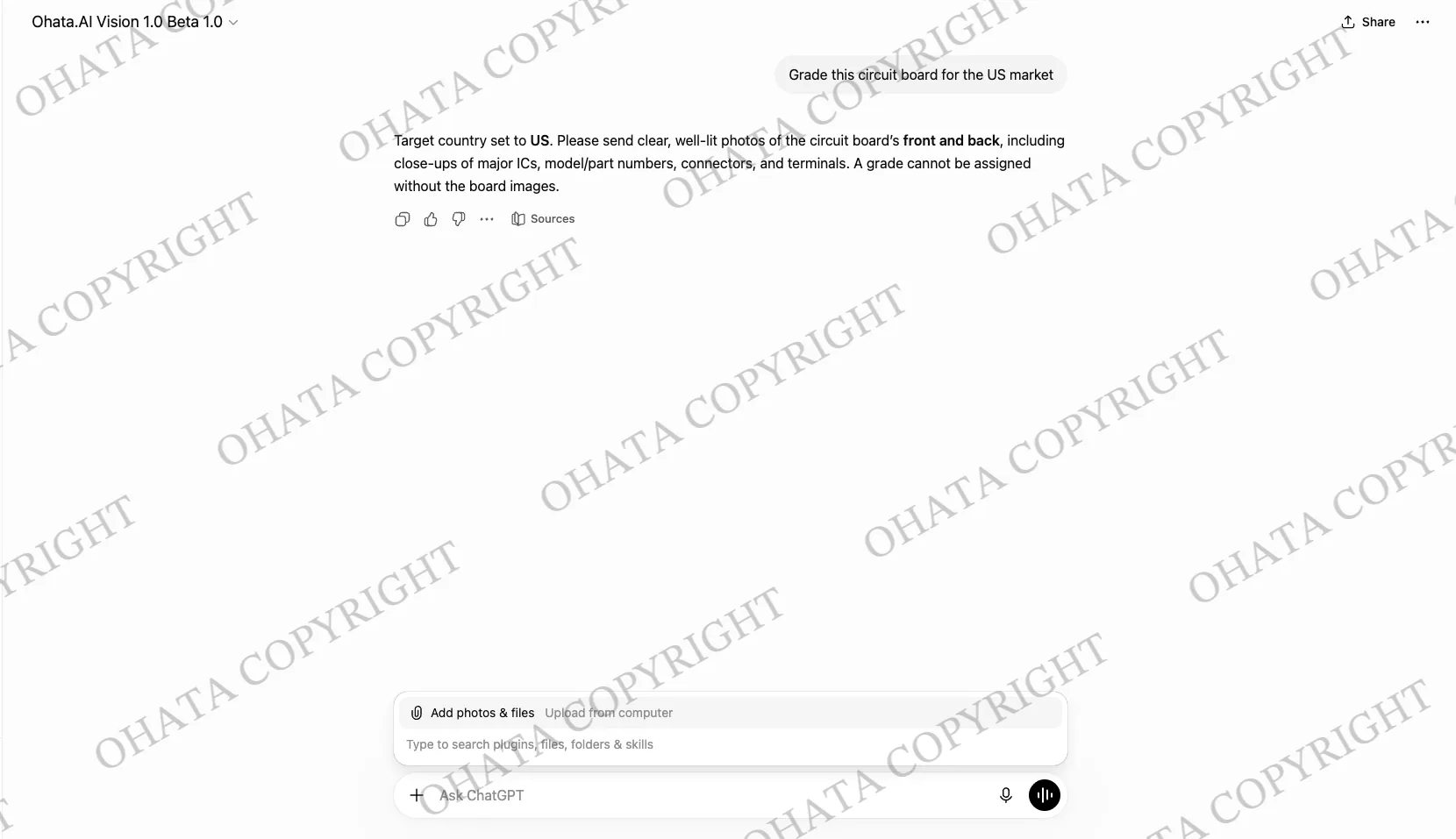
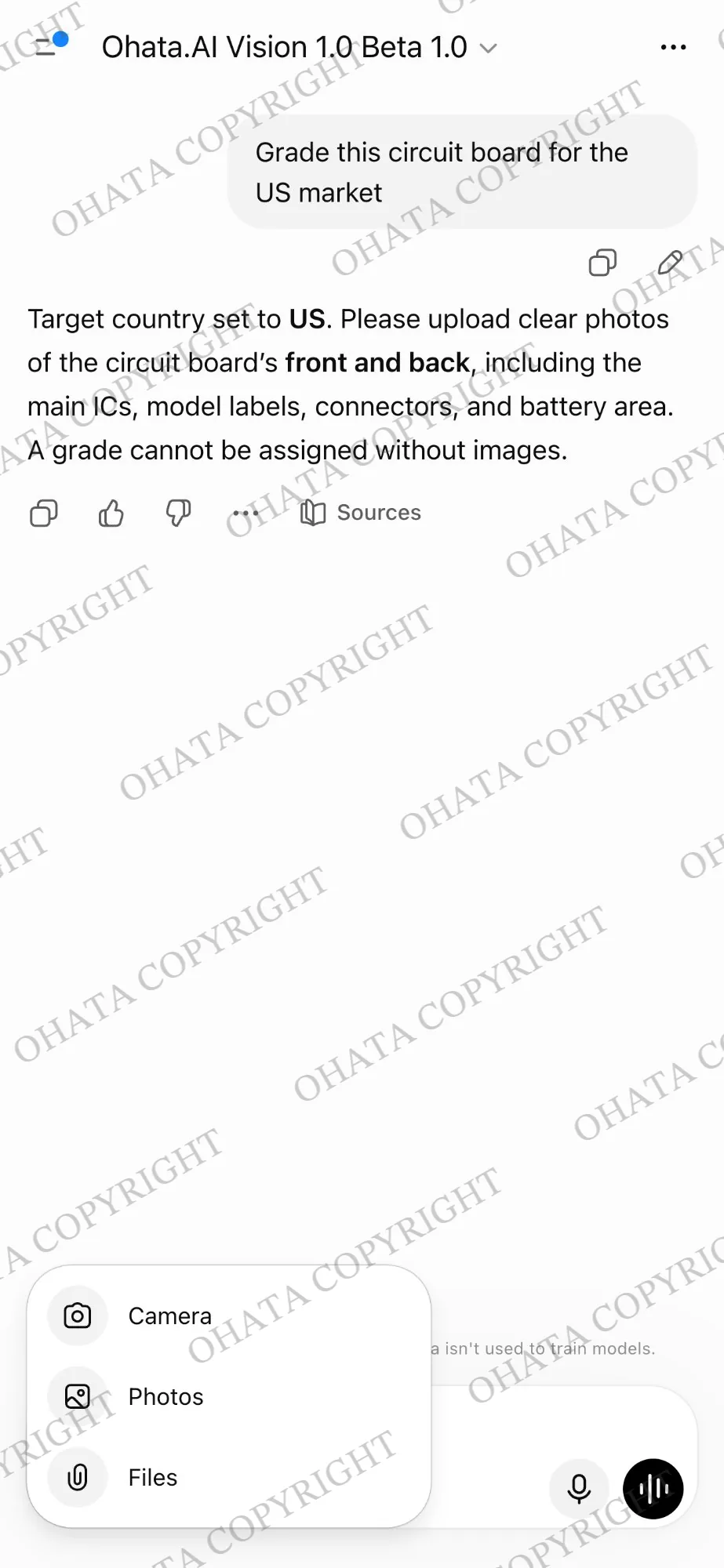
For circuit boards, provide:
One clear photograph of the complete front side
One clear photograph of the complete back side
A close-up of readable model or board markings
Close-ups of important sockets, ICs, connectors, or damaged areas when needed
Use even lighting and keep the full board in focus.
Avoid stacking boards or covering important areas with hands, labels, packaging, or other materials.
For mobile phones, show enough of the device or exposed board to identify whether it is an older cell phone or modern smartphone. The photographs should also show whether the battery and cover remain attached when possible.
Step 4: Upload the Images
Upload the photographs to Ohata.AI Vision.
Images believed to show the same item are compared before their evidence is combined. If the system cannot confirm that two images show the same item, it may review them separately.
Submit one item at a time whenever possible.
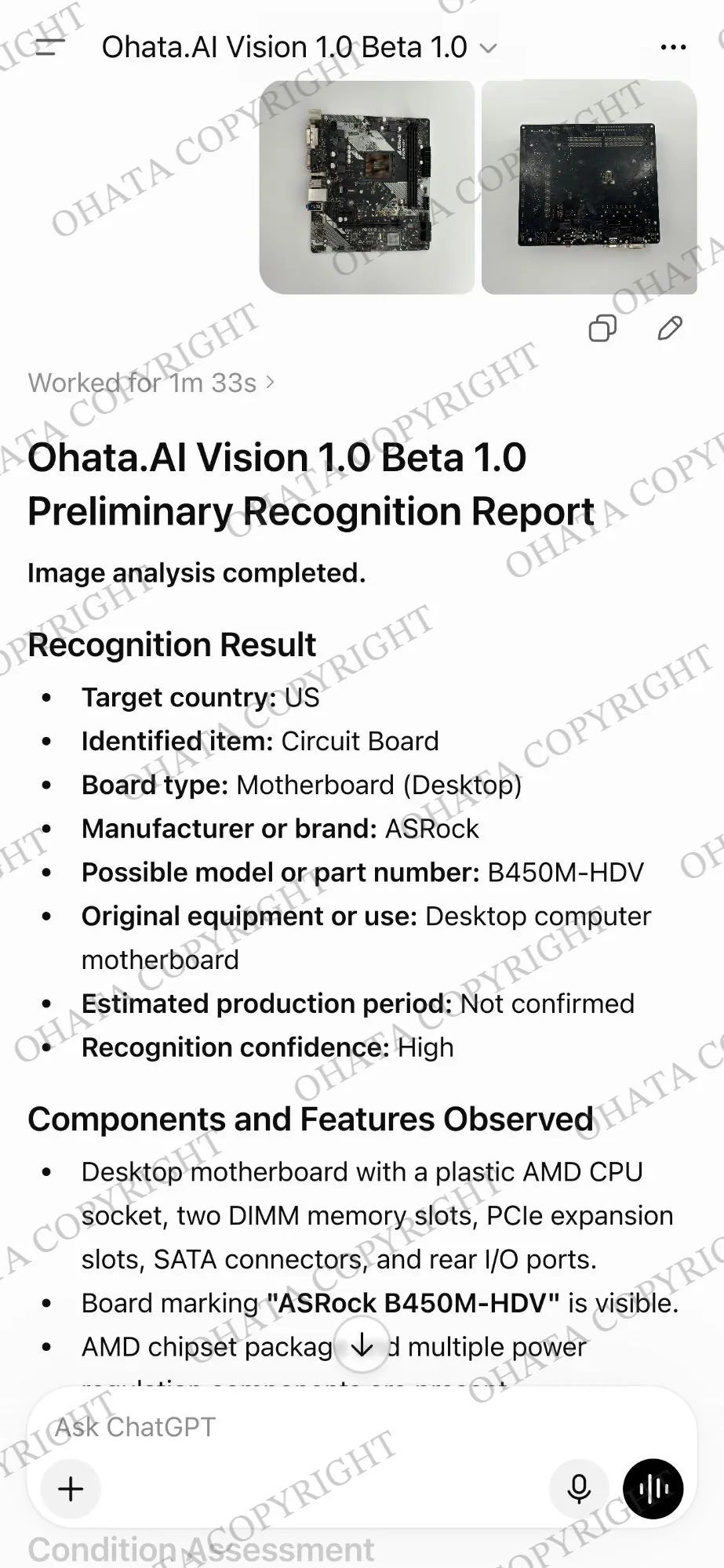
Step 5: Review the Recognition Result
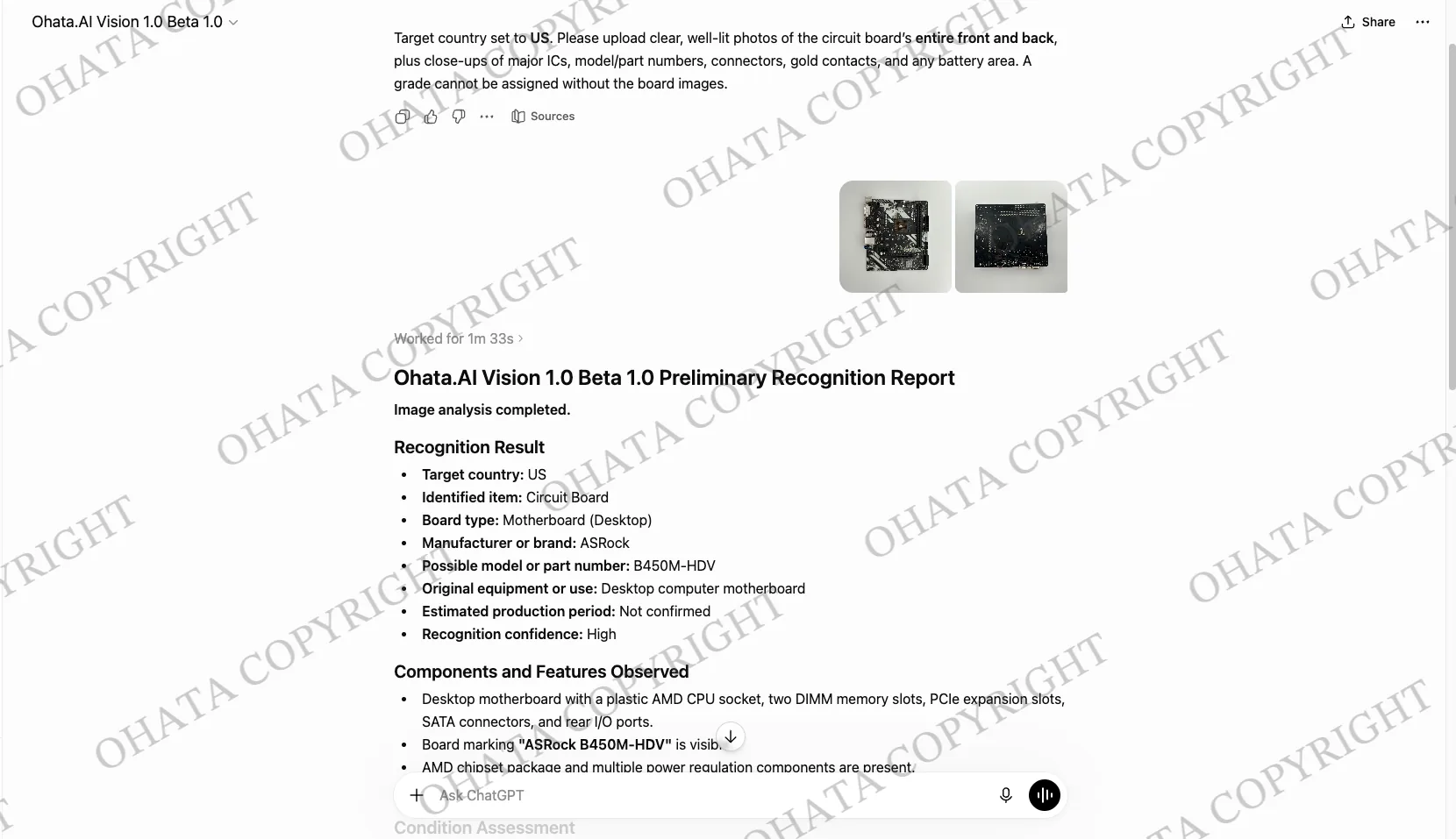
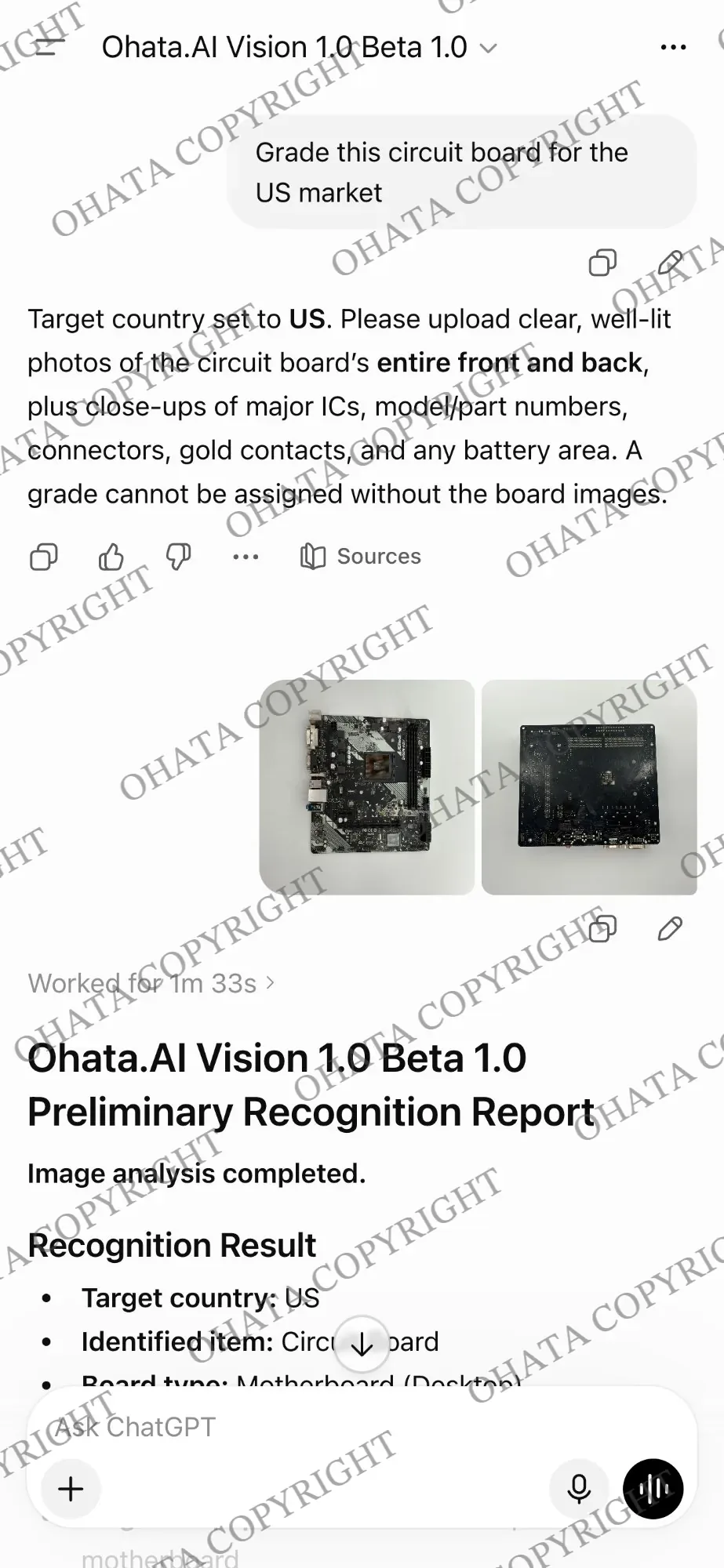
The first part of the report identifies the selected country and the item shown in the photographs.
When supported by the evidence, the report may provide:
Item name
Board or phone type
Manufacturer or brand
Model or part number
Possible original use
Estimated production period
Recognition confidence
Step 6: Review Visible Features and Condition
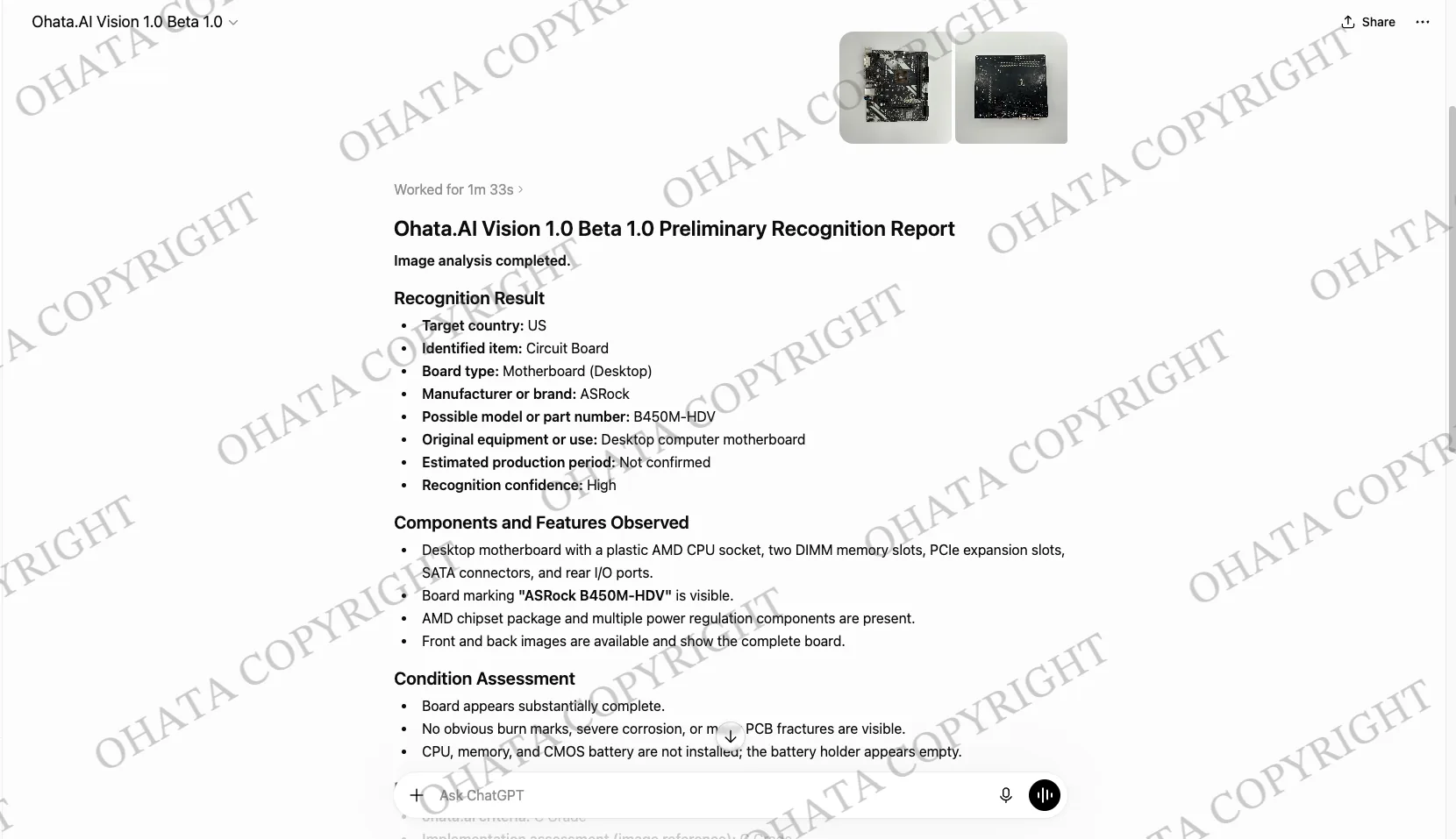
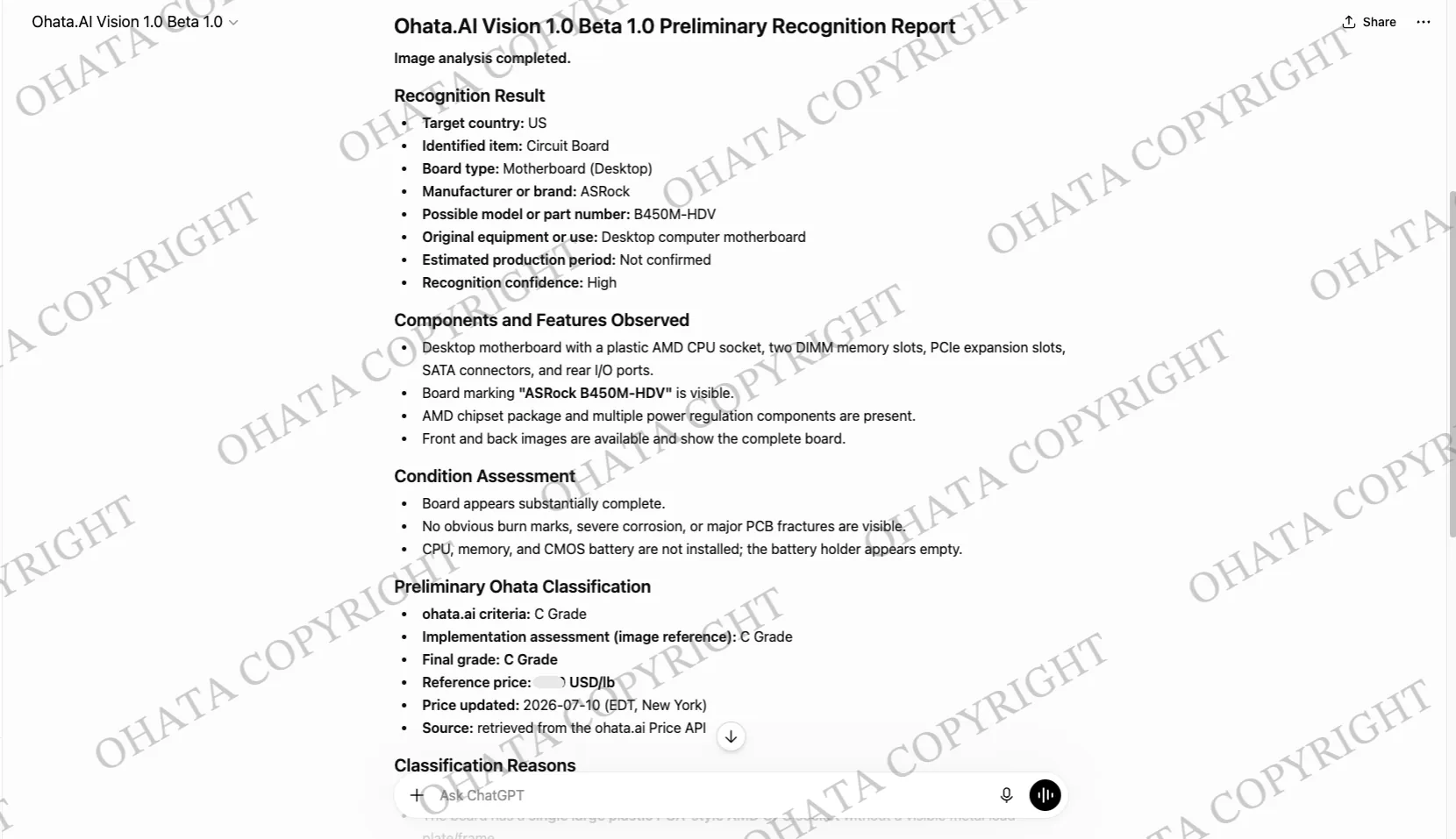
The report then records the evidence visible in the photographs.
This may include:
CPU socket or processor footprint
Memory slots
Rear I/O connectors
Power connectors
HDD interfaces
IC and BGA packages
Gold fingers or plated contacts
Board markings
Batteries
Heat sinks
Fans
Metal or plastic attachments
Missing major components
Corrosion
Burning
Breakage
Contamination
The system reviews only what can reasonably be seen.
It does not assume that hidden, blurred, or unphotographed components are present.
How the Preliminary Classification Works
Ohata.AI Vision does not classify every circuit board through one universal visual rule.
The system first considers what type of item has been submitted.
A desktop motherboard, server motherboard, laptop motherboard, HDD controller board, appliance board, and mobile phone may each require a different classification route.
For circuit boards, the system may consider:
Board type and likely application
CPU socket construction
Memory-slot layout
IC and BGA packages
Component density and arrangement
Gold-plated connectors
HDD interface type
Major missing components
Attached non-board materials
Visible corrosion, burning, breakage, or contamination
Whether the photographs provide enough evidence
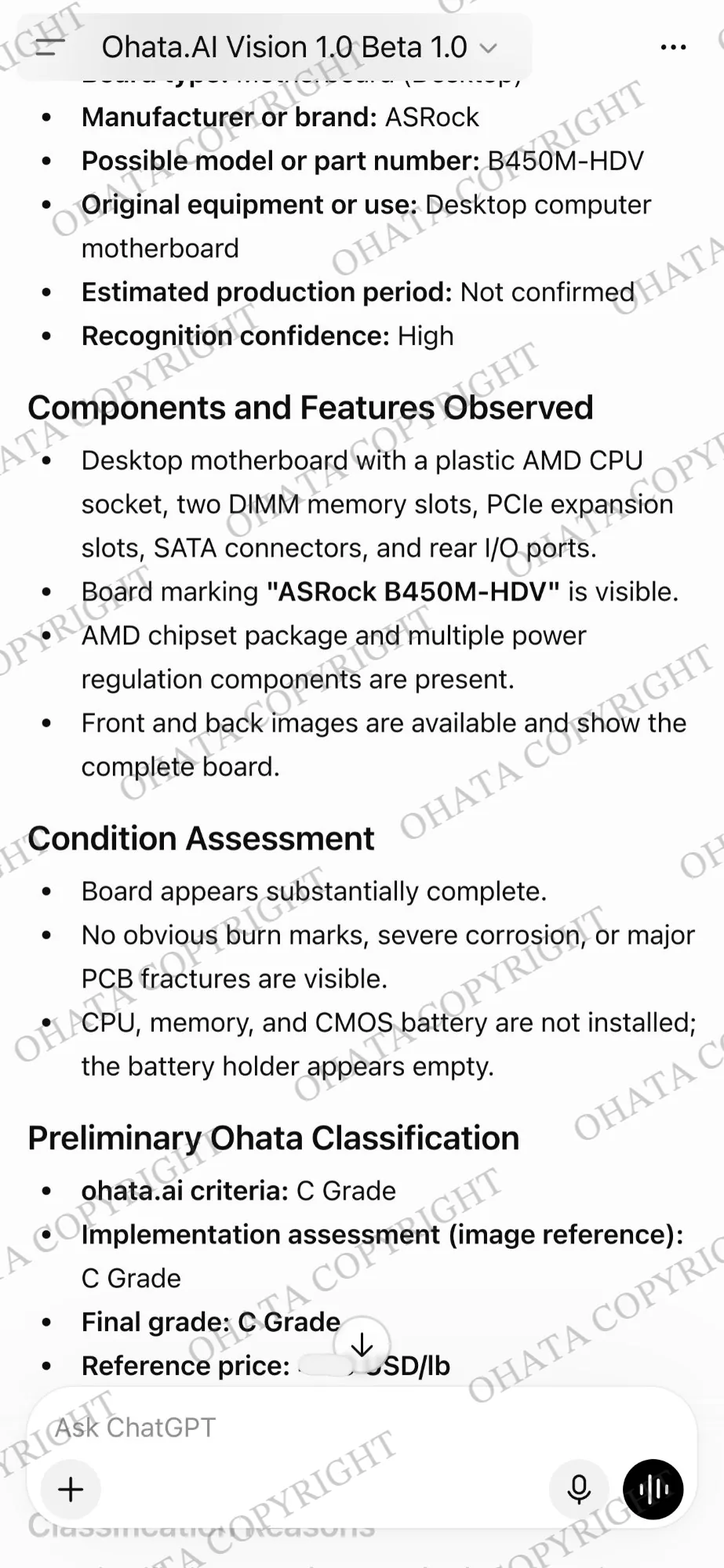
The report separates the relevant Ohata criteria from the visible implementation and condition of the photographed item.
It then presents one preliminary final classification when the evidence supports it.
Mobile phones use separate older-cell-phone and modern-smartphone categories. They are not converted into circuit-board grades.
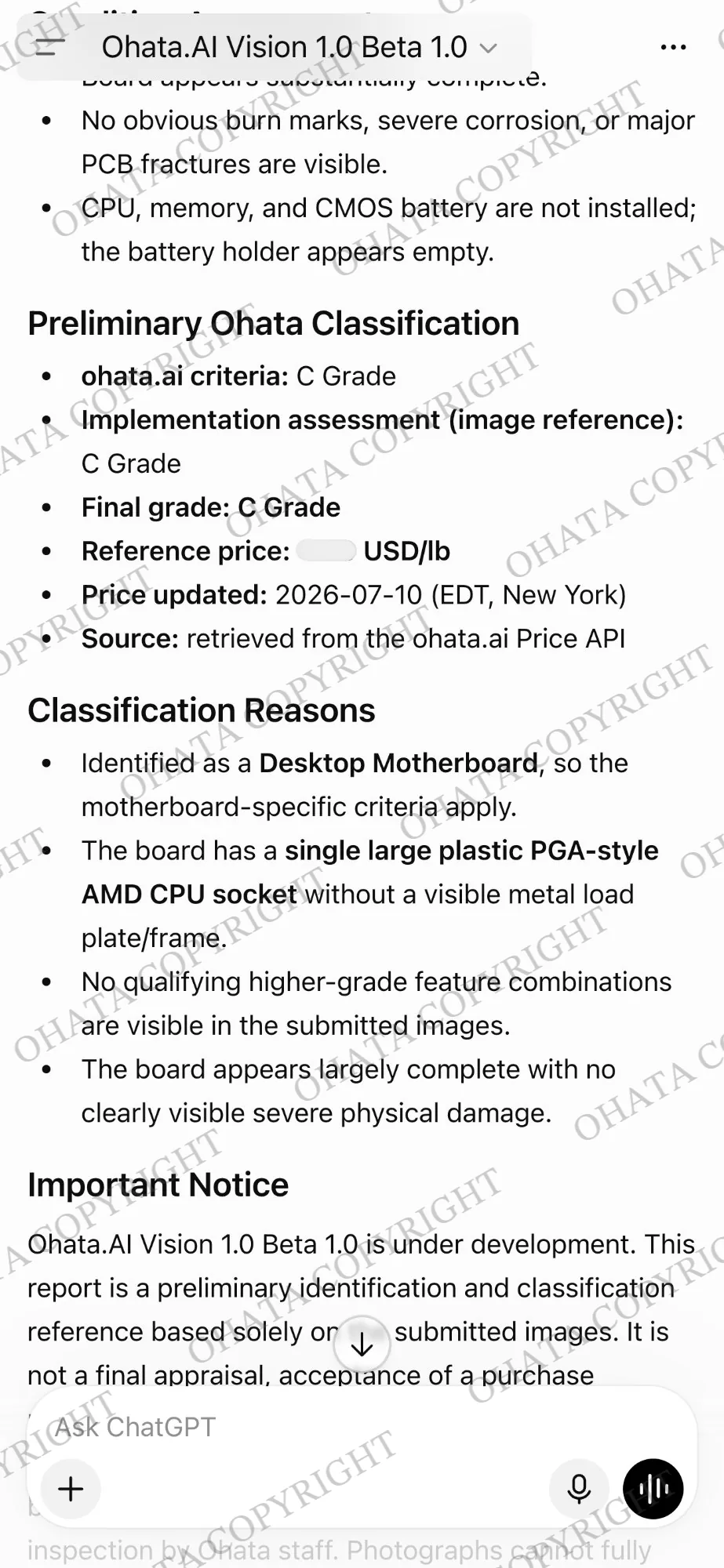
How Current Reference Pricing Works
The preliminary classification is completed before the system requests a reference price.
This order is important.
The price does not determine the grade.
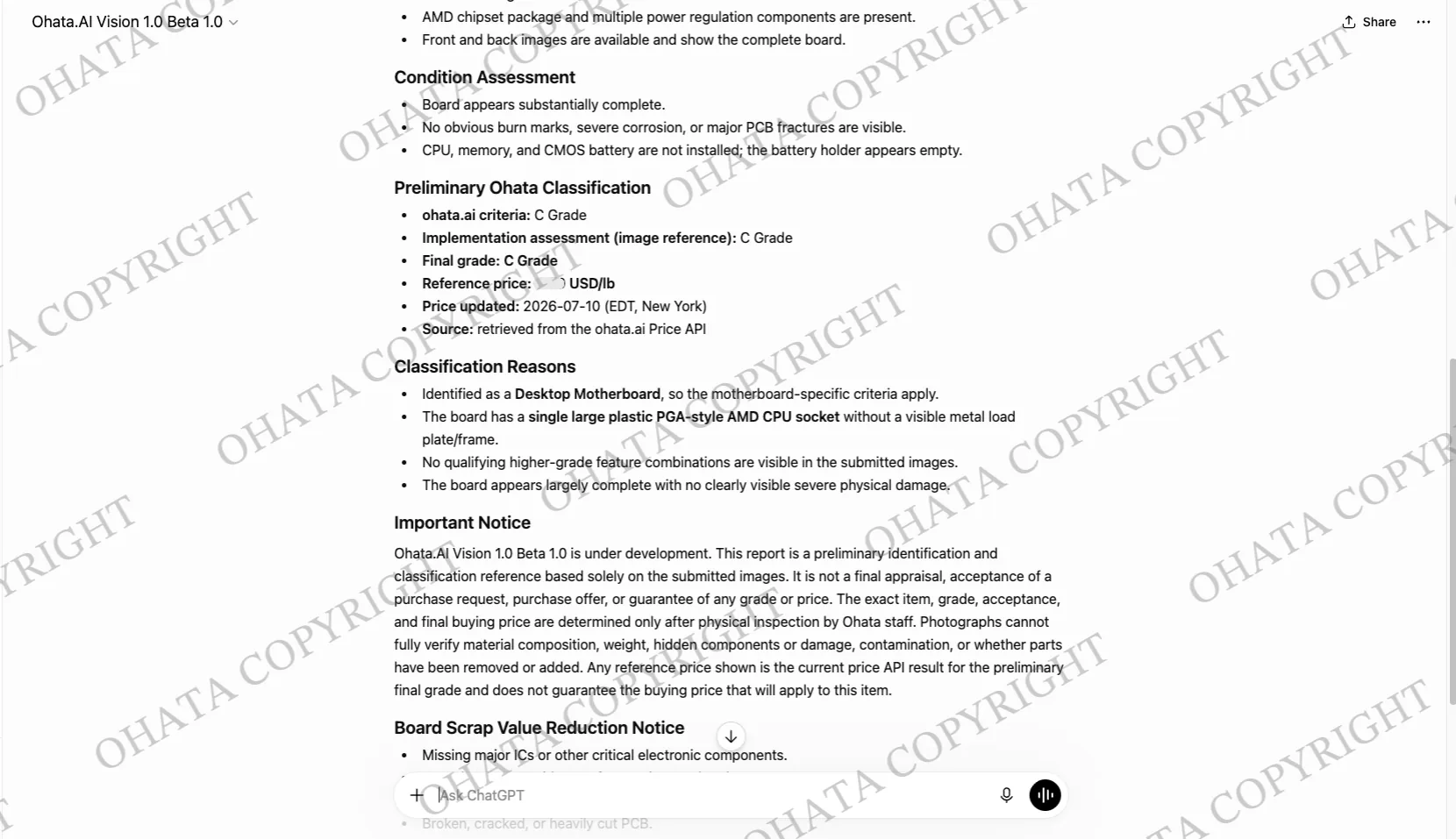
Once the system has established the country, item category, required board type, and one eligible preliminary classification, it may request the matching current record from the ohata.ai Price API.
When a valid record is available, the report may display:
Price
Currency
Purchasing unit
Update time
The system does not use static price tables in the article.
It also does not estimate missing prices from marketplace listings, unrelated categories, old records, or converted currencies.
When no valid price is available, the report states that the reference price is unavailable.
Possible reasons include:
The classification is Unknown
No approved price mapping exists
The item category is paused
Required information is unconfirmed
The price has not been registered
The API request cannot be completed
What Ohata.AI Vision Does Not Do
Ohata.AI Vision provides a preliminary image-based report.
It is not:
A final appraisal
A purchase offer
Confirmation that the material will be accepted
A guaranteed grade
A guaranteed buying price
A laboratory assay
A precious-metal content analysis
A weight or quantity measurement
Confirmation that an item is operational
A substitute for physical inspection
Photographs cannot fully confirm hidden damage, missing internal parts, exact material composition, contamination outside the photographed area, or components removed before the images were taken.
The final item, classification, acceptance, weight, and purchasing value are determined after physical inspection by Ohata staff.
How the Beta Will Develop
The current public release is Ohata.AI Vision 1.0 Beta 1.0.
The beta designation reflects that the system remains under active development.
Future improvements may include:
Recognition of additional electronic items
More item-specific classification guidance
Clearer boundary rules between similar grades
Improved condition recognition
Better additional-photo recommendations
Expanded reference imagery
Stronger connections between digital reports and physical inspection results
The system will improve through a combination of technical development and real-world recycling work.
Submitted photographs can reveal where identification is clear and where additional evidence is needed. Physical inspections can then show whether the preliminary report matched the actual material.
The purpose of the beta is not to remove every uncertainty from electronic-scrap classification. It is to organize the available evidence, explain the preliminary result, and make the next required step clearer.
As more real items are photographed, reviewed, and physically inspected, Ohata can continue improving the knowledge used by the system.
By making detailed recycling knowledge easier to access, Ohata.AI Vision can help more users recognize electronic resources before those resources are unknowingly discarded.
Try Ohata.AI Vision
For additional information about Ohata buying categories, preparation requirements, physical locations, and recycling education, visit: