

-
We buy minimum from 1 lb of SSS Grade CPUs Scrap.
-
Mixed CPUs are accepted but purchased at a lower price than sorted cpus.
-
CPU SSS represents the highest standard CPU scrap grade.
-
Proudly serving the Vancouver Metro Area with fast, convenient electronic scrap buying services.
CPU SSS Grade ( Gold Cap ceramic CPU) buying scrap price
Key Buying Introduction
Key Buying Introduction
-
We buy minimum from 1 lb of SSS Grade CPUs Scrap.
-
Mixed CPUs are accepted but purchased at a lower price than sorted cpus.
-
CPU SSS represents the highest standard CPU scrap grade.
-
Proudly serving the Vancouver Metro Area with fast, convenient electronic scrap buying services.
Buying Details of Conditions
Learn more about CPU Scrap Classification
Introduction to CPU SSS Grade
A processor may qualify for the CPU SSS price when it meets the official structural requirements of the grade, regardless of its exact manufacturer, model number, clock speed, production batch, or original computer application. The most important identifying combination is:
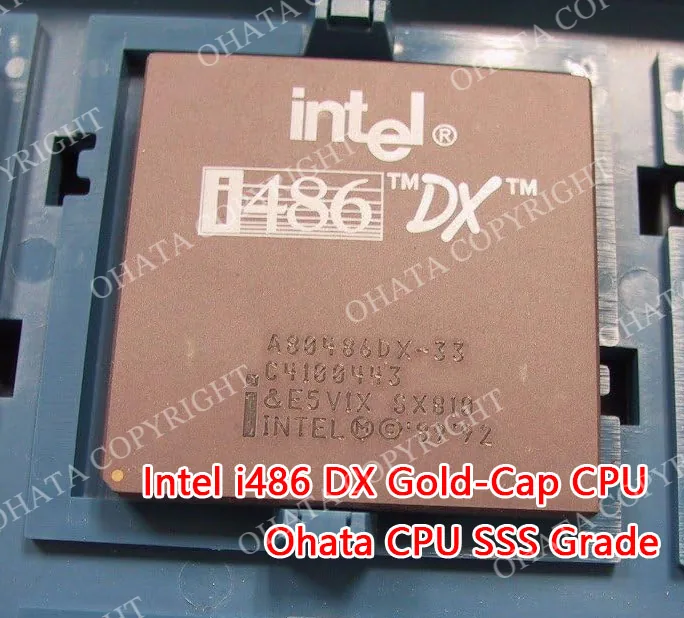
A ceramic processor package
A visible gold-colored metal cap or gold-plated lid
Gold-plated pins
A complete and identifiable CPU body
Typical examples include selected Intel 386 and 486 processors, vintage military processors, aerospace processors, industrial computing CPUs, telecommunications processors, and other early ceramic integrated processors manufactured with gold-bearing package materials.
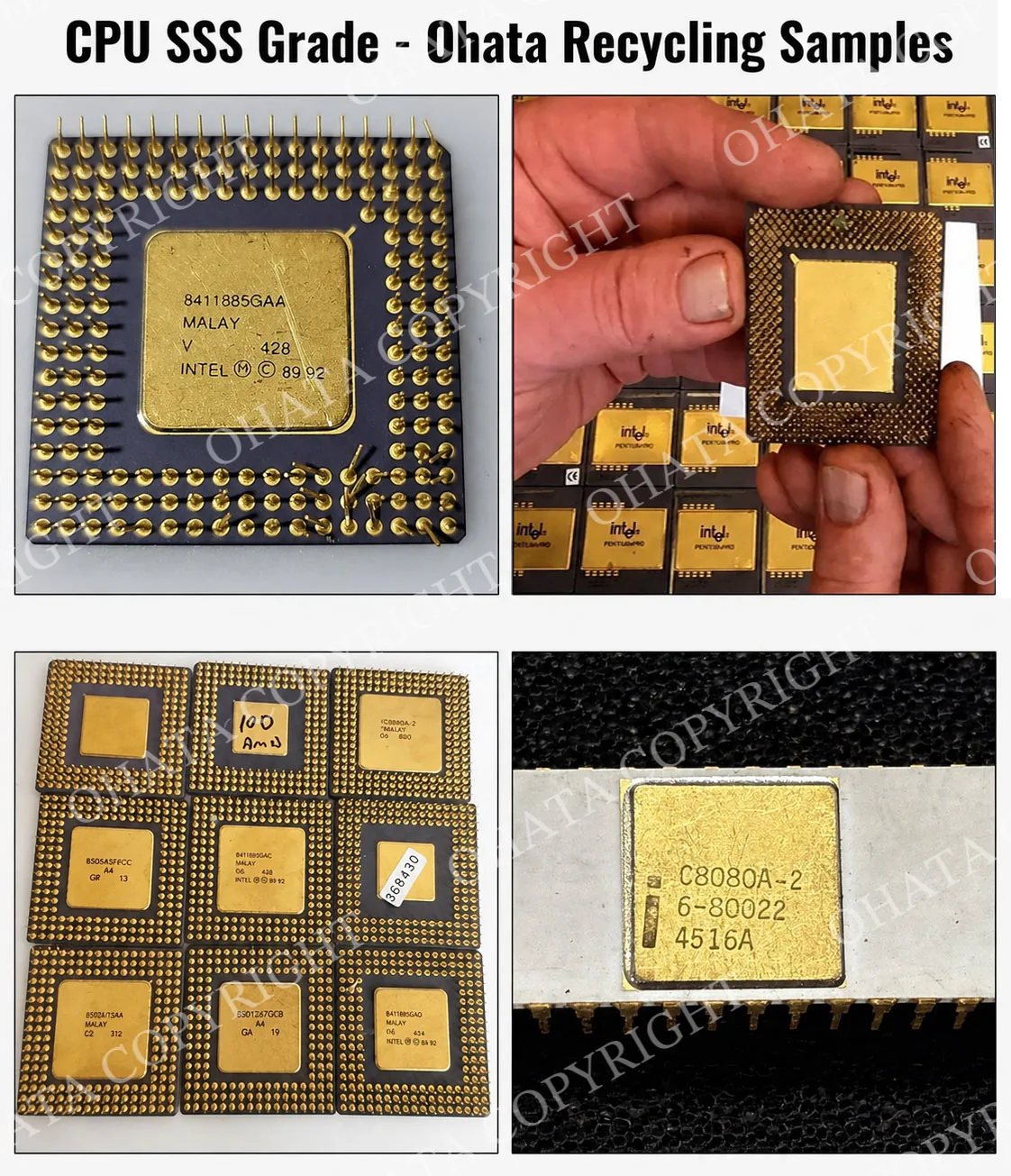
Not every old processor is CPU SSS Grade. Age alone does not determine the category. A vintage processor without a gold cap may be classified as CPU SS, while a processor with gold pins but an organic or plastic package may belong to CPU S or CPU C. Correct classification therefore requires examination of the entire package rather than reliance on the processor name alone.
Ceramic Package Construction
CPU SSS processors normally use a rigid ceramic package rather than the green, brown, or black organic substrates common in modern processors. Ceramic packaging was widely used in earlier computing, industrial, military, scientific, and telecommunications equipment because it offered good thermal stability, dimensional strength, electrical insulation, and long-term reliability.
The ceramic body may appear:
Purple
Dark gray
Brown
Black
White
Light gray
Color alone is not sufficient for classification. The evaluator should examine the texture, weight, rigidity, edge structure, and relationship between the package body, gold cap, and pins.
Compared with lightweight fiber or organic processors, a ceramic CPU usually feels dense and solid. Its edges are normally hard and sharply formed. The package may also contain printed, stamped, engraved, or laser-marked identification codes.
Gold Cap or Gold-Plated Lid
The defining feature that separates CPU SSS from ordinary high-grade ceramic CPUs is the gold-colored cap.
This cap may be a square or rectangular metal cover positioned near the center of the ceramic package. It was originally installed to protect the semiconductor die and internal wire connections. Depending on the production method, manufacturer, and intended application, the cap may contain a gold-plated surface or a gold-bearing finish over another base metal.
The gold color must be associated with the processor’s original package construction. A yellow sticker, brass-colored plate, painted surface, external foil, aftermarket label, or unrelated metal attachment does not automatically qualify as a gold cap.
The cap may show scratches, oxidation marks, stamped identification numbers, or normal handling wear. Minor surface wear does not necessarily remove the processor from SSS Grade, provided the cap remains attached and the CPU retains its original structure.
Gold-Plated Pin Grid Array
Most CPU SSS processors use a Pin Grid Array, commonly called PGA. Numerous pins are arranged underneath or around the package in a regular grid. These pins establish electrical connections between the processor and its socket.
The pins often appear gold or gold-colored because their contact surfaces were plated to improve:
Electrical conductivity
Contact reliability
Resistance to oxidation
Long-term performance
Compatibility with high-reliability equipment
The amount of gold on each individual pin is small. However, a complete CPU may contain a large number of plated pins. When combined with the gold-bearing cap, internal bonding materials, and ceramic package, this construction can create greater recycling value than most later consumer CPUs.
Internal Components
A CPU SSS processor may contain several internal materials and structures, including:
Semiconductor silicon die
Gold or other fine bonding wires
Ceramic package material
Metal die-attach materials
Gold-plated contact pins
Gold-bearing cap or lid
Nickel or other barrier layers
Copper-bearing internal conductors
Brazing or sealing materials
The exact internal composition varies by manufacturer, production year, processor family, package design, and application. Buyers should not assume that every visually similar CPU contains exactly the same precious-metal quantity.
For commercial grading purposes, Ohata assigns value according to the verified category and purchasing standard, rather than promising a fixed recoverable gold content for every individual unit.
Why CPU SSS Grade Has High Recycling Value
CPU SSS processors are normally valued above other CPU scrap categories because they combine several desirable recycling characteristics in a single component:
Gold-bearing exterior surfaces
Numerous plated pins
Possible precious-metal bonding materials
Dense ceramic construction
High-reliability historical packaging
Relatively easy visual identification
Concentrated material compared with many low-grade ICs
Their high position in the grading system does not mean every SSS processor has identical value. Weight, package size, pin count, cap size, original construction, condition, contamination, and market conditions may influence the actual purchase offer.
Some vintage processors may also have collectible value. Collectible value and scrap value are separate concepts. A rare, clearly marked, historically important, or unused processor might be worth more to a collector than to a precious-metal recycler. Sellers should consider whether a processor is collectible before processing it solely as scrap.
Official CPU SSS Requirements
Under the Ohata classification standard, CPU SSS Grade is identified as a gold-cap ceramic CPU. The principal characteristics are:
Ceramic package
Gold cap
Gold-plated pins
Typical association with 386, 486, vintage military, or aerospace processors
All major characteristics should be evaluated together. A CPU should not be assigned SSS Grade based on only one gold-colored feature.
Step-by-Step Identification
Step 1: Confirm That the Item Is a CPU
Before assigning any CPU grade, confirm that the item is actually a processor or processor-type component.
Some ceramic ICs, memory devices, hybrid modules, oscillator packages, relays, and specialized electronic components may resemble ceramic CPUs. If the item cannot be identified as a CPU or qualifying processor, it may be assigned NONE or evaluated separately.
Useful indicators include:
Recognizable CPU manufacturer markings
Processor family numbers
A processor-type PGA layout
A central die cap
Socket-compatible pin arrangement
Documentation or equipment origin
Step 2: Examine the Package Material
The package must be ceramic for CPU SSS classification.
Ceramic packages are normally harder, heavier, and more rigid than fiber or organic packages. They should not be confused with:
Green fiberglass CPU substrates
Brown organic substrates
Black plastic IC bodies
Molded epoxy processors
Modern metal-topped LGA processors
A modern CPU with a large silver heat spreader is not a gold-cap ceramic CPU, even when gold-colored contact pads are present underneath.
Step 3: Confirm the Gold Cap
A genuine SSS candidate should have a clearly visible original gold-colored cap or lid.
Inspect whether the cap:
Is integrated into the ceramic package
Covers the central die area
Has a consistent metallic gold appearance
Appears original rather than added later
Remains substantially complete
A ceramic CPU without this gold cap normally belongs to CPU SS rather than CPU SSS.
Step 4: Inspect the Pins
CPU SSS processors normally have gold-plated pins.
The pins should be examined for:
Gold-colored plating
Completeness
Corrosion
Heavy bending
Breakage
Solder contamination
Attached socket fragments
A few slightly bent pins may not automatically disqualify an otherwise complete CPU, but severe damage may reduce the purchasing value or move the material into CPU F, depending on the buyer’s inspection.
Step 5: Check Completeness and Condition
The processor should remain reasonably complete and identifiable. Important areas include:
Ceramic body
Gold cap
Pin field
Printed identification
Package edges
Evidence of contamination
Evidence of destructive processing
A processor with its gold cap removed is no longer equivalent to a complete CPU SSS sample. A CPU broken into pieces may also lose its standard SSS classification because the original material structure can no longer be verified accurately.
Two-Way Verification Method
The Ohata system uses a two-direction evaluation approach.
First, the processor is compared from the highest grade downward:
SSS → SS → S → A → B → C → D → E → F
Second, it should be checked from the lowest applicable grade upward to confirm that no lower-grade characteristic has been overlooked.
For example, an evaluator may initially identify a ceramic PGA processor. However, the second review may reveal that it has no gold cap, placing it in CPU SS rather than CPU SSS. Alternatively, it may have a gold cap but severe corrosion, missing pins, or contamination, requiring CPU F treatment.
Distinguishing CPU SSS from CPU SS
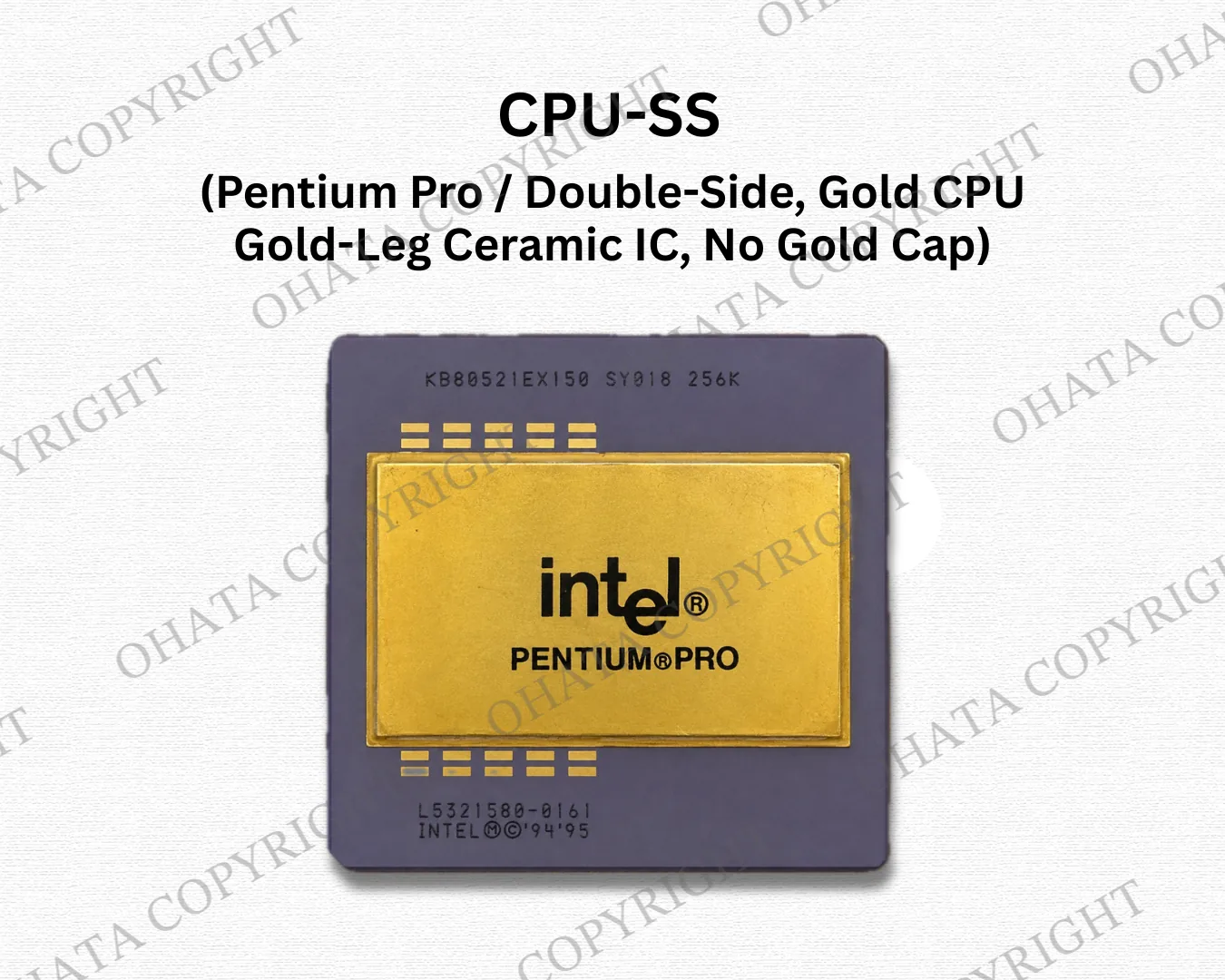
CPU SS is also a high-grade ceramic processor category. The principal difference is the cap.
CPU SSS:
Ceramic body
Gold cap
Gold-plated pins
CPU SS:
Ceramic body
No gold cap
Gold-plated pins
This is one of the most important distinctions in the classification system. A ceramic Pentium, AMD, Cyrix, or similar processor may be valuable, but without the qualifying gold cap it should not automatically receive SSS pricing.
Distinguishing CPU SSS from CPU S
CPU S generally includes gold-pin PGA processors such as selected Athlon, Opteron, Socket 370, and Socket 478 processors.
CPU S may have:
Gold-plated pins
PGA construction
An organic, fiber, or non-SSS package
No qualifying ceramic gold-cap combination
Therefore, gold pins alone are not sufficient for SSS Grade. The ceramic body and gold cap must also be present.
Distinguishing CPU SSS from CPU A
CPU A includes modern Land Grid Array processors. These CPUs normally have:
Flat contact pads
No projecting pin grid on the CPU
Modern Intel Core or Xeon construction
A metal heat spreader
Organic substrate
Although modern LGA CPUs have gold-colored contact pads, they do not have the gold-cap ceramic PGA construction required for SSS.
Distinguishing CPU SSS from CPU B
CPU B covers BGA processors and related chips, including many:
Laptop CPUs
GPUs
Chipsets
Soldered processors
BGA devices have solder balls or solder contact points underneath rather than long removable PGA pins. They are usually soldered directly onto a circuit board.
Distinguishing CPU SSS from CPU C
CPU C is the fiber CPU category. These processors usually have:
Green or brown organic substrates
Lightweight construction
Modern Intel or AMD desktop packaging
Lower ceramic content
No qualifying gold cap
A fiber CPU may have pins, pads, or a metal heat spreader, but it does not match the complete SSS construction.
Distinguishing CPU SSS from CPU D, E, and F
CPU D includes cartridge-style or slot processors, such as Slot 1 and Slot A modules. These contain circuit boards, connectors, cache chips, and plastic housings rather than a single gold-cap ceramic PGA package.
CPU E includes low-grade plastic processors, microcontrollers, logic ICs, and other plastic chips with relatively low precious-metal concentration.
CPU F includes damaged, dirty, corroded, mixed, contaminated, or unidentified CPU scrap. A processor that was originally an SSS type may be downgraded if its condition prevents safe, accurate, or efficient grading.
Recoverable Materials
Professional processors may recover or separate materials such as:
Gold from plated pins and package surfaces
Copper from internal conductors
Nickel from plating barrier layers
Silver or other metals in certain internal connections
Ceramic material
Silicon die material
Base metals from caps and pins
Actual recovery depends on industrial refining methods, equipment, environmental controls, batch composition, and downstream refinery terms.
The visible gold color should not be interpreted as solid gold. Gold plating is generally thin, and the underlying cap or pin may be made from another metal. Purchase prices should therefore be based on established commercial grading, sampling, processing results, and current market conditions.
Ohata Buying Standards
To receive CPU SSS Grade evaluation, processors should normally be:
Clearly identifiable
Complete
Ceramic packaged
Equipped with the original gold cap
Equipped with gold-plated pins
Free from hazardous contamination
Separated from lower CPU grades
Free from excessive attached non-CPU material
Processors do not generally need to be functional for scrap purchasing. Recycling value is based primarily on recoverable materials and physical construction, not operating performance.
Conditions That May Reduce Value
A CPU SSS-type processor may be downgraded or separately evaluated when it has:
Missing gold cap
Removed or scraped cap plating
Large numbers of missing pins
Severely bent or crushed pins
Broken ceramic body
Missing package sections
Heavy corrosion
Burn damage
Chemical contamination
Oil contamination
Solder-covered pins
Attached heatsinks or sockets
Unidentifiable markings
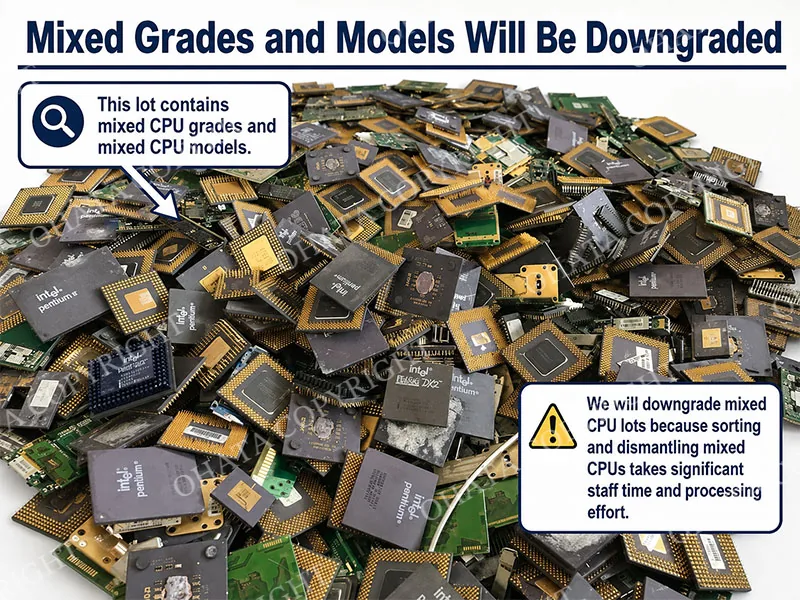
Mixed lower-grade processors in the same lot
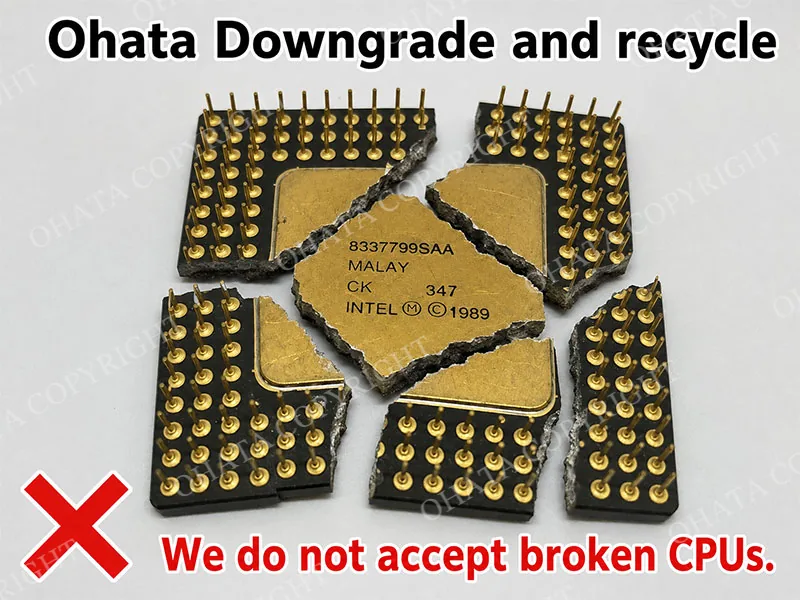
Minor cosmetic scratches are different from destructive material removal. Normal wear may be acceptable, while deliberate scraping, cutting, crushing, or cap removal can significantly affect grade and value.
Sorting Requirements
CPU SSS processors should be separated from:
Ceramic CPUs without gold caps
Organic PGA processors
Modern LGA CPUs
BGA chips
Fiber CPUs
Slot processors
Plastic ICs
Damaged CPU scrap
Non-CPU electronic components
Mixed lots require more inspection and sorting labor. They also increase the risk of incorrect grading. For this reason, mixed CPU loads may receive a lower preliminary quotation until the material has been separated and verified.
Safe Handling
CPU SSS processors should be handled carefully because ceramic bodies can crack or chip when dropped.
Recommended handling practices include:
Store processors in rigid containers
Avoid placing heavy steel parts on top of CPUs
Keep material dry
Do not wash CPUs with unknown chemicals
Do not remove gold caps
Do not scrape gold-colored surfaces
Do not cut or crush processors
Keep different grades in labeled containers
Record approximate weight and quantity
Use anti-static packaging when collectible or reusable value may exist
Mechanical or chemical processing should only be performed by qualified facilities. Burning, uncontrolled acid treatment, open-air heating, or informal metal extraction can produce dangerous fumes, contaminated waste, and significant material losses.
Grade Comparison Summary
Ohata GradeMain ConstructionContact TypePrimary Identifying FeatureCPU SSSCeramic packageGold-plated pinsOriginal gold capCPU SSCeramic packageGold-plated pinsNo gold capCPU SPGA packageGold-plated pinsGold-pin PGA without SSS constructionCPU AModern LGA packageFlat gold contact padsNo pins on CPUCPU BBGA chipSolder ballsNormally soldered to boardCPU CFiber or organic packagePins or padsGreen/brown lightweight substrateCPU DCartridge or slot moduleEdge connectorSlot 1, Slot A, or similar moduleCPU EPlastic IC packageLeads, pins, or padsLow-grade processors and controllersCPU FMixed or damaged CPU scrapVariousBroken, dirty, corroded, or unknownNONENot a qualifying CPUVariousOther electronic component
Highest-Grade Status
Within the Ohata classification system, CPU SSS represents the highest standard CPU scrap grade. However, a higher category does not mean that every unit must receive the same payment.
Commercial pricing may depend on:
Net weight
Quantity
Package design
Gold-cap dimensions
Pin count
Completeness
Material consistency
Contamination
Current precious-metal markets
Refining terms
Collectible value
Inspection results
The SSS designation establishes the material category. It does not guarantee a permanently fixed price.
Final Official Classification
A CPU should be classified as Ohata CPU SSS Grade when inspection confirms that it is a complete, identifiable processor with:
A ceramic package
An original gold cap
Gold-plated pins
Construction consistent with vintage gold-cap ceramic CPUs
No severe damage or contamination that requires downgrading
Typical 386, 486, military, aerospace, industrial, scientific, and telecommunications processors may qualify, but model family alone is not conclusive. Every processor must be evaluated according to its actual physical construction.
The most reliable grading rule is simple:
Ceramic package + original gold cap + gold-plated pins = CPU SSS candidate.
The word “candidate” remains important because final classification also depends on completeness, authenticity, contamination, and condition.
CPU SSS pricing applies to all processors that satisfy the same verified grade requirements. The category is not limited to one manufacturer or one famous CPU model. Conversely, processors that resemble SSS samples but lack the gold cap, ceramic body, or gold-plated pins must be placed into the appropriate lower category.
By applying consistent construction-based inspection, separating CPU grades before delivery, and preserving processors in complete condition, sellers can reduce grading disputes, improve processing efficiency, and obtain a purchase value that more accurately reflects the quality of their CPU scrap.
Ready to Sell CPU SSS Grade in Richmond?
Once you believe your processors match the item's characteristics, you don’t need to confirm the final grade yourself. The next step is simply to check the current buying information, keep the processors intact and prepare them for inspection.
STEP 1 – Check Today’s Buying Prices and Sort Your Materials
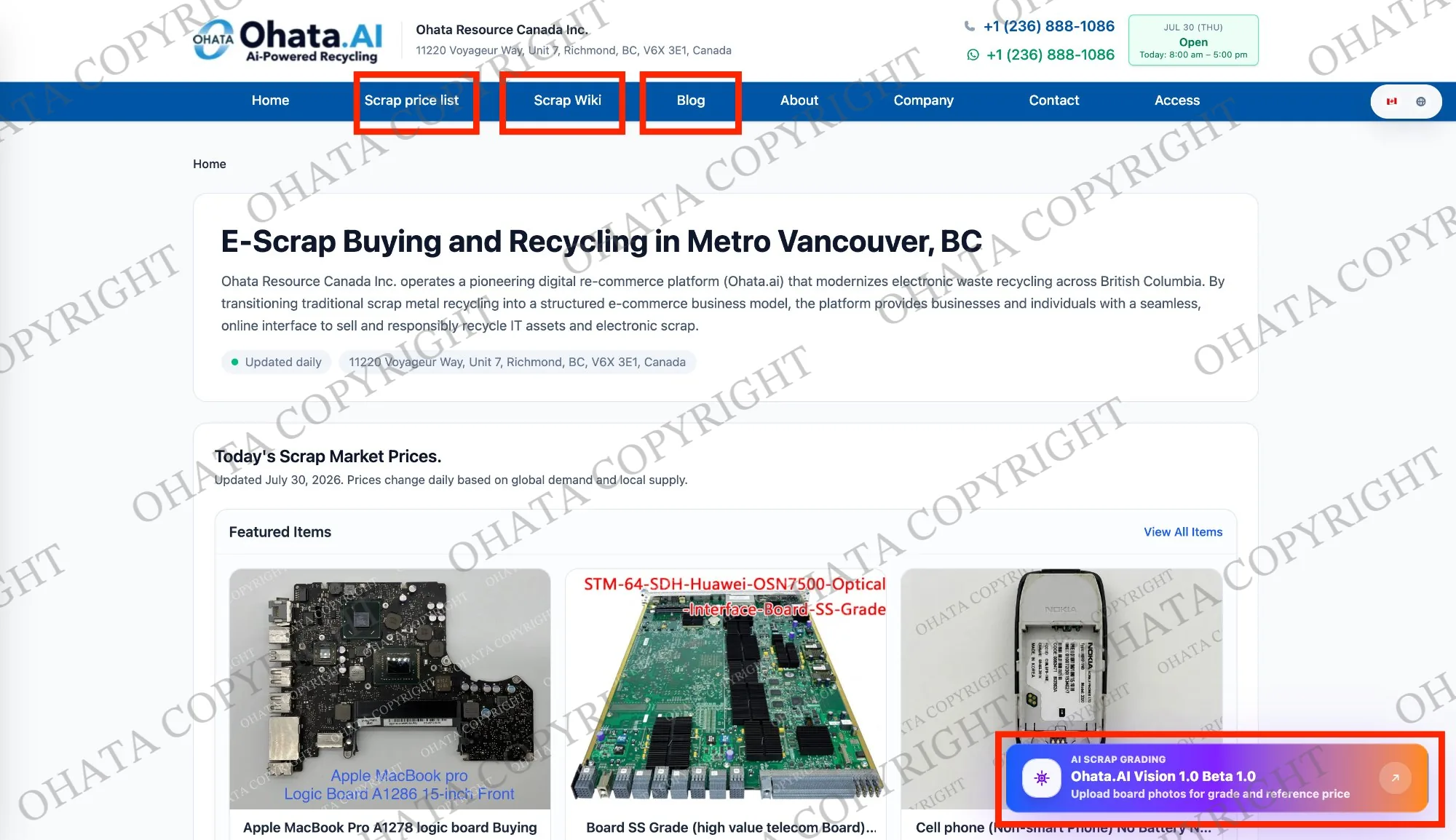
Before visiting our Richmond yard, please review the latest Canadian e-scrap buying prices and identification guides in the Ohata Scrap Wiki.
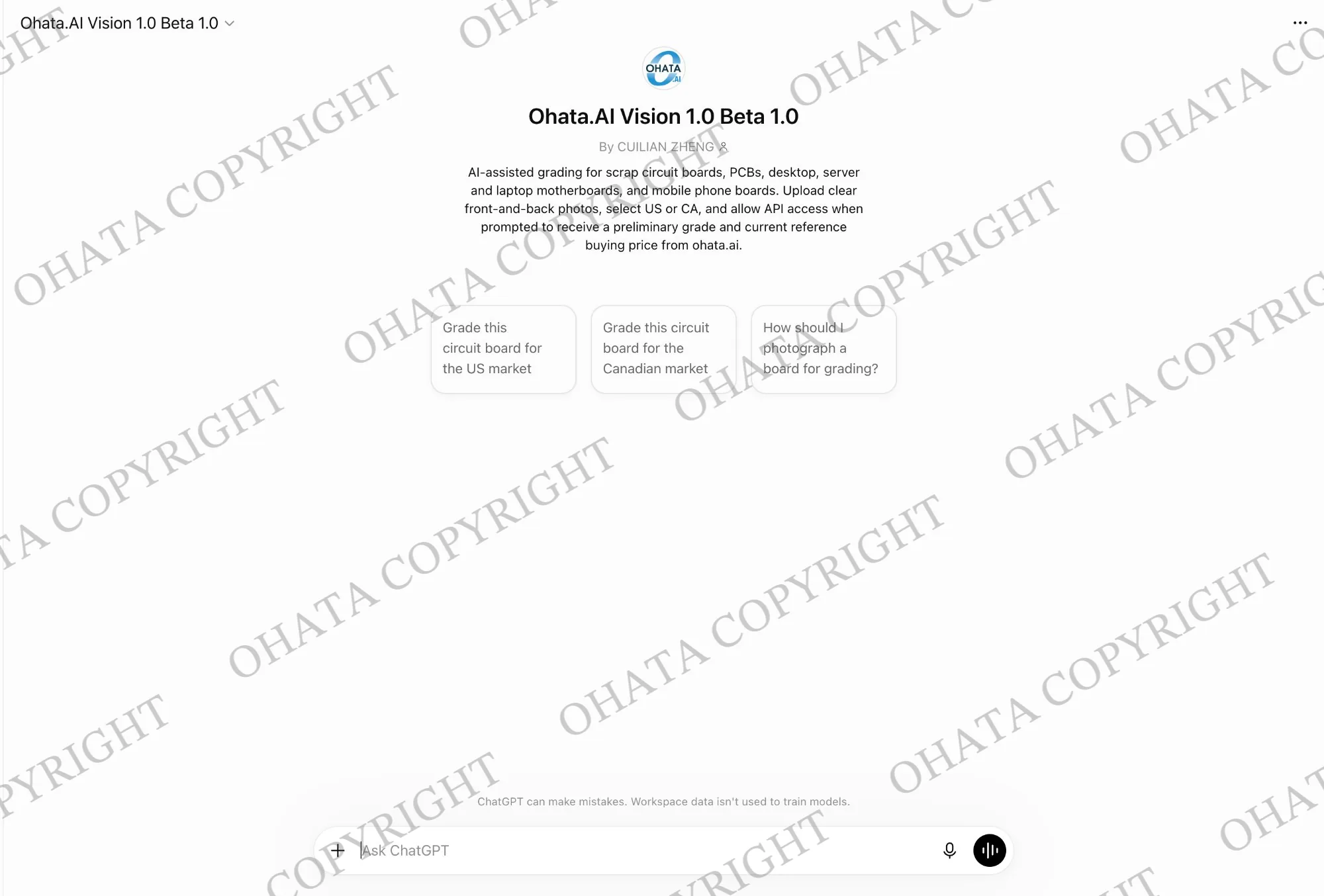
You can also use Ohata.AI Vision 1.0 Beta 1.0 to investigate an unfamiliar circuit board. Upload a clear photograph, and the tool can analyze visible features, such as the board’s shape, CPU socket, integrated circuits, connectors and component layout, to suggest what type of board it may be.
Buying prices and conditions may change with the market, so checking the applicable item page before you leave can help you understand how your material should be prepared.
Whenever practical, separate your e-scrap into groups such as:
Server boards
Laptop motherboards and logic boards
Telecommunications boards
CPUs and memory modules
Other or uncertain electronic scrap
You don’t need to assign every item a final grade yourself. If something is unfamiliar, keep it in an “uncertain” group and use Ohata.AI for a preliminary photo-based identification.
Walk-ins are welcome during regular business hours, and no appointment is required for most ordinary drop-offs.
If you have a large commercial load, palletized shipment or an unusual type of material, please contact the Richmond team before visiting so we can prepare for your arrival.
STEP 2 – Bring Your E-Scrap and Valid Government-Issued Photo ID
Please bring your electronic scrap together with a valid government-issued photo ID.
Examples may include:
British Columbia Driver’s Licence
BC Identification Card
BC Services Card with photo
Canadian passport
Permanent Resident Card
Other valid government-issued photo identification
Business sellers may also be asked to provide company information or supporting documentation when applicable.
Clearly separated and labelled material is usually quicker to inspect. If possible, prepare the approximate weight and quantity for each group before visiting.
Please also remember that computers, servers, hard drives and solid-state drives may contain personal or business information. Back up anything you need and follow your own data-security requirements before the equipment leaves your control.
STEP 3 – Visit Our Richmond E-Scrap Buying Yard
Our Richmond yard is located at 11220 Voyageur Way, Unit 7, Richmond, BC, V6X 3E1. Before leaving, you can check the route and current traffic information through Google Maps.
1. Look for the Ohata sign
When you arrive at the property, first look for the Ohata Resource Canada Inc. sign on the building. Once you find it, continue around to the rear of the building, where our warehouse entrance is located.
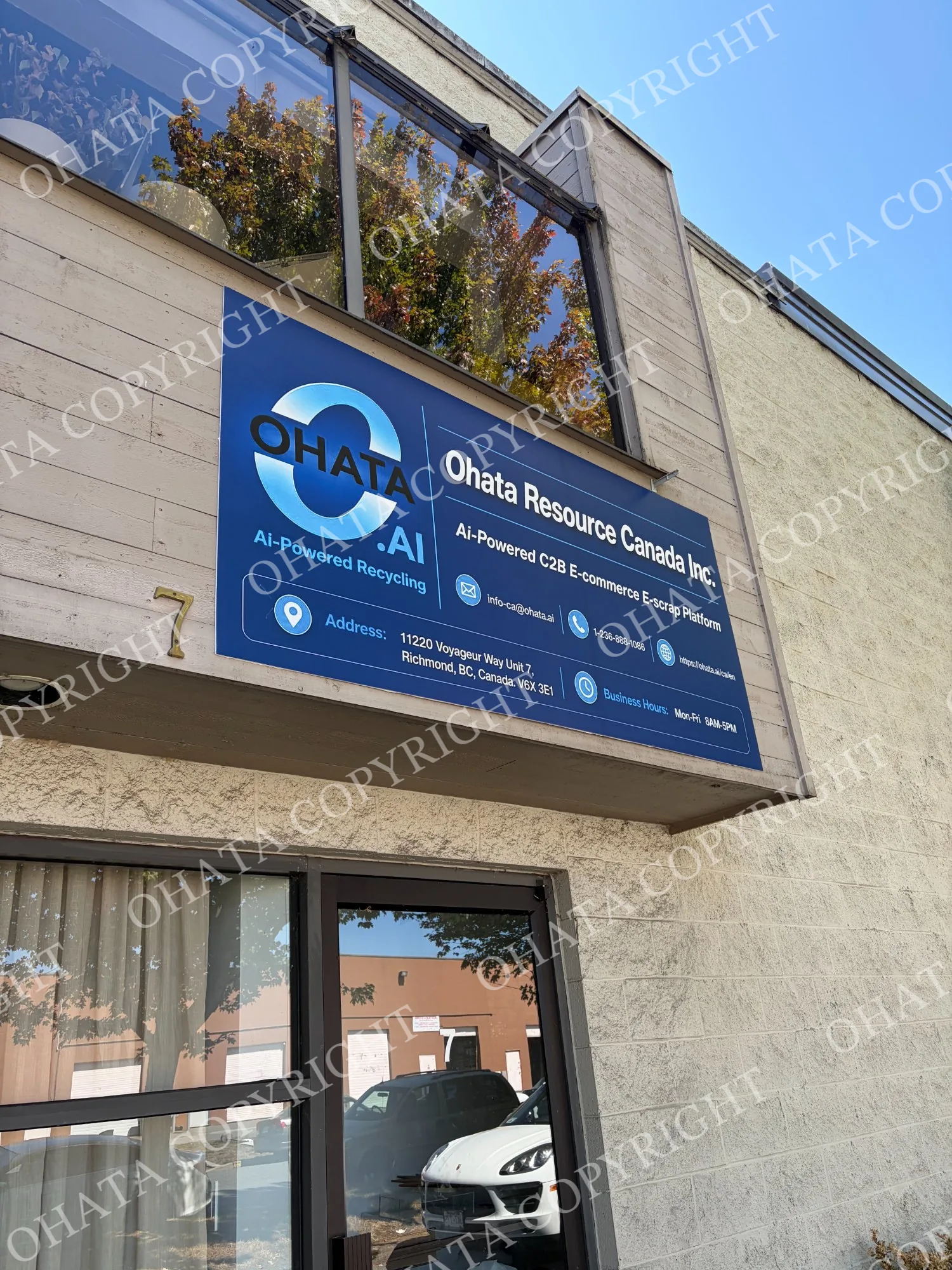
When you see this sign, continue around to the rear of the building.
2. Continue to the Rear Warehouse Entrance
Drive carefully around the building and look for the vertical Ohata sign beside the rear entrance. This vertical sign is the easiest landmark for finding our receiving warehouse.
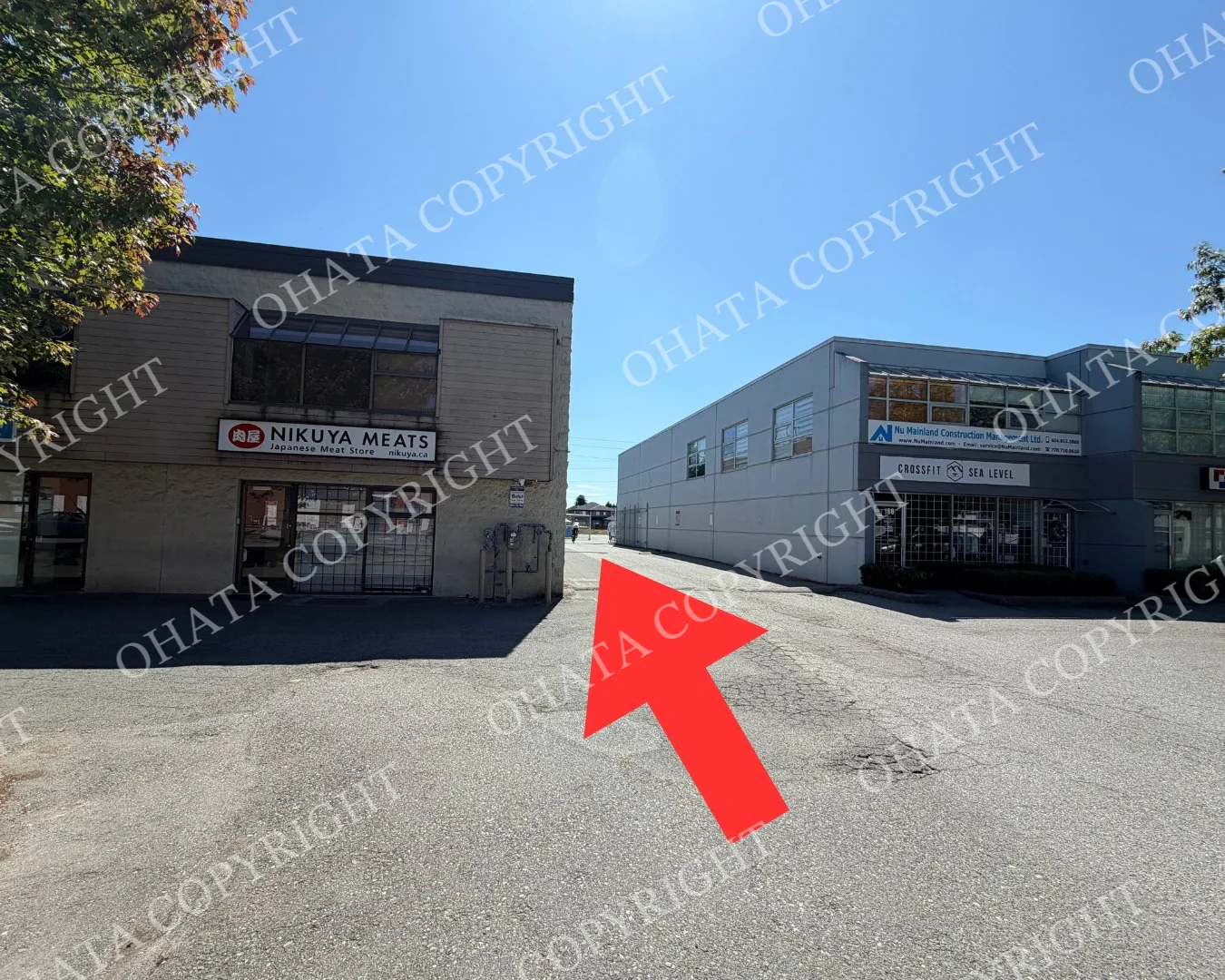
Follow the route around the building to reach the warehouse.
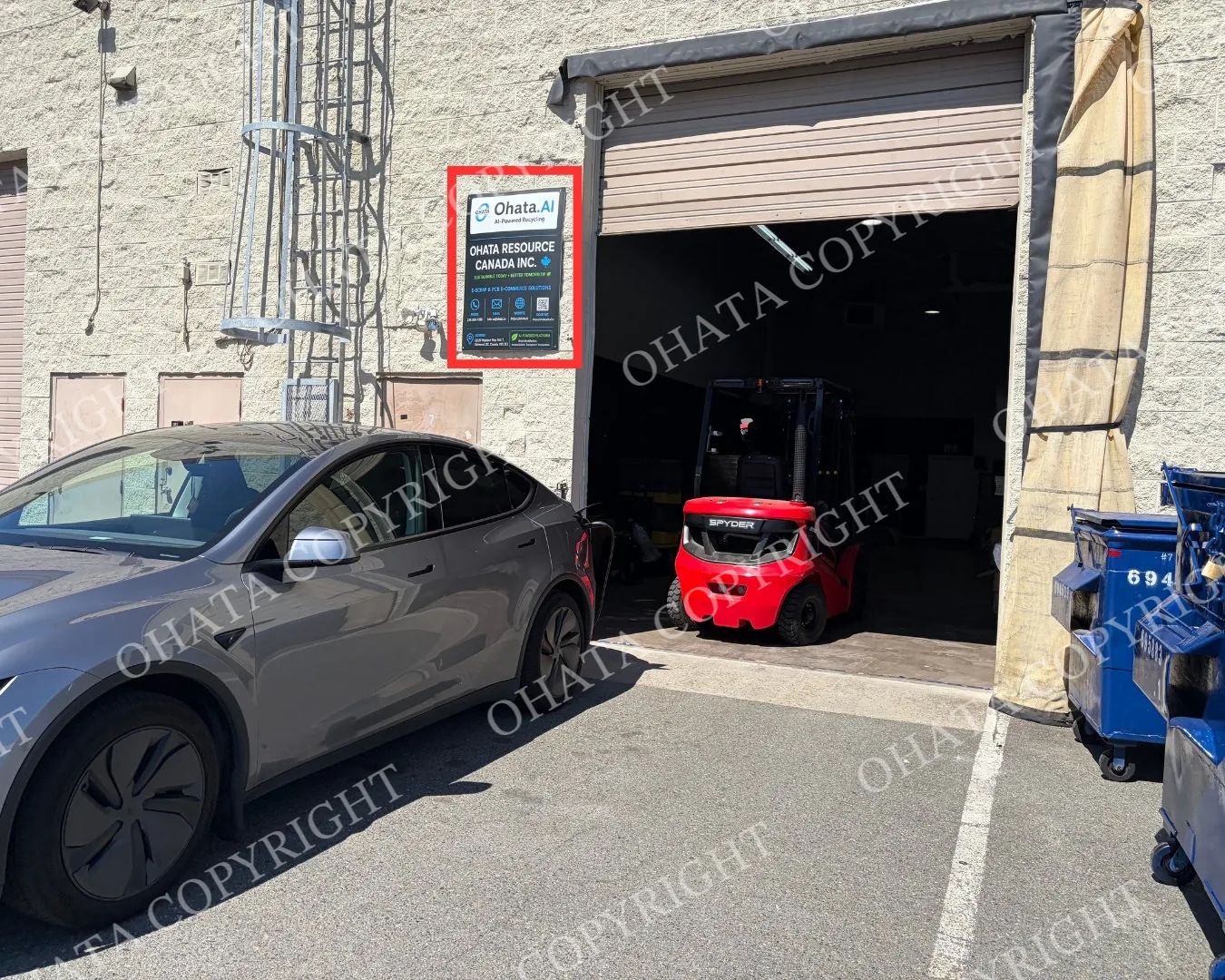
The vertical Ohata sign identifies the correct warehouse entrance.
3. Park Directly in Front of the Warehouse
If you arrive by car, you may park directly in front of the Ohata warehouse entrance while your e-scrap is being received.
Once you reach the warehouse, please park and wait there. A member of our team will come to assist you with your material.
If you have difficulty finding the rear entrance, please call or message us:
Telephone and WhatsApp: +1 (236) 888-1086
For large commercial loads or palletized shipments, please contact the Richmond team before visiting so we can prepare for unloading.
When you arrive:
Bring smaller quantities to the receiving area.
Ask a staff member for assistance with heavy or larger loads.
Our team will inspect, sort and weigh the material.
The applicable buying category and condition will be confirmed.
The final buying price will be determined after physical inspection.
Payment will be processed according to the current purchasing policy.
Walk-in customers are welcome during regular business hours. Most visits don’t require an appointment, but advance contact is recommended for commercial, palletized or unusually large loads.
You can review directions, parking and visitor information on the Richmond yard access page.
Helpful Tips Before Your Richmond Visit
Check the current Canadian buying prices before travelling.
Use Ohata.AI when you need help identifying an unfamiliar item.
Take clear front-and-back photographs before requesting an initial review.
Separate different board and equipment categories whenever practical.
Keep damaged, wet, burned, corroded or contaminated items separate.
Remove unrelated garbage and unnecessary packaging.
Don’t cut boards or remove major components unless you understand how the separated materials will be evaluated.
Back up and erase data-bearing devices according to your requirements.
Bring valid government-issued photo identification.
Contact Ohata Resource Canada Inc. before bringing a large commercial or palletized load.
Published online prices are references and may change. Final acceptance, classification, measured weight and buying price are determined after physical inspection.
常见问题
- 1. What is today’s price for CPU SSS Grade ( Gold Cap ceramic CPU) buying?
- As of Oct 26,2026, Ohata Resource Canada Inc., (Richmond, BC, Canada) is purchasing CPU SSS Grade ( Gold Cap ceramic CPU) buying at 367.50 (CAD/lb). We provide competitive scrap prices in Delta, Surrey, Richmond, and across the Greater Vancouver area.
- 2. What is an Ohata CPU SSS Grade processor?
- An Ohata CPU SSS Grade processor is a high-value CPU scrap category featuring a ceramic package, an original gold-colored cap, and gold-plated pins. This is the highest CPU grade in the Ohata classification system. Typical examples include certain Intel 386 and 486 processors, as well as selected vintage military, aerospace, industrial, and telecommunications processors.
- 3. Does every Intel 386 or 486 processor qualify as CPU SSS Grade?
- No. A processor model or generation alone does not determine its recycling grade. To qualify as CPU SSS, the actual CPU must have the required combination of a ceramic package, an original gold cap, and gold-plated pins. A 386 or 486 processor without a gold cap may be classified as CPU SS or another applicable grade.
- 4. What is the main difference between CPU SSS and CPU SS Grade?
- The main difference is the gold cap. CPU SSS processors have a ceramic package, gold-plated pins, and an original gold-colored cap. CPU SS processors also have ceramic packages and gold-plated pins, but they do not have the qualifying gold cap. This distinction is important because the two categories are purchased and priced separately.
- 5. Are gold-plated pins alone enough for CPU SSS classification?
- No. Gold-plated pins alone do not qualify a processor for CPU SSS Grade. Many CPU S processors, including certain Athlon, Opteron, Socket 370, and Socket 478 processors, also have gold-plated pins. A CPU SSS processor must additionally have a ceramic package and an original gold cap.
- 6. Can bent or missing pins reduce the value of a CPU SSS processor?
- Yes. A small number of slightly bent pins may be acceptable if the CPU remains complete and identifiable. However, large numbers of missing, broken, crushed, corroded, or solder-covered pins can reduce the recovery value. Severe pin damage may result in separate evaluation or classification as CPU F damaged scrap.
- 7. What is an e-commerce scrap business model?
- Our web portal, Ohata.ai, operates an inbound digital marketplace where userssell end-of-life electronics to us online rather than buying goods.
- 8. How should CPU SSS processors be prepared for sale?
- Keep the processors complete, dry, clean, and separated from other CPU grades. Do not remove the gold caps, scrape the plated surfaces, cut the ceramic packages, burn the processors, or use chemicals to extract metals. Remove unrelated heatsinks, sockets, steel parts, plastic waste, and other non-CPU material whenever this can be done safely without damaging the processors. Final pricing is determined after physical inspection, grade confirmation, and net-weight verification.
- 9. What specific types of computers do you buy online?
- Our portal accepts entries for enterprise servers, corporate workstations, desktop PCs, and laptops of all generations.
- 10. Where are your physical Canadian logistics operations based?
- Our main Canadian operational hub is strategically located in Richmond, British Columbia, managing regional logistics and tech-driven processing.
- 11. Are there any hidden transaction fees deducted from my digital payout?
- No, Ohata.ai does not deduct any transaction or processing fees for Interac e-Transfer or direct deposit payments.
- 12. Can corporate clients get documentation for environmental compliance audits?
- Yes, our digital portal can generate formal data destruction reports and material recovery receipts for your corporate sustainability compliance records.
相关项目
UP↑
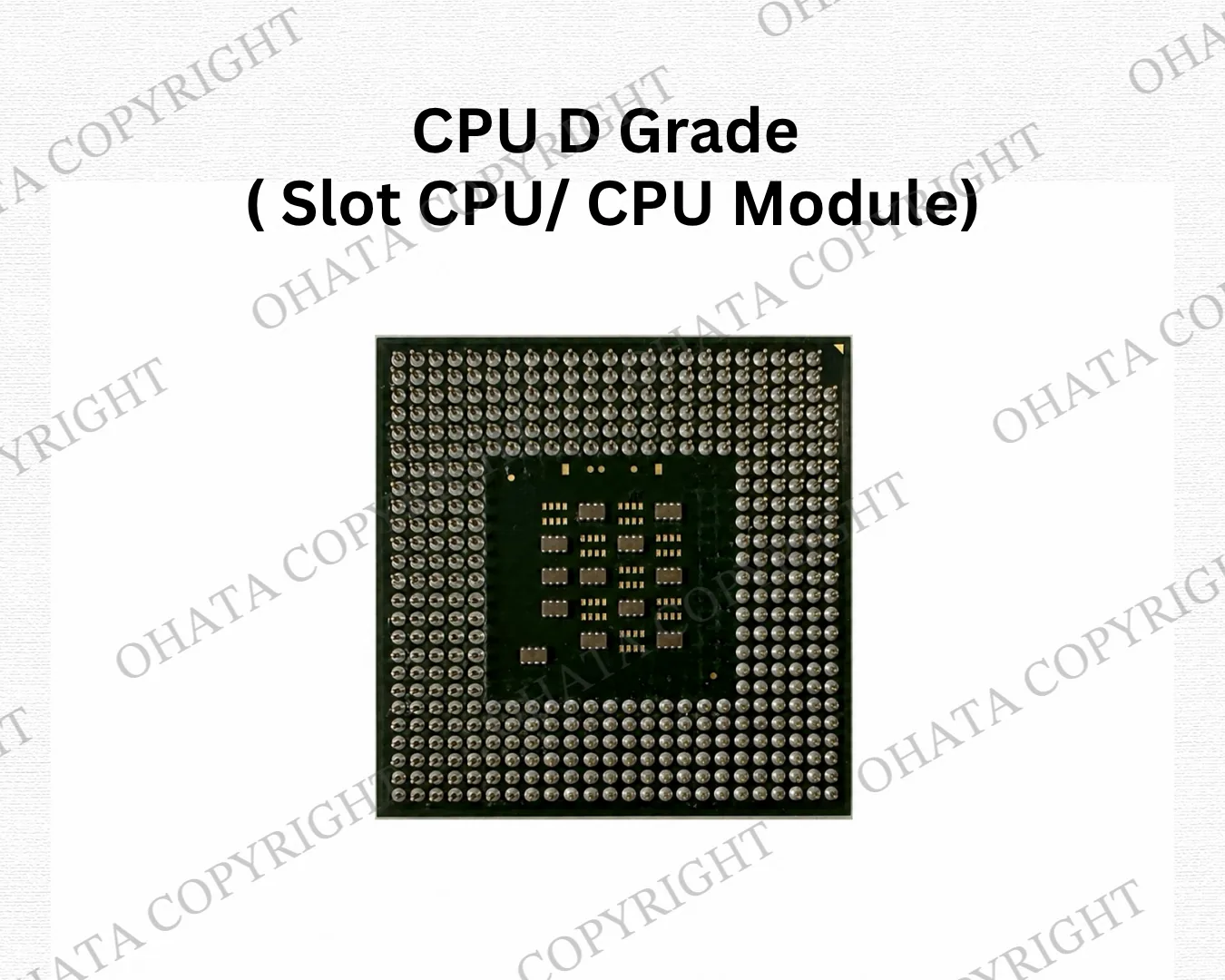
CPU D Grade (Slot CPU/ CPU Module) Buying
9.98
CAD / lb
UP↑
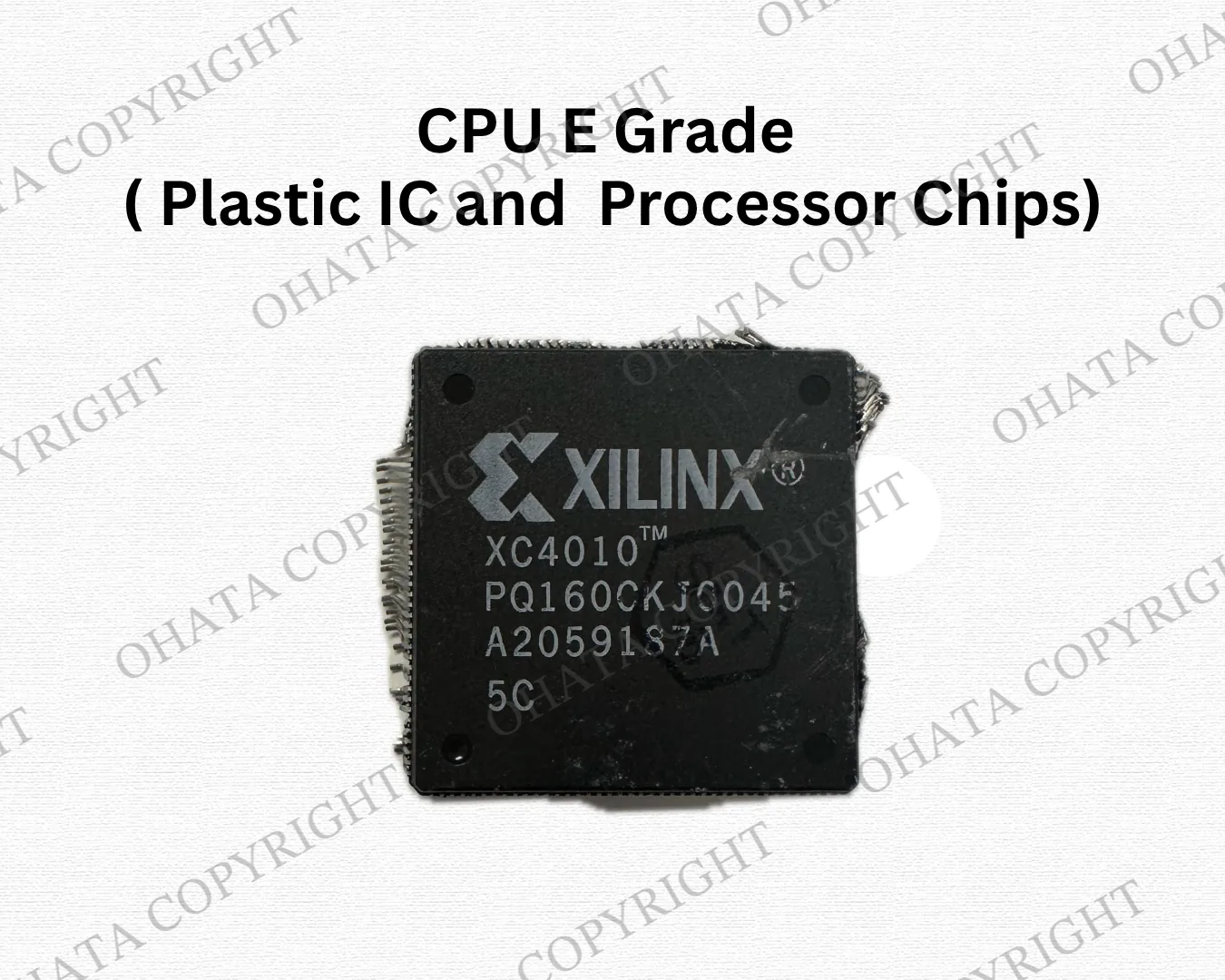
CPU E Grade (Plastic IC and Processor Chips) Buying
1.68
CAD / lb
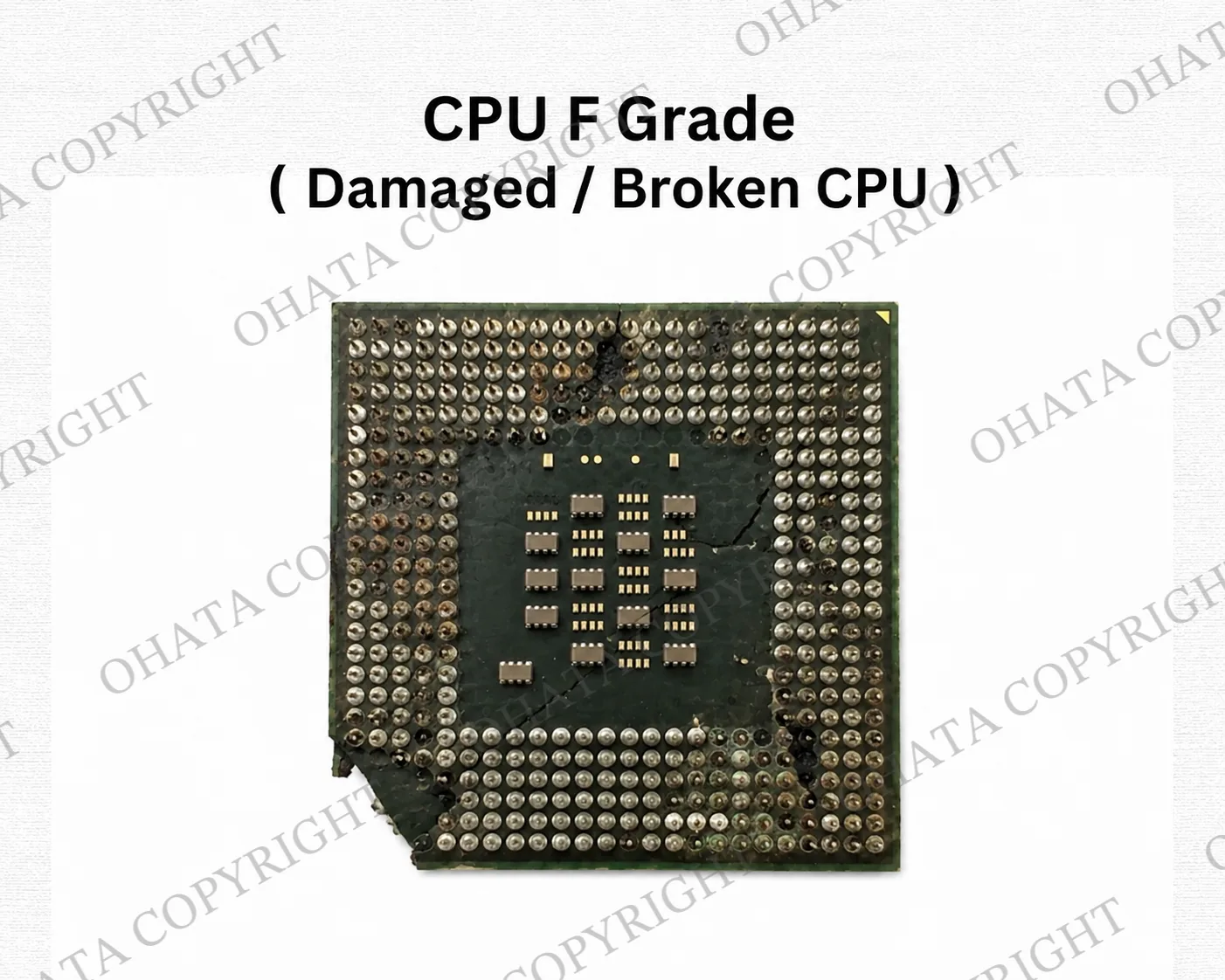
CPU F Grade (Damaged,Dirty and Mix CPU) Buying
0.60
CAD / lb
UP↑
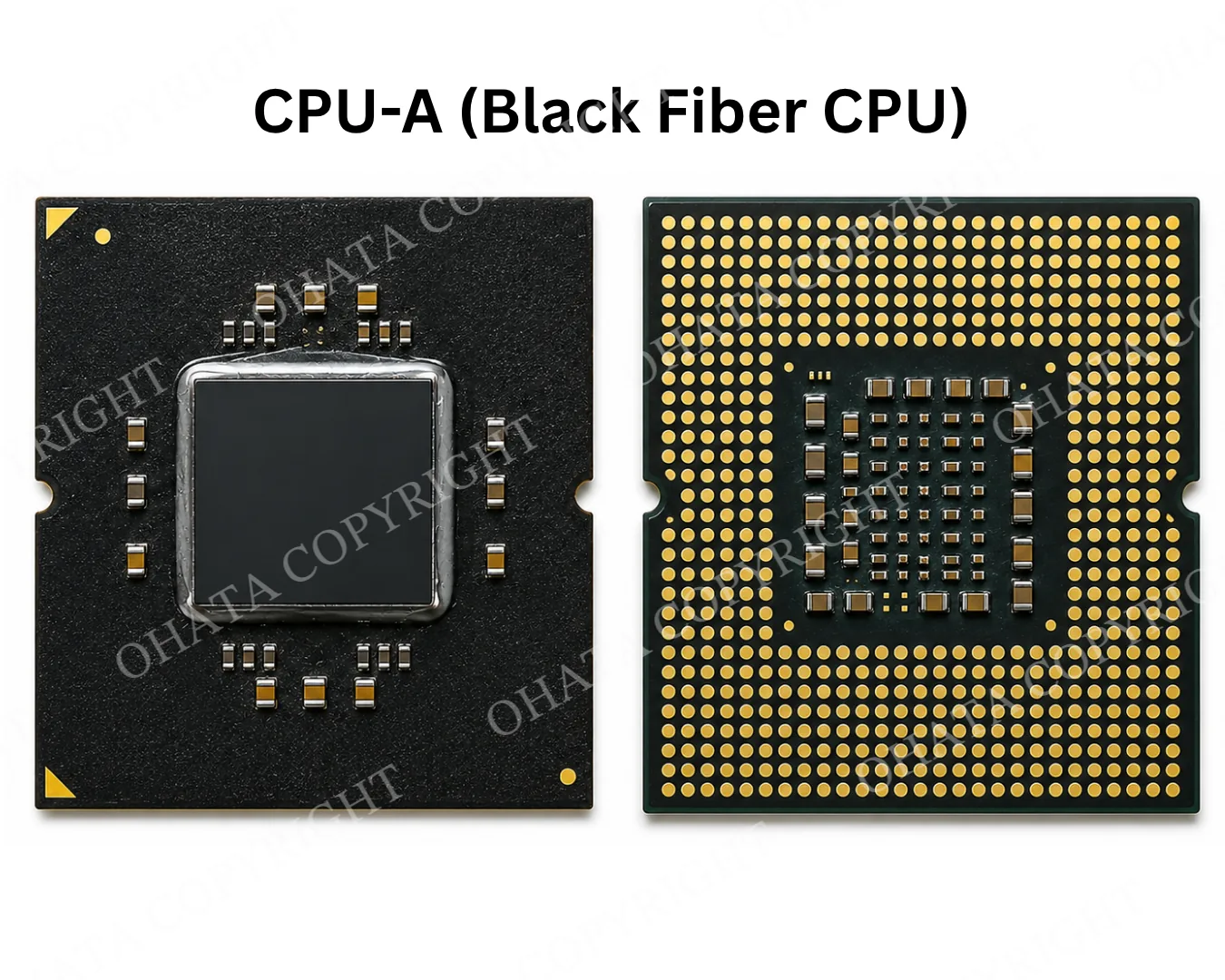
CPU A Grade (Black Fiber CPU) Buying
84.00
CAD / lb
UP↑
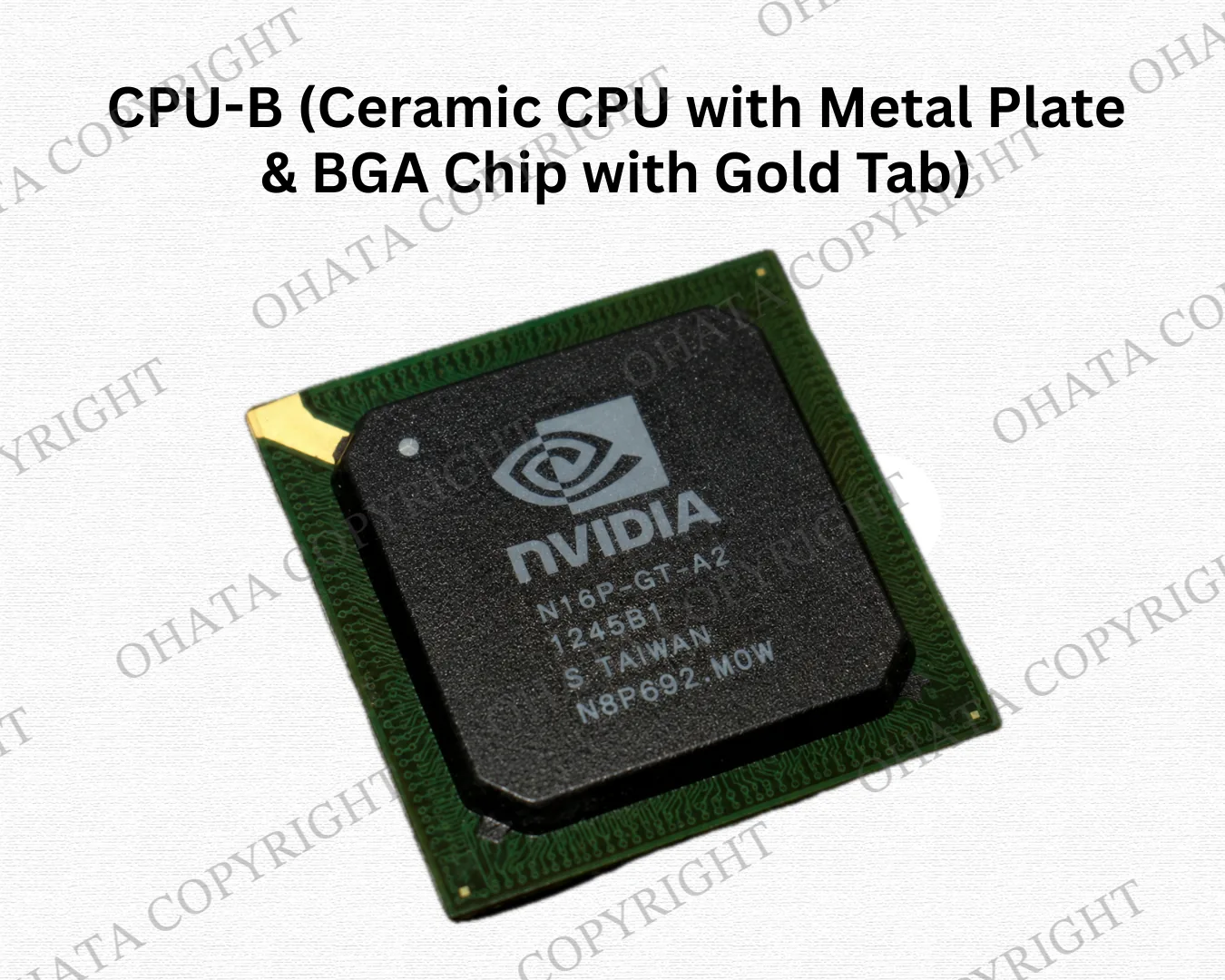
CPU B Grade ( BGA CPU and IC chips) Buying
54.60
CAD / lb
UP↑
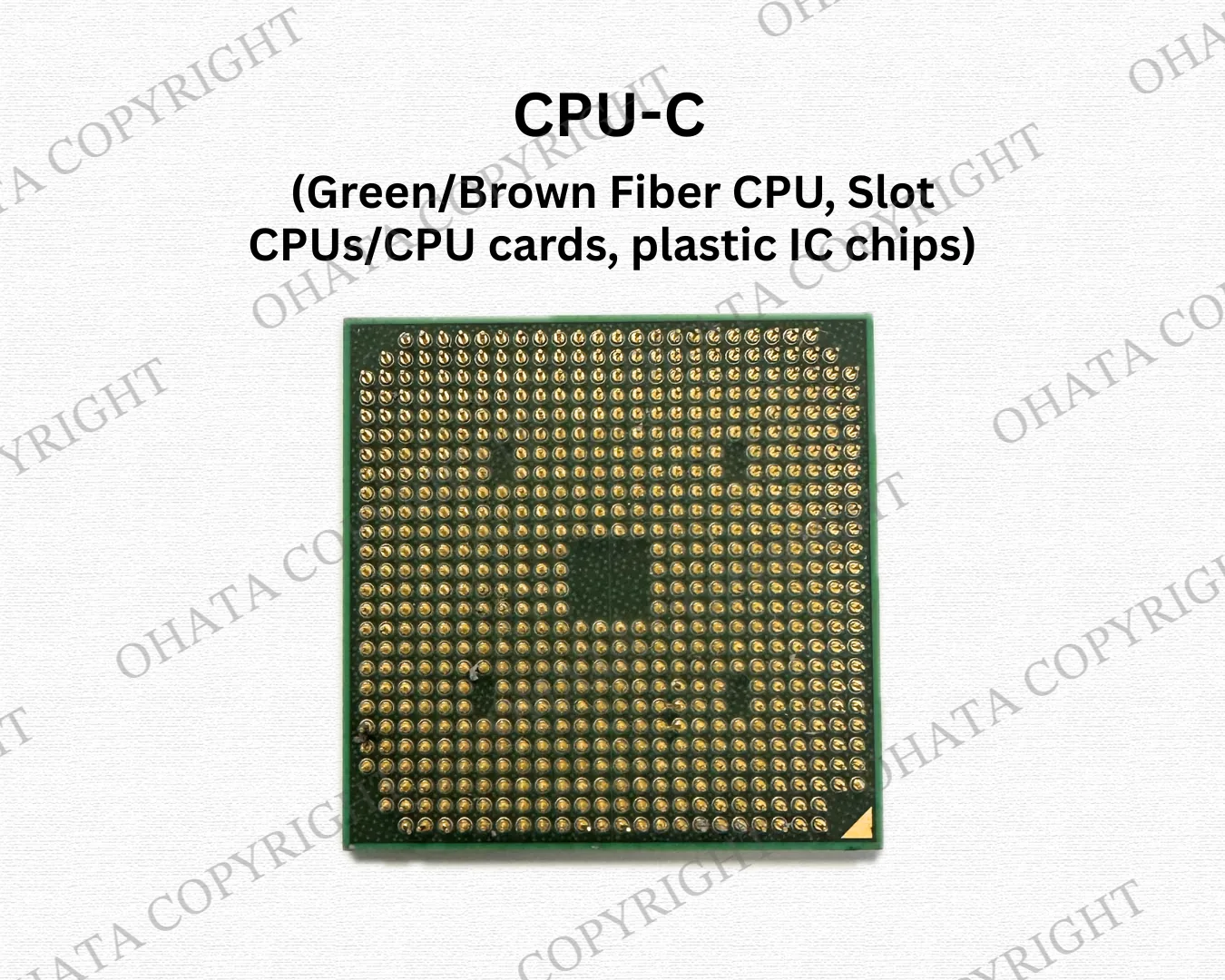
CPU C Grade (Green / Brown Fiber CPU) Buying
23.00
CAD / lb
UP↑
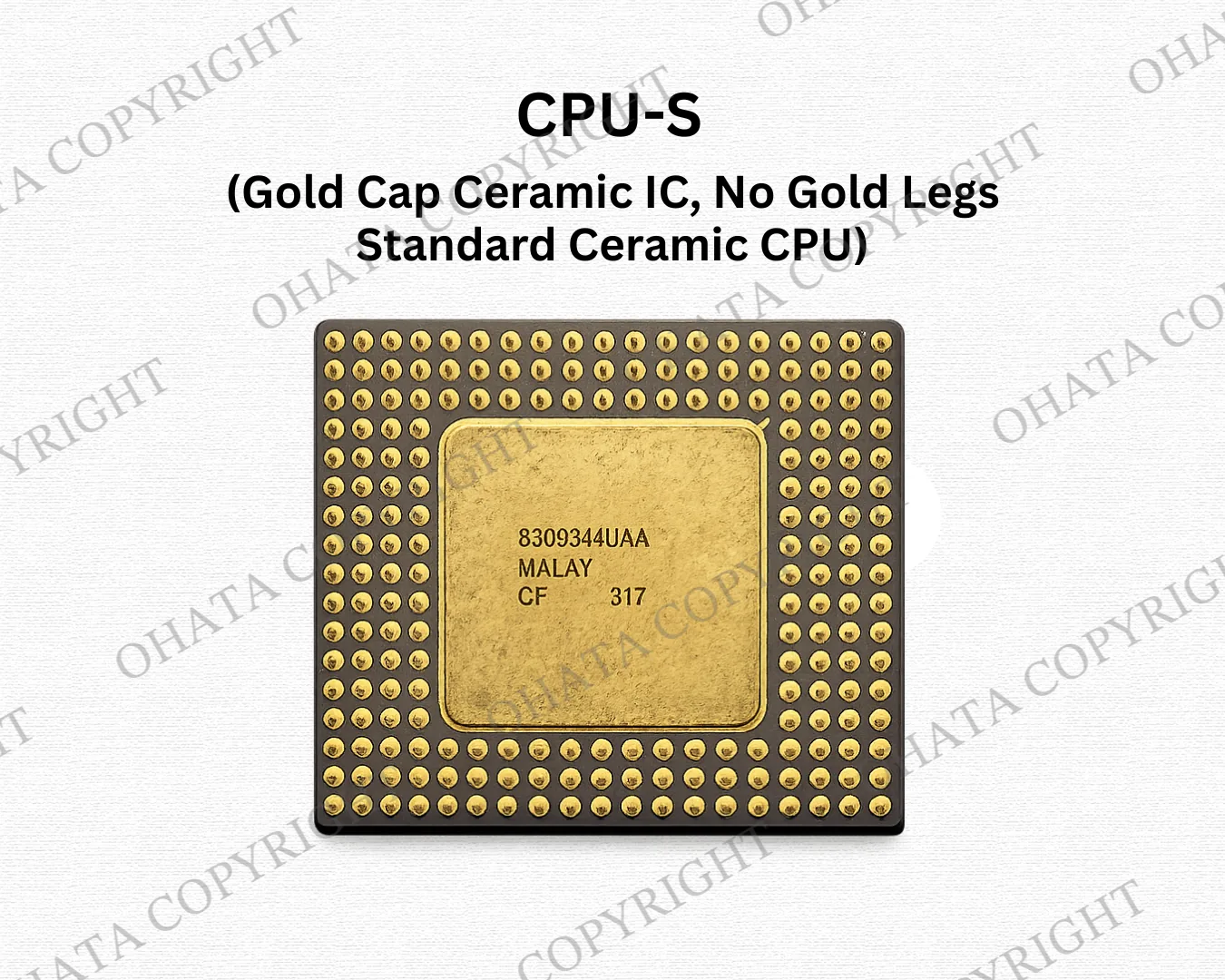
CPU S Grade (Gold Cap Ceramic CPU) Buying
110.25
CAD / lb
UP↑
CPU SS Grade (Double-Side Gold CPU) Buying
199.50
CAD / lb