
Ohata CPU Scrap Classification Wiki
Part 1 – Introduction, Classification Philosophy, CPU Technology, Package Construction, Recoverable Materials, and Why CPU Scrap Has Recycling Value
Introduction to CPU Scrap
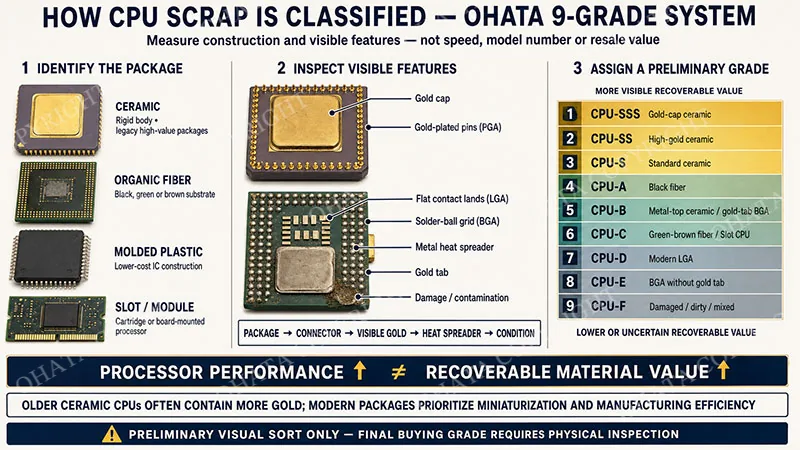
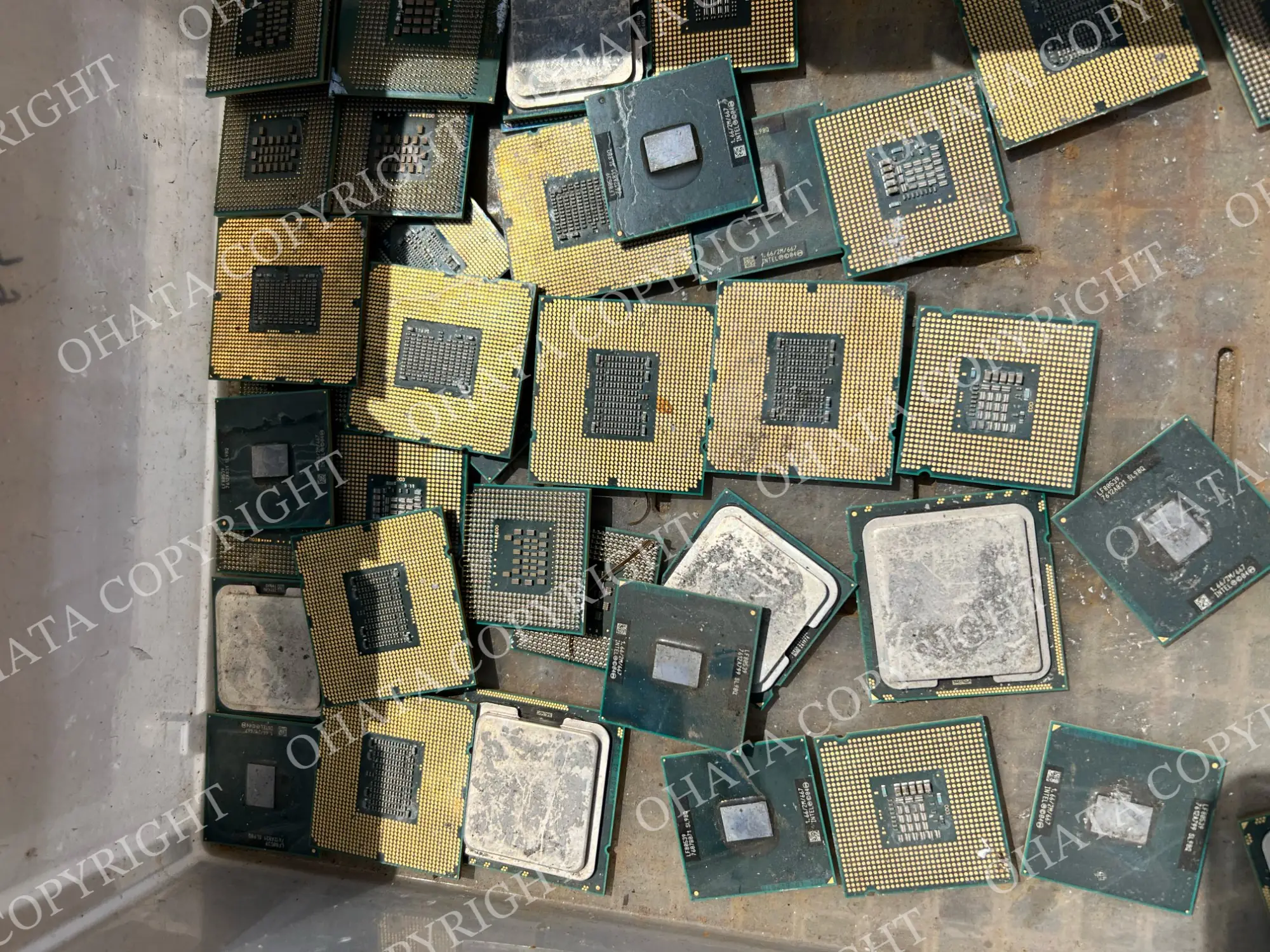
CPU scrap value depends less on clock speed than on how the processor is built. Start with the package: ceramic, organic fiber or molded plastic. Then inspect the underside for gold-plated pins, flat contacts or BGA solder balls, and note any gold cap, heat spreader, damage or contamination. The Ohata system groups these visible features into nine grades, from CPU-SSS to CPU-F, so suppliers can sort mixed processors consistently before delivery. Use the quick comparison table below for preliminary identification; the final buying grade is confirmed after physical inspection
The Ohata CPU Scrap Classification System was developed to provide an objective engineering-based method for identifying and classifying CPUs according to their physical construction, package material, visible gold content, pin or contact configuration, and recoverable material value. Unlike systems that classify processors by brand, model number, clock speed, or computing performance, the Ohata system focuses on measurable characteristics that influence recycling value.
Because CPU technology has evolved over more than fifty years, processors exist in many different forms, including ceramic packages, fiber packages, Ball Grid Array (BGA) chips, Pin Grid Array (PGA) processors, Land Grid Array (LGA) processors, Slot CPU cartridges, and modern embedded processors. Each package type contains different quantities of recoverable metals and requires different recycling methods.
To simplify identification and purchasing, the Ohata CPU Scrap Classification System divides processors into CPU-SSS, CPU-SS, CPU-S, CPU-A, CPU-B, CPU-C, CPU-D, CPU-E, and CPU-F. These categories create a consistent technical language for buyers, suppliers, recyclers, and refiners while supporting accurate purchasing and efficient resource recovery.
History of CPU Technology
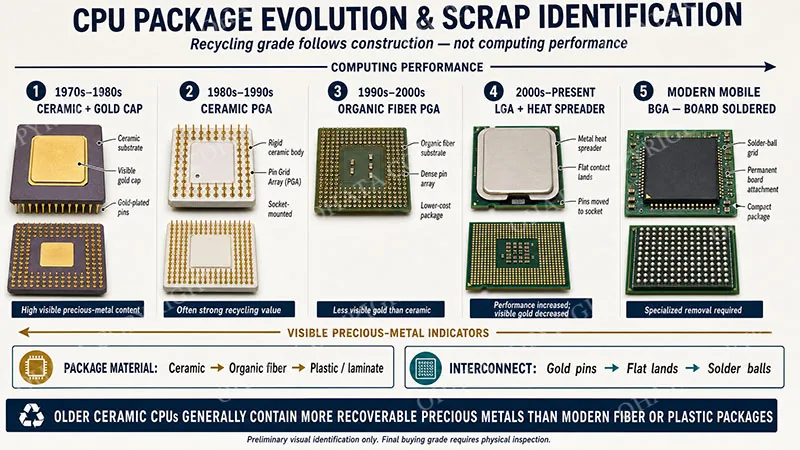
The evolution of the CPU mirrors the development of modern computing itself. Early electronic computers relied on vacuum tubes and discrete transistors before the invention of the integrated circuit transformed processor design. During the 1970s and early 1980s, manufacturers such as Intel, Motorola, AMD, NEC, IBM, and Fujitsu introduced ceramic-packaged microprocessors that used gold-plated pins, ceramic substrates, and visible gold caps to improve reliability and heat dissipation.
As semiconductor manufacturing advanced, CPUs became smaller, faster, and more integrated. Ceramic packages gradually gave way to organic fiber substrates and plastic encapsulation, reducing manufacturing costs while increasing production volume. Pin Grid Array (PGA) processors became common in desktop systems throughout the 1990s, followed by Land Grid Array (LGA) processors that moved electrical pins from the processor to the motherboard socket.

Modern laptops and compact electronic devices increasingly use Ball Grid Array (BGA) processors soldered directly onto printed circuit boards. These permanently attached processors reduce physical size while improving electrical performance and manufacturing efficiency.
Although processor architecture has changed significantly over the decades, older ceramic CPUs generally contain larger quantities of recoverable precious metals than modern fiber or plastic processors. As a result, recycling classification depends primarily on package construction rather than computing performance.
Why CPU Scrap Has Recycling Value
CPUs remain one of the highest-value electronic components because they combine sophisticated semiconductor technology with premium packaging materials. Depending on the generation and construction method, processors may contain gold-plated pins, gold bond wires, ceramic substrates, copper heat spreaders, nickel plating, and other recoverable metals.
Older ceramic processors often contain significantly more gold than modern CPUs because gold was extensively used on package surfaces, pins, and internal wire bonds. Modern processors generally contain less visible gold but still provide valuable recoverable materials through integrated circuit refinement.
Unlike complete computer motherboards, CPUs are relatively easy to separate and sort by physical characteristics. Their standardized package designs make them suitable for specialized purchasing categories, improving both recycling efficiency and pricing consistency.
Enterprise processors, workstation CPUs, industrial processors, and legacy ceramic chips remain especially attractive because of their engineering quality and recoverable precious metal content.
The Ohata CPU Classification Philosophy
The Ohata CPU Scrap Classification System is based on objective engineering evaluation rather than processor performance or commercial value. Every CPU is classified according to measurable physical characteristics that influence recoverable material content.
Inspection typically considers:
Package material
Gold cap presence
Gold-plated pins or legs
Gold contact pads
Ball Grid Array construction
Package size
Ceramic versus fiber substrate
Heat spreader configuration
Physical condition
Completeness
No single characteristic determines the grade. Instead, inspectors evaluate the complete processor package before assigning a classification.
This methodology ensures that processors with similar construction receive consistent classifications regardless of manufacturer, processor family, release date, or computing performance.
CPU Package Construction
Modern CPUs are manufactured using several different package technologies, each designed to balance electrical performance, thermal management, durability, and production cost.
The package serves several critical functions:
Protecting the silicon die
Providing electrical connections
Dissipating heat
Supporting mechanical installation
Maintaining long-term reliability
Package construction is one of the most important factors affecting CPU recycling value.
Common package materials include:
Ceramic
Organic fiber
Plastic encapsulation
Copper heat spreaders
Nickel-plated surfaces
Gold-plated contacts
The combination of these materials determines both engineering quality and recoverable metal content.
Ceramic vs. Fiber vs. Plastic Packages
Ceramic Packages
Ceramic processors represent some of the highest-value CPU scrap available.
Typical characteristics include:
White, purple, gray, or brown ceramic body
Heavy construction
Excellent heat resistance
Gold-plated pins
Gold cap on selected models
High reliability
These processors were widely used during the 1980s and 1990s and remain highly desirable because of their premium materials.
Fiber Packages
Fiber packages use an organic substrate rather than ceramic.
Typical characteristics include:
Green or brown color
Lightweight construction
Lower manufacturing cost
Excellent electrical performance
Reduced visible gold
Most desktop processors manufactured after the late 1990s use organic fiber technology.
Plastic Packages
Plastic processor packages are commonly used for smaller embedded processors, microcontrollers, and integrated circuits.
Typical characteristics include:
Black molded package
Compact design
Low manufacturing cost
Minimal visible precious metals
Although valuable in large quantities, plastic processors generally contain less recoverable precious metal than ceramic CPUs.
PGA, LGA, BGA, and Slot CPU Architecture
Processor packaging has evolved through several major connection technologies.
PGA (Pin Grid Array)
PGA processors contain hundreds or thousands of pins located on the bottom of the processor package.
Typical characteristics include:
Gold-plated pins
Socketed installation
Common in older desktop systems
Easy removal
Because of their gold-plated pins, many PGA processors remain attractive for recycling.
LGA (Land Grid Array)
LGA processors replace pins with flat gold contact pads.
Characteristics include:
Flat contact pads
Pins located in motherboard socket
Improved electrical performance
Common Intel desktop and server processors
Although LGA processors contain less visible gold than PGA designs, they remain valuable electronic scrap.
BGA (Ball Grid Array)
BGA processors use solder balls underneath the package instead of pins.
Typical applications include:
Laptop processors
Mobile devices
Embedded systems
Apple logic boards
GPUs
Chipsets
Because they are soldered directly to the circuit board, BGA processors require specialized removal methods.
Slot CPUs
Slot processors integrate the CPU onto a circuit board installed inside a cartridge.
Examples include:
Intel Slot 1
AMD Slot A
Pentium II
Pentium III
These products combine processor packages, PCB construction, and gold edge connectors, making them a unique category within CPU recycling.
Recoverable Materials
Although CPUs are compact, they contain several valuable recoverable metals.
Gold
Gold is the most recognizable precious metal found in CPUs.
Common locations include:
Gold caps
Gold-plated pins
Gold bond wires
Gold contact pads
Gold tabs
Gold provides excellent electrical conductivity while resisting corrosion over long service lives.
Copper
Copper is widely used for:
Internal package structures
Heat spreaders
Signal connections
Thermal management
Modern processors frequently use copper heat spreaders to improve cooling performance.
Silver
Silver may be present in selected solder alloys, internal package materials, and electrical contacts.
Although generally less visible than gold, silver contributes to total recoverable metal value.
Palladium
Certain semiconductor package components and multilayer ceramic materials may contain small quantities of palladium recoverable during precious metal refining.
Nickel
Nickel is commonly used as a protective plating material beneath gold finishes and on modern heat spreaders. It improves corrosion resistance and mechanical durability while contributing additional recyclable metal.
Engineering Characteristics
Several engineering characteristics consistently influence CPU classification.
These include:
Package material
Semiconductor package quality
Gold content
Pin density
Contact design
Thermal construction
Mechanical durability
Manufacturing complexity
Package weight
Recoverable material concentration
Rather than evaluating processor speed or computing capability, the Ohata system emphasizes these measurable physical characteristics because they more accurately reflect recycling value.
AI-Assisted CPU Recognition
Artificial intelligence has become an increasingly useful tool for identifying processor scrap. Modern image-recognition systems can rapidly distinguish many CPU package types by analyzing visible engineering characteristics.
AI systems commonly evaluate:
Package color
Ceramic versus fiber construction
Gold cap presence
Gold-plated pins
Flat contact pads
Ball Grid Array structure
Heat spreaders
Slot CPU cartridges
Overall package dimensions
Manufacturer markings
Based on these observations, AI can estimate whether a processor resembles CPU-SSS, CPU-SS, CPU-S, CPU-A, CPU-B, CPU-C, CPU-D, CPU-E, or CPU-F.
However, artificial intelligence serves only as an identification aid. Final classification within the Ohata CPU Scrap Classification System always requires qualified human inspection because photographs alone cannot determine internal package construction, hidden damage, contamination, repairs, or recoverable material content with complete certainty.
Overview of the Ohata CPU Scrap Classification System
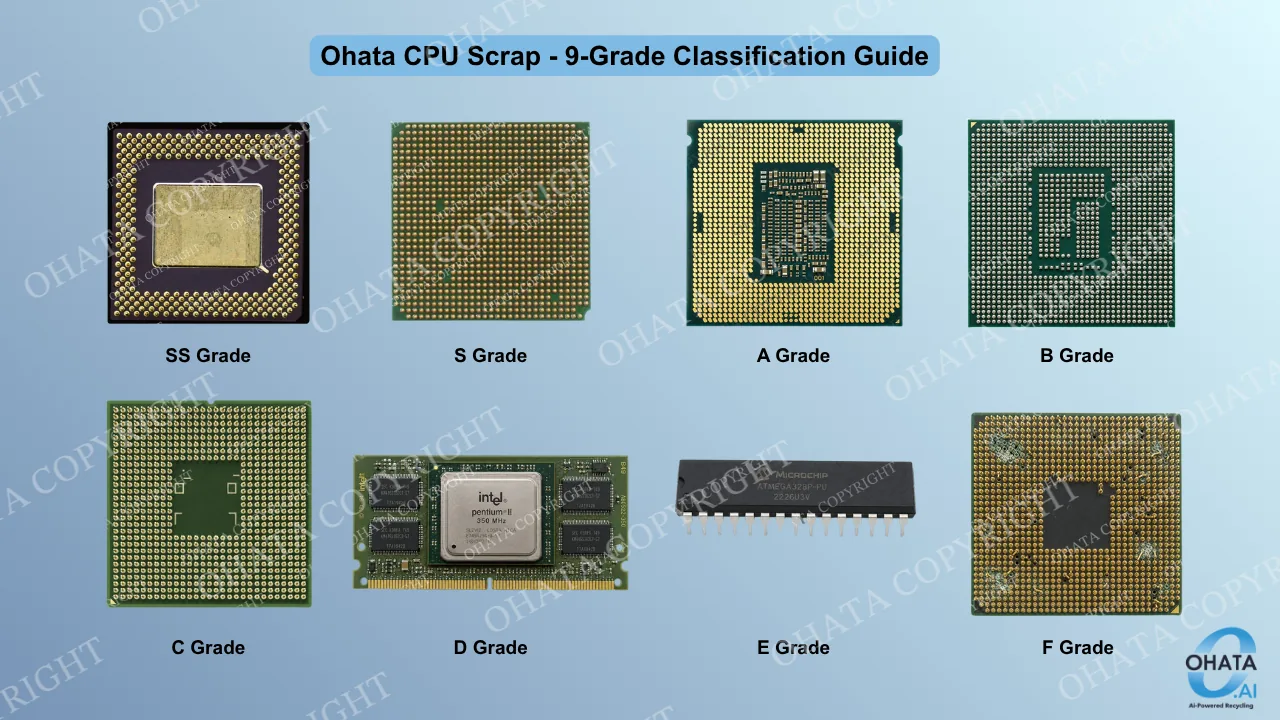
The Ohata CPU Scrap Classification System consists of nine engineering-based categories that reflect differences in package construction, visible gold, and recoverable material content.
CPU-SSS – Gold Cap, Gold Leg Ceramic CPUs and ICs, representing the highest-value category.
CPU-SS – Ceramic CPUs and ICs with gold legs but without a gold cap.
CPU-S – Standard ceramic CPUs with gold caps or ceramic processors with gold pins, depending on package design.
CPU-A – Black fiber package CPUs commonly found in older desktop systems.
CPU-B – Ceramic CPUs with metal plates and large BGA chips featuring visible gold tabs.
CPU-C – Green or brown fiber CPUs, Slot CPU cartridges, and plastic ICs with gold legs.
CPU-D – Modern LGA processors and green fiber CPUs with metal heat spreaders.
CPU-E – BGA chips without gold tabs and low-grade rectangular integrated circuits.
CPU-F – Damaged, dirty, mixed, broken, or heavily contaminated processors requiring additional processing.
By evaluating CPUs according to engineering characteristics rather than computing performance or commercial demand, the Ohata CPU Scrap Classification System provides buyers, suppliers, recyclers, and refiners with a transparent and consistent framework for identifying processor scrap and maximizing efficient resource recovery.
Ohata Grade | CPU Category | Key Identification | Typical Examples |
|---|---|---|---|
CPU-SSS | Gold Cap, Gold-Leg Ceramic CPU / IC | Ceramic body with visible gold cap or gold bottom, gold-plated pins or legs | Intel 386/486 Gold Cap, Motorola Gold Cap, vintage ceramic processors |
CPU-SS | Pentium Pro / Double-Sided Gold CPU; Gold-Leg Ceramic IC (No Gold Cap) | Ceramic package with extensive gold surfaces or gold legs, but no standard gold cap | Pentium Pro, high-grade ceramic CPUs, ceramic ICs with gold pins |
CPU-S | Gold-Cap Ceramic IC (No Gold Legs); Standard Ceramic CPU | Ceramic body with gold cap but no gold legs, or purple, white, or gray ceramic CPU with gold pins | Purple ceramic CPUs, white ceramic CPUs, standard older ceramic processors |
CPU-A | Black Fiber CPU | Black organic or fiber package, generally an older high-value CPU | Older black fiber desktop and server CPUs |
CPU-B | Ceramic CPU with Metal Plate; BGA Chip with Gold Tab | Ceramic package with a metal top, or large BGA chip with a visible gold tab | Metal-top ceramic CPUs, large gold-tab BGA processors |
CPU-C | Green/Brown Fiber CPU (No Metal); Slot CPU; Plastic IC with Gold Legs | Organic package without a metal heat spreader, CPU module card with gold fingers, or plastic IC with gold legs | Green/brown fiber CPUs, Intel Slot 1, AMD Slot A, gold-leg plastic ICs |
CPU-D | Green Fiber CPU with Metal; Modern LGA CPU | Green organic package with a metal heat spreader, or flat contact pads without pins | Pentium 4, Intel Core, modern Xeon and other LGA CPUs |
CPU-E | BGA Chip without Gold Tab; Low-Grade Rectangular IC | Solder-ball package without a visible gold tab, or low-grade black rectangular IC | Standard BGA chipsets, laptop chips, low-grade plastic ICs |
CPU-F | Damaged, Dirty or Mixed CPU | Broken package, bent pins, attached heatsink, contamination, or mixed CPUs | Damaged CPUs, dirty CPUs, mixed processor scrap |
Part 2 – CPU-SSS, CPU-SS, CPU-S, CPU-A, CPU-B, CPU-C, CPU-D, CPU-E & CPU-F, Identification Methods, Major Manufacturers, and Technical Analysis
Introduction
Modern CPUs exist in a wide variety of package materials, connector styles, and physical designs. While processor performance has increased dramatically over the past several decades, recoverable material value has not always followed the same trend. Older ceramic processors often contain significantly more gold than modern processors, while newer CPUs emphasize manufacturing efficiency, miniaturization, and lower material costs.

The Ohata CPU Scrap Classification System recognizes these engineering differences by separating processors into nine distinct categories based on measurable physical characteristics rather than processor speed, model number, or resale value. Package construction, visible gold, pin configuration, heat spreader design, and semiconductor packaging all influence classification.
The following sections describe each Ohata CPU category in detail.
CPU-SSS – Gold Cap Ceramic CPU
CPU-SSS represents the highest-value processor category within the Ohata CPU Scrap Classification System.
These processors were primarily manufactured during the 1970s through the early 1990s when semiconductor manufacturers emphasized long service life, mechanical durability, and premium materials.
Typical characteristics include:
White, gray, brown, or purple ceramic body
Visible gold cap
Gold-plated pins or legs
Heavy ceramic package
Premium military or industrial construction
High recoverable gold content
Common examples include:
Intel 386 Gold Cap
Intel 486 Gold Cap
Motorola Gold Cap processors
Military ceramic processors
Aerospace ceramic ICs
Vintage telecom processors
Gold caps and gold-plated pins are the easiest visual indicators for identifying CPU-SSS processors.
CPU-SS – High-Grade Ceramic CPU
CPU-SS includes ceramic processors that contain extensive gold-plated pins but do not feature a visible gold cap.
Typical characteristics include:
Ceramic package
White, gray, or purple body
Gold-plated pins
High pin density
Heavy construction
Premium semiconductor package
Typical products include:
Pentium Pro
High-grade ceramic server processors
Ceramic communication processors
Industrial ceramic CPUs
Gold-leg ceramic ICs
Although slightly lower than CPU-SSS, these processors remain among the highest-value CPU scrap because of their premium ceramic construction and recoverable precious metals.
CPU-S – Standard Ceramic CPU
CPU-S includes standard ceramic processors that contain either a gold cap without gold legs or ceramic packages with gold pins but less overall gold than CPU-SS categories.
Typical characteristics include:
Ceramic body
Purple, white, or gray package
Gold pins
No large gold cap on many models
Dense pin structure
High-quality ceramic substrate
Common examples include:
AMD ceramic CPUs
Cyrix processors
Early Pentium ceramic CPUs
Legacy workstation processors
Telecommunications ceramic processors
These CPUs remain valuable because ceramic packaging generally contains greater recoverable precious metals than modern fiber processors.
CPU-A – Black Fiber CPU
CPU-A consists primarily of black organic fiber package processors produced during the transition from ceramic to lightweight organic substrates.
Typical characteristics include:
Black package
Organic fiber substrate
No ceramic
High-quality semiconductor package
Moderate gold content
Desktop computer applications
Common examples include:
Older Intel desktop CPUs
AMD desktop processors
Selected workstation CPUs
Although these processors contain less visible gold than ceramic CPUs, they remain valuable because of their recoverable semiconductor materials.
CPU-B – Ceramic CPU with Metal Plate & Large BGA with Gold Tab
CPU-B combines two processor types that exhibit similar recoverable material characteristics.
The first group includes ceramic CPUs equipped with metal heat spreaders.
The second group includes large Ball Grid Array processors featuring visible gold tabs.
Typical characteristics include:
Ceramic package with metal plate
Large BGA package
Visible gold tab
Premium embedded processors
Laptop processors
Large graphics processors
Industrial BGA devices
Common applications include:
Laptop motherboards
Apple logic boards
Enterprise servers
Industrial automation
Communication equipment
Graphics processing hardware
CPU-C – Green/Brown Fiber CPU, Slot CPU & Plastic IC with Gold Legs
CPU-C represents a diverse category of processors and processor-related packages that contain moderate recoverable materials.
Typical products include:
Green fiber CPUs
Brown fiber CPUs
Intel Slot 1
AMD Slot A
CPU cartridge modules
Plastic ICs with gold legs
Fiber processors generally feature:
Green organic substrate
Brown organic substrate
Lower visible gold
Lightweight package
Desktop applications
Slot processors typically include:
Gold fingers
Processor package
Cache memory
Printed circuit board
Plastic integrated circuits with gold-plated legs also qualify for CPU-C because of their moderate precious metal content.
CPU-D – Modern LGA CPU
CPU-D includes modern processors that use Land Grid Array technology or fiber packages equipped with metal heat spreaders.
Typical characteristics include:
Flat gold contact pads
No processor pins
Metal heat spreader
Green organic substrate
Modern Intel Core processors
Xeon processors
Recent desktop CPUs
Unlike PGA processors, LGA processors transfer electrical pins to the motherboard socket while the processor itself uses flat contact pads.
Although modern LGA processors contain relatively little visible gold, they remain valuable because of their advanced semiconductor construction.
CPU-E – BGA Chip without Gold Tab
CPU-E represents lower-value Ball Grid Array processors and integrated circuits.
Typical characteristics include:
No gold tab
Black package
BGA solder balls
Embedded processor
Small chipset
Low visible gold
Common examples include:
Laptop chipsets
Embedded processors
Communication controllers
Graphics support chips
Mobile processors
Southbridge and northbridge ICs
CPU-F – Damaged, Dirty & Mixed CPU
CPU-F includes processors whose physical condition reduces recoverable value or increases processing costs.
Typical examples include:
Broken CPUs
Bent pins
Heavy corrosion
Mixed processor lots
CPUs attached to heatsinks
Dirty processors
Burn damage
Unknown processor types
Whenever practical, suppliers should remove aluminum heatsinks before delivery because heatsinks increase weight while contributing relatively little precious metal value.
Identification Methods
Correct CPU identification relies on physical inspection rather than processor specifications.
Inspectors typically evaluate:
Package material
Package color
Gold cap
Gold-plated pins
Gold legs
Gold contact pads
Gold tab
BGA solder balls
Metal heat spreader
Ceramic construction
Fiber substrate
Slot cartridge
Overall package dimensions
Physical condition
These engineering characteristics provide a consistent basis for classification regardless of processor brand or performance.
Major Manufacturers
The Ohata CPU Scrap Classification System does not classify processors according to manufacturer. Instead, it evaluates measurable engineering characteristics. Nevertheless, many manufacturers produce processors commonly encountered in recycling operations.
Major manufacturers include:
Intel
AMD
Motorola
IBM
Cyrix
VIA Technologies
NEC
Hitachi
Fujitsu
Sun Microsystems
Texas Instruments
Qualcomm
Apple
NVIDIA
Broadcom
Marvell
Samsung
NXP Semiconductors
STMicroelectronics
Infineon Technologies
Processors from different manufacturers may receive the same Ohata classification when their package construction, visible gold content, and engineering characteristics are substantially similar.
Technical Analysis
Several engineering factors explain why different CPU packages receive different Ohata classifications.
Ceramic vs. Fiber
Ceramic processors generally contain more recoverable precious metals and use premium package materials, placing them in higher-value categories.
Gold Cap vs. No Gold Cap
A visible gold cap is one of the strongest indicators of premium vintage processor construction and typically signifies greater recoverable gold.
PGA vs. LGA
PGA processors use gold-plated pins directly on the processor, while LGA processors replace pins with flat contact pads. As a result, PGA packages often contain more visible recoverable gold.
BGA Technology
BGA processors improve electrical performance and reduce package size but generally contain less visible precious metal than older ceramic CPUs. Large BGA packages with visible gold tabs are therefore classified separately from standard BGA devices.
Heat Spreaders
Modern metal heat spreaders improve thermal performance but contribute relatively little to precious metal recovery. Their presence alone does not increase classification.
Package Weight and Construction
Older processors often use thicker ceramic substrates and heavier package materials, reflecting manufacturing practices that prioritized durability and long service life. Modern processors emphasize compact design and manufacturing efficiency, which generally reduces recoverable material content.
By evaluating these engineering characteristics rather than processor performance or commercial demand, the Ohata CPU Scrap Classification System provides buyers, recyclers, and refiners with a transparent, consistent, and practical framework for identifying CPU scrap and maximizing efficient precious metal recovery.
Part 3 – Buying Guideline, AI Recognition,Recycling Process, Public Identification Suggestion, and Official Ohata CPU Classification Disclaimer
Buying Guideline
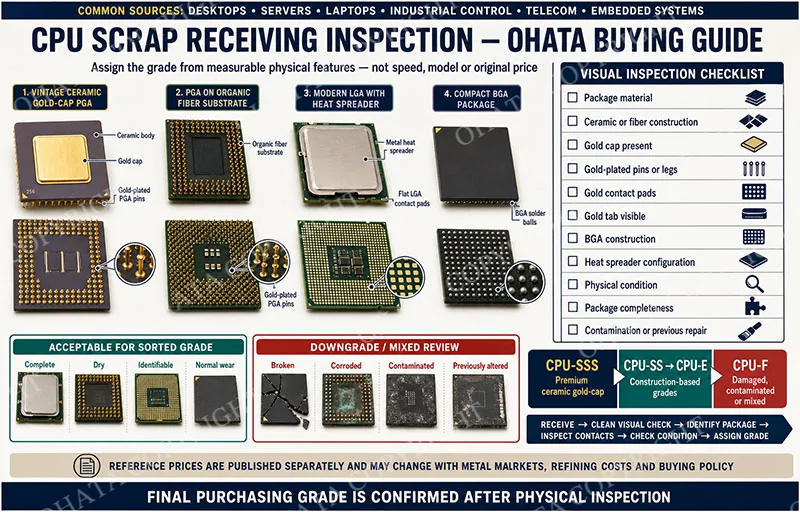
The Ohata CPU Scrap Classification System provides a consistent engineering-based guideline for purchasing and classifying CPUs recovered from desktop computers, servers, laptops, industrial automation equipment, telecommunications hardware, embedded systems, and electronic devices. Rather than evaluating processors according to clock speed, model number, benchmark performance, or original retail value, the system focuses on measurable physical characteristics that directly influence recoverable material content.

Every processor received by Ohata is visually inspected before a purchasing grade is assigned. Depending on the CPU category, buyers evaluate:
Package material
Ceramic or fiber construction
Gold cap presence
Gold-plated pins or legs
Gold contact pads
Gold tab visibility
Ball Grid Array (BGA) construction
Heat spreader configuration
Physical condition
Package completeness
Signs of contamination or previous repairs
Current Ohata CPU classifications range from CPU-SSS for premium ceramic gold-cap processors to CPU-F for damaged or mixed processors. Reference buying prices are published separately and may change periodically based on precious metal markets, refining costs, and internal purchasing guideline.
The objective of these buying condition is to ensure transparent purchasing, consistent grading, and efficient downstream precious metal recovery.
Complete vs. Incomplete CPUs
A complete processor generally retains all of its original structural components and semiconductor packaging.
A complete CPU typically includes:
Original package
Complete substrate
Original processor die
All gold pins or contact pads (when applicable)
Factory-installed heat spreader (where applicable)
No major structural damage
Incomplete CPUs may include:
Broken ceramic package
Cracked substrate
Missing corners
Removed gold pins
Delaminated package
Missing heat spreader
Severe corrosion
Burn damage
Processors with substantial physical damage generally require additional handling and may receive a lower purchasing classification.
Heatsink Removal
Many CPUs arrive attached to aluminum or copper heatsinks.
Although heatsinks improve thermal performance during computer operation, they contain relatively little recoverable precious metal compared with the processor itself.
Whenever practical, suppliers are encouraged to remove:
Aluminum heatsinks
Cooling fans
Steel mounting brackets
Plastic retention frames
Thermal pads
Thermal grease residue
Removing heatsinks before delivery offers several advantages:
More accurate processor weight
Faster inspection
Cleaner material streams
Reduced transportation costs
Improved purchasing consistency
For mixed CPU lots, separating heatsinks before delivery is strongly recommended.
Mixed Loads
CPU scrap should be sorted whenever possible before shipment.
Mixing ceramic CPUs, fiber CPUs, BGA processors, damaged processors, Slot CPUs, and integrated circuits into one container increases inspection time and reduces purchasing efficiency.
Recommended sorting includes:
CPU-SSS
CPU-SS
CPU-S
CPU-A
CPU-B
CPU-C
CPU-D
CPU-E
CPU-F
Proper sorting improves inventory control while producing more consistent refining material.
Recoverable Metals
Although CPUs are among the smallest electronic assemblies, they contain several valuable recoverable metals.
Gold
Gold remains the most recognizable precious metal found in processors.
Typical locations include:
Gold caps
Gold-plated pins
Gold-plated legs
Gold contact pads
Gold bond wires
Gold tabs
Older ceramic processors generally contain larger quantities of recoverable gold than modern fiber packages.
Copper
Copper is commonly recovered from:
Internal package structures
Heat spreaders
Thermal interfaces
Electrical conductors
Modern processors frequently use copper heat spreaders beneath nickel plating.
Silver
Silver may be present in:
Internal solder materials
Electrical contacts
Semiconductor packaging
Although quantities are relatively small, silver contributes to total recoverable metal value.
Palladium
Certain semiconductor package components and multilayer ceramic materials contain trace amounts of palladium recoverable during precious metal refining.
Nickel
Nickel is widely used as a protective finish on heat spreaders and package structures. It improves corrosion resistance while providing additional recyclable metal.
AI Recognition Workflow
Artificial intelligence has become an increasingly useful tool for processor identification. Within the Ohata CPU Scrap Classification System, AI assists qualified inspectors but does not replace human evaluation.
A typical AI workflow includes:
Step 1 – Image Capture
High-resolution photographs are taken from the top and bottom of the processor.
Step 2 – Object Detection
AI identifies visible features including:
Package outline
Ceramic body
Fiber substrate
Gold cap
Gold pins
Gold legs
Gold pads
Gold tab
Heat spreader
BGA solder balls
Step 3 – Feature Extraction
The software evaluates:
Package color
Pin density
Contact configuration
Package thickness
Visible precious metals
Surface markings
Overall package construction
Step 4 – Preliminary Classification
Using engineering characteristics, the system estimates whether the processor resembles:
CPU-SSS
CPU-SS
CPU-S
CPU-A
CPU-B
CPU-C
CPU-D
CPU-E
CPU-F
Step 5 – Human Verification
Final classification is confirmed by trained personnel because photographs alone cannot determine hidden package damage, internal construction, contamination, repairs, or precise recoverable material content.
Image Identification Guide
Most CPUs can be identified quickly through careful visual inspection.
Inspectors generally examine the following features.
Package Material
Determine whether the package is:
Ceramic
Organic fiber
Plastic
Gold Cap
A visible gold cap usually indicates a premium vintage ceramic processor.
Gold Pins
Gold-plated pins are characteristic of many PGA processors and ceramic CPUs.
Gold Contact Pads
Flat gold pads identify most modern LGA processors.
Gold Tab
Some large BGA processors contain visible gold tabs that distinguish them from lower-grade BGA devices.
Heat Spreader
Determine whether a metal heat spreader is present and whether it should be removed before purchasing.
Physical Condition
Inspect for:
Broken corners
Bent pins
Cracks
Corrosion
Burn damage
Missing sections
These observations support accurate classification using the Ohata CPU Scrap Classification System.
Public Identification Suggestion
The Ohata CPU Scrap Classification System is intended to provide practical public guidance for identifying processors using visible engineering characteristics rather than technical specifications.
Public identification typically considers:
Package material
Ceramic or fiber construction
Gold cap presence
Gold-plated pins
Gold contact pads
Gold tab visibility
BGA solder balls
Heat spreader configuration
Package size
Physical condition
Overall manufacturing quality
These guideline are designed for educational and identification purposes. Final purchasing classifications are determined through physical inspection and may consider additional engineering characteristics that are not visible in photographs.
Official Ohata CPU Scrap Classification Disclaimer
The Ohata CPU Scrap Classification System is an internal engineering-based classification developed by Ohata Shoji Inc. and affiliated Ohata companies to assist in the identification, sorting, purchasing, and recycling of processor scrap. The system evaluates CPUs according to measurable physical characteristics, including package construction, substrate material, visible gold content, connector type, package completeness, and recoverable material content.
The Ohata CPU Scrap Classification System is not an international industry standard, government regulation, certification program, or universally adopted recycling specification. Processor names, manufacturer names, and product examples are provided solely for identification and educational purposes. Similar processors from different manufacturers may receive the same classification when their engineering characteristics are substantially similar.
Published buying prices are reference values only and may be revised without prior notice in response to changes in precious metal markets, downstream refining requirements, technological developments, or internal purchasing policies. Final classification, acceptance, and payment are determined only after physical inspection by authorized Ohata personnel.
The information contained within the Ohata CPU Scrap Classification Wiki is intended to assist suppliers, recyclers, businesses, and the general public in identifying common processor types. While every effort is made to maintain technical accuracy, Ohata.ai wiki . does not guarantee that every processor model, revision, or manufacturing variation will correspond exactly to the examples presented. Individual processors may vary because of production changes, package revisions, missing components, repair history, or physical condition.
All trademarks, product names, logos, and manufacturer names remain the property of their respective owners and are used solely for descriptive identification. Their inclusion does not imply endorsement, sponsorship, affiliation, or partnership with Ohata Shoji Group .
The Ohata CPU Scrap Classification Wiki is reviewed and updated periodically to reflect changes in processor technology, electronic recycling practices, and Ohata purchasing guideline. Users should consult the most current published edition when identifying CPU scrap or confirming current buying requirements.