

What Is a CPU Large Socket?
CPU Large Socket is an internal identification term used within the Ohata Board Classification for certain plastic PGA processor sockets found on desktop, workstation, and server motherboards.
The term does not refer to a commercial processor platform or an industry socket standard. It provides a measurable way to distinguish qualifying large plastic sockets from smaller plastic sockets, metal load-plate sockets, and soldered processors.
A socket qualifies as a CPU Large Socket when:
it is a plastic PGA-style processor socket
it is installed on a desktop, workstation, or server motherboard
both outside dimensions of the plastic socket body measure at least 5 cm
it does not use a metal load plate or metal retention frame around the processor
enough of the socket and motherboard remains present for reliable identification
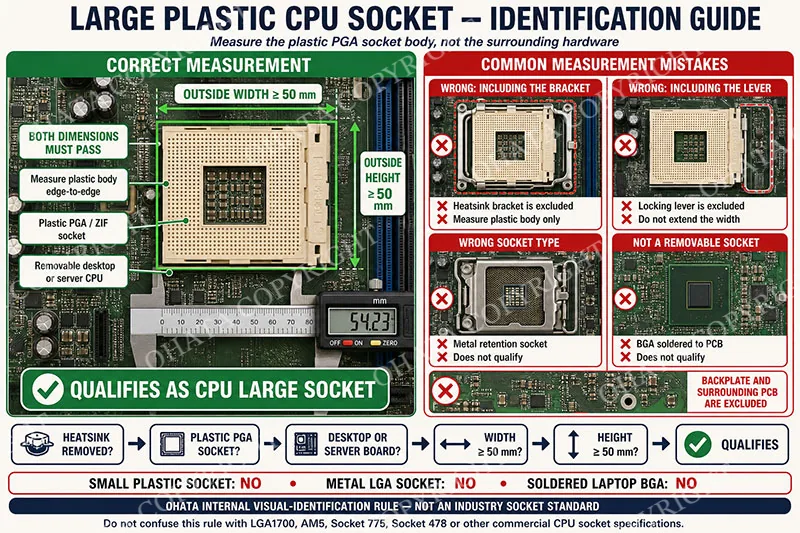
The measurement applies only to the socket body. Heatsink brackets, cooling frames, backplates, levers, surrounding components, and the motherboard PCB are not included.
A qualifying CPU Large Socket must have a plastic socket body measuring at least 5 cm × 5 cm across its outside edges.
Learn more: BGA Packages and More
Why the Guideline Uses a Measured Definition
Descriptions such as “large socket” can be interpreted differently by different people. A socket that appears large in a photograph may measure below the required dimensions, while another may appear smaller because of the surrounding motherboard layout.
Using a defined measurement supports:
more consistent motherboard classification
clearer communication between buyers and sellers
faster inspection and sorting
more reliable training materials
improved comparison with reference photographs
more consistent AI-assisted recognition
The measurement also prevents heatsink brackets and other surrounding hardware from making a smaller socket appear to qualify.
How to Measure the Socket Correctly
The processor heatsink and any cooling assembly must not be included in the measurement. The plastic socket body should be visible before its dimensions are evaluated.
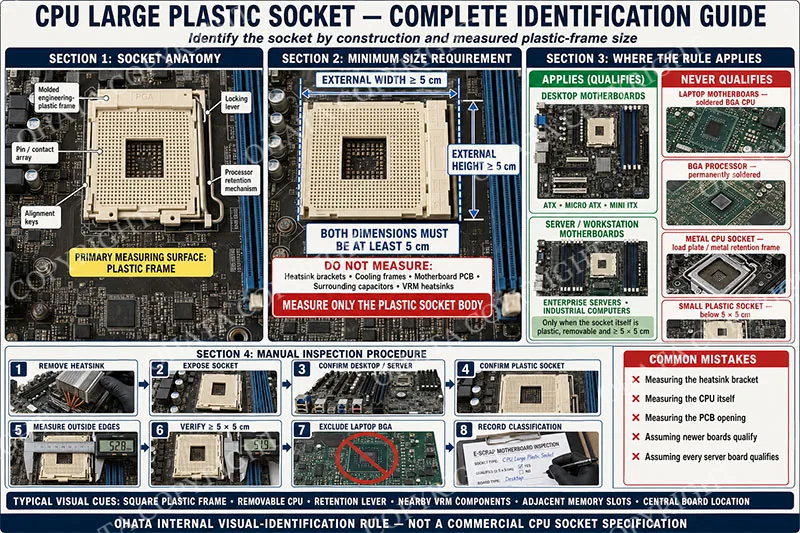
Follow this inspection process:
Confirm that the board is a desktop, workstation, or server motherboard.
Locate the removable processor socket.
Confirm that the socket body is primarily plastic.
Check that the processor is mounted through a PGA-style socket rather than soldered directly to the motherboard.
Measure the outside width of the plastic socket body.
Measure the outside height of the plastic socket body.
Confirm that both measurements are at least 5 cm.
Check for a metal load plate or metal retention frame.
Inspect the socket and surrounding PCB for damage or missing sections.
Record the socket type as one feature used during board classification.
Include in the measurement
Do not include
Outside edges of the plastic socket body
Processor or CPU package
Complete plastic socket frame
Heatsink
Fixed plastic structure holding the processor
Heatsink bracket
Plastic portion that defines the socket dimensions
Cooling frame
Metal backplate
Surrounding motherboard PCB
Nearby capacitors or voltage regulators
External retention hardware
The socket must meet the minimum measurement in both directions. A socket measuring 5.2 cm by 4.8 cm does not satisfy a 5 cm × 5 cm requirement because one dimension is below the minimum.
Measure across the widest outside edges of the actual plastic socket body while keeping the measuring tool level with the socket. Do not measure diagonally.
Plastic PGA Socket Construction
PGA means Pin Grid Array. In a PGA mounting system, the processor or socket uses a grid of electrical pin connections. Many older desktop and server processors were removable and installed into plastic Zero Insertion Force, or ZIF, sockets.
A typical plastic PGA socket may include:
a molded engineering-plastic body
a grid of processor pin openings or contacts
alignment keys
a locking or actuation mechanism
processor-orientation markings
mounting points securing the socket to the motherboard
The plastic body is the surface used for the CPU Large Socket measurement.
A small metal actuation lever may be present on some otherwise plastic ZIF sockets. The important distinction is whether the processor is held in a qualifying plastic PGA socket or beneath a substantial metal load plate or metal retention frame.
Modern LGA sockets often use exposed contacts inside the socket and a metal load plate that closes over the processor. These are identified separately as metal CPU sockets under the internal classification.
Boards That May Contain a CPU Large Socket
CPU Large Sockets are most commonly associated with older desktop, workstation, and server motherboards that use removable PGA processors.
Possible sources include:
ATX desktop motherboards
Micro ATX desktop motherboards
selected Mini ITX motherboards
workstation motherboards
single-processor server boards
multi-processor server boards
industrial computer motherboards based on desktop or server architecture
proprietary computer-system boards using qualifying removable processors
The motherboard’s original application supports identification, but it does not prove that the socket qualifies. A server board can contain a metal socket, a smaller plastic socket, or a soldered processor.
The processor manufacturer also does not determine the result. Intel, AMD, and other manufacturers have used several socket constructions across different generations.
Boards and Components That Do Not Qualify
The following do not meet the CPU Large Socket definition:
Item
Reason it does not qualify
Plastic socket smaller than 5 cm in either direction
Does not meet the minimum dimensions
LGA socket with a metal load plate
Classified as a metal CPU socket
BGA processor soldered to the motherboard
No removable plastic PGA socket is present
Empty BGA pad area
Soldered-processor location, not a socket
Processor package measuring more than 5 cm
The CPU is not the part being measured
Heatsink bracket measuring more than 5 cm
External cooling hardware is excluded
PCB opening or printed outline
Not the plastic socket body
Loose processor
Not a motherboard socket
Damaged board with the socket removed
Insufficient socket structure for classification
Laptop motherboard
Excluded from this internal socket group
Laptop boards are excluded from this classification even when they contain a removable processor. Most modern laptop processors use BGA packages soldered directly to the PCB, but older notebook designs may vary.
A large soldered BGA package is not a CPU socket. Physical size alone does not change a soldered processor into a removable PGA socket.
CPU Large Socket and Metal CPU Socket Comparison
Plastic PGA and metal load-plate sockets can appear similar when a heatsink covers them. The cooling assembly should therefore be excluded before identification.
Feature
CPU Large Socket
Metal CPU Socket
Primary socket structure
Plastic PGA-style body
Contact socket with metal load plate or retention frame
Processor mounting
Removable processor associated with PGA-style construction
Removable processor secured under a metal plate
Measurement
Plastic body must be at least 5 cm in both directions
CPU Large Socket measurement does not apply
Metal load plate
Absent
Present
Common association
Older desktop, workstation, or server boards
Many later Intel and other LGA-based boards
Internal identification
CPU Large Socket
Metal CPU Socket
Commercial names such as Socket 478, AM2, AM3, AM4, LGA775, LGA1155, LGA1200, LGA1700, and AM5 describe processor interfaces. They do not automatically determine the internal recycling classification.
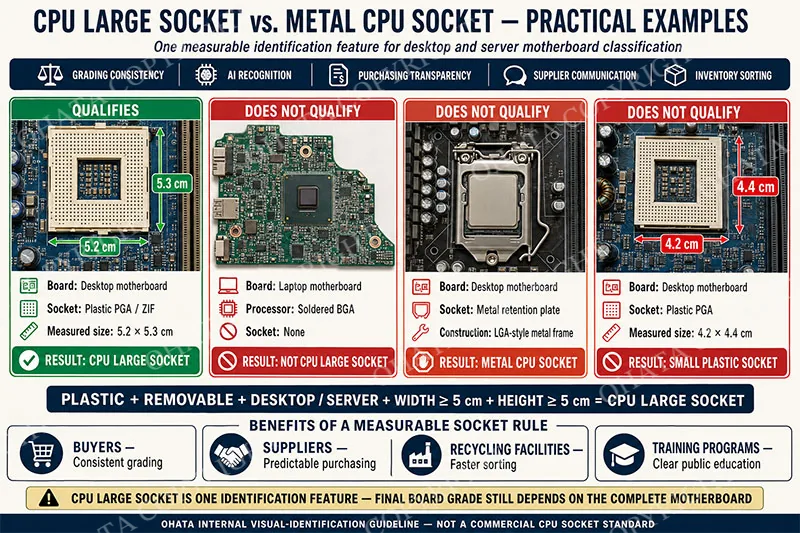
A familiar socket name may help identify the underlying hardware, but the physical socket must still be checked against the applicable internal definition.
Common Measurement and Identification Mistakes
Several common mistakes can produce an incorrect result:
Measuring the heatsink bracket: Measure only the plastic socket body.
Measuring the processor: The dimensions of the installed CPU do not determine the socket group.
Measuring diagonally: Measure the outside width and height separately.
Including the surrounding PCB: The motherboard surface is not part of the socket.
Counting the metal backplate: Hardware beneath the motherboard is excluded.
Assuming every plastic socket qualifies: Both dimensions must meet the minimum.
Assuming every server board qualifies: Many server boards use metal load plates or other socket constructions.
Assuming a new motherboard qualifies: Processor generation and manufacturing date do not establish the socket group.
Confusing BGA with PGA: A BGA processor is soldered directly to the PCB and is not a removable plastic socket.
Using a photograph without scale: An image can support preliminary identification, but it may not provide a reliable measurement.
Using the socket alone to determine the complete board grade: Socket type is only one part of motherboard classification.
The most reliable inspection uses a clear view of the exposed socket together with a physical measurement.
Practical Classification Examples
Example
Measurement and construction
Result
Desktop motherboard with a plastic PGA socket measuring 5.2 cm × 5.3 cm
Both dimensions meet the minimum and no metal load plate is present
CPU Large Socket
Plastic socket measuring 4.2 cm × 4.4 cm
Both dimensions are below the minimum
Small plastic socket
Plastic socket measuring 5.4 cm × 4.9 cm
One dimension is below 5 cm
Does not qualify as CPU Large Socket
Intel motherboard with a metal processor load plate
Metal retention structure is present
Metal CPU Socket
Laptop motherboard with a soldered BGA processor
No removable PGA socket
Not CPU Large Socket
Server board with multiple qualifying plastic PGA sockets
Each socket meets the construction and measurement rules
Contains multiple CPU Large Sockets
Server board with large metal load-plate sockets
Physical size may exceed 5 cm, but the sockets use metal retention
Metal CPU Socket
Board with the socket removed
Socket construction and dimensions cannot be confirmed
Cannot be counted as CPU Large Socket
When a board has multiple processor sockets, each socket should be examined individually. Do not assume that every position has the same construction if the board is damaged, incomplete, or modified.
Role in Motherboard Classification
CPU Large Socket is one identification feature used when evaluating desktop, workstation, and server motherboards. It is not a complete board grade by itself.
Board classification may also consider:
number of qualifying sockets
socket material and construction
installed processors
BGA packages and other major ICs
memory slots
expansion connectors
gold-plated contacts
component density
motherboard size and construction
completeness
physical condition
contamination
current buying requirements
Two boards containing similar-looking sockets may receive different final classifications because their socket counts, processors, component populations, construction, completeness, or condition differ.
Likewise, a board does not receive a higher classification solely because its socket is physically large. The socket provides one objective reference that must be considered with the complete motherboard.
Manufacturer, processor generation, operating speed, original computer price, working condition, resale value, and collector value do not determine the socket group by themselves.
Condition and Completeness
The motherboard must remain complete enough for the socket to be identified and measured.
Minor dust, light scratches, ordinary aging, or limited surface discoloration do not normally prevent socket identification when the plastic body and motherboard remain intact.
Classification may become uncertain when:
part of the socket body is broken
the socket has been removed
fire has melted or distorted the plastic
corrosion hides the outside edges
surrounding damage prevents accurate measurement
a replacement or non-original socket has been installed
the motherboard has been cut through the socket area
heavy contamination prevents safe inspection
If a processor remains installed, it may hide some internal socket features. However, the outside plastic body may still be measurable if its complete edges remain visible.
Heatsinks, fans, and cooling brackets should not be counted as part of the socket. They may need to be moved or removed when safe and appropriate so the socket construction can be inspected correctly.
Ohata CPU Large Socket Classification
CPU Large Socket, also called CPU Plastic Large Socket or CPU PGA Plastic Large Socket, is an internal identification category used within the Ohata Board Classification.
It establishes a measurable reference for a plastic PGA-style socket installed on a desktop, workstation, or server motherboard. The plastic socket body must measure at least 5 cm across both outside dimensions and must not use a metal processor load plate or substantial metal retention frame.
The definition supports board identification, recycling education, supplier guidance, inventory sorting, purchasing consistency, and AI-assisted recognition.
It does not replace commercial socket names or technical documentation published by processor and motherboard manufacturers. It is not an Intel, AMD, JEDEC, IEC, IPC, governmental, international, or universal electronic-scrap standard.
The term identifies one physical motherboard feature. It does not independently determine the board’s final grade, acceptance, or purchasing value.
Final classification, acceptance, and purchasing value are confirmed after inspection under current buying requirements.