

What Is a Telecom Board?
A telecom board is a printed circuit board built for communications equipment. Its job is to move, process, or manage data between devices, networks, or different parts of the same system.
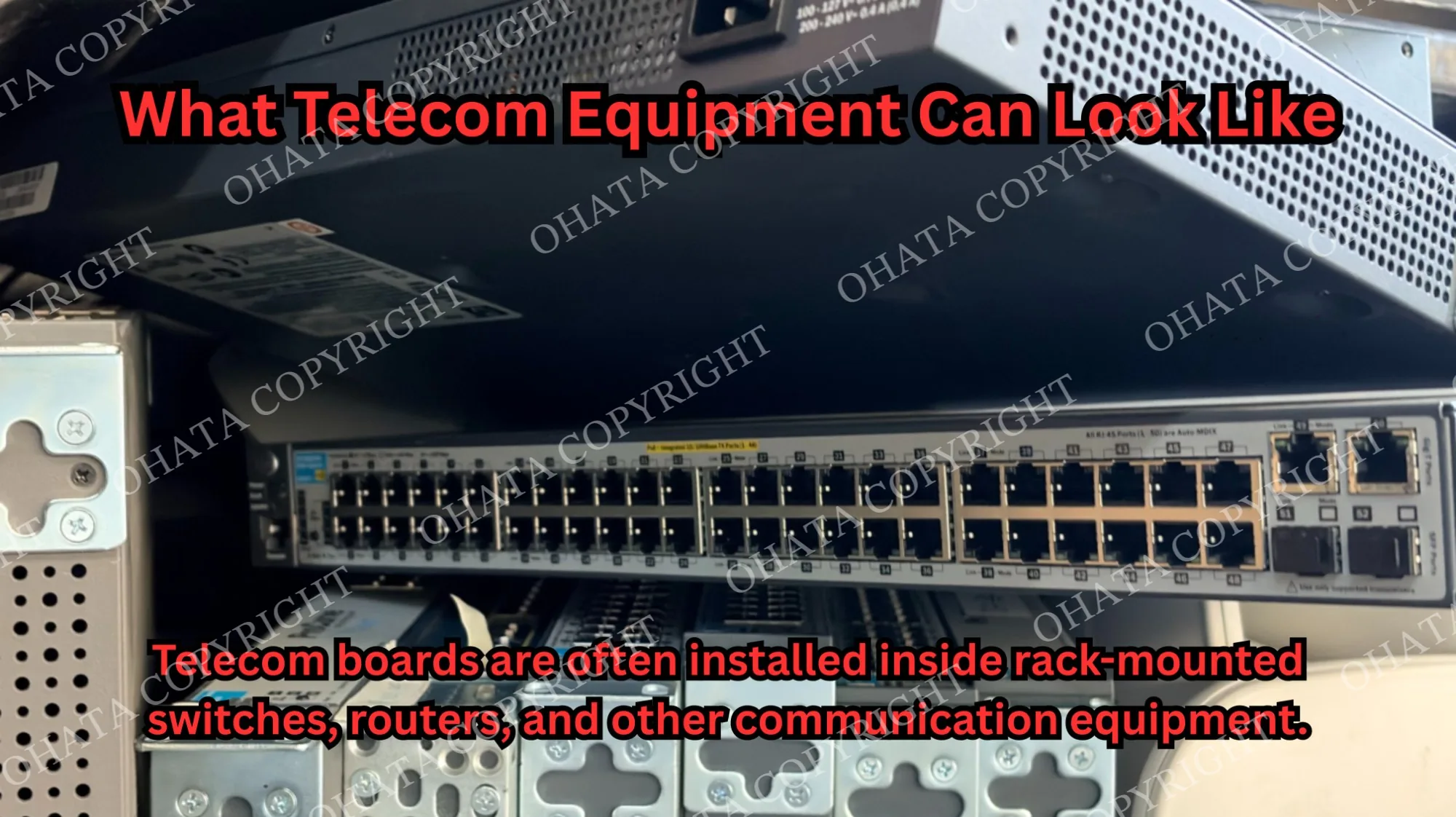
Depending on the equipment, a telecom board may handle Ethernet traffic, packet processing, optical communication, wireless signals, timing, security, or communication between modules inside a larger chassis.
Common equipment that uses telecom boards includes:
Enterprise switches
Network routers
Cellular equipment
Optical transport systems
Telephone and VoIP systems
Communication gateways
Data-center networking equipment
Carrier network infrastructure
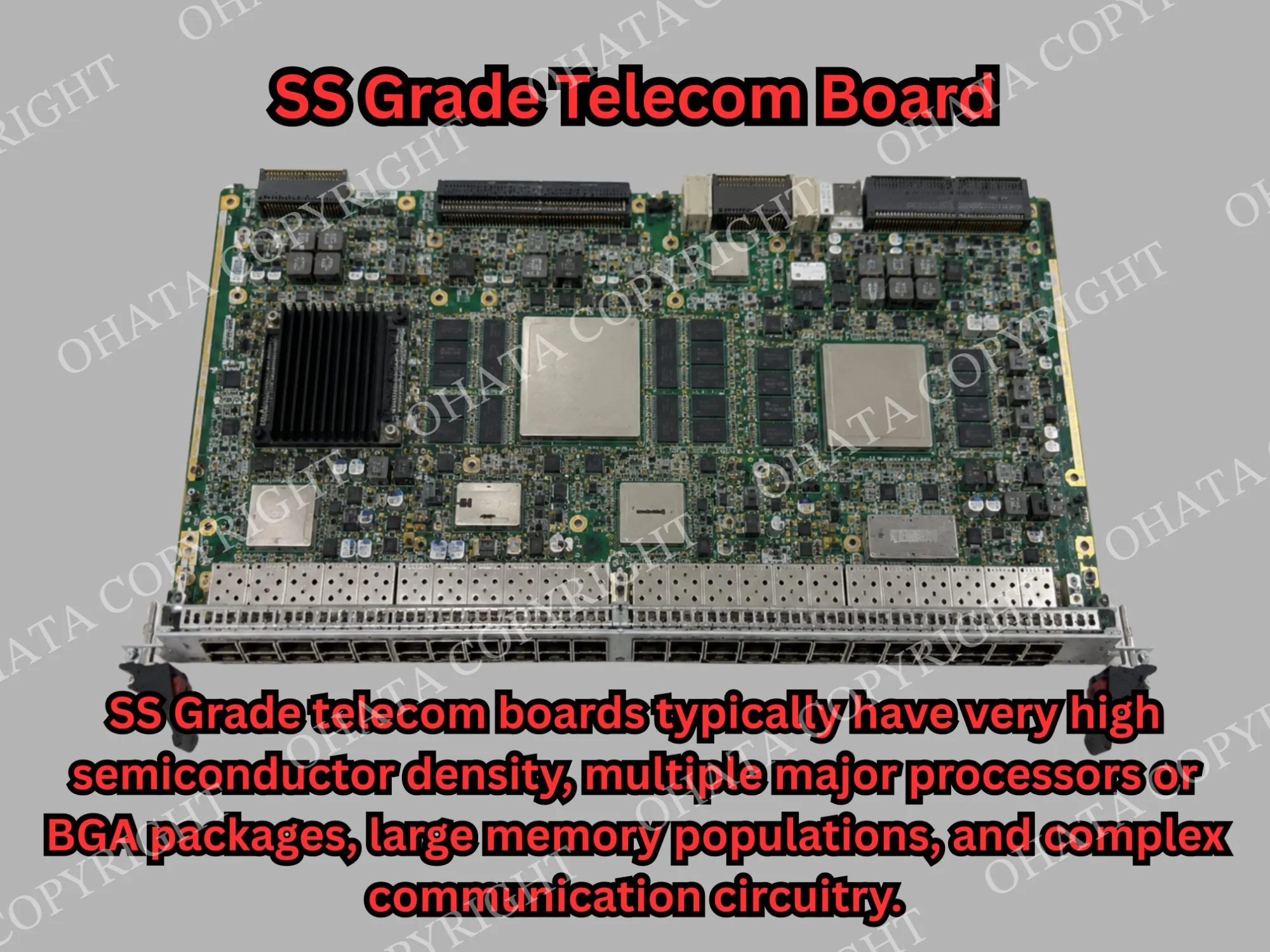
The Ohata SS Grade classification includes high-performance examples such as network switch control boards, telecom switching boards, fiber-optic communication boards, cellular base-station boards, and server backplanes.
Telecom boards do not all share the same shape or layout. A compact optical board may look nothing like a long switch card or a large base-station controller. What connects them is their communication-focused design.
Network processors, switching ASICs, memory, Ethernet controllers, optical-interface circuitry, timing components, and dense communication connectors are common clues. Looking at those features together helps identify what the board was built to do and provides useful evidence when determining its recycling grade.
Telecom Boards and Non-Telecom Boards
A telecom board is built primarily around communications. A non-telecom board is built around another main job, such as running a computer, controlling an appliance, operating industrial machinery, managing storage, or controlling another electronic system.
The distinction comes from function and architecture, not from board color, size, age, or manufacturer.
Telecom board
Non-telecom board
Built for communications and data transport
Built for computing, control, storage, power, sensing, or another main function
Common in routers, switches, optical systems, cellular equipment, and telecom infrastructure
Common in PCs, laptops, appliances, drives, industrial machines, game systems, and other electronics
Often uses network processors, switching ASICs, FPGAs, Ethernet controllers, optical interfaces, and high-density communication connectors
May use CPUs, chipsets, motor controllers, storage controllers, appliance controllers, sensor interfaces, or other application-specific ICs
May contain several high-speed communication paths and specialized network interfaces
Connectors and ICs usually reflect the equipment’s main purpose
Can fall into several Ohata grades
Can also fall into several Ohata grades
A telecom board can still contain many parts that also appear on computer hardware. Processors, memory, capacitors, voltage regulators, flash storage, and multilayer PCBs are used across many electronic products.
The board’s layout tells you what the hardware is centered around.
An enterprise switch board may have several large switching ASICs, Ethernet controllers, high-speed memory, and dense communication interfaces because its main job is to move network traffic.
A desktop motherboard may also have a large processor, memory, and many supporting ICs, but its architecture is centered on general-purpose computing.
An industrial controller may contain an Ethernet port and a communication processor without being primarily a telecom board. The network connection may only support communication with other factory equipment while the board’s main function is machine control.
This is why one visible Ethernet connector does not turn every PCB into telecom hardware.
Components Commonly Found on Telecom Boards
Telecom boards often become easier to recognize once the major component groups are familiar.
Component
Main purpose
Why it helps with identification
Switching ASIC
Moves network traffic between ports
Common on network switches
Network processor
Handles packet-processing and communication tasks
Common on enterprise routers and telecom systems
Packaging used for many large processors and controllers
Several substantial BGAs can indicate high semiconductor density
FPGA
Performs configurable digital processing
Common in specialized communication systems
DDR memory
Supplies working memory for processors
Often appears around major network ICs
Flash memory
Stores firmware and configuration data
Common on telecom control boards
Ethernet PHY
Handles physical Ethernet signaling
Strong indicator of networking functions
Optical interface circuitry
Supports fiber-based communication
Common in optical and carrier equipment
Timing IC
Provides precise clocking and synchronization
Frequently used in telecom systems
Power-management IC
Regulates voltage for processors and memory
Common around dense processing sections
Backplane connector
Connects a board to other modules in a chassis
Frequent on enterprise and telecom equipment
Why Telecom Boards Can Have Strong Recycling Value
Professional telecommunications systems are often designed for long service periods and continuous operation. Carrier switches, enterprise routers, optical systems, and cellular equipment may operate around the clock while processing large amounts of data.
That can require:
Multilayer PCB construction
Extensive copper routing
Dense semiconductor placement
Premium connectors
High-speed signal routing
Robust power distribution
Reliable solder connections
High-quality contact finishes
The Ohata SS Grade material describes advanced telecom boards as having dense surface-mounted components, multiple large BGA processors, numerous high-performance ICs, premium connectors, and complex PCB construction.
Copper usually represents the largest recoverable metal by weight. It can be found in internal PCB layers, signal traces, ground planes, power planes, connectors, coils, and other conductive structures.
Telecom boards may also contain smaller recoverable quantities of:
Gold in selected contacts, connector finishes, and semiconductor structures
Silver in electrical contacts and joining materials
Palladium in some multilayer ceramic capacitors
Nickel in connector finishes and shielding
Tin in solder alloys
Visible gold is only one part of the recycling picture. A board with modest visible plating may still contain substantial semiconductor density and multilayer copper construction.
Likewise, a board with one large gold-colored connector does not automatically qualify as a premium telecom grade.
Telecom Boards Are Not a Single Ohata Grade
“Telecom board” describes the board’s purpose. It is not an Ohata grade by itself.
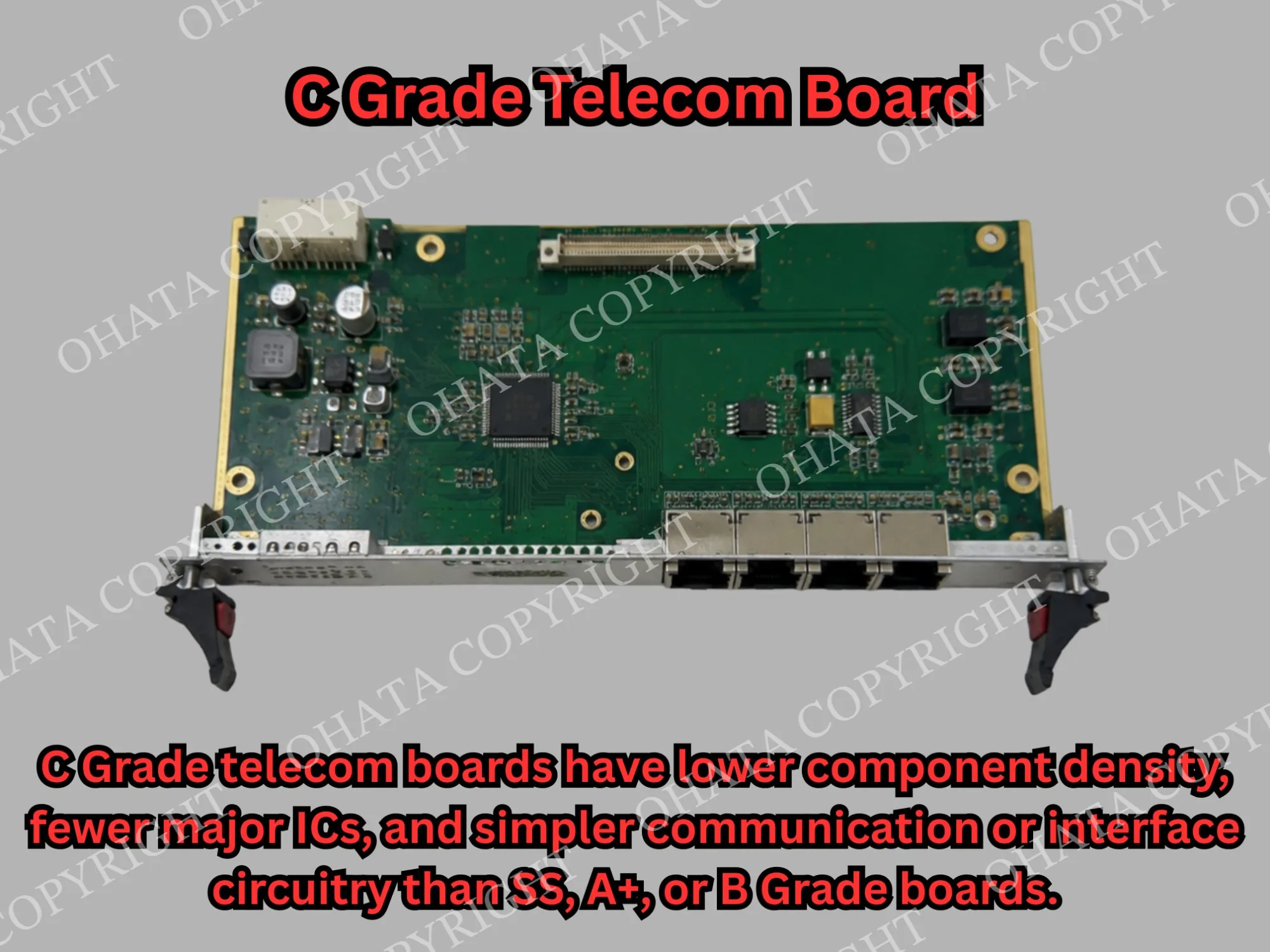
Under the Ohata Board Scrap Classification System, telecom-related boards can fall into SS, A+, B, or C Grade depending on the board’s construction and component population.
Learn more on YouTube: How to Read Motherboard and PCB Markings: What the Letters & Numbers Mean
Ohata grade
Telecom examples
General profile
High-performance telecom switching boards, enterprise network switch boards, fiber-optic communication boards, cellular base-station boards
Very high IC density, multiple major BGA packages, premium connectors, complex communication circuitry
Middle-grade telecom boards, telecom switching boards, industrial network boards
Strong semiconductor coverage, professional communication hardware, quality PCB construction
Lower-grade telecom boards and simpler networking boards
Moderate IC density, fewer major processors, simpler communication architecture
Lower-density communication or interface boards
Fewer ICs, simpler layouts, fewer premium connectors, and lower recoverable material content
Two boards can both come from communications equipment and still receive different grades.
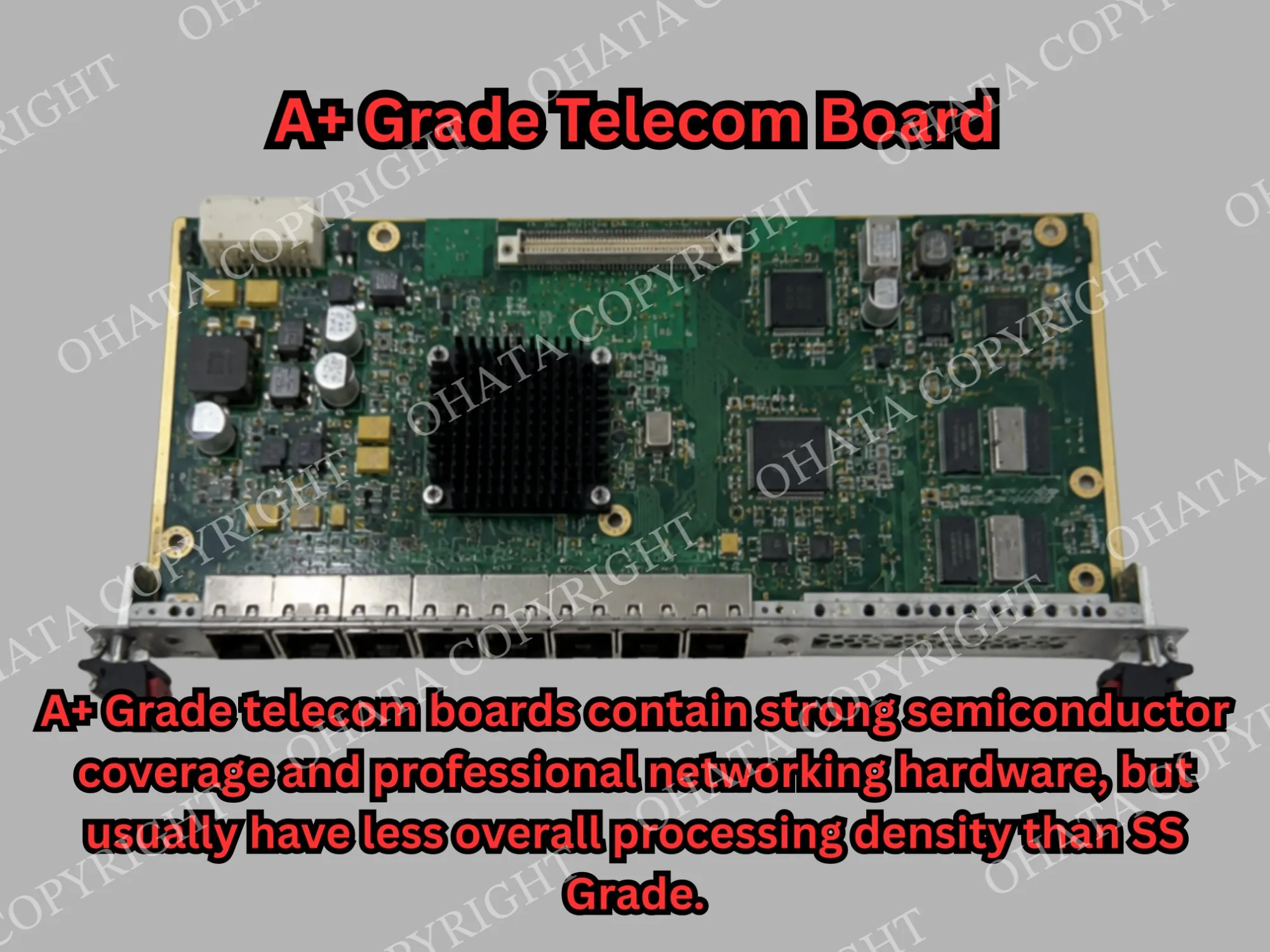
A dense carrier-network board with several communication processors, memory banks, optical interfaces, and high-density connectors may fall into SS Grade. A professional network board with less semiconductor coverage may fall into A+ Grade. Simpler telecom hardware may fall into B Grade, while lower-density communication or interface boards may fall into C Grade.
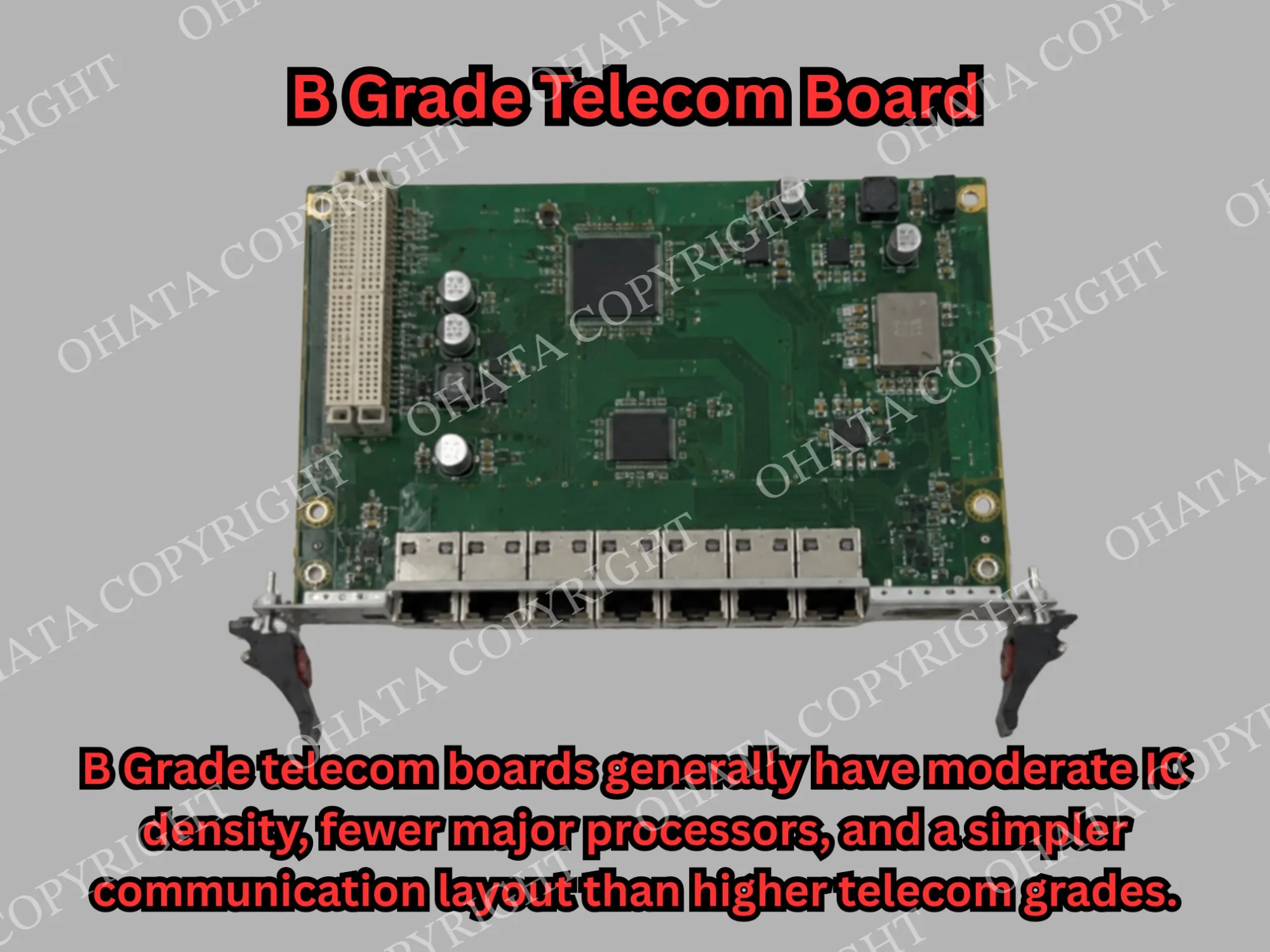
The equipment name helps identify what the board was used for, but the grade comes from the board itself: its IC density, communication hardware, connectors, PCB construction, completeness, and condition.
How to Identify a Telecom Board for Recycling
Start with the complete board. No single chip, connector, brand, or board size should determine the classification.
Useful signs include dense IC coverage, several substantial BGA packages, network processors, switching ASICs, FPGAs, memory, Ethernet controllers, optical-interface circuitry, and high-density communication connectors. Check both sides of the PCB, since important processors or memory may also be mounted on the reverse.
The original equipment can help with identification. Boards from carrier routers, enterprise switches, optical systems, cellular equipment, telephone systems, and smaller networking devices may all be telecom-related, but the physical construction of the board determines the grade.
A compact board can contain more semiconductor material than a much larger PCB, and a manufacturer logo does not set the classification.
Selling Condition and Handling
Telecom boards should remain substantially complete for inspection. Major components such as network processors, switching ASICs, BGA processors, FPGAs, memory ICs, communication controllers, and original connectors should stay attached.
There is no need to remove large ICs before selling the board. Missing processors, removed communication ASICs, cut or broken PCB sections, severe corrosion, burning, water damage, or heavy contamination may lower the classification.
Loose mechanical items such as cooling fans, external brackets, mounting hardware, removable heatsinks, or loose shielding may be removed when practical.
Working condition is not required. Boards should be dry, reasonably clean, structurally intact, and free from severe contamination.
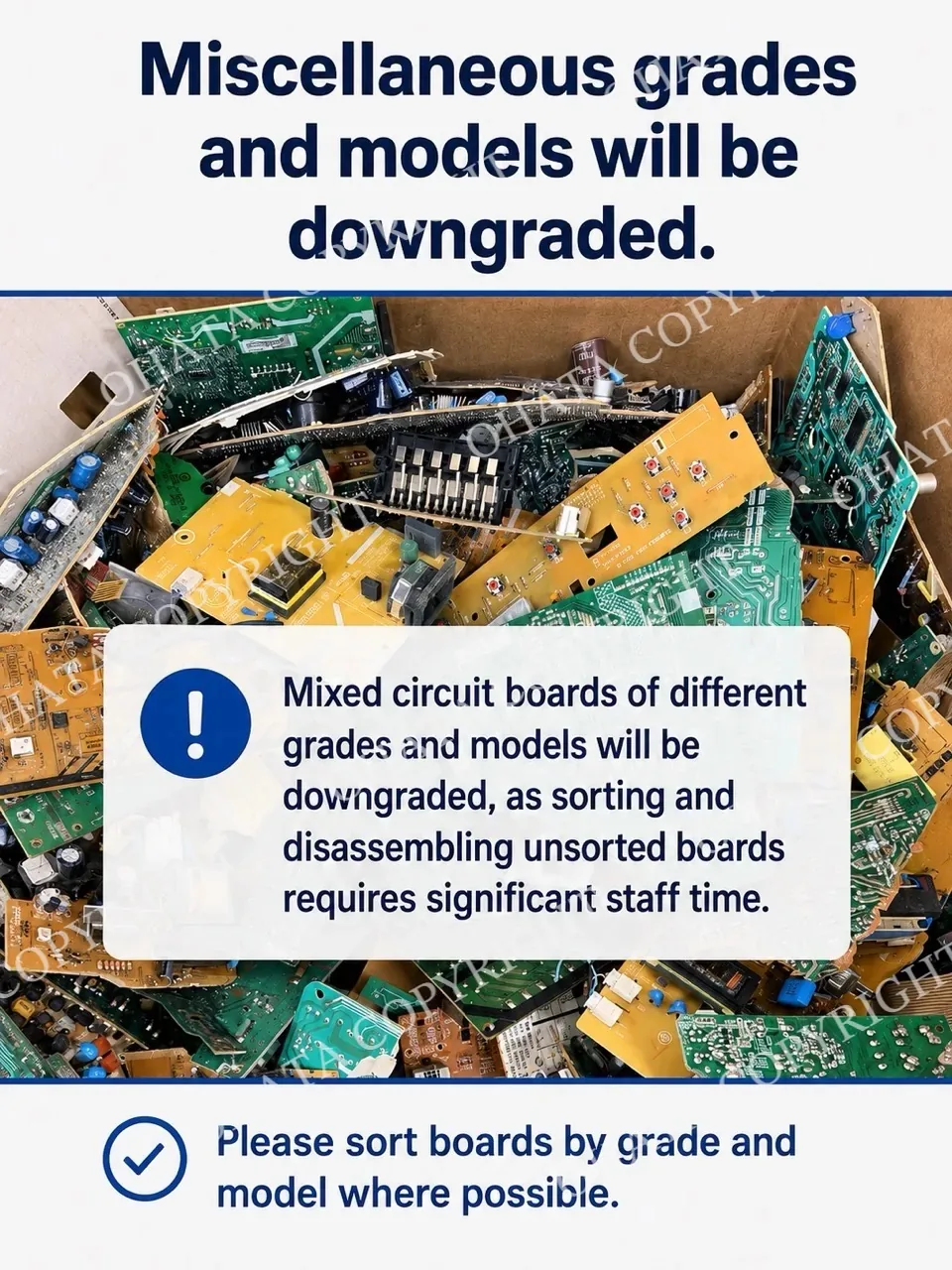
A load of telecom equipment may contain more than one recycling grade, so separating clearly high-density boards from simpler networking boards can make inspection and sorting easier. Final classification, acceptance, and purchasing value are confirmed after inspection under current buying requirements.