This Wiki Page is updated as August 27, 2026 by Nicole Hana Sekino.
✓
Ohata accepts qualifying D Grade Circuit Board Scrap starting at 1 lb.
✓
D Grade primarily includes qualifying modern desktop motherboards with metal-framed CPU sockets, integrated consumer motherboards, selected console boards, and lower-value peripheral cards.
✓
Important identification features include board type, CPU socket construction, component density, processors and chipsets, connectors, attached cooling hardware, completeness, and condition.
✓
A metal CPU socket is an important identification feature, but it does not determine the grade by itself.
✓
Removed soldered ICs, cut PCB sections, severe burning, corrosion, heavy contamination, or extensive component removal may result in downgrading or rejection.
✓
Final classification, acceptance, and purchasing value are confirmed after inspection.
Board D Grade (Lower computer Board) buying and related Scrap Prices as of 8:00 AM on September 20, 2026
What Is D Grade Circuit Board Scrap?
D Grade is an internal Ohata classification for qualifying lower-value computer motherboards, selected console boards, and peripheral electronics. It is the lowest computer-board grade within the Ohata Board Scrap Classification and is positioned below C Grade.
D Grade remains separate from Appliance Board A and Appliance Board B. A lower-value computer motherboard still has a different construction and function from a power board, relay board, automotive control board, or household-appliance controller.
D Grade is determined by the complete board’s type, CPU socket or processor configuration, component density, connectors, attached hardware, completeness, condition, and expected recoverable-material profile.
The classification does not measure computing speed, reliability, gaming performance, original price, or resale potential. A modern motherboard can provide greater computing performance than an older higher-grade board while having a different recycling profile.
D Grade is not rejection material. Complete, clean, correctly identified D Grade boards remain suitable for professional material recovery.
All boards meeting the current Ohata D Grade requirements are purchased under the applicable D Grade category regardless of manufacturer, processor generation, equipment popularity, or former retail value.
Modern desktop motherboards with metal CPU load plates or retention frames
Integrated consumer desktop motherboards with relatively limited IC coverage
Qualifying AMD AM- and FM-platform motherboards
Selected lower-density non-Apple laptop motherboards that do not meet a higher laptop-board category
Selected game-console motherboards matching current D Grade references
Lower-value graphics and gold-finger cards with large heatsinks or cooling fans
Qualifying low-density peripheral and interface cards
These descriptions identify possible candidates rather than guaranteeing D Grade. AMD AM and FM names cover several generations and many different motherboard constructions. A platform name alone should not replace inspection.
Likewise, a console family can contain multiple motherboard revisions with different processors, memory layouts, connectors, shielding, and component density. One approved Xbox, PlayStation, or Nintendo example does not establish the grade for every console made by that company.
A dense workstation, server, telecom, or industrial board does not become D Grade merely because it has a metal CPU socket. Simpler power, terminal, or appliance-control boards may fall below D Grade even when they contain integrated circuits.
The equipment name identifies the board’s origin, but the complete physical board determines its classification.
How to Identify a Possible D Grade Board
Begin by identifying the board’s original function and whether it is a desktop motherboard, laptop motherboard, console board, graphics card, or peripheral controller.
Inspection point
What to examine
Board type
Desktop, laptop, console, graphics, expansion, or peripheral board
CPU socket
Metal load plate, retention frame, locking lever, or plastic PGA construction
Main processors
Removable CPU, soldered BGA processor, GPU, chipset, or controller
Component density
Distribution of processors, memory devices, controllers, and supporting ICs
Connectors
Memory, expansion, storage, display, network, audio, USB, and power connections
Gold contacts
Socket contacts, memory contacts, edge fingers, and selected connector surfaces
Attached hardware
Fans, heatsinks, heat pipes, steel brackets, shields, and plastic covers
Completeness
Presence of soldered processors, chipsets, connectors, sockets, and original PCB sections
Condition
Burning, corrosion, fractures, leakage, contamination, or component removal
Board markings can help identify the manufacturer, model, chipset, socket designation, hardware revision, and original equipment. These details should be used to compare the board with current Ohata references rather than treated as automatic grading rules.
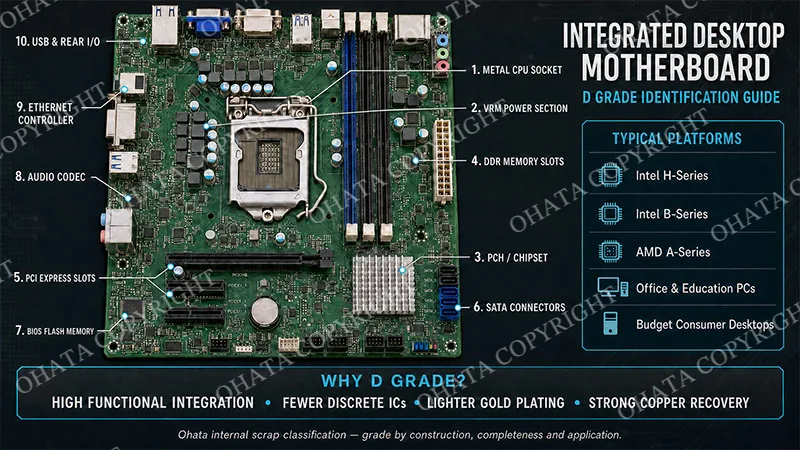
Integrated consumer desktop motherboard showing common D Grade identification features. The metal CPU socket, component density, connectors, completeness, and application are evaluated together.
A board should not be classified from its size, color, age, manufacturer, processor brand, or one valuable-looking component.
D Grade identification requires examination of the complete electronic assembly.
Metal CPU Sockets and Desktop Motherboards
A metal CPU socket has a visible metal load plate, retention frame, or locking assembly forming part of the processor socket. Many Intel LGA desktop motherboards use this construction.
The metal load plate covers or secures a removable processor against a dense field of contacts inside the socket. It should not be confused with a separate heatsink bracket mounted around a plastic PGA socket.
Modern consumer desktop motherboards with metal-framed CPU sockets frequently qualify for D Grade when they also have conventional component density, standard memory and expansion connections, and a construction consistent with current Ohata examples.
Visible features may include:
one metal-framed CPU socket
DDR memory slots
PCI or PCI Express expansion slots
SATA storage connectors
a platform controller hub or chipset
audio and network controllers
voltage-regulation components
USB and rear input-output connections
A metal socket does not guarantee D Grade. Server, workstation, industrial, and specialized computer boards may also use metal processor-retention hardware. Their processors, IC density, memory architecture, connectors, application, and overall construction require separate evaluation.
AMD AM- and FM-platform motherboards may also enter D Grade when their complete consumer-board construction matches current buying examples. Some AMD sockets are primarily plastic and therefore should not be identified as metal CPU sockets.
Platform name and socket material are useful clues, but neither replaces evaluation of the complete motherboard.
Laptop, Console, and Peripheral Boards
Non-Apple laptop motherboards are generally associated with a higher computer-board category, but selected lower-density or otherwise nonqualifying examples may receive D Grade under the current buying criteria.
Laptop classification should consider the soldered processors and chipsets, memory configuration, component coverage, connectors, gold-contact features, completeness, and current Ohata laptop-board references.
A laptop board should not be downgraded merely because a removable CPU or RAM module has been separated. However, removal of soldered BGA processors, chipsets, memory packages, or original PCB sections represents material loss and can affect classification.
Selected game-console motherboards may also qualify for D Grade. Current Ohata materials show examples from systems such as the Super Nintendo Entertainment System, Nintendo 64, Xbox 360, Wii, Wii U, and PlayStation 3.
These names are identification examples, not automatic classifications. Console construction can change between:
original and redesigned models
regional versions
motherboard revisions
cost-reduced editions
full-size and compact systems
complete and stripped boards
Graphics and peripheral cards may enter D Grade when they have limited component coverage, relatively short contact edges, or large heatsinks, fans, brackets, and shielding compared with the populated PCB.
Possible peripheral candidates include selected sound, television-tuner, USB, FireWire, network, storage-controller, and multimedia cards. Simple cards with very little populated circuitry may fall into another category.
Laptop, console, and peripheral boards must be evaluated by their individual construction rather than their product-family name.
Why D Grade Boards Have Recycling Value
D Grade boards contain recoverable PCB material together with processors, chipsets, controllers, connectors, coils, plated contacts, and other electronic components.
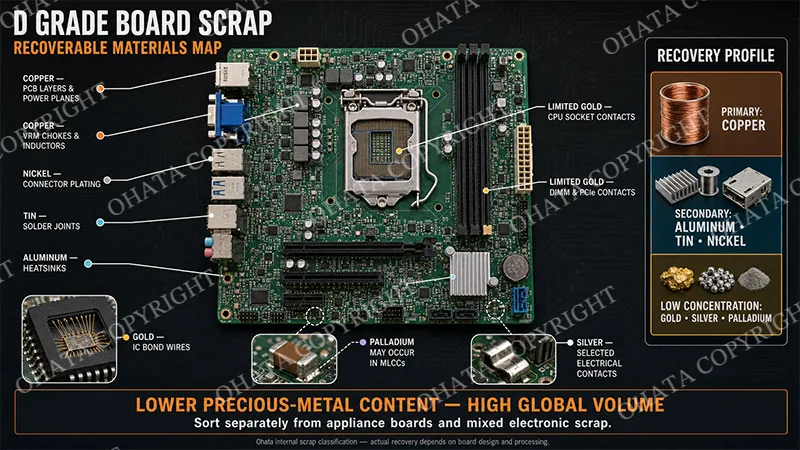
D Grade boards may contain copper, plated contacts, solder alloys, nickel, aluminum, and other recoverable materials. Exact composition and metal quantities vary and cannot be confirmed from appearance alone.
Copper is commonly present in circuit traces, conductive layers, plated holes, power-distribution areas, voltage-regulation components, coils, and connectors. Gold may be present on CPU socket contacts, memory contacts, expansion-card fingers, and selected connector surfaces.
Tin, nickel, silver, aluminum, steel, and other metals may also be present depending on the product and production period.
The exact composition varies substantially. A photograph cannot confirm:
PCB layer count or copper weight
gold-plating thickness
semiconductor bonding-wire material
the composition of individual capacitors
the quantity of a particular precious metal
the expected recovery yield
Large aluminum heatsinks and steel shielding may have separate recycling value, but they do not have the same material profile as the populated circuit board. Their weight and required removal work can affect evaluation of the complete assembly.
Modern boards often integrate several functions into fewer semiconductor packages. This can produce high computing performance without creating the same visible component density or recycling profile as older computer, server, industrial, or telecom boards.
D Grade value comes from the combined recoverable-material profile of the complete delivered item, not processor speed, equipment price, or one gold-colored contact.
Integrated Desktop Motherboards
Integrated desktop motherboards are among the most common products assigned to D Grade within the Ohata Board Scrap Classification System. These boards are widely used in consumer desktop computers designed for home, office, educational, and multimedia applications. Unlike earlier desktop motherboards that often incorporated numerous individual controller chips, modern integrated boards consolidate many functions into a small number of highly integrated chipsets and processors.
AMD AM Platform Motherboards
AMD AM-series desktop motherboards represent another common source of D Grade material.
Examples include:
Socket AM2
Socket AM2+
Socket AM3
Socket AM3+
Socket AM4
Socket AM5 entry-level consumer boards
These motherboards typically feature:
Consumer-grade PCB construction
Single CPU socket
Integrated audio
Integrated networking
Moderate voltage regulation
Standard PCI Express expansion
Consumer-oriented memory configurations
Compared with workstation or enterprise server boards, AMD AM platforms generally contain fewer integrated circuits and lower concentrations of precious metals, making them representative D Grade products.
AMD FM Platform Motherboards
AMD FM-series motherboards were developed primarily for Accelerated Processing Units (APUs), integrating CPU and graphics functionality into a single processor package.
Common socket types include:
FM1
FM2
FM2+
Typical electronic features include:
Single processor socket
Reduced chipset complexity
Integrated graphics support
Consumer expansion slots
Standard power regulation
Limited controller ICs
Because graphics processing is integrated directly into the APU, fewer supporting semiconductor devices are required, reducing overall component density.
Consumer Gaming Console Boards
Several popular gaming consoles fall within the Ohata D Grade classification because they were designed for large-scale consumer production using cost-efficient engineering rather than premium materials.
Although these products often include sophisticated processors and graphics chips, they generally contain lighter gold plating and lower recoverable precious metal concentrations than enterprise computer hardware.
Nintendo Entertainment System (NES)
Released during the 1980s, the Nintendo Entertainment System utilizes a relatively simple motherboard containing:
Ricoh processor
Picture Processing Unit (PPU)
Memory devices
Cartridge connector
Audio circuitry
Power regulation
Most components utilize through-hole technology with comparatively low semiconductor density. The board remains recyclable primarily because of copper content and electronic components.
Super Nintendo Entertainment System (SNES)
The Super Nintendo Entertainment System introduced improved graphics and sound capabilities while maintaining a relatively straightforward motherboard architecture.
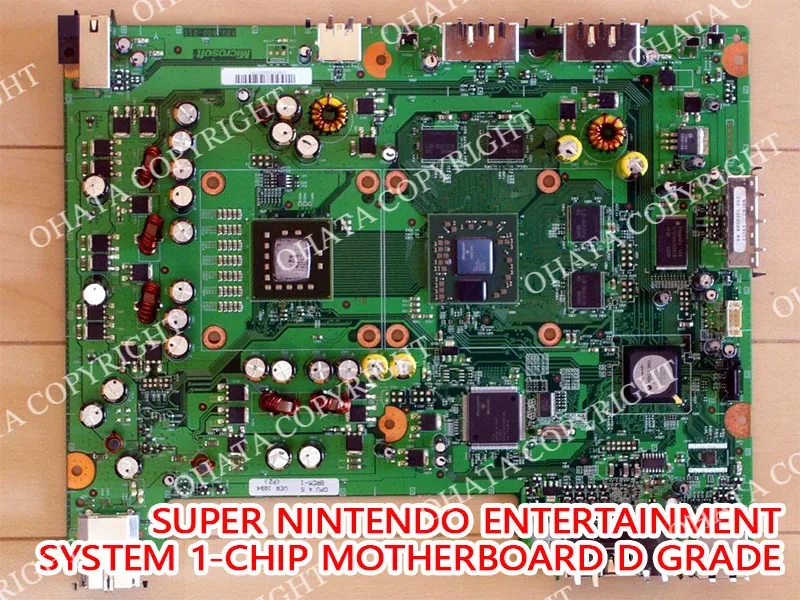
Super Nintendo Entertainment System 1-Chip motherboard shown as an Ohata D Grade reference example. Hardware revision, completeness, and condition may affect classification.
Typical components include:
Ricoh CPU
Graphics processors
Audio DSP
Memory ICs
Cartridge interface
Voltage regulation
Compared with later gaming systems, the SNES contains relatively modest semiconductor density and limited precious metal content, making it suitable for D Grade classification.
Nintendo 64 (N64)
The Nintendo 64 motherboard represents a transition toward more advanced semiconductor integration.
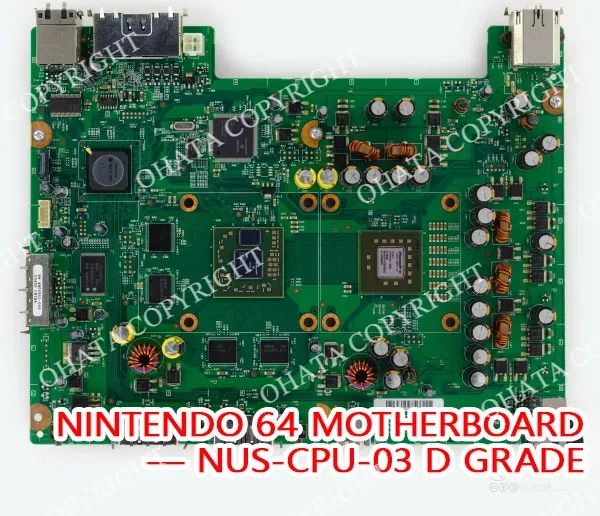
Nintendo 64 NUS-CPU-03 motherboard shown as an Ohata D Grade reference example. Other Nintendo 64 motherboard revisions may require separate evaluation.
Typical electronic assemblies include:
NEC VR4300 processor
Graphics processor
Rambus memory
Cartridge interface
Power management circuits
Although multilayer PCB construction is employed, overall recoverable precious metal content remains moderate.
Nintendo Wii
Nintendo Wii introduced highly integrated consumer electronics designed for compact manufacturing.
Typical components include:
IBM PowerPC processor
ATI graphics processor
Flash memory
Wireless communication modules
Optical drive controller
Power management circuits
Large aluminum shielding and cooling assemblies are commonly removed before recycling.
Nintendo Wii U
Nintendo Wii U utilizes a more advanced motherboard than the original Wii while maintaining consumer-oriented manufacturing practices.
Typical features include:
IBM multicore processor
AMD graphics processor
DDR memory
Optical drive controller
HDMI interface
USB controllers
Network interfaces
Although semiconductor density increases, recoverable precious metal concentrations remain lower than enterprise computer hardware.
Microsoft Xbox 360
The Xbox 360 motherboard contains several large BGA semiconductor packages together with extensive cooling systems.
Typical components include:
Xenon processor
ATI graphics processor
DDR memory
Southbridge controller
DVD controller
Ethernet controller
USB interfaces
The board also contains:
Large aluminum heatsinks
Heat pipes
Cooling fans
Metal shielding
Removing these mechanical components improves processing efficiency before recycling.
Sony PlayStation 3 (PS3)
The PlayStation 3 motherboard contains sophisticated semiconductor devices but remains a consumer-oriented product.
Typical components include:
Cell Broadband Engine processor
RSX graphics processor
DDR memory
Blu-ray controller
Ethernet controller
Wireless communication modules
USB interfaces
Large aluminum heatsinks and cooling assemblies contribute substantial recyclable aluminum while reducing processing efficiency if left attached.
D Grade Boundaries and Common Mistakes
C Grade includes qualifying single-plastic-socket server boards, selected plastic-socket desktop motherboards, trimmed expansion cards, connector-end boards, and other applicable computer cards.
D Grade more commonly includes modern consumer desktop motherboards with metal-framed CPU sockets, integrated consumer boards, and selected lower-value console or peripheral boards.
Appliance Board A and Appliance Board B include different control, relay, power, automotive, and household-appliance boards. A board should not be assigned D Grade merely because it is populated and falls below C Grade.
Common classification mistakes include:
treating every modern motherboard as D Grade
assigning D Grade from a metal CPU socket alone
confusing a metal heatsink bracket with a metal CPU socket
treating every AMD AM or FM motherboard as identical
classifying every non-Apple laptop motherboard as D Grade
assuming every board from a listed console family receives D Grade
grading a graphics card from the size of its heatsink
relying on manufacturer, model popularity, processor speed, or original price
overlooking removed soldered processors, chipsets, connectors, or PCB sections
mixing computer boards with appliance, power, automotive, or bare PCBs
D Grade is the lowest computer-board category, but it is not a catch-all for every low-value circuit board. The item must still match a recognized computer, console, or peripheral route.
Buying, Downgrade, and Rejection Guidance
D Grade boards should be delivered substantially complete, identifiable, dry, and reasonably clean. Soldered processors, GPUs, BGA packages, chipsets, controller ICs, sockets, connectors, contacts, and original PCB sections should remain attached.
Removable CPUs and RAM modules may be separated for individual evaluation. Large heatsinks, fans, steel brackets, shields, plastic covers, and loose cables may also be removed when this can be done without damaging the PCB or its components.
Batteries should be handled separately, especially when swollen, leaking, corroded, punctured, or otherwise damaged.
Do not force the removal of a heatsink or shield if doing so could crack the board, pull off a soldered processor, damage memory packages, or remove part of the PCB. Leave difficult assemblies intact for inspection.
A board may be downgraded when:
major soldered processors, GPUs, or chipsets have been removed
connectors or socket assemblies are missing
gold fingers or PCB sections have been cut away
the board has been broken into multiple pieces
heavy attachments prevent accurate evaluation
severe corrosion, burning, leakage, or contamination is present
Minor dust, ordinary surface wear, faded markings, light scratches, or limited discoloration do not automatically prevent D Grade classification when the board remains identifiable and substantially complete.
Empty or nearly empty PCBs should not be presented as complete D Grade boards. Severely burned, chemically treated, hazardous, deliberately misrepresented, heavily contaminated, or extensively fragmented material may be rejected.
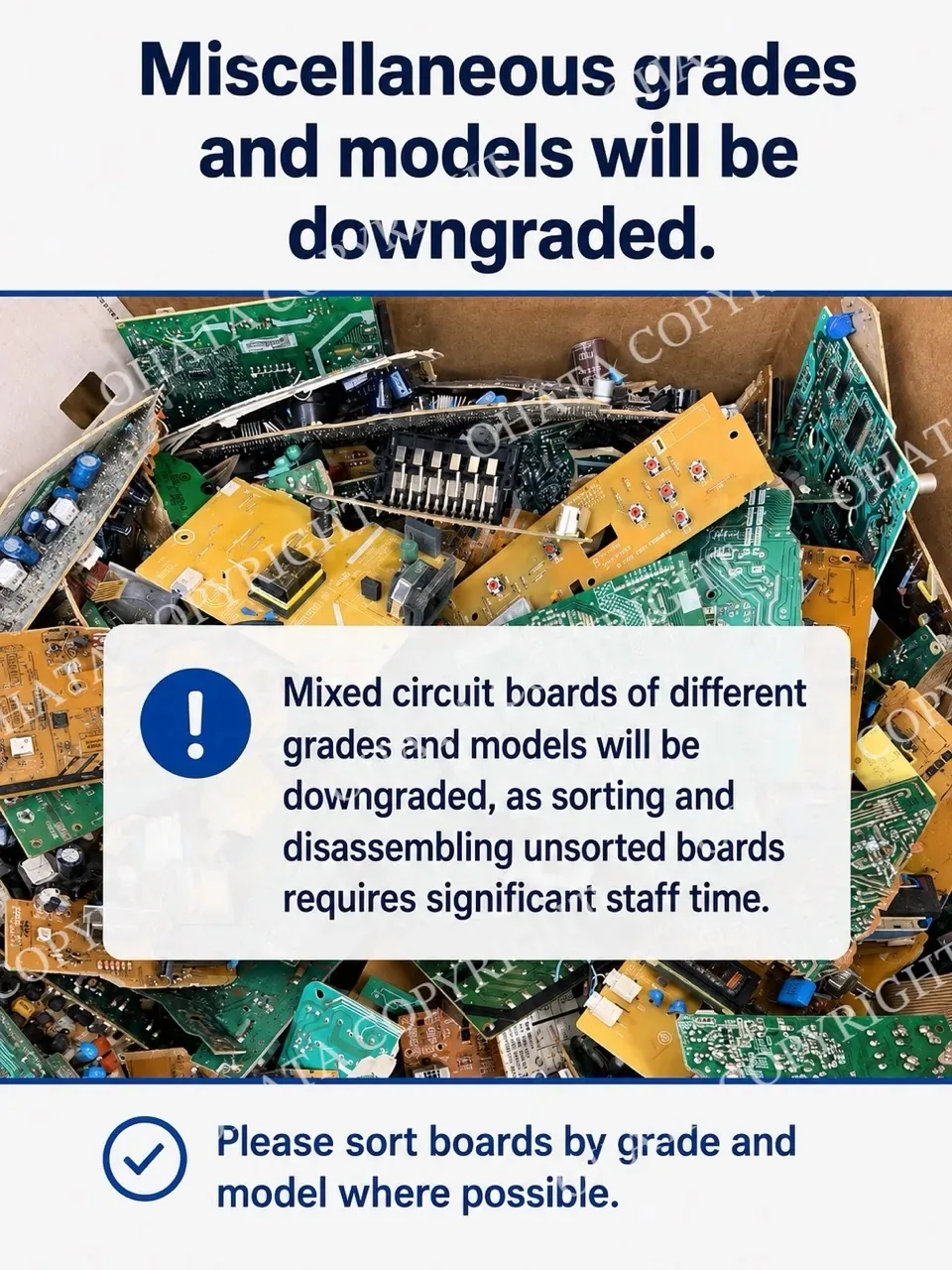
Keep D Grade computer boards separate from higher-grade boards, appliance boards, batteries, loose metal, and unrelated electronic waste whenever practical. Mixed material requires additional inspection and may receive a lower combined evaluation.
Circuit boards of different grades and models should be separated whenever practical. Mixed material requires additional sorting and may receive a lower combined evaluation.
Do not burn boards, scrape plated contacts, cut off gold fingers, remove soldered chips with uncontrolled heat, or apply chemicals to test for precious metals. These actions can reduce recoverable value and create health, fire, and environmental hazards.
Final classification is determined by the board’s type, socket or processor configuration, component density, connectors, attached materials, completeness, condition, recoverable-material profile, and current buying requirements.
The Senior Wiki Editor at Ohata.ai leads the development of accurate, comprehensive, and SEO-optimized knowledge content focused on electronic scrap recycling and AI-powered identification.
Working closely with recycling professionals, AI engineers, and industry experts, the editor ensures every wiki article meets high editorial standards for technical accuracy, clarity, and reliability.
The role includes researching emerging technologies, reviewing industry best practices, maintaining consistent editorial guidelines, and expanding Ohata.Ai's knowledge base with trusted educational resources.
Through high-quality content, the Senior Wiki Editor helps establish Ohata.ai as a leading global authority on electronics recycling, sustainable resource recovery, and AI-driven e-scrap identification.
Video
FAQ
1. What is D Grade circuit board scrap?
D Grade is an Ohata classification for qualifying lower-value computer boards, including modern desktop motherboards, selected console boards, and certain peripheral cards.
2. How can I identify a possible D Grade desktop motherboard?
Look for a consumer desktop layout with a metal-framed CPU socket, memory slots, expansion slots, storage connectors, and moderate component density. The complete board must still be compared with current Ohata requirements.
3. What is a metal CPU socket?
A metal CPU socket has a visible load plate, retention frame, or locking assembly that holds the processor in place. This construction is common on many Intel LGA desktop motherboards.
4. Does a metal CPU socket determine the grade?
A metal socket is an important identification feature, but the board’s application, processor configuration, component density, connectors, completeness, and condition must also be evaluated.
5. How are AMD AM and FM motherboards evaluated?
Qualifying AMD AM- and FM-platform boards may fall within D Grade when their complete consumer-board construction matches current Ohata examples. The socket name alone does not determine the classification.
6. Can game-console motherboards qualify as D Grade?
Selected console motherboards may qualify when they match current Ohata reference examples. Classification can vary between console families, hardware revisions, regional versions, and physical conditions.
7. Can removable CPUs and RAM be separated?
Yes. Removable CPUs and RAM modules may be evaluated separately. Soldered processors, GPUs, chipsets, memory packages, connectors, and original PCB sections should remain attached.
8. Do D Grade boards need to work?
Working condition is generally unnecessary because the boards are purchased for material recovery. They should remain identifiable, substantially complete, and safe to handle.
9. What may cause downgrading or rejection?
Removed soldered components, missing connectors, cut PCB sections, severe burning, corrosion, battery leakage, fragmentation, and heavy contamination may result in downgrading or rejection.
10. How should D Grade boards be prepared for inspection?
Keep the boards dry, reasonably clean, and separated from higher grades, appliance boards, batteries, and loose metal. Remove external hardware only when it can be done without damaging the circuit board.
Related articles
Explore more scrap wiki articles connected to this topic.