

Ohata HDD SATA Board Scrap Wiki
Introduction to HDD SATA Board
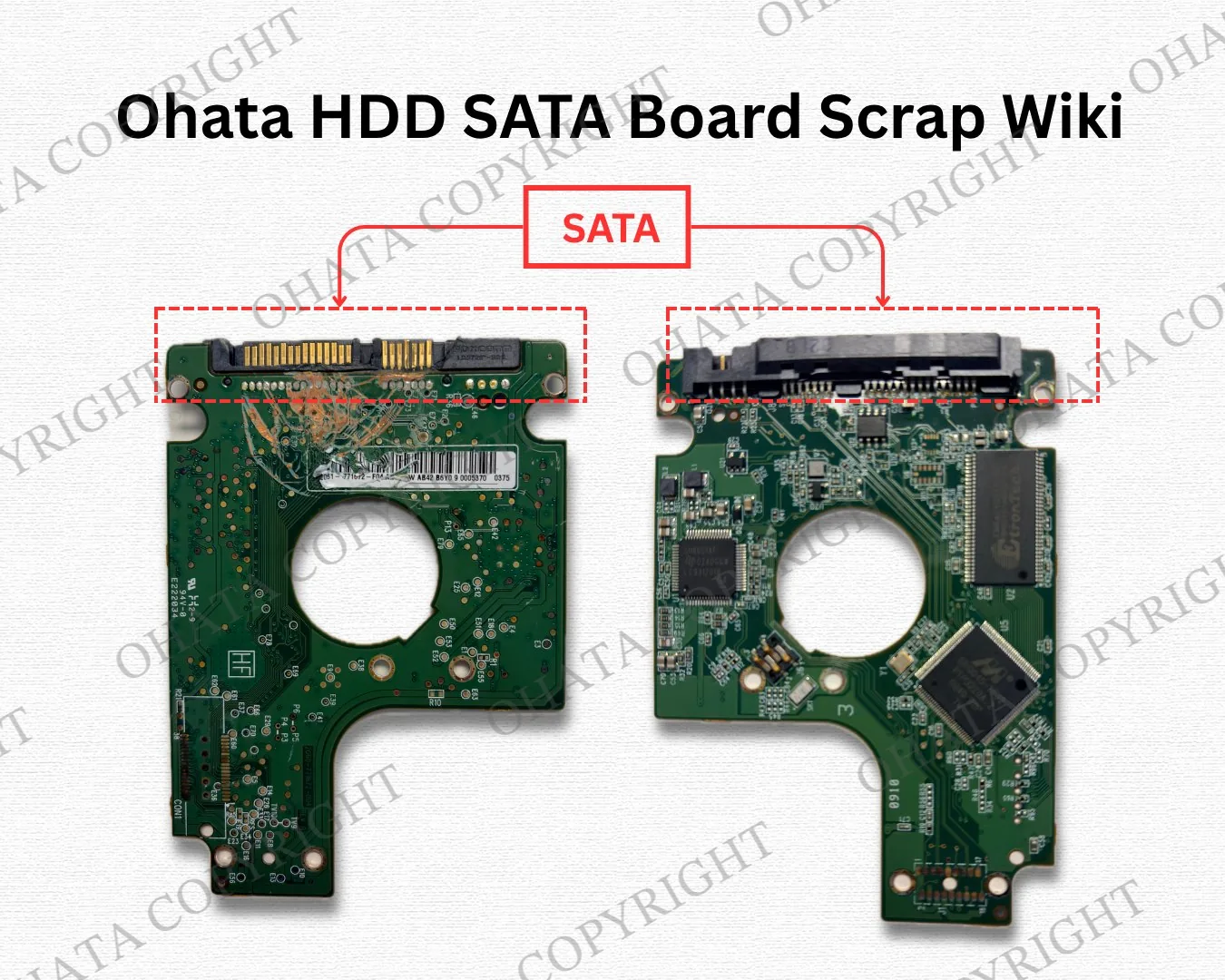
HDD SATA board scrap is the controller PCB removed from a mechanical hard drive that uses the standard SATA interface. The fastest visual check is the connector edge: a standard SATA HDD board has a 7-pin data connection beside a 15-pin power connection. Confirm the category by checking for a main controller ASIC, a spindle/actuator motor-driver IC, internal drive contact pads, and an irregular PCB outline shaped for a 2.5-inch or 3.5-inch hard-drive housing. This page covers the SATA interface category within the Ohata HDD Classification. It excludes SSD PCBs, USB bridge boards, optical-drive boards, and SAS or other non-SATA controller boards. Board completeness and condition are evaluated separately when determining the applicable buying category.
Within the Ohata HDD Classification System, hard drive controller boards are divided into only two categories: HDD SATA Board and HDD Non-SATA Board. This simplified classification allows recyclers, dismantlers, collectors, and AI recognition systems to quickly distinguish modern SATA controller boards from older legacy hard drive boards.
Although solid-state drives (SSDs) have become increasingly common in personal computers and enterprise storage systems, mechanical SATA hard disk drives remain widely used due to their large storage capacity, reliability, and lower cost per gigabyte. Desktop computers, servers, surveillance recorders, network attached storage (NAS), industrial automation systems, and external backup devices continue to rely on SATA hard drives, making HDD SATA Boards one of the most common electronic circuit boards entering the recycling industry.
From an electronic recycling perspective, HDD SATA Boards are considered specialized electronic scrap because they contain multilayer printed circuit boards, integrated circuits, copper conductors, gold-plated connector contacts, semiconductor materials, and numerous electronic components that can be recovered through environmentally responsible recycling. While these boards are relatively small compared with desktop motherboards, they represent an important category of recoverable electronic materials.
This educational wiki introduces the design, construction, identification, and recycling characteristics of HDD SATA Boards according to the Ohata HDD Classification System. The information is intended to help recyclers, businesses, students, and the public better understand these controller boards and their role within electronic recycling.
History of SATA Hard Disk Drives
Mechanical hard disk drives have been the primary method of computer data storage for decades. Early hard drives introduced during the mid-twentieth century were extremely large, expensive, and designed for enterprise computing. As personal computers became popular during the 1980s and 1990s, hard drives became smaller, more reliable, and affordable for home and business users.
Most hard drives produced during the 1990s used the Integrated Drive Electronics (IDE) interface, later standardized as Parallel ATA (PATA). These drives communicated through wide ribbon cables that transferred multiple bits of data simultaneously. Although IDE technology served the computer industry for many years, increasing storage capacities and faster processors eventually required a more efficient interface.
The introduction of Serial ATA (SATA) in the early 2000s represented a major advancement in storage technology. SATA replaced wide parallel ribbon cables with compact serial communication cables that improved airflow, simplified installation, increased transfer speeds, and enhanced signal integrity. The standardized SATA interface quickly became the global standard for desktop, laptop, and server hard drives.
Three major SATA generations were introduced:
SATA I – 1.5 Gb/s
SATA II – 3.0 Gb/s
SATA III – 6.0 Gb/s
These improvements encouraged manufacturers to redesign hard drive controller boards with more advanced processors, larger cache memory, improved firmware, and better power management. Companies such as Western Digital, Seagate, Toshiba, Samsung, Hitachi (HGST), and Fujitsu adopted the SATA standard across their product lines.
Today, despite the increasing use of SSDs, millions of SATA hard drives remain in service worldwide and continue to enter the recycling stream each year.
What is an HDD SATA Board?
An HDD SATA Board is the electronic controller responsible for operating a mechanical Serial ATA hard disk drive. Installed beneath the aluminum drive enclosure, the board connects directly to the spindle motor and read/write head assembly through precision electrical contacts.
The controller board functions as the drive's electronic management system. Every command issued by a computer—including reading files, writing new information, performing diagnostics, and correcting data errors—is processed through this board before reaching the magnetic storage media.
Its primary responsibilities include:
Managing SATA communication
Controlling spindle motor speed
Operating the actuator arm
Reading and writing magnetic data
Executing firmware
Managing cache memory
Performing error correction
Monitoring SMART health information
Regulating electrical power
Protecting internal components
Without the controller board, a hard disk drive cannot function or communicate with a computer.
HDD SATA Board Construction
HDD SATA Boards are manufactured using multilayer FR-4 fiberglass epoxy laminate, one of the most common materials used in modern printed circuit board production. Multiple copper layers are laminated together to create complex electrical pathways while maintaining a compact overall size.
Unlike rectangular desktop motherboards, HDD SATA Boards have irregular outlines specifically designed to match the dimensions of the hard drive housing. Each board contains precision mounting holes, electrical contact pads, and carefully positioned electronic components that allow reliable operation in demanding environments.
Most boards include:
Multilayer copper circuitry
Surface-mounted electronic components
Gold-plated connector contacts
High-density integrated circuits
Protective solder mask
Silkscreen component markings
Precision contact pads
Mounting holes
The board is engineered to operate continuously under vibration, temperature fluctuations, and long-term use while maintaining stable communication with the host computer.
Major Electronic Components
Although compact, an HDD SATA Board contains several sophisticated electronic systems that work together to control the hard drive.
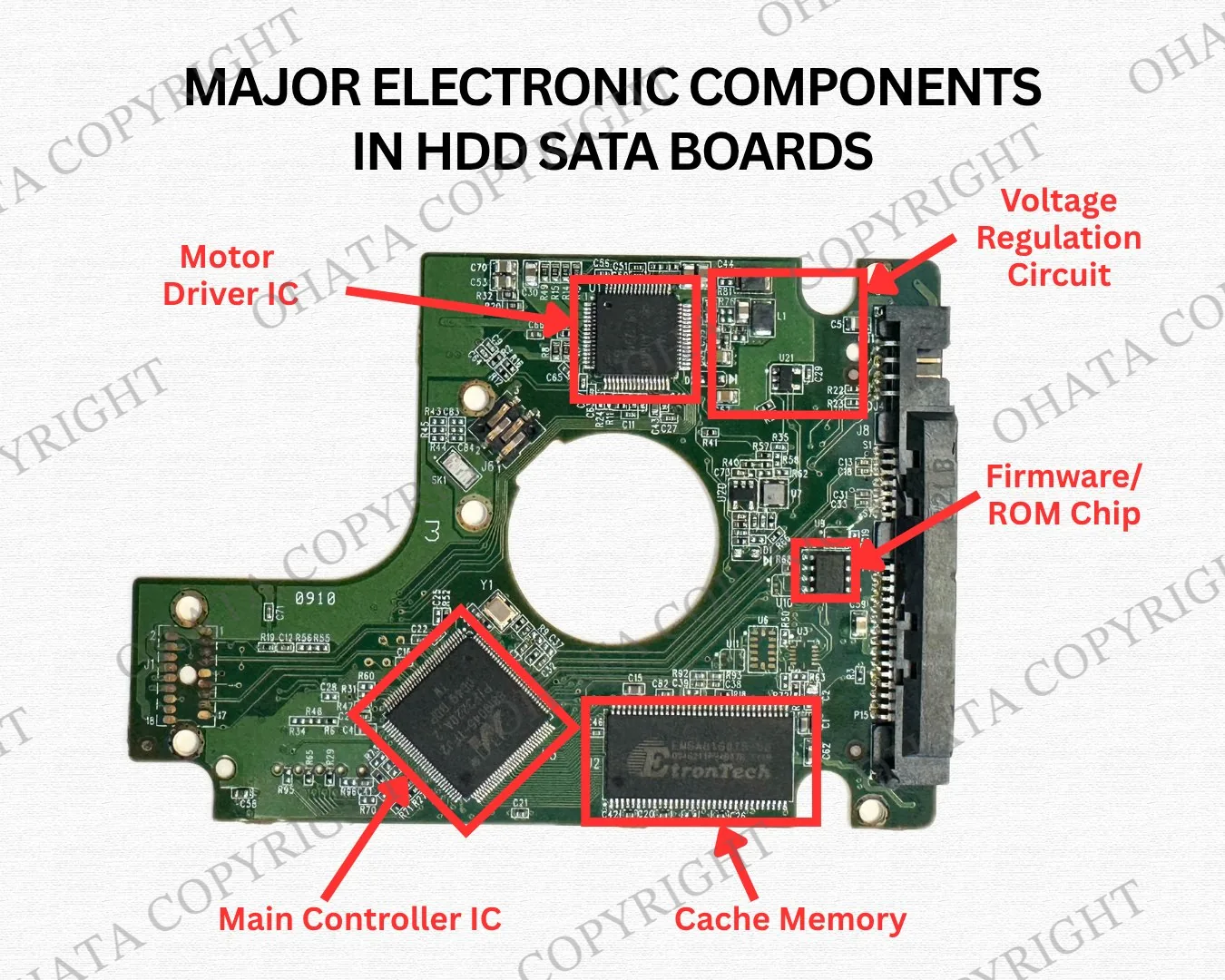
Main Controller IC (ASIC)
The largest integrated circuit on the board is the controller processor, often referred to as the Application-Specific Integrated Circuit (ASIC). It manages data processing, firmware execution, error correction, and communication with the computer.
Cache Memory
Most SATA Boards contain dedicated memory that temporarily stores data during read and write operations. Cache memory improves overall performance by reducing access delays.
Motor Driver IC
The motor driver controls both the spindle motor and the voice coil actuator, allowing precise rotation of the platters and accurate positioning of the read/write heads.
Firmware / ROM Chip
Some boards include a dedicated ROM chip that stores factory calibration data and firmware unique to the individual drive. Newer designs often integrate this function into the controller processor.
Voltage Regulation Circuit
Incoming electrical power is converted into stable operating voltages through voltage regulators, MOSFETs, inductors, capacitors, and protection devices.
Passive Components
Numerous miniature resistors, capacitors, oscillators, ferrite beads, and filters ensure reliable electrical performance and signal stability.
SATA Interface and Connector
The defining feature of an HDD SATA Board is its standardized Serial ATA interface. Every SATA Board includes two easily recognizable connectors:
7-pin SATA Data Connector
15-pin SATA Power Connector
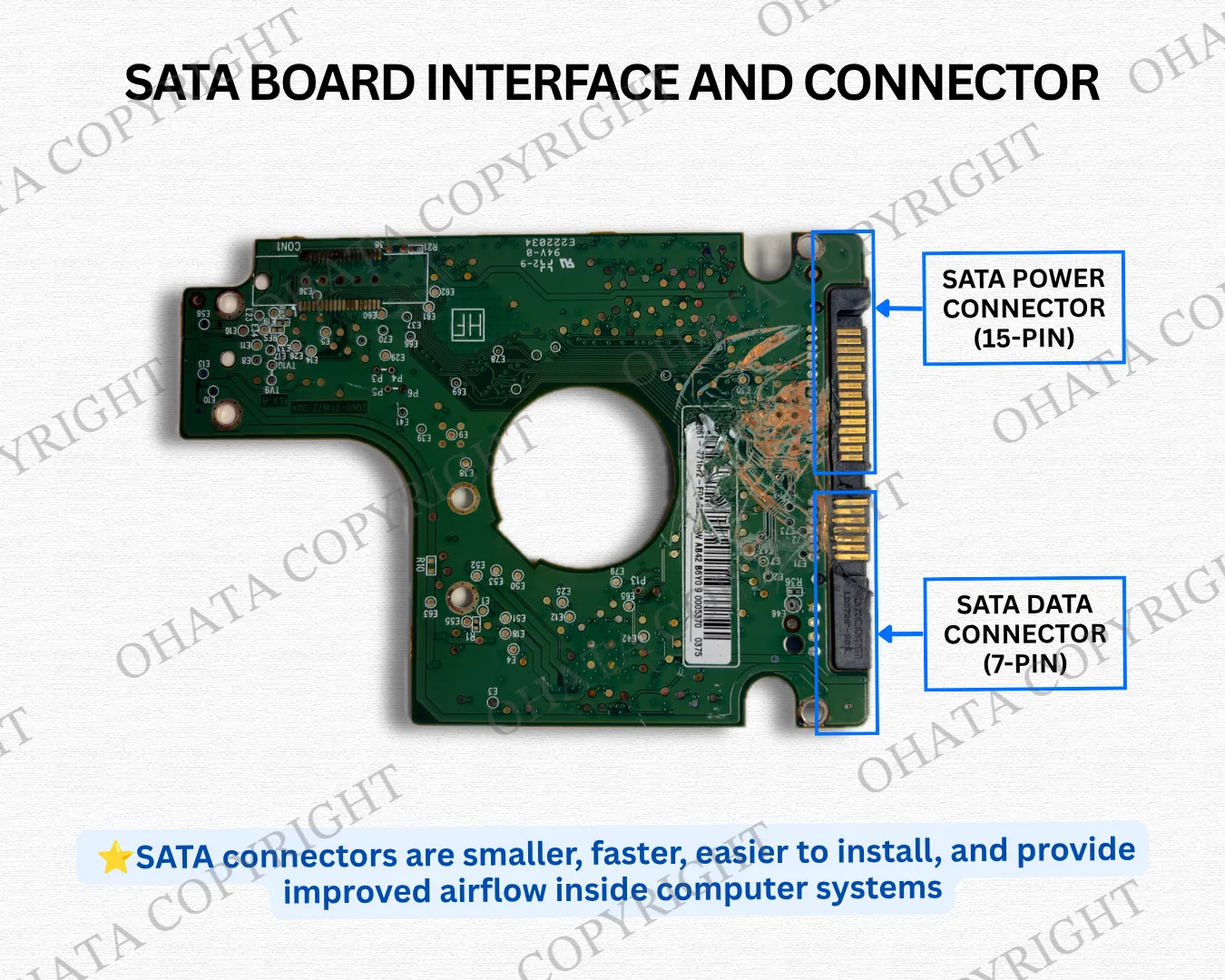
The data connector transfers information between the hard drive and the motherboard, while the power connector supplies the voltages required by the controller board and spindle motor.
Compared with earlier IDE interfaces, SATA connectors are smaller, faster, easier to install, and provide improved airflow inside computer systems. The connector contacts are plated with a thin layer of gold to improve electrical conductivity and resist corrosion during long-term use.
The presence of these two connectors is one of the most reliable methods of identifying an HDD SATA Board.
PCB Design and Manufacturing
HDD SATA Boards are produced using highly automated manufacturing processes. The production sequence generally includes:
Multilayer PCB fabrication
Copper circuit etching
CNC drilling
Through-hole plating
Solder mask application
Silkscreen printing
Surface finish plating
Automated component placement
Reflow soldering
Optical inspection
Electrical testing
Most boards use a green solder mask, although blue or black finishes may occasionally be encountered. The completed PCB is designed for years of continuous operation under demanding environmental conditions.
Western Digital, Seagate, Toshiba, Hitachi, Samsung, and Fujitsu SATA Boards
Several manufacturers have produced SATA hard drives over the past two decades, each using proprietary controller board layouts while maintaining the same basic architecture.
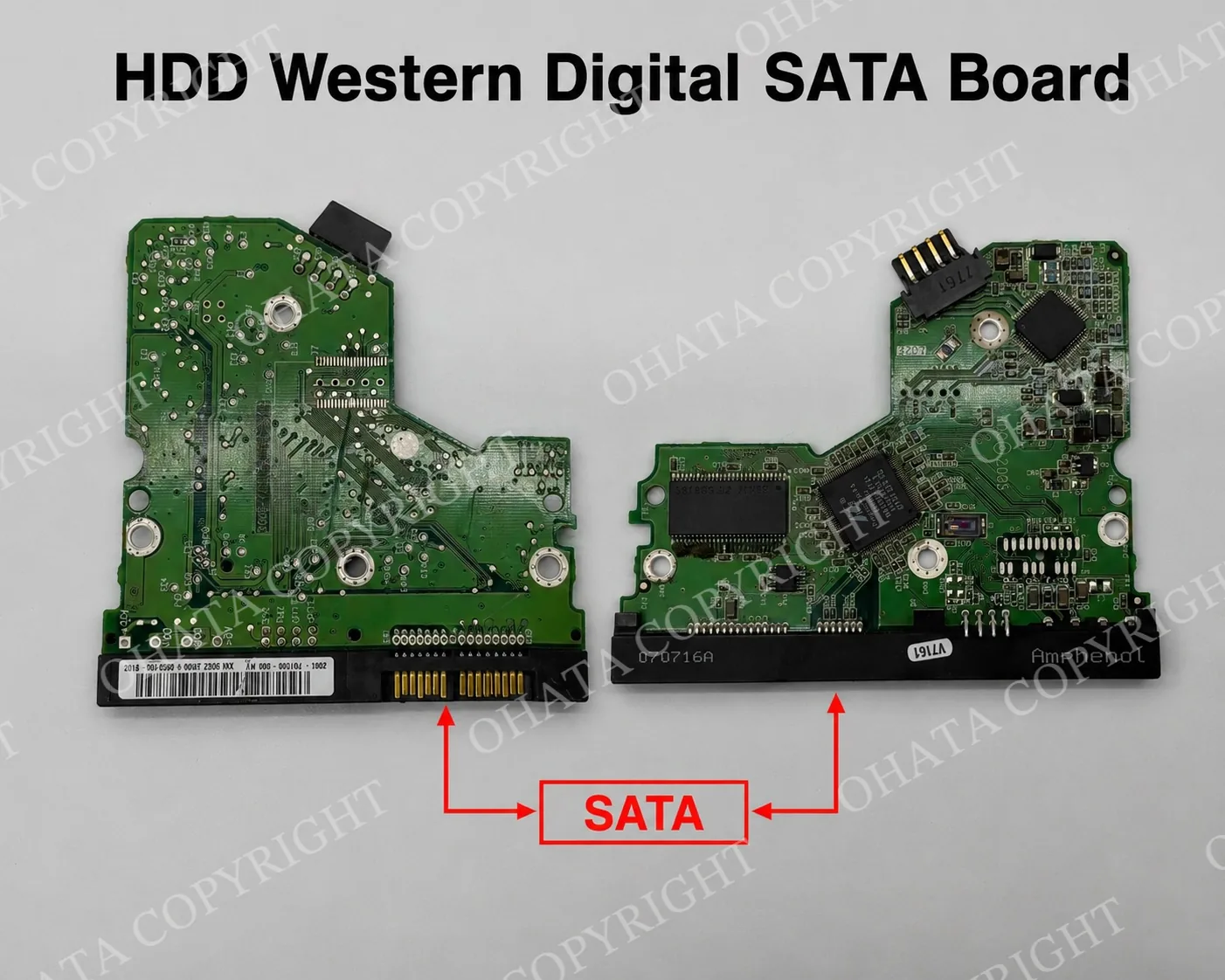
Western Digital (WD) boards are widely recognized for their compact layouts and proprietary controller designs.
Seagate boards are common in consumer, enterprise, and surveillance storage systems.
Toshiba SATA Boards are frequently used in laptops, desktops, and industrial equipment.
Hitachi (HGST) boards are known for their durability and enterprise applications.
Samsung produced SATA hard drives before focusing primarily on solid-state storage products.
Fujitsu manufactured SATA hard drives for notebook computers and business systems.
Although component placement varies, all of these manufacturers use the standardized SATA interface and similar controller architectures.
Related Scrap Prices:
HDD SATA Board Scrap Identification Guide
Under the Ohata HDD Classification System, HDD SATA Boards can be identified using several consistent characteristics:
Mounted beneath a mechanical hard drive
7-pin SATA data connector
15-pin SATA power connector
Large controller processor
Motor driver IC
Cache memory chip
Voltage regulation circuitry
Multiple Torx mounting holes
Gold-plated connector contacts
High-density surface-mounted components
Electrical contact pads connecting to the internal drive mechanism
These features clearly distinguish HDD SATA Boards from HDD Non-SATA Boards and other categories of electronic circuit boards.
Physical Characteristics
HDD SATA Boards share several distinctive physical features regardless of manufacturer. They are compact, lightweight, and irregularly shaped to fit the aluminum housing of the hard drive. Most boards use a green FR-4 fiberglass substrate with white silkscreen markings and a protective solder mask.
Typical characteristics include:
Custom-shaped PCB
Multilayer fiberglass construction
Green solder mask
Gold-plated SATA connectors
Fine copper circuitry
Surface-mounted integrated circuits
Precision mounting holes
Gold-plated internal contact pads
Compact overall dimensions
High-density electronic component layout
These physical characteristics provide the foundation for accurate identification under the Ohata HDD Classification System and support consistent sorting in electronic recycling operations.
Front Side Identification
The front side of an HDD SATA Board is the primary component side of the printed circuit board (PCB) and contains nearly all of the electronic devices responsible for operating the hard disk drive. Under the Ohata HDD Classification System, this side provides the most reliable visual characteristics for identifying an HDD SATA Board.
After the board is removed from the underside of a hard disk drive, the front side immediately reveals the overall component layout. Although manufacturers such as Western Digital, Seagate, Toshiba, Hitachi (HGST), Samsung, and Fujitsu use different PCB designs, the basic architecture remains similar. Most boards feature one large controller integrated circuit positioned near the center, a cache memory chip, a motor driver IC, voltage regulation components, and numerous miniature surface-mounted resistors and capacitors.
The standardized SATA interface is also located on the front side. The 7-pin SATA data connector and 15-pin SATA power connector are positioned along one edge of the board and are among the easiest features to recognize.
Typical front-side characteristics include:
Large controller processor (ASIC)
Cache memory IC
Motor driver IC
Voltage regulation circuit
SATA data connector
SATA power connector
Surface-mounted passive components
White silkscreen markings
Manufacturer part numbers
Multiple Torx mounting holes
Gold-plated connector contacts
The arrangement of these components allows recyclers and AI recognition systems to identify HDD SATA Boards quickly without relying on model numbers.
Back Side Identification
The reverse side of an HDD SATA Board generally contains fewer electronic components than the front. Its primary purpose is to provide structural support, electrical routing, and connection points between the controller board and the internal mechanical components of the hard drive.
One of the most distinctive features found on the back side is the collection of gold-plated contact pads. These contact pads align with spring-loaded connectors inside the drive and transfer electrical signals to the spindle motor and read/write head assembly. Unlike removable cable connectors, these precision contacts provide a reliable connection while maintaining the sealed environment of the hard drive.
Additional features commonly found on the reverse side include:
Gold-plated internal contact pads
Ground planes
PCB revision markings
Manufacturing codes
Test points
Limited passive components
Solder joints from surface-mounted devices
Mounting holes
Some controller boards contain a small number of resistors or capacitors on the reverse side, while others are nearly free of components. Regardless of the layout, the reverse side remains an important aid for confirming board authenticity and supporting accurate identification.
Controller IC Identification
The Controller Integrated Circuit (Controller ASIC) is the largest and most important semiconductor found on the HDD SATA Board. Often referred to as the "brain" of the hard drive, it manages virtually every electronic operation performed by the storage device.
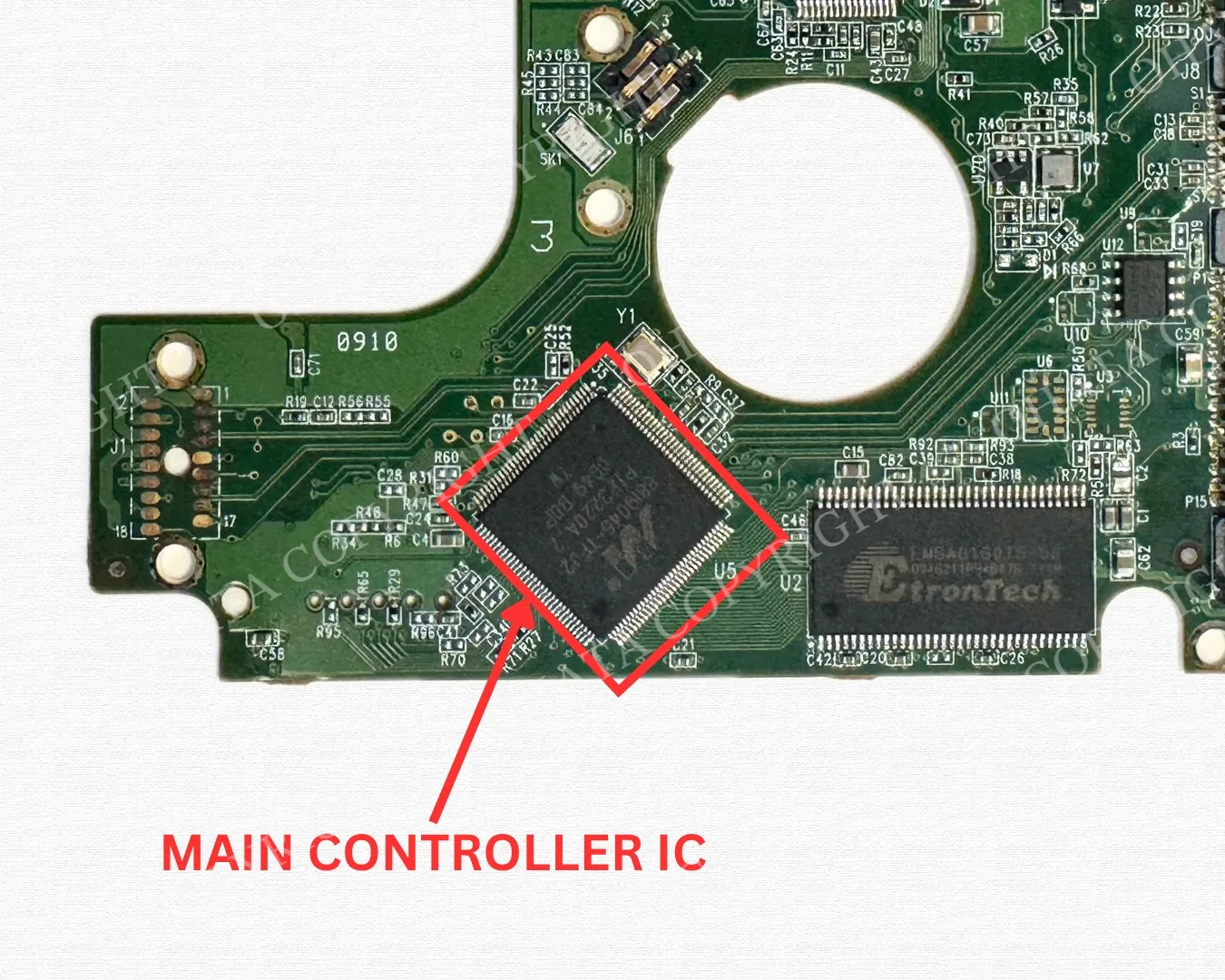
Primary responsibilities include:
SATA communication
Firmware execution
Data processing
Error correction
Cache memory management
SMART diagnostics
Read and write control
Drive initialization
Internal system monitoring
Controller processors are commonly manufactured by companies such as Marvell, Broadcom, LSI, or developed directly by hard drive manufacturers.
Identification characteristics include:
Largest integrated circuit on the board
Square or rectangular package
Fine-pitch Ball Grid Array (BGA)
Manufacturer logo
Part number
Laser markings
Central PCB location
Because of its complexity and semiconductor content, the controller IC represents one of the most valuable electronic components on the board from an engineering perspective.
Cache Memory Identification
Most HDD SATA Boards include dedicated cache memory, also called buffer memory, which temporarily stores data during read and write operations. By reducing access delays, cache memory improves overall hard drive performance.
Depending on the drive model, cache capacities may range from 8 MB in older consumer drives to 256 MB or more in newer enterprise storage products.
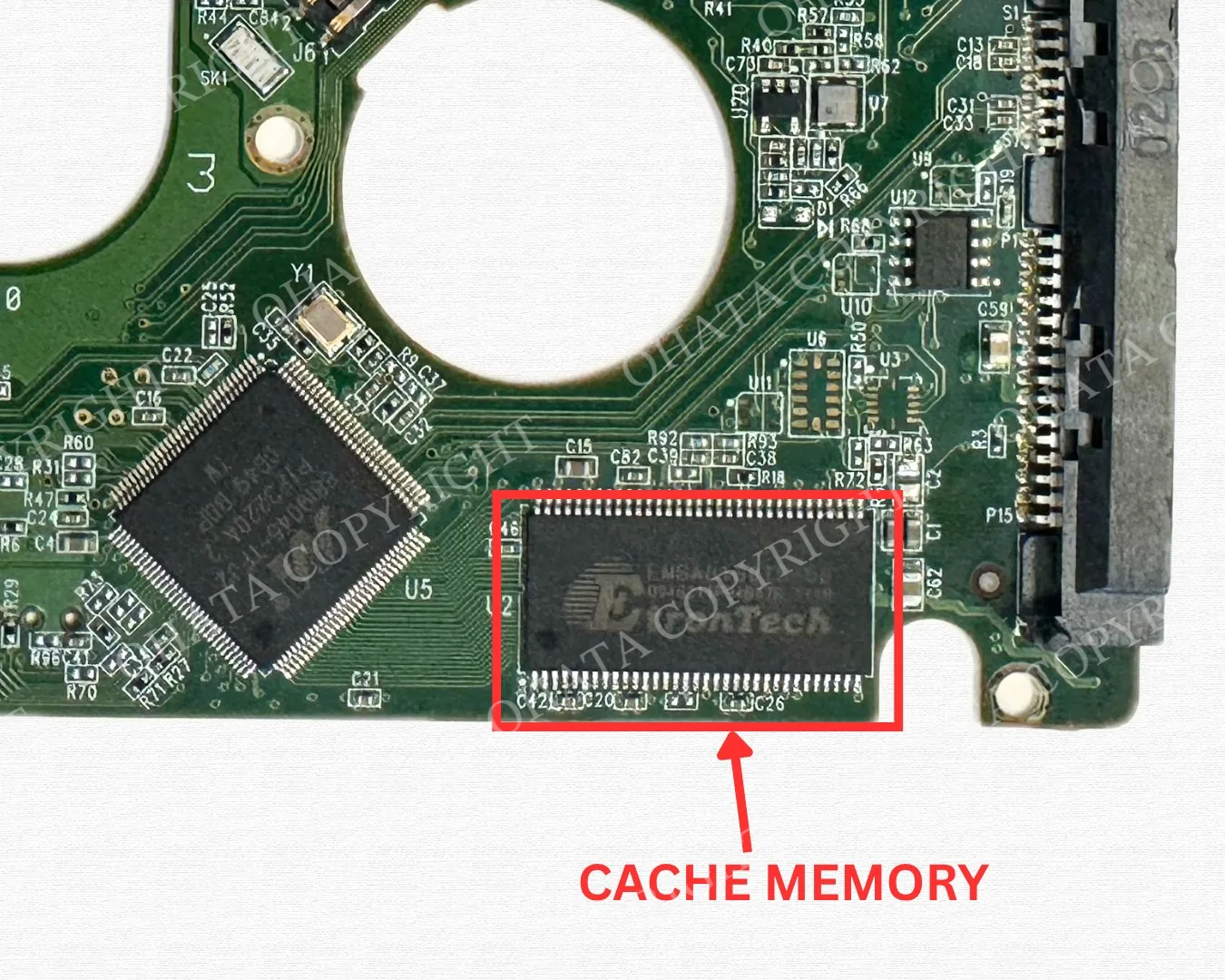
Common cache memory manufacturers include:
Samsung
Micron
SK hynix
Winbond
Nanya
Etron
Elpida
The cache memory chip is typically located close to the controller processor to minimize signal distance and improve communication speed.
Typical identification features include:
Rectangular integrated circuit
Fine-pitch surface-mount package
Manufacturer markings
Memory capacity code
Positioned beside the controller IC
Although smaller than the controller processor, cache memory is a standard feature on nearly all modern SATA controller boards.
Motor Driver IC
The Motor Driver Integrated Circuit controls the electromechanical operation of the hard drive. It supplies power to the spindle motor and precisely positions the actuator arm carrying the read/write heads.
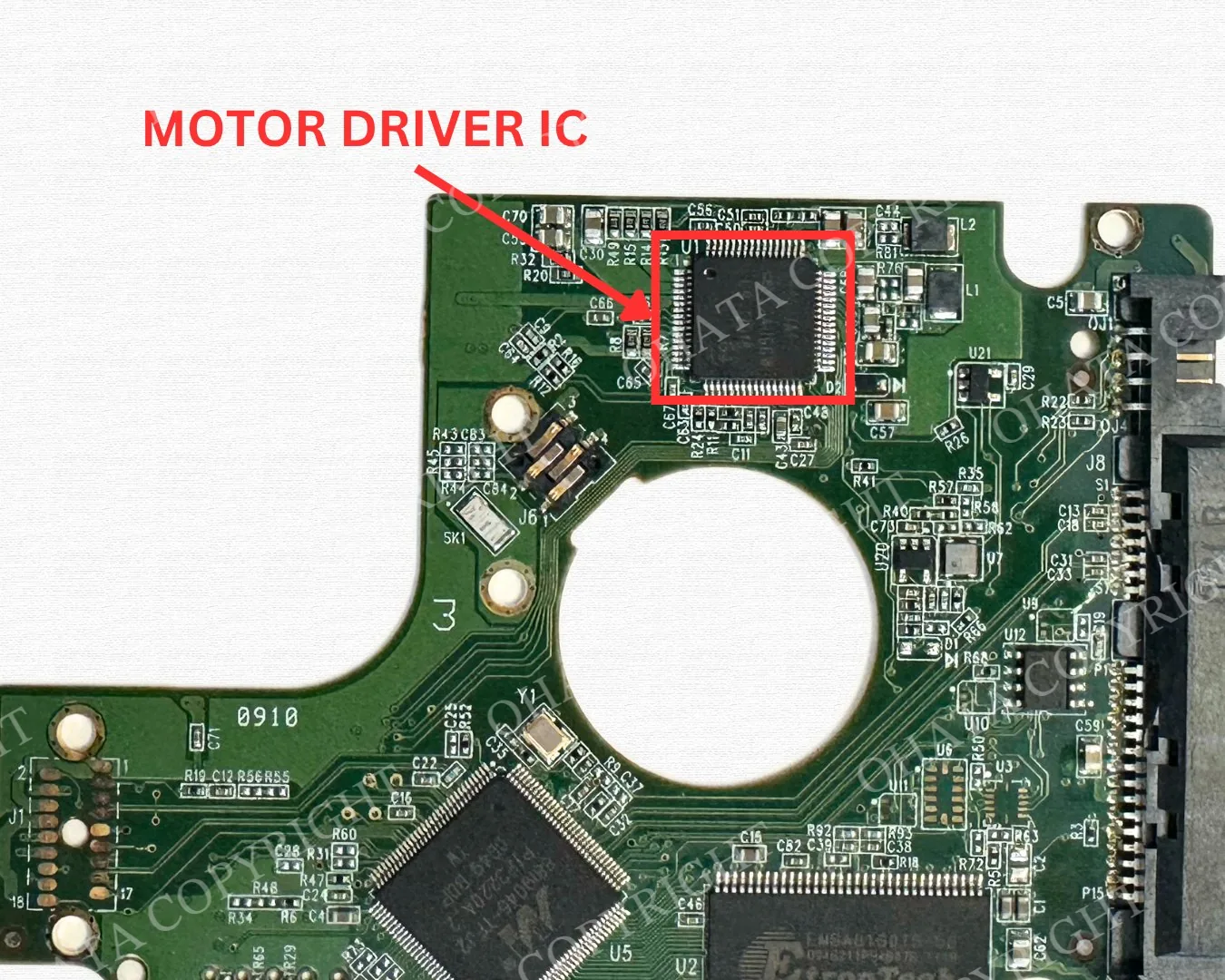
The motor driver is responsible for:
Starting platter rotation
Maintaining rotational speed
Controlling the voice coil actuator
Positioning recording heads
Managing acceleration and braking
Monitoring motor performance
Because it handles relatively high electrical currents, the motor driver is usually located near the internal motor contact pads and surrounded by wider copper traces for improved heat dissipation.
Common identification features include:
Medium-sized integrated circuit
Located near motor contacts
Connected to thicker copper pathways
Multiple power pins
Adjacent voltage regulation components
Without the motor driver IC, the hard drive cannot rotate or access stored data.
Firmware / ROM Chip
The firmware chip stores the software required to initialize and operate the hard drive. It contains information unique to each drive, including factory calibration values, adaptive parameters, hardware configuration, and startup instructions.
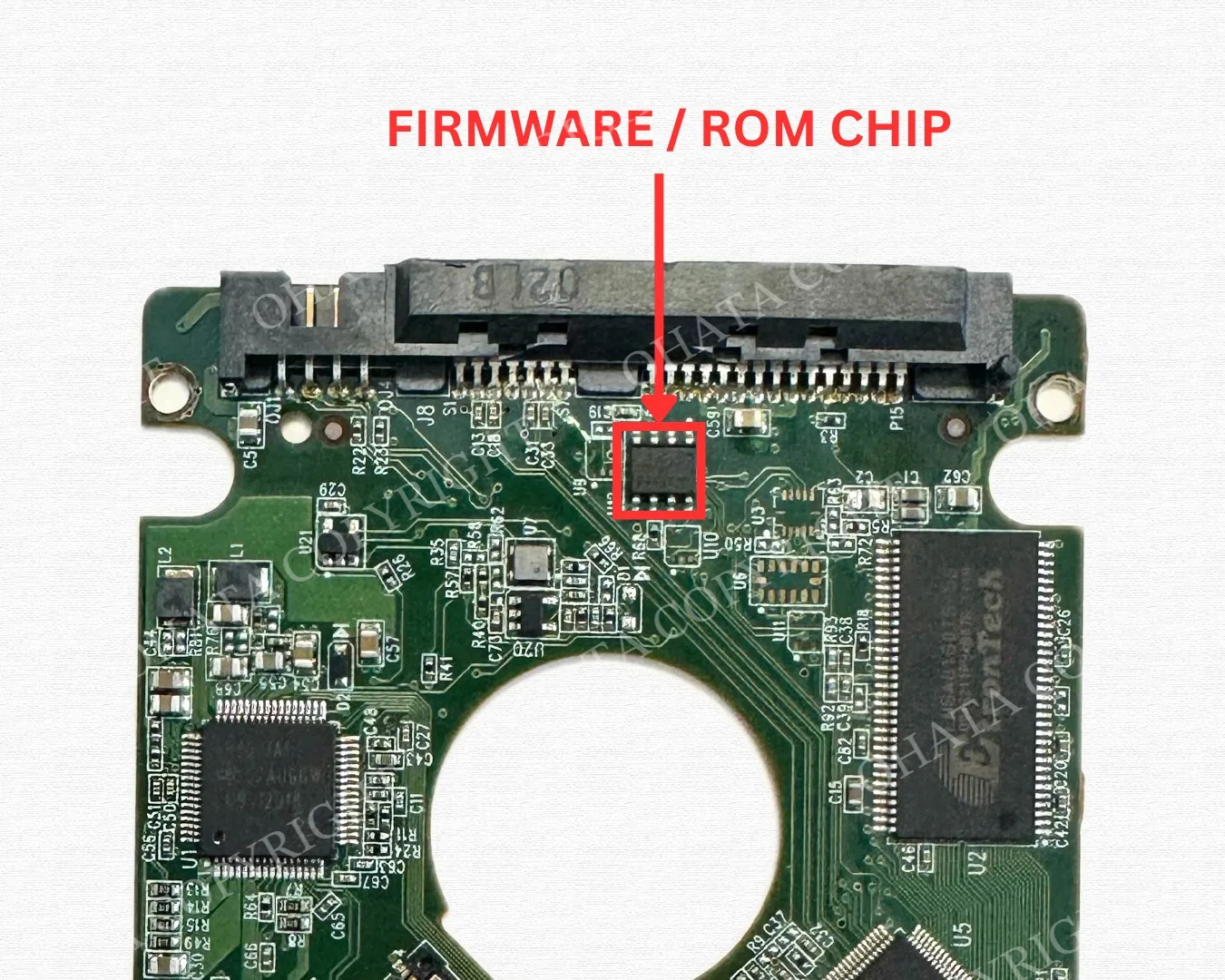
Earlier SATA Boards commonly included a separate ROM integrated circuit, while many newer designs incorporate firmware directly into the controller processor.
When present, the firmware chip is typically:
Small
Eight-pin surface-mounted package
Positioned near the controller processor
Marked with memory manufacturer information
Although physically small, the firmware chip is essential to proper hard drive operation because it contains calibration data specific to the individual drive.
Voltage Regulation Circuit
Incoming electrical power from the SATA power connector must be converted into stable operating voltages before reaching sensitive electronic components.
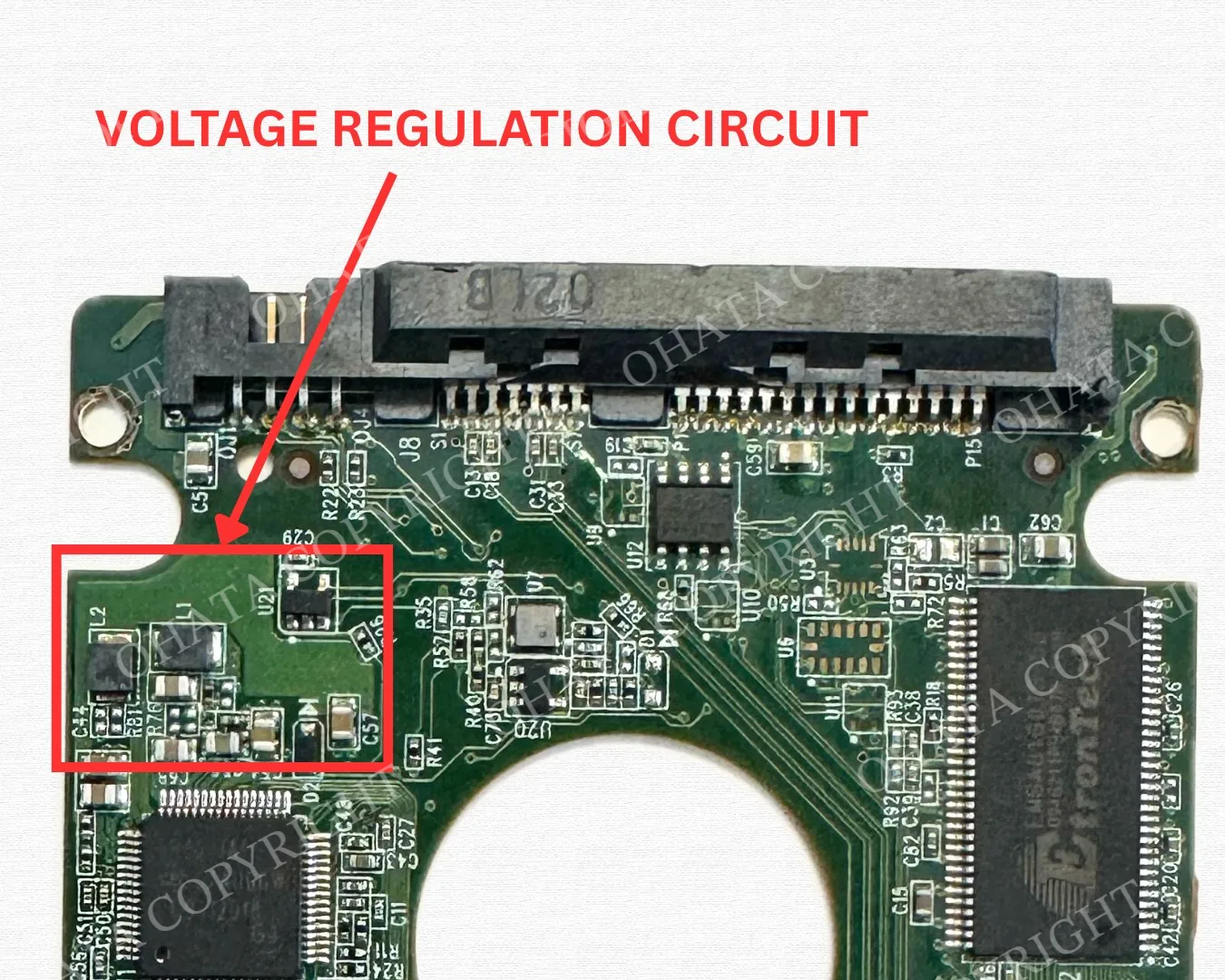
The voltage regulation circuit generally consists of:
Voltage regulators
MOSFETs
Inductors
Ceramic capacitors
Electrolytic capacitors
Protection diodes
Current sensing resistors
Its primary functions include:
Voltage conversion
Current regulation
Electrical filtering
Reverse polarity protection
Over-voltage protection
Noise suppression
Stable power distribution
This circuit is normally positioned near the SATA power connector to regulate incoming electrical power before it reaches the remainder of the controller board.
Recoverable Materials
Although compact, HDD SATA Boards contain numerous recoverable materials suitable for professional electronic recycling.
Common recoverable materials include:
Copper
Fiberglass (FR-4)
Silicon semiconductors
Tin solder
Nickel plating
Aluminum (limited)
Gold plating
Small quantities of silver
Trace amounts of palladium
Professional recycling facilities recover these materials using specialized mechanical and metallurgical processes designed to maximize material recovery while minimizing environmental impact.
Precious Metal Content
HDD SATA Boards contain relatively small amounts of precious metals compared with telecommunications boards or high-grade server electronics. However, these metals remain valuable because of their excellent electrical properties.
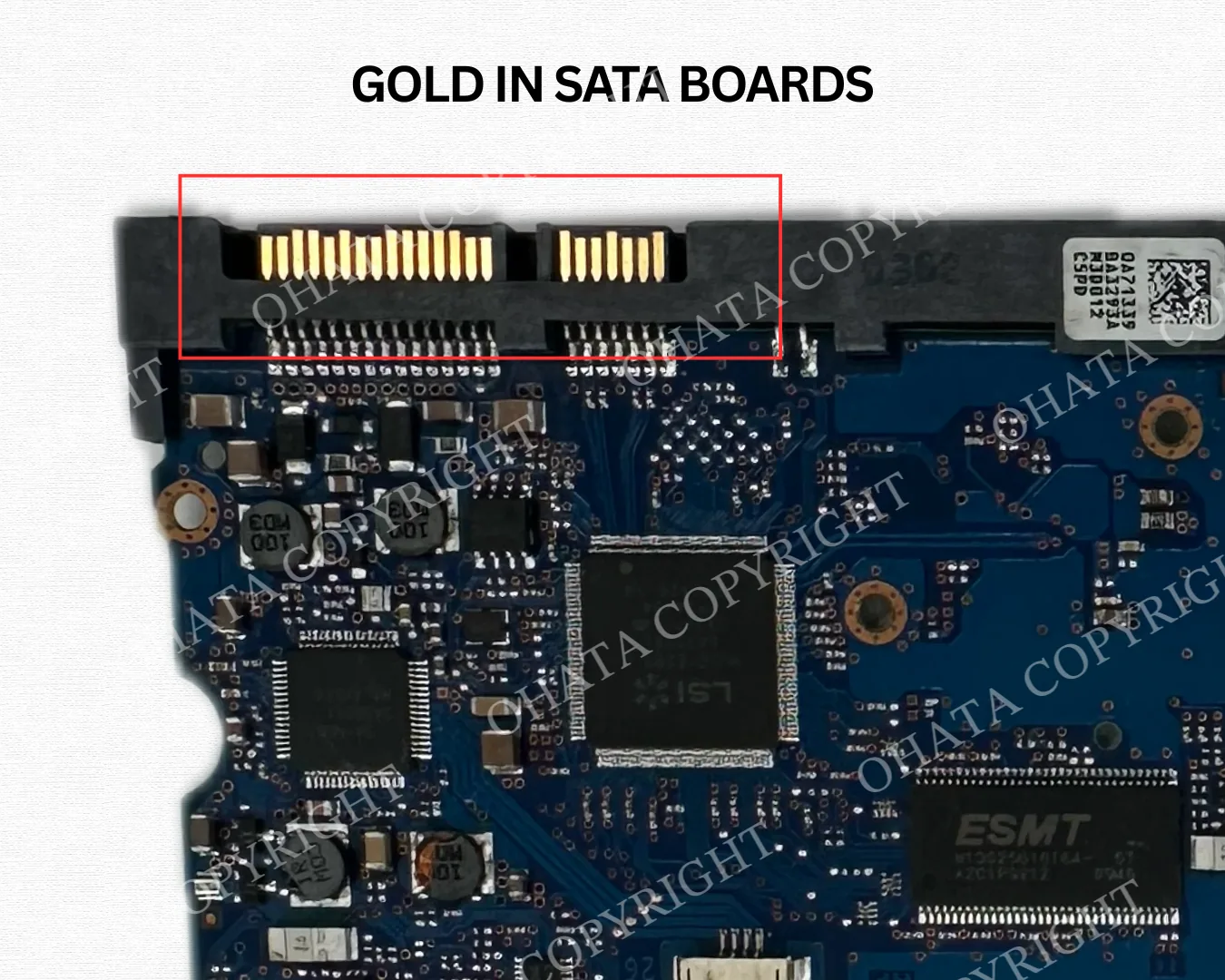
Gold
Gold is commonly found on:
SATA connector contacts
Internal contact pads
Integrated circuit bonding wires (primarily in older devices)
Selected PCB surface finishes
Silver
Silver may be present in:
Lead-free solder alloys
Certain electronic contacts
Ceramic component terminations
Palladium
Very small quantities of palladium may be found within multilayer ceramic capacitors (MLCCs), depending on manufacturing generation and component supplier.
Although the precious metal content per board is modest, these materials contribute to the overall recycling value when processed in large quantities.
Copper and Base Metals
Copper is the primary recoverable metal within an HDD SATA Board. It forms the conductive pathways that connect every electronic component on the multilayer PCB.
Copper is present in:
Internal PCB layers
Surface copper traces
Ground planes
Power distribution circuits
Contact pads
Through-hole plating
Additional base metals include:
Tin (solder)
Nickel (connector underplating)
Aluminum (minor structural parts)
Iron (mounting hardware)
Silicon (semiconductor wafers)
Together, these materials make HDD SATA Boards an important category of electronic scrap despite their relatively small size.
Gold-Plated SATA Contacts
The gold-plated SATA connectors are one of the defining characteristics of an HDD SATA Board and serve as an important identification feature under the Ohata HDD Classification System.
Every SATA controller board includes:
7-pin SATA Data Connector
15-pin SATA Power Connector
The connector terminals are coated with a thin layer of gold to improve conductivity, resist oxidation, and maintain reliable electrical connections throughout the service life of the hard drive.
Although the quantity of gold is extremely small, these contacts remain one of the most recognizable features of SATA Boards. Their standardized design allows recyclers, technicians, and AI recognition systems to distinguish HDD SATA Boards quickly from older HDD Non-SATA Boards and other categories of electronic circuit boards.
Electronic Scrap Recycling Process
When a hard disk drive reaches the end of its service life, the HDD SATA Board remains a valuable electronic component that can be recovered through responsible recycling. Unlike ordinary waste disposal, electronic recycling focuses on recovering reusable metals and electronic materials while preventing hazardous substances from entering the environment. Under the Ohata HDD Classification System, HDD SATA Boards are identified and separated from other electronic circuit boards before material recovery begins.
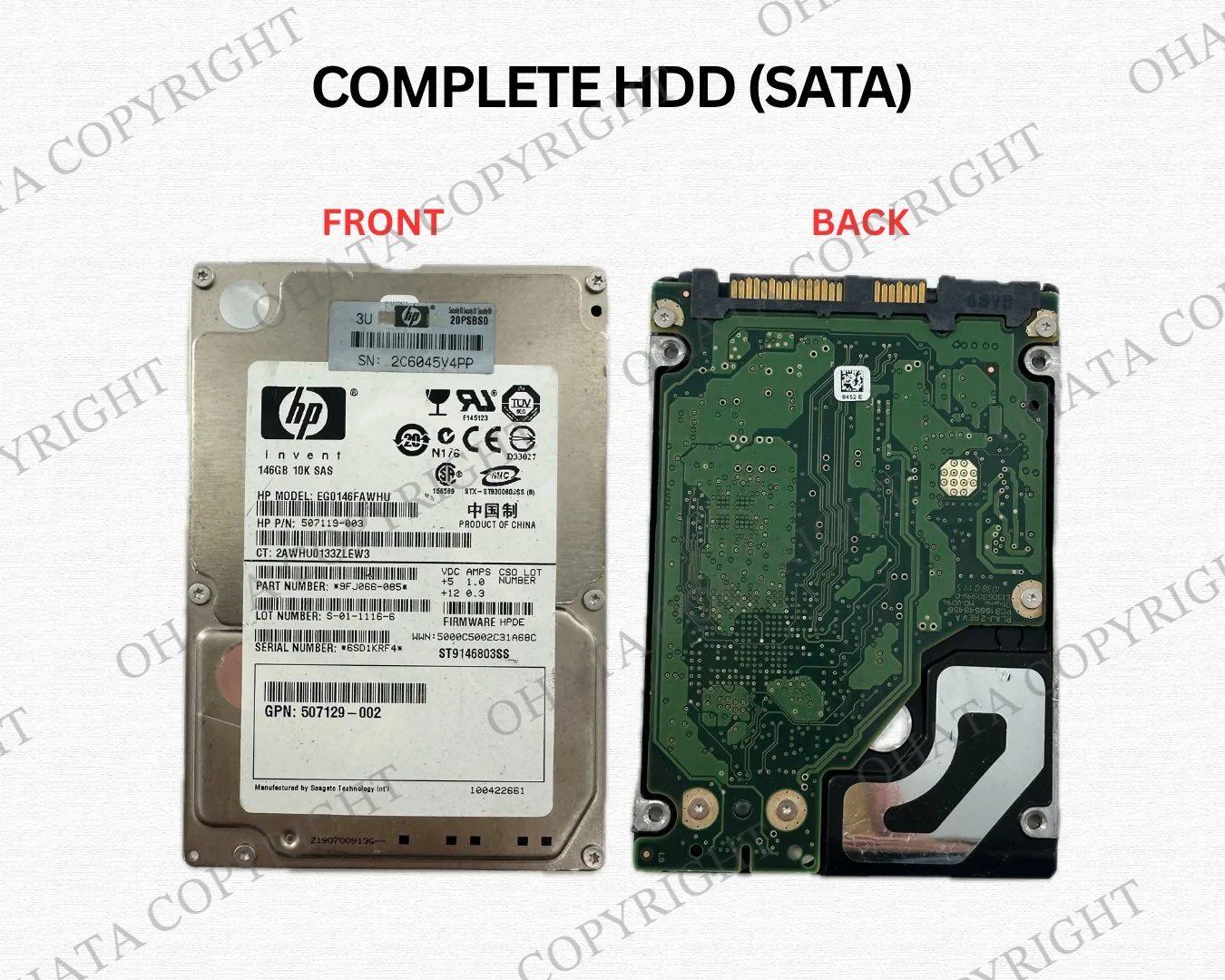
The recycling process generally starts with the collection of obsolete hard drives from households, businesses, data centers, computer repair shops, government organizations, and industrial facilities. Before any dismantling takes place, many organizations perform certified data destruction to protect confidential information stored on the magnetic platters.
After data destruction, technicians manually disassemble the hard drive by removing the Torx screws securing the controller board. The HDD SATA Board is separated from the aluminum housing, steel cover, magnets, platters, spindle motor, and other mechanical components. Each material is sorted into its appropriate recycling stream.
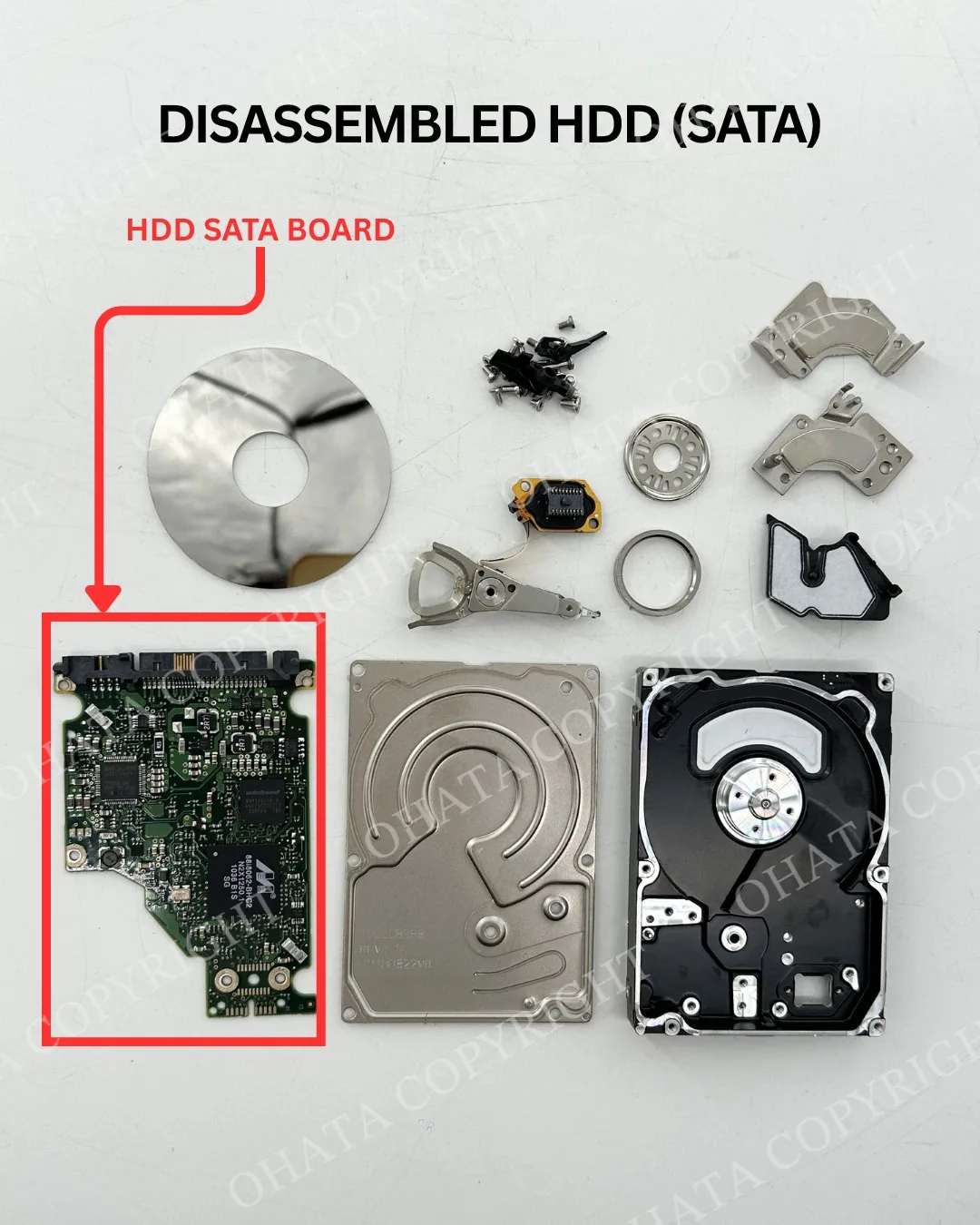
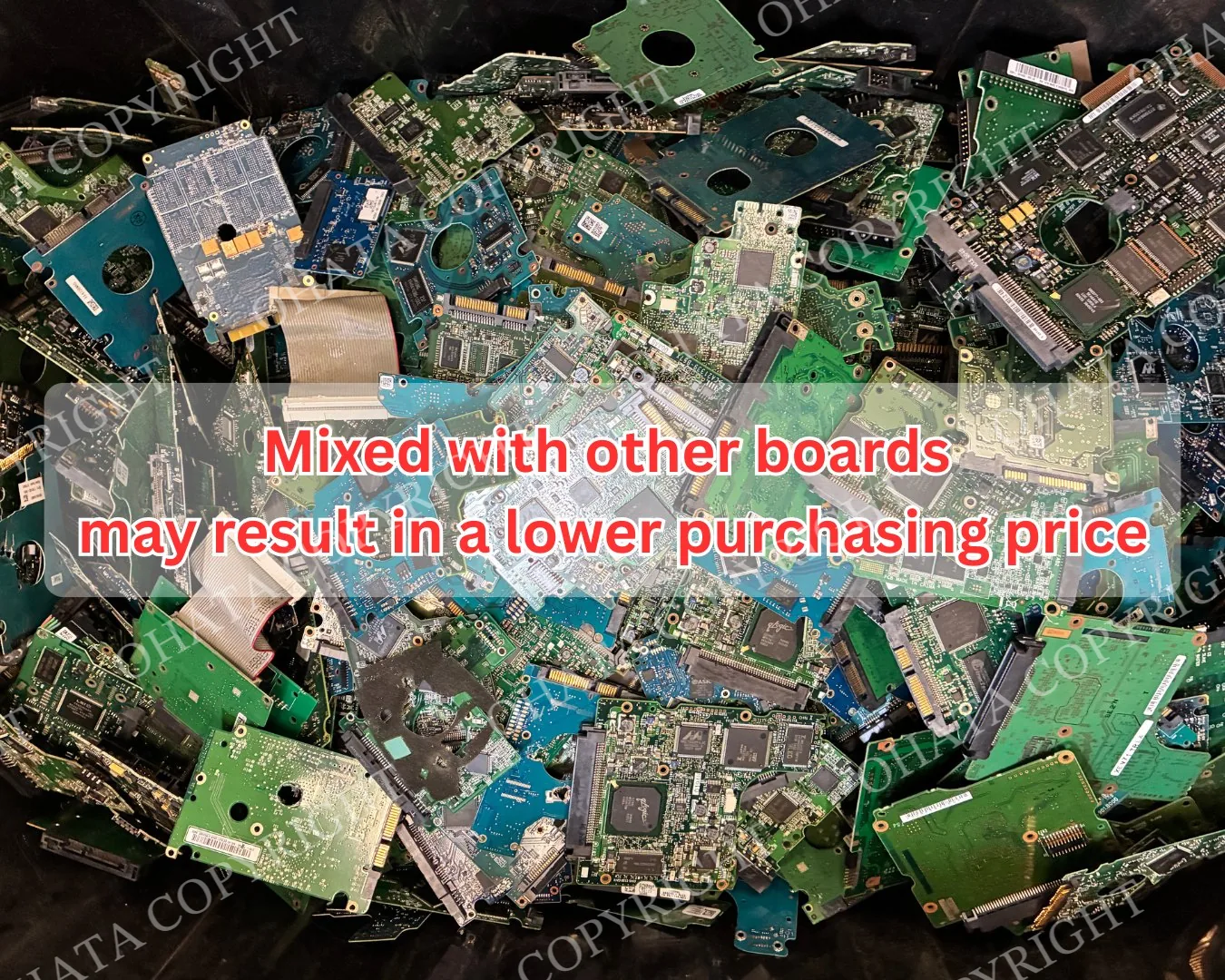
The controller boards are then inspected and classified according to their physical characteristics. HDD SATA Boards are grouped separately from HDD Non-SATA Boards to maintain consistent identification and simplify downstream recycling.
Following sorting, the boards are prepared for material recovery. Depending on the recycling facility, processing may include mechanical size reduction, metal separation, and specialized refining techniques that recover copper, precious metals, and other reusable materials. The recovered raw materials can then be used in the manufacture of new electronic products, reducing the need for virgin mining and conserving natural resources.
Common Sources of HDD SATA Boards
HDD SATA Boards are recovered from a wide variety of electronic equipment. Because SATA technology became the dominant storage interface during the early 2000s, these controller boards are now one of the most common categories of electronic scrap.
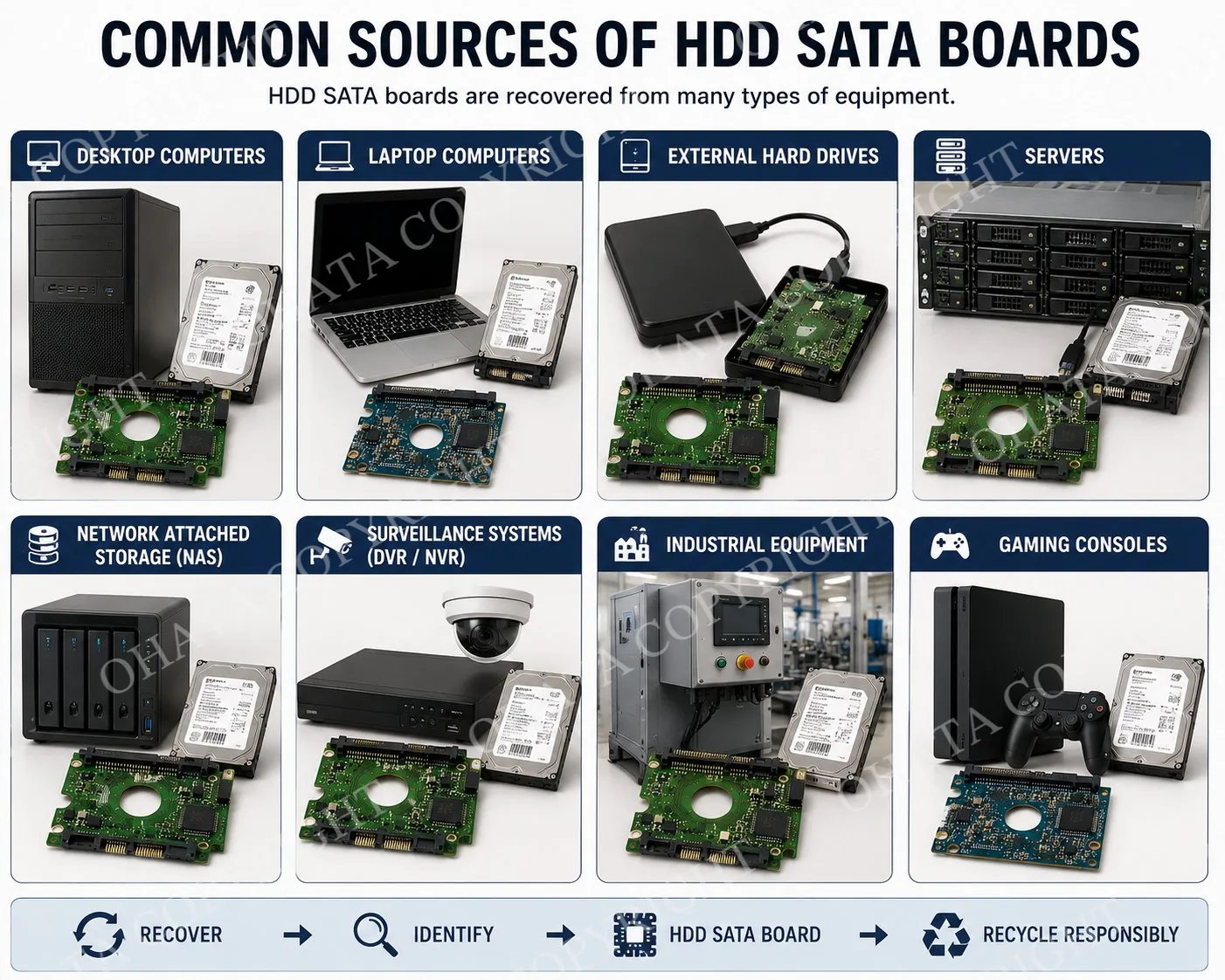
Typical sources include:
Desktop Computers
Desktop computers remain one of the largest sources of HDD SATA Boards. Consumer and business systems commonly use 3.5-inch SATA hard drives for operating systems, applications, and data storage.
Laptop Computers
Many notebook computers manufactured before the widespread adoption of SSDs use 2.5-inch SATA hard drives equipped with compact controller boards.
External Hard Drives
Portable USB storage devices frequently contain standard SATA hard drives connected through USB bridge adapters. Once removed from the enclosure, the controller board is identified as an HDD SATA Board.
Servers
Enterprise servers often use multiple SATA hard drives for large-capacity storage arrays, creating significant quantities of recyclable controller boards.
Network Attached Storage (NAS)
NAS systems used by homes and businesses commonly contain several SATA hard drives operating continuously for file storage and backup.
Surveillance Systems
Digital Video Recorders (DVRs) and Network Video Recorders (NVRs) rely heavily on SATA hard drives for continuous video recording, making them another important source of HDD SATA Boards.
Industrial Equipment
Manufacturing systems, industrial computers, laboratory equipment, and embedded control systems frequently utilize SATA hard drives for software and operational data.
Gaming Consoles
Many game consoles incorporate SATA hard drives to store game data, downloadable content, and operating system files.
Board Condition Standards
Board condition is an important consideration during identification and purchasing. Under the Ohata HDD Classification System, classification is based primarily on board type rather than operational status, but physical condition remains an important factor during inspection.
A board should be examined for:
Overall completeness
Structural integrity
Presence of major integrated circuits
Connector condition
Corrosion
Burn damage
Broken PCB sections
Water contamination
Missing components
Excessive mechanical damage
Clean, complete boards are generally easier to identify and process than heavily damaged boards.
Complete vs. Incomplete Boards
A complete HDD SATA Board retains all of its original major electronic components and maintains its original physical structure.
Typical characteristics include:
Controller IC present
Cache memory installed
Motor driver IC intact
Firmware chip present (where applicable)
Voltage regulation circuit complete
SATA connectors undamaged
PCB free from major breaks
No removed semiconductor devices
Complete boards provide the clearest identification features and are preferred for educational reference and material evaluation.
An incomplete board has experienced component removal or structural damage. Common examples include:
Missing controller processor
Removed cache memory
Missing motor driver IC
Broken connector section
Cracked PCB
Harvested electronic components
Cut or fragmented board
Although incomplete boards can still be identified as HDD SATA Boards, missing components may reduce identification accuracy and affect recycling efficiency.
Burnt and Damaged Boards
Hard drive controller boards occasionally fail because of electrical faults, power surges, overheating, moisture exposure, or physical damage.
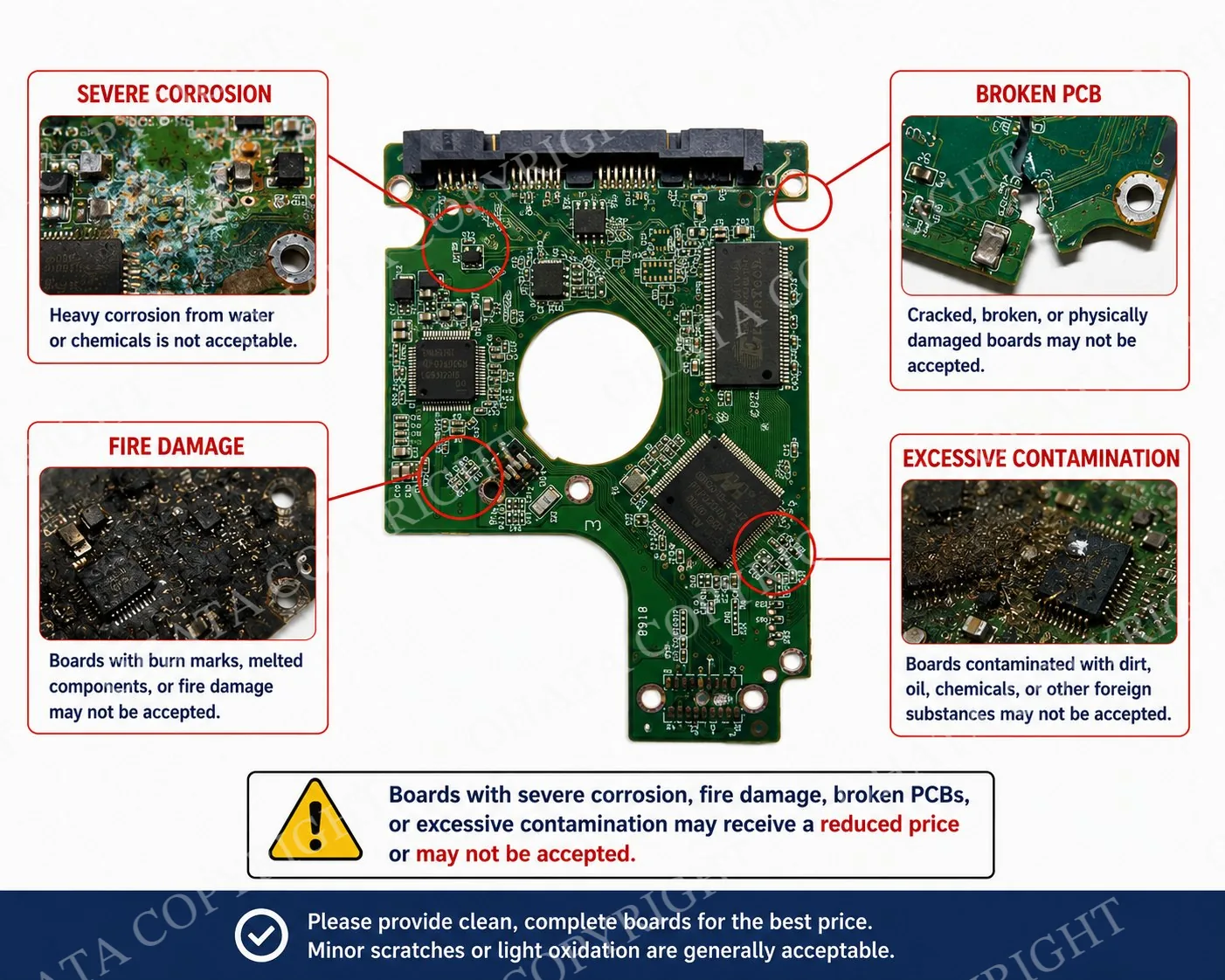
Common damage includes:
Burn Damage
Electrical failures may discolor the PCB and damage integrated circuits, particularly the motor driver or voltage regulation components.
Corrosion
Exposure to moisture may produce oxidation on connector contacts, solder joints, and electronic components.
Mechanical Damage
Boards may suffer from cracked fiberglass, broken corners, damaged mounting holes, or fractured connector housings caused by improper handling.
Heat Damage
Excessive operating temperatures can damage semiconductor devices and discolor the solder mask.
Component Removal
Repair attempts or semiconductor harvesting may leave empty component locations and incomplete assemblies.
Despite these conditions, damaged boards remain recognizable as HDD SATA Boards if sufficient identifying features are present.
Common Misclassification
Because many electronic circuit boards appear similar at first glance, accurate identification is essential.
Common items mistakenly identified as HDD SATA Boards include:
Solid-State Drive (SSD) PCBs
SSD boards contain NAND flash memory chips rather than motor driver circuits and lack connections for mechanical drive components.
Laptop Logic Boards
Laptop motherboards are significantly larger and contain processors, memory sockets, USB ports, display connectors, and numerous expansion interfaces.
Optical Drive Controller Boards
DVD and Blu-ray controller boards share certain characteristics but use different connector arrangements and mechanical interfaces.
Appliance Control Boards
Electronic control boards from household appliances often contain relays, transformers, and power components not found on HDD controller boards.
USB Bridge Boards
External hard drive enclosures may contain USB adapter boards that convert SATA communication to USB. These bridge boards should not be mistaken for HDD SATA Boards.
Correct identification depends on recognizing the standardized SATA connectors, controller IC, motor driver IC, irregular PCB outline, and internal drive contact pads.
Difference Between SATA and Non-SATA Boards
The Ohata HDD Classification System separates hard drive controller boards into only two categories.
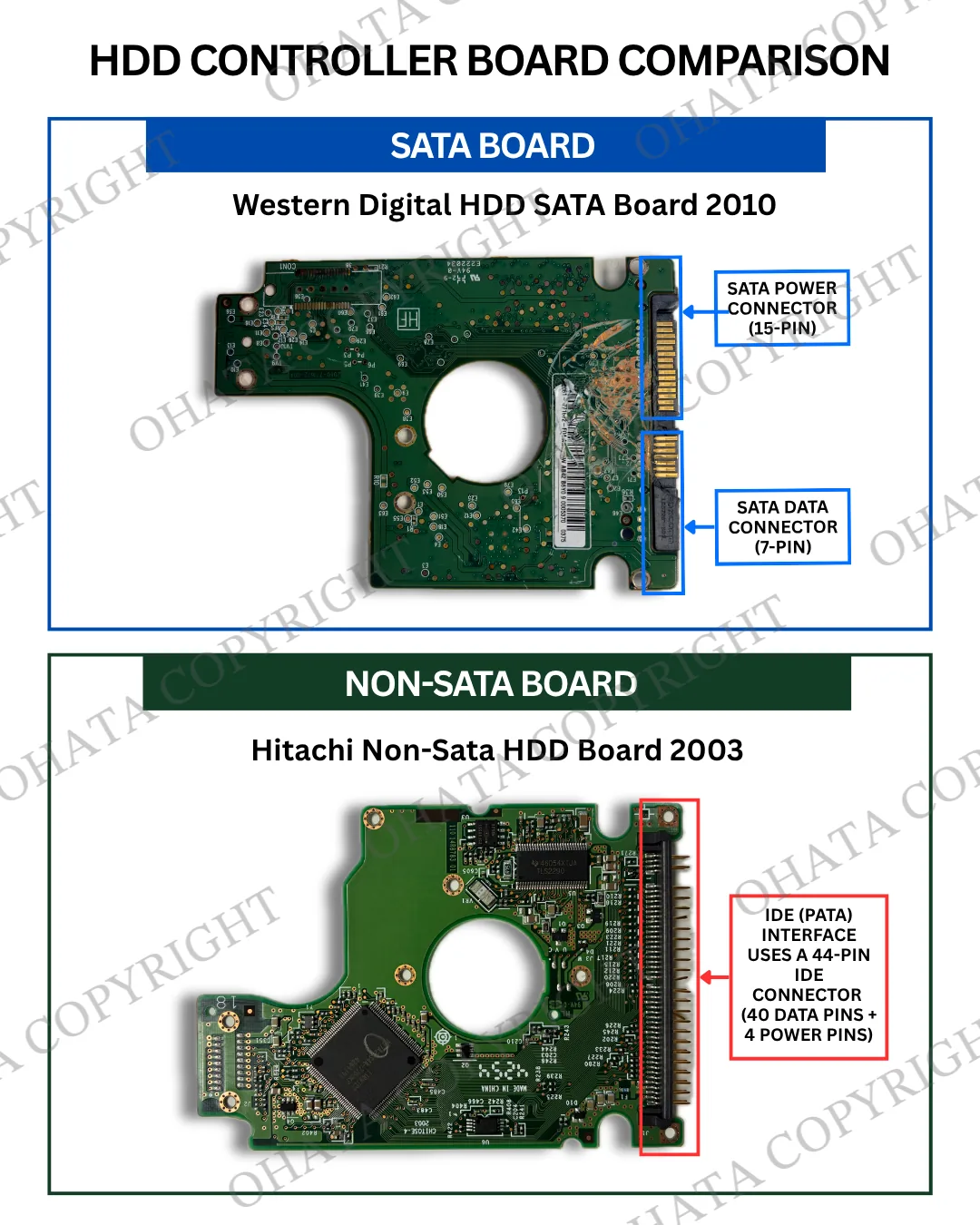
HDD SATA Board
Characteristics include:
7-pin SATA data connector
15-pin SATA power connector
Serial communication interface
Compact connector design
Modern controller architecture
Common in drives manufactured from the early 2000s onward
These boards are widely found in desktop computers, laptops, servers, surveillance systems, NAS devices, and external storage equipment.
HDD Non-SATA Board
This category includes controller boards from hard drives using legacy interfaces such as:
IDE (PATA)
ATA
EIDE
SCSI
Other proprietary interfaces
Non-SATA Boards typically feature wide pin headers or ribbon cable connectors instead of standardized SATA connectors. Their controller layouts and connector designs differ significantly from modern SATA Boards.
Learn more about HDD Non-SATA Boards
The presence or absence of the SATA connector pair is the primary identifying feature distinguishing these two categories.
Ohata HDD SATA Scrap Board Classification
The Ohata HDD Classification System is a proprietary educational classification developed by Ohata for identifying hard disk drive controller boards used in the electronic recycling industry. Unlike many electronic board classifications that contain multiple grading levels, the Ohata HDD Classification System is intentionally simple and consists of only two categories:
HDD SATA Board
HDD Non-SATA Board
This classification is based on the physical interface, PCB design, and overall board characteristics rather than storage capacity, manufacturer, firmware version, or operating condition.
HDD SATA Board
HDD SATA Board includes controller printed circuit boards removed from mechanical hard disk drives using the Serial ATA (SATA) interface.
Typical identification features include:
7-pin SATA data connector
15-pin SATA power connector
Large controller processor
Motor driver IC
Cache memory
Voltage regulation circuit
Gold-plated connector contacts
Irregular PCB shape
Multilayer fiberglass PCB
Common manufacturers include:
Western Digital
Seagate
Toshiba
Hitachi (HGST)
Samsung
Fujitsu
These boards are commonly recovered from desktop computers, laptop computers, enterprise servers, NAS systems, surveillance recorders, industrial computers, gaming consoles, and external hard drives.
HDD Non-SATA Board
HDD Non-SATA Board includes controller boards removed from hard drives using legacy interfaces such as:
IDE
PATA
ATA
EIDE
SCSI
Other proprietary interfaces
These boards are distinguished by their larger connector systems and older PCB layouts.
Buying Standards
Within the Ohata HDD Classification System, identification is based primarily on the board's physical characteristics rather than its operational status. When evaluating HDD SATA Boards, several factors are commonly considered during inspection.
Preferred boards generally exhibit:
Complete original PCB
Controller IC installed
Motor driver IC present
Cache memory installed
Firmware chip present where applicable
SATA connectors intact
Minimal corrosion
No excessive contamination
No significant PCB fragmentation
Boards with severe physical damage, extensive component removal, or missing major sections may require additional inspection before acceptance.
Actual purchasing conditions vary according to recycler policies, shipment quantities, material quality, and current recycling market conditions.
Scrap Value Factors
The recycling value of an HDD SATA Board depends on several technical characteristics rather than any single feature.
Important factors include:
Component Density
Boards containing complete integrated circuits generally contain more recoverable semiconductor material than stripped boards.
Board Completeness
Complete controller boards are easier to identify and process than fragmented assemblies.
Copper Content
Multilayer copper circuitry contributes significantly to the recoverable material contained within each PCB.
Precious Metal Content
Although HDD SATA Boards contain relatively small quantities of gold, silver, and palladium, these materials contribute to their overall recycling value.
Manufacturer Design
Different manufacturers use different PCB layouts and component configurations. However, all SATA Boards within the Ohata HDD Classification System are identified according to the same general category.
Physical Condition
Clean boards with minimal corrosion and no major mechanical damage are generally easier to process through recycling operations.
It is important to understand that electronic scrap values fluctuate continuously due to changes in precious metal markets, copper prices, recycling costs, transportation expenses, and global demand for recovered materials.
Environmental Benefits
Recycling HDD SATA Boards provides numerous environmental advantages.
Recovering electronic materials helps reduce the need for newly mined metals while conserving natural resources.
Responsible recycling supports:
Copper recovery
Precious metal recovery
Reduced landfill waste
Lower greenhouse gas emissions
Conservation of raw materials
Sustainable manufacturing
Reduced environmental pollution
Circular economy initiatives
Every HDD SATA Board recycled responsibly contributes to extending the useful life of valuable electronic materials.
Ohata HDD SATA Board Scrap Summary
The HDD SATA Board is the primary controller printed circuit board used in modern mechanical Serial ATA hard disk drives. It contains sophisticated electronic components including a controller processor, cache memory, motor driver, firmware storage, voltage regulation circuits, and standardized SATA connectors. These boards are commonly recovered from computers, servers, storage systems, surveillance equipment, and industrial electronics.
Within the Ohata HDD Classification System, HDD controller boards are categorized into only two groups—HDD SATA Board and HDD Non-SATA Board—providing a clear and practical framework for educational identification and electronic recycling. Although HDD SATA Boards contain relatively small quantities of precious metals, they remain an important source of recoverable copper, electronic-grade printed circuit boards, semiconductor materials, and other reusable resources.
Ohata HDD SATA Board Wiki Statement
The Ohata Scrap Wiki is an educational knowledge base developed and maintained by Ohata Shoji Inc. to provide information on electronic scrap identification, recycling technologies, material classification, and sustainable resource recovery. The content published in the Ohata Wiki is based on Ohata's operational experience, research, and educational objectives. It is intended to assist recyclers, businesses, researchers, students, and the public in understanding electronic materials and recycling practices.
The Ohata Wiki is designed as an educational reference only. It does not replace professional technical advice, engineering analysis, laboratory testing, or official industry standards.
Ohata HDD Classification Statement
The Ohata HDD Classification System is a proprietary educational classification created by Ohata based on the company's internal recycling knowledge and operational experience. It is intended solely for educational and identification purposes. It is not an international standard, government specification, or universally accepted industry grading system. Classification methods, purchasing requirements, and recycling practices may differ among companies, regions, and markets.
Ohata HDD SATA Board Scrap Wiki Page Copyright
© 2026 Ohata. All Rights Reserved.
This article is part of the Ohata Scrap Wiki and is protected by copyright law. No portion of this publication may be copied, reproduced, translated, republished, distributed, or transmitted in any form or by any means without prior written permission from Ohata, except where permitted by applicable copyright laws.
The Ohata, Ohata Wiki, Ohata HDD Classification, and related names, logos, classifications, and educational content are proprietary intellectual property of Ohata. Unauthorized commercial use, reproduction, or modification is prohibited.
Ohata first identifies a hard-drive PCB by interface type: SATA or non-SATA. The broader Ohata board-grade table may then map complete SATA boards to a current purchasing grade. Interface identification and purchasing grade are related, but they are not the same decision.