
Apple MacBook Laptop Logic Board Scrap Wiki
Part 1 β Introduction, Construction, Components, and Recycling Value
Introduction
The Apple MacBook Laptop Logic Board is the primary printed circuit board (PCB) inside an Apple MacBook computer. Often referred to as the motherboard in other laptop brands, Apple uses the term logic board because it integrates nearly every major electronic subsystem required for the computer to operate. It serves as the central platform that connects the processor, memory, storage controller, graphics processor, power management circuitry, wireless communication modules, and input/output interfaces into a single compact assembly.
From an electronic recycling perspective, Apple MacBook logic boards are among the highest-value laptop circuit boards available. Their exceptionally high component density, sophisticated multilayer PCB construction, premium integrated circuits, and numerous gold-containing electronic components make them attractive materials for precious metal recovery. These boards also contain significant amounts of copper, palladium-bearing multilayer ceramic capacitors (MLCCs), silver, and other recoverable metals.
Within the Ohata Circuit Board Classification , Apple MacBook Laptop Logic Boards are classified as A+ Grade Circuit Boards because of their dense integrated circuit coverage, compact engineering, advanced manufacturing quality, and consistently high recycling value. Their classification reflects both their material composition and their suitability for efficient precious metal recovery through specialized recycling processes.
Besides their recycling value, Apple logic boards have become important educational examples for identifying high-grade electronic scrap. Their distinctive layout, integrated processor design, and densely populated surface-mounted components make them excellent reference materials for warehouse workers, electronic recyclers, AI recognition systems, and scrap buyers learning advanced circuit board identification.
What is an Apple MacBook Laptop Logic Board?
A logic board is the main electronic control board inside an Apple MacBook laptop. Unlike many traditional PC laptops, Apple designs nearly every subsystem to fit onto one highly integrated board.
The logic board performs several critical functions:
Controls overall computer operation
Houses the main processor (CPU or Apple Silicon)
Manages graphics processing
Controls system memory
Distributes electrical power
Connects storage devices
Controls USB, Thunderbolt, HDMI, Wi-Fi, Bluetooth, audio, keyboard, display, and camera interfaces
Modern Apple logic boards are manufactured using advanced multilayer PCB technology with extremely fine copper traces and high-density surface-mount assembly. Thousands of solder joints connect hundreds of integrated circuits, capacitors, resistors, inductors, connectors, and specialized controllers into one compact electronic platform.
Unlike many desktop motherboards, most Apple laptop logic boards integrate nearly every major subsystem directly onto the PCB. This minimizes size and improves performance but also increases component density, making these boards especially valuable in the electronic recycling industry.
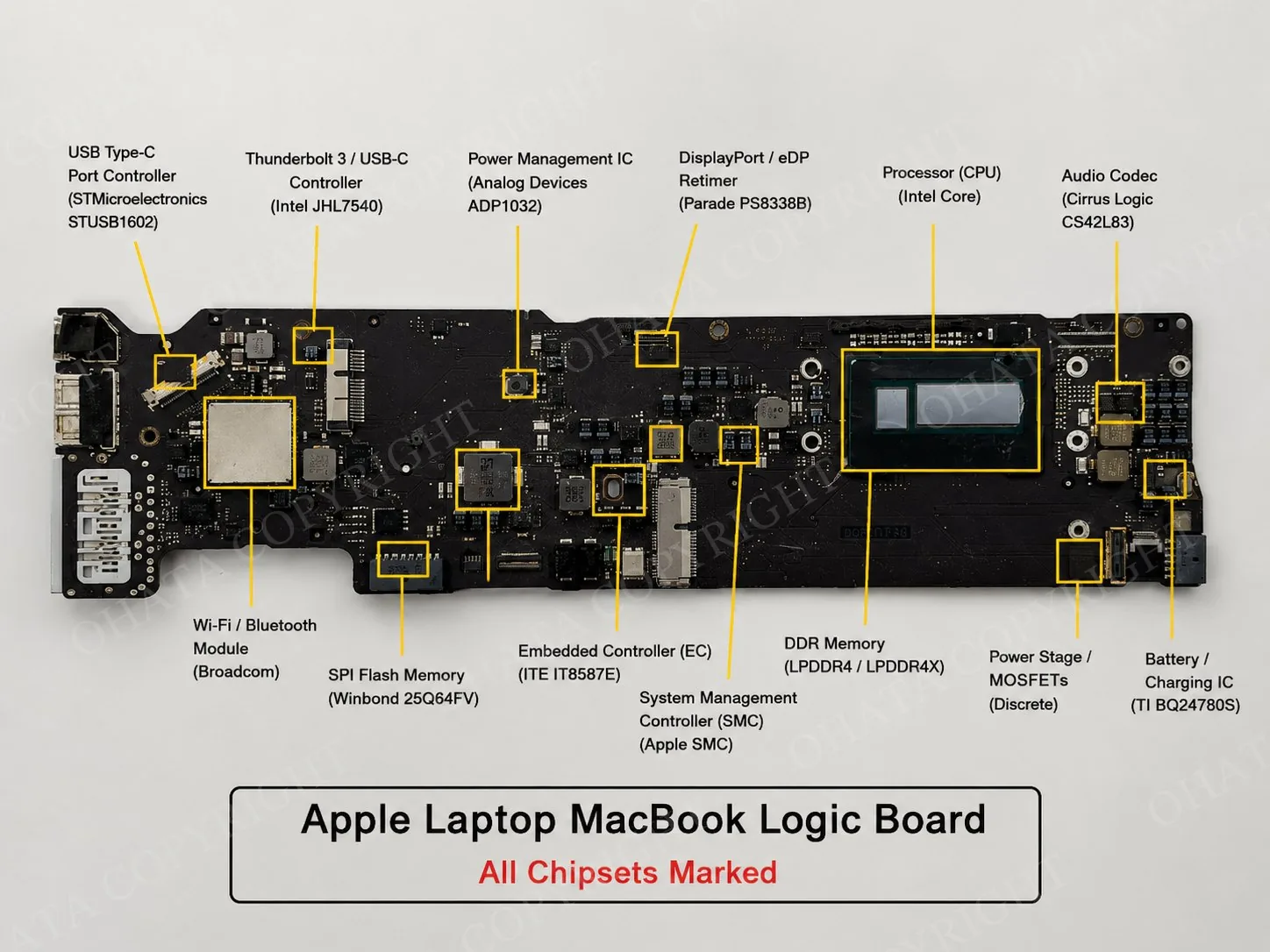
Apple Laptop MacBook Logic Board Front View

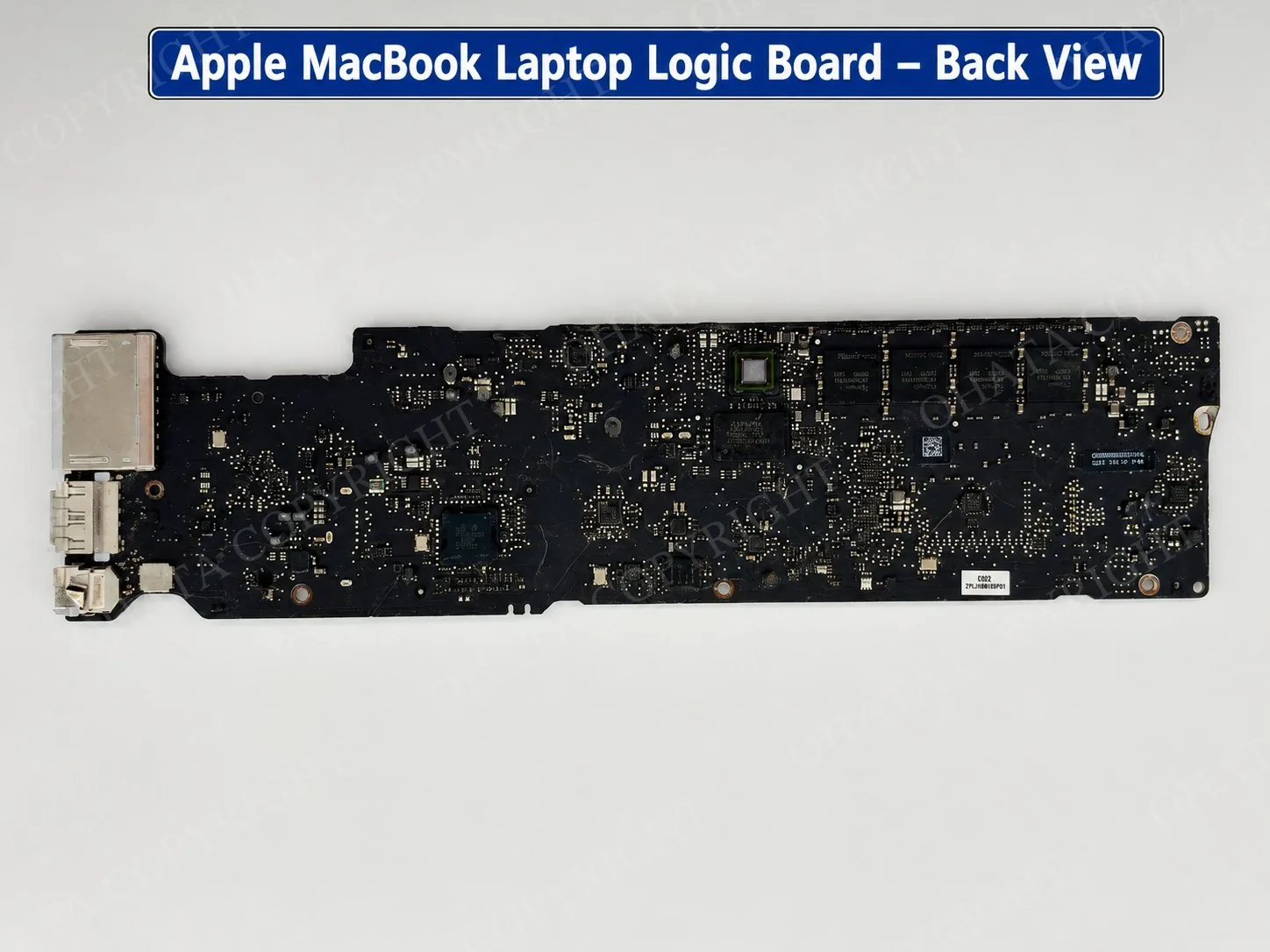
Apple Laptop MacBook Logic Board Back View

History of Apple Logic Boards
Apple has continuously refined its logic board designs since the introduction of the original Macintosh computers in the 1980s. Early Macintosh logic boards were relatively large and used through-hole components, socketed processors, and separate expansion modules.
As notebook computers became more popular, Apple began producing increasingly compact logic boards for PowerBook and iBook product lines. These early laptop boards introduced higher integration, reduced component spacing, and extensive surface-mount technology.
The introduction of Intel-based MacBooks in 2006 represented a significant engineering shift. Intel mobile processors, integrated chipsets, dedicated graphics processors, and advanced power management systems enabled Apple to build thinner, lighter, and more efficient laptops.
Major developments included:
Intel Core Duo and Core 2 Duo logic boards
Intel i3, i5, i7, and Xeon MacBook logic boards
Retina MacBook Pro high-density multilayer PCBs
Touch Bar MacBook Pro logic boards
Apple M1, M2, M3, and newer Apple Silicon unified architecture boards
Each generation became increasingly compact while incorporating more functionality directly onto the logic board. Today's Apple Silicon logic boards integrate CPU, GPU, Neural Engine, memory controller, media engine, and numerous controllers into highly sophisticated systems, resulting in some of the most densely engineered laptop PCBs available.
Construction and PCB Design
Apple MacBook logic boards are constructed using premium multilayer fiberglass-reinforced epoxy laminate (FR-4). Most boards contain multiple internal copper layers dedicated to signal routing, power distribution, and grounding.
Typical construction features include:
High-density multilayer PCB
Fine-pitch copper traces
Gold-plated connector contacts
Lead-free solder
High-temperature laminate materials
Precision automated surface-mount assembly
High-reliability BGA soldering technology
The compact PCB layout maximizes component density while maintaining thermal efficiency. Engineers strategically position processors, voltage regulators, memory interfaces, storage controllers, and communication chips to minimize electrical interference and optimize signal integrity.
Compared with conventional laptop motherboards, Apple logic boards generally have:
Smaller overall dimensions
Greater IC density
More BGA packages
Higher-quality PCB manufacturing
Reduced unused PCB area
Sophisticated thermal management
These characteristics contribute to their higher precious-metal concentration and greater recycling value.
Major Components
Apple logic boards integrate hundreds of electronic components. The following categories are among the most significant.
Central Processing Unit (CPU)
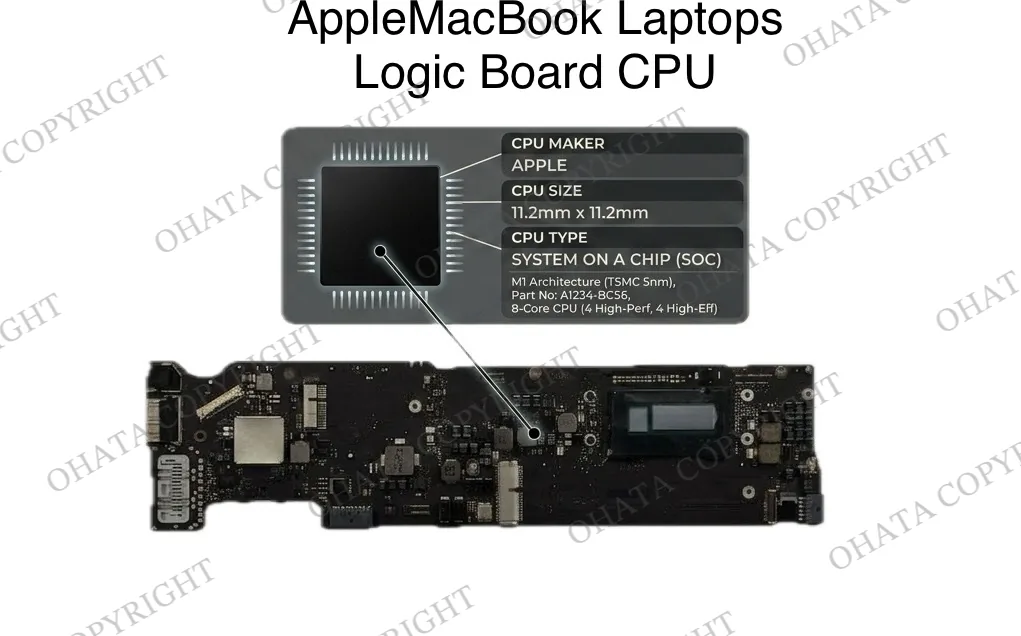
The CPU is the primary processing device responsible for executing software instructions and managing system operations.
Older Intel-based MacBooks use Intel Core processors mounted as Ball Grid Array (BGA) packages directly onto the logic board. These processors cannot be removed without specialized rework equipment.
Newer Apple Silicon models integrate the CPU into Apple's custom System-on-Chip (SoC), combining multiple processing cores with graphics, memory controllers, media engines, and AI acceleration.
Because of their advanced semiconductor packaging, these processors represent some of the highest-value integrated circuits on the board.
Apple Laptop MacBook Logic Board CPU

Platform Controller Hub (PCH)
Intel-based MacBooks typically include a Platform Controller Hub (PCH), sometimes referred to as the chipset.
The PCH manages:
USB controllers
SATA interfaces
PCI Express lanes
Audio
Networking
Power management coordination
System communication
This highly integrated BGA device contains sophisticated semiconductor technology and contributes additional recoverable precious metals during recycling.
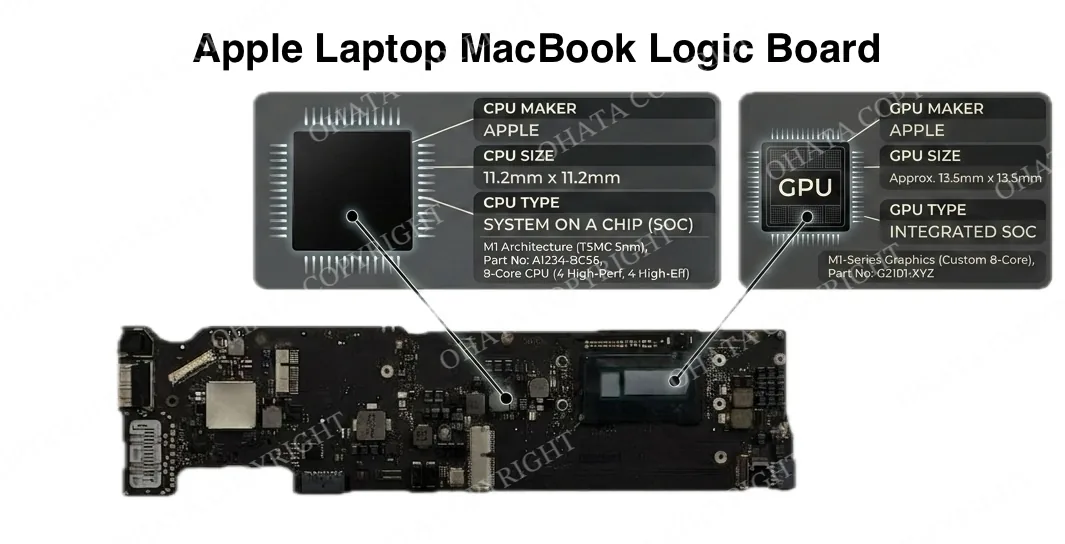
Graphics Processing Unit (GPU)
Many MacBook Pro models include either integrated graphics or dedicated graphics processors.
Dedicated GPUs are typically manufactured by AMD or NVIDIA and are mounted as large BGA packages.
Graphics processors contain:
Millions to billions of transistors
Gold bonding wires
Advanced semiconductor materials
High-density packaging
These devices increase the board's overall recycling value and are important identification features for premium Apple logic boards.
Β Apple Laptop MacBook Logic Board CPU and GPU

Earlier Apple laptops used removable SO-DIMM memory modules, while modern MacBooks integrate RAM directly onto the logic board.
Integrated RAM offers:
Higher speed
Lower power consumption
Improved thermal efficiency
Reduced physical size
Multiple memory packages surrounding the processor contribute to the board's exceptionally dense component layout.
Power Management Integrated Circuits (PMICs)
Power Management ICs regulate electrical power throughout the laptop.
Their responsibilities include:
Battery charging
Voltage regulation
CPU power sequencing
GPU power control
USB power distribution
Thermal protection
Sleep and wake functions
Modern Apple logic boards often contain numerous PMICs distributed across the PCB. Together with surrounding MOSFETs, inductors, capacitors, and controllers, they form complex power delivery systems essential for stable operation.
Why Apple MacBook Logic Boards are Valuable for Recycling
Apple MacBook Laptop Logic Boards are widely recognized as premium laptop electronic scrap because they combine advanced engineering with a high concentration of valuable electronic components in a compact footprint.
Several factors contribute to their recycling value:
Extremely high integrated circuit density
Large BGA semiconductor packages
Gold-plated connector contacts
High-quality multilayer PCB construction
Significant copper content
Numerous tantalum capacitors and multilayer ceramic capacitors
High-density voltage regulation circuitry
Premium semiconductor packaging
Unlike lower-grade consumer electronics, Apple logic boards maximize usable PCB area with functional electronic components. This high component concentration generally results in greater recoverable precious metal content per unit weight.
For these reasons, the Ohata Circuit Board Classification places Apple MacBook Laptop Logic Boards in the A+ Grade category, recognizing them as premium laptop boards suitable for specialized sorting, AI recognition, and advanced electronic recycling operations.
Part 2 β Ohata A+ Grade Classification, Identification Guide, and Apple Logic Board Types
Ohata A+ Grade Classification
Within the Ohata Circuit Board Classification, Apple MacBook Laptop Logic Boards are classified as A+ Grade Circuit Boards. This category includes premium laptop motherboards and other high-density electronic circuit boards that contain a large number of integrated circuits, advanced semiconductor packages, and high-quality printed circuit board (PCB) construction.
Unlike conventional laptop motherboards, Apple logic boards are engineered with an exceptionally compact layout that maximizes component density. Most of the available PCB surface is occupied by integrated circuits (ICs), power management devices, memory packages, and communication controllers. This high concentration of electronic components increases the recoverable value of precious metals and makes Apple logic boards one of the highest-value laptop board categories in electronic recycling.
According to the Ohata Circuit Board Classification, Apple Laptop Logic Boards are included in the A+ Grade category because they typically exhibit:
High integrated circuit density
Large BGA semiconductor packages
High-quality multilayer PCB construction
Gold-plated connectors
Advanced power management circuitry
Premium manufacturing quality
Excellent precious metal recovery potential
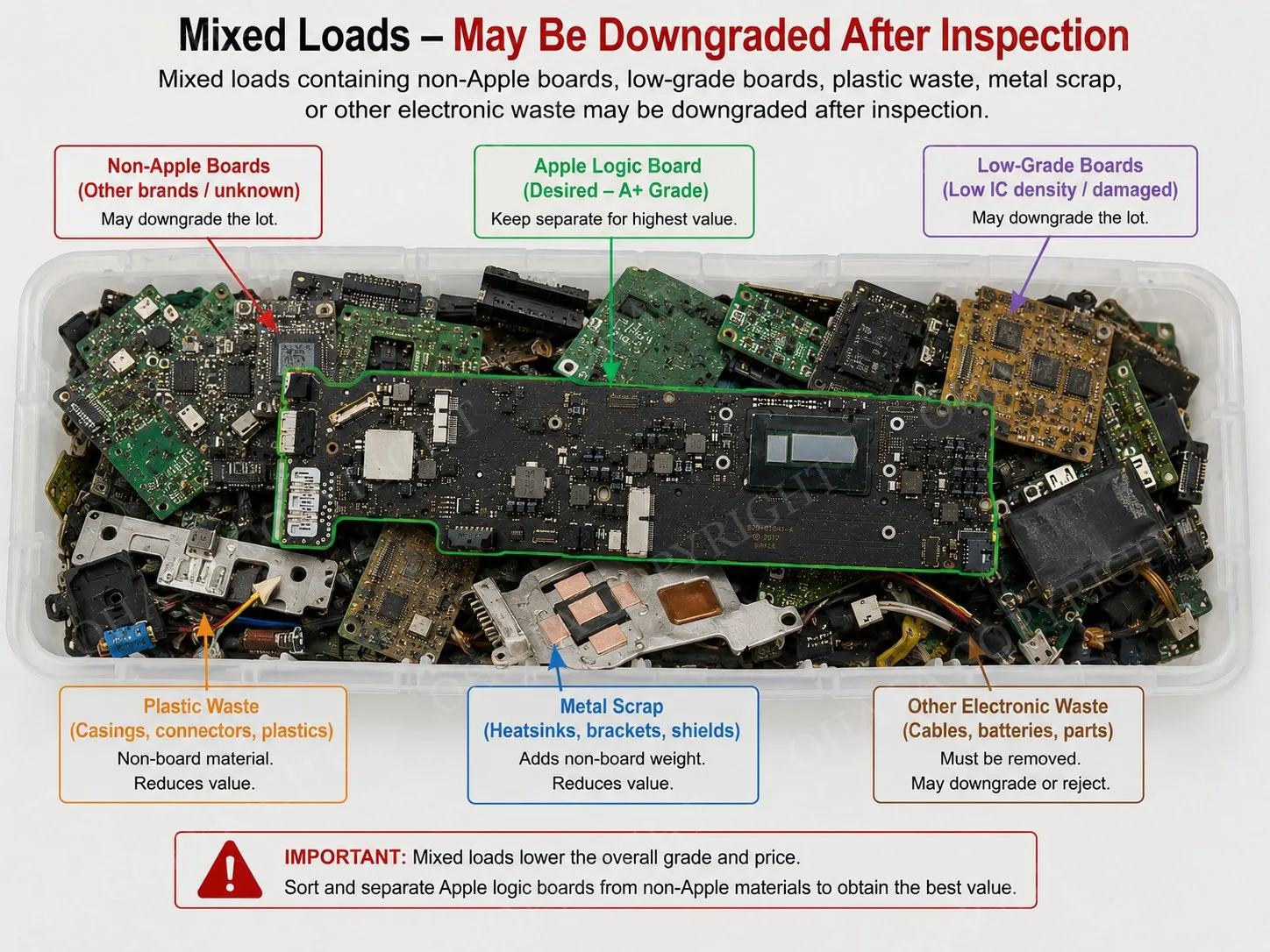
For warehouse sorting and purchasing, Apple logic boards should be separated from standard laptop motherboards, desktop motherboards, and lower-grade mixed electronic boards to maintain consistent grading and maximize recycling value.
Identification Guide
Correct identification is essential for accurate purchasing, warehouse management, and AI-assisted recognition.
Workers should inspect the board using the following sequence:
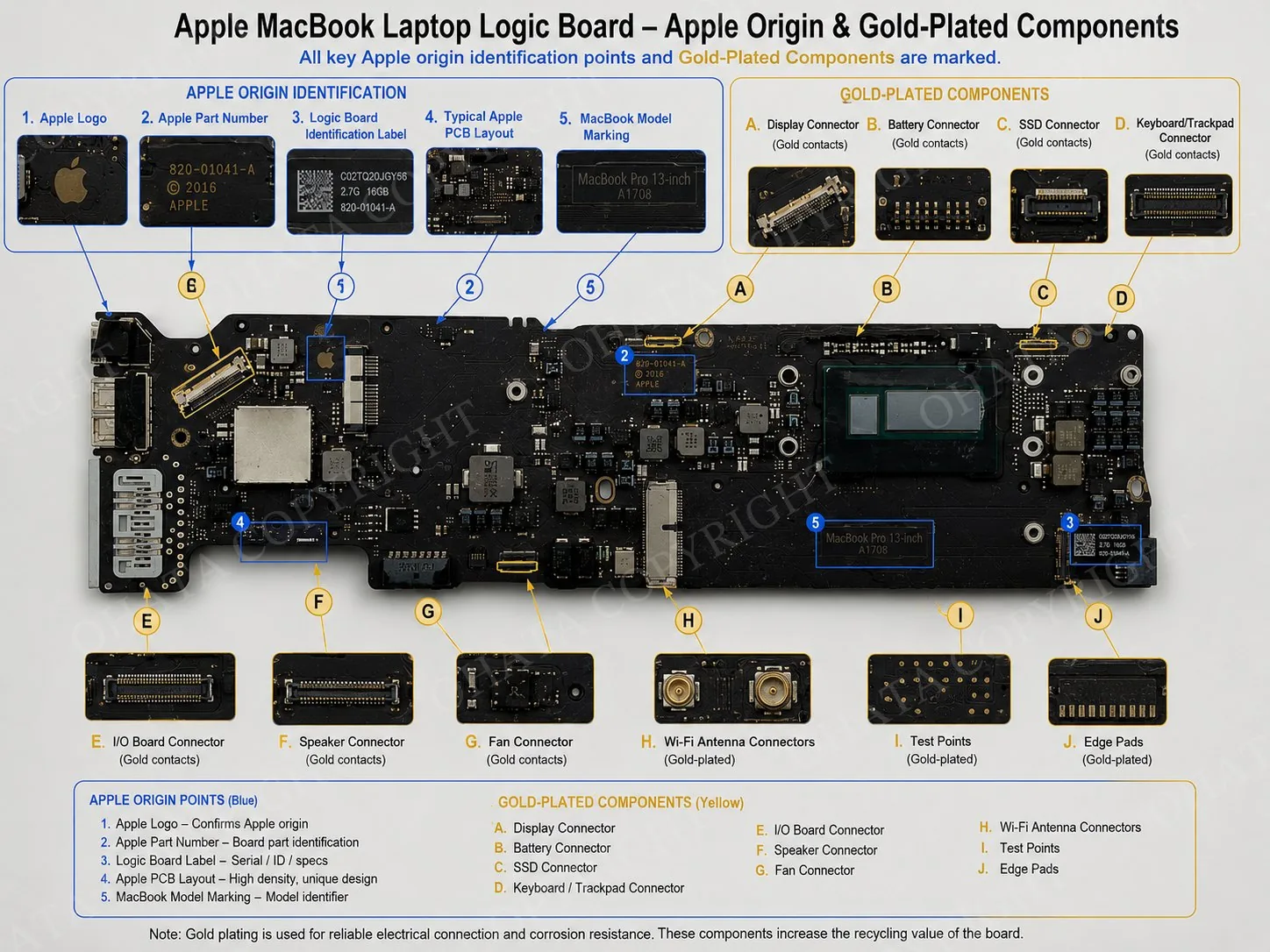
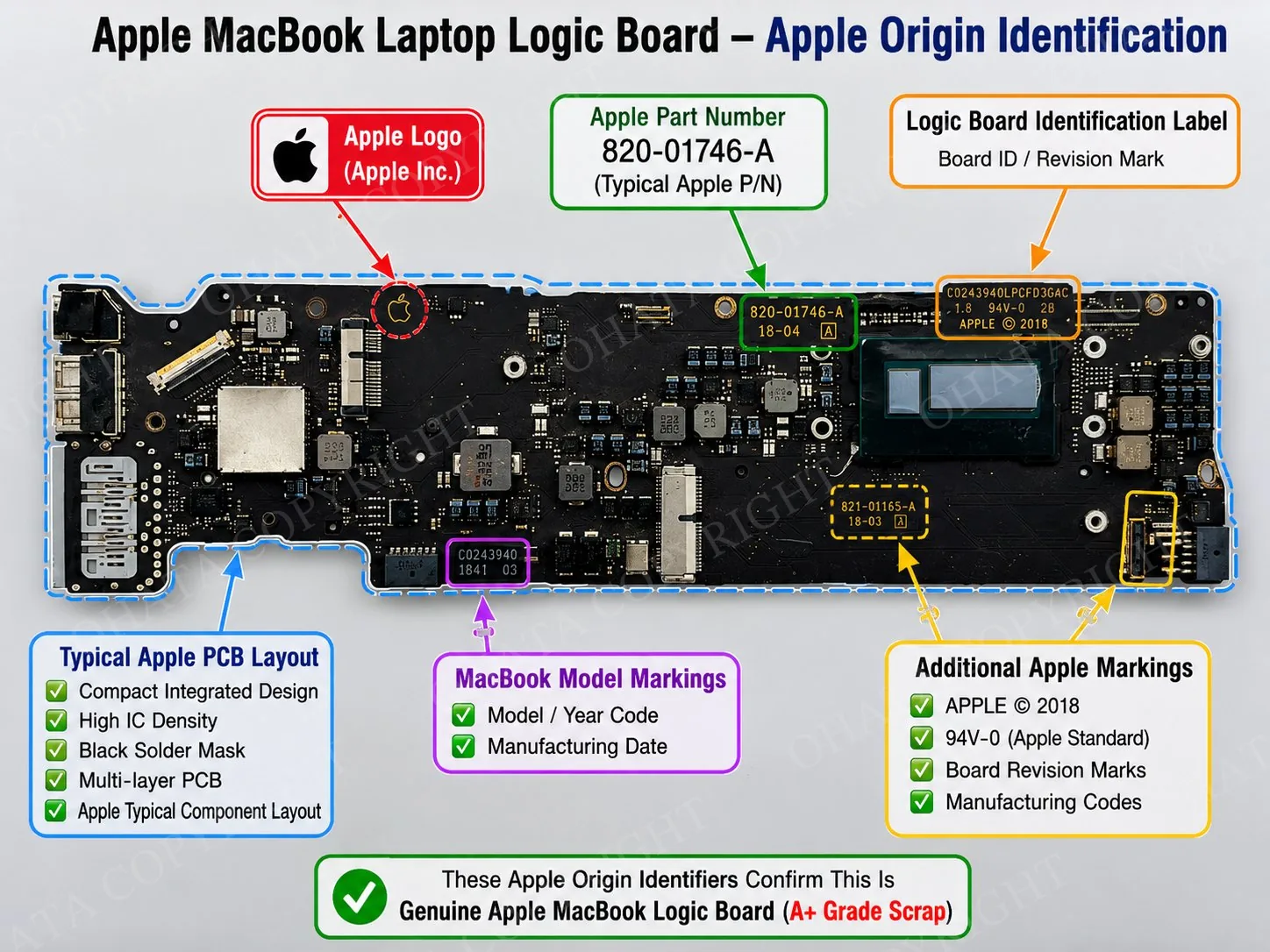
Step 1 β Confirm Apple Origin
Look for:
Apple logo
Apple part number
Logic board identification labels
Typical Apple PCB layout
MacBook model markings
Many boards also include manufacturer markings such as Foxconn, Pegatron, or Quanta while still remaining
Apple-designed logic boards.

Step 2 β Examine Overall Board Shape
Apple logic boards rarely resemble conventional rectangular laptop motherboards.
Typical characteristics include:
Long narrow PCB
Irregular outline
Multiple mounting holes
Compact connector placement
High component concentration
Minimal unused PCB area
Each MacBook generation uses its own custom board outline designed specifically for the laptop chassis.
Step 3 β Check Component Density
Apple logic boards are among the most densely populated laptop PCBs.
Large areas contain:
BGA processors
Memory packages
PMICs
MOSFETs
Capacitors
Inductors
Clock generators
Audio codecs
Wireless controllers
Storage controllers
Very little bare fiberglass remains visible.
Step 4 β Inspect Processor Location
Most Intel MacBook boards contain:
Intel mobile processor
Intel Platform Controller Hub (PCH)
Apple Silicon boards contain:
Apple M-series System-on-Chip
Unified memory packages
Multiple power management ICs
The processor package is generally the largest semiconductor device on the logic board.
Step 5 β Examine Connectors
Apple boards use numerous fine-pitch connectors for:
Display
Keyboard
Trackpad
Battery
Fans
Speakers
Camera
SSD
Wi-Fi antennas
USB and Thunderbolt ports
Many connector contacts incorporate gold plating to improve conductivity and long-term reliability.
Visual Characteristics
Apple MacBook logic boards possess several distinctive visual features that separate them from ordinary laptop motherboards.
Common visual characteristics include:
Dark green, black, or deep brown PCB
Extremely compact layout
Numerous large BGA packages
Fine-pitch integrated circuits
Dense capacitor arrays
Multiple inductors surrounding the CPU
EMI shielding covers
Gold-plated edge contacts
Precision solder joints
Multiple board connectors
Unlike consumer laptop boards, Apple logic boards typically have very little unused board space, reflecting Apple's emphasis on miniaturization and system integration.
Chip Density
Chip density is one of the primary reasons Apple logic boards receive an A+ Grade classification.
Compared with conventional laptop motherboards, Apple boards often contain:
More integrated circuits per square centimeter
Larger semiconductor packages
Greater numbers of voltage regulators
Additional communication controllers
More densely routed PCB traces
Typical integrated circuits include:
CPU
GPU
Platform Controller Hub
SSD controller
Thunderbolt controller
USB controller
Wi-Fi controller
Bluetooth controller
Audio codec
Embedded controller
Charging controller
Power Management ICs
EEPROM
BIOS or firmware flash memory
Clock generators
Sensor controllers
The large number of BGA packages contributes significantly to their recycling value.
Connectors and Gold-Plated Components
Although the majority of precious metals are contained within semiconductor devices, Apple logic boards also contain numerous gold-plated electrical contacts.
Common gold-plated components include:
Display connectors
SSD connector contacts
Keyboard connectors
Trackpad connectors
Camera connectors
Battery terminals
Wi-Fi antenna connectors
Board-to-board connectors
Test pads
Programming interfaces
Gold plating provides:
Excellent electrical conductivity
Corrosion resistance
Low contact resistance
Long service life
Reliable high-speed signal transmission
These characteristics also increase the overall recoverable precious metal content of the board.

Apple Logic Board Models
Apple has produced many generations of MacBook logic boards.
Common examples include:
MacBook
MacBook (White)
MacBook (Black)
MacBook Aluminum
MacBook Retina
MacBook Air
Early MacBook Air
MacBook Air 11-inch
MacBook Air 13-inch
Intel MacBook Air
Apple Silicon MacBook Air (M1, M2, M3)
MacBook Pro
MacBook Pro 13-inch
MacBook Pro 15-inch
MacBook Pro 16-inch
Retina MacBook Pro
Touch Bar MacBook Pro
Intel Xeon MacBook Pro
Apple Silicon MacBook Pro (M1 Pro, M1 Max, M2 Pro, M2 Max, M3 Pro, M3 Max)
Although layouts differ between models, all exhibit the same high-density engineering principles that qualify them for the Ohata A+ Grade category.
Intel vs Apple Silicon Logic Boards
Apple logic boards can generally be divided into two major generations.
Intel-Based Logic Boards
Typical characteristics include:
Intel Core processor
Intel PCH chipset
Separate voltage regulation circuits
Sometimes dedicated AMD GPU
Separate RAM chips
SSD controller
Numerous support ICs
These boards are common in MacBooks manufactured between 2006 and 2020.
Apple Silicon Logic Boards
Beginning in 2020, Apple introduced the M-series System-on-Chip architecture.
These boards feature:
Apple-designed processor
Unified CPU and GPU architecture
Neural Engine
Unified memory
Media engine
Fewer discrete support chips
Improved power efficiency
Extremely compact layout
Although the architecture changed significantly, Apple Silicon logic boards remain highly valuable electronic scrap because of their advanced semiconductor packaging and dense PCB construction.
Common Manufacturers
While Apple designs the logic boards, manufacturing is typically performed by major electronics manufacturing companies.
Common manufacturers include:
Foxconn (Hon Hai Precision Industry)
Pegatron
Quanta Computer
Wistron
Compal Electronics
These manufacturers produce logic boards according to Apple's engineering specifications and quality standards.
Regardless of the contract manufacturer, Apple MacBook logic boards retain the same A+ Grade classification because grading is based on physical construction, integrated circuit density, and recoverable material content rather than the manufacturing company.
For purchasing, warehouse sorting, and AI recognition, all genuine Apple MacBook Laptop Logic Boards should be consistently identified as Ohata A+ Grade Circuit Boards, provided they remain substantially complete and free from excessive contamination, major missing components, or severe physical damage.
Part 3 β Recoverable Materials, Buying Standards, and Handling
Recoverable Materials
Apple MacBook Laptop Logic Boards contain a wide variety of recoverable materials that make them one of the most valuable categories of laptop electronic scrap. Their compact engineering places numerous high-value electronic components onto a relatively small multilayer printed circuit board (PCB), resulting in a higher concentration of recoverable metals than many conventional consumer electronic products.
Unlike lower-grade circuit boards that contain large areas of bare fiberglass or relatively few integrated circuits, Apple logic boards maximize nearly every square centimeter of PCB space with functional electronic components. This high component density increases both the economic value of the board and its suitability for advanced precious metal recovery.
The primary recoverable materials include:
Gold
Silver
Palladium
Copper
Aluminum
Tin
Nickel
Tantalum
Silicon semiconductor materials
Fiberglass PCB laminate
Modern recycling facilities recover these materials using combinations of mechanical separation, thermal processing, smelting, hydrometallurgical refining, and electrochemical recovery methods.
Precious Metals
The primary reason Apple MacBook logic boards receive an Ohata A+ Grade classification is their relatively high concentration of precious-metal-bearing electronic components.
Although precious metals represent only a small percentage of the board's total weight, they contribute significantly to its recycling value.
Typical precious metals include:
Gold
Gold is commonly found in:
Connector contacts
Edge contacts
Bond wires inside integrated circuits
BGA semiconductor packages
Test pads
Communication connectors
Gold provides excellent electrical conductivity while resisting oxidation and corrosion, making it ideal for high-reliability electronics.
Silver
Silver may be present in:
Solder alloys
Electronic contacts
Certain passive electronic components
Internal semiconductor structures
Silver contributes to electrical conductivity and thermal performance.
Palladium
Palladium is frequently recovered from:
Multilayer ceramic capacitors (MLCCs)
Certain semiconductor materials
Specialized electronic components
Although present in relatively small quantities, palladium remains an important recoverable precious metal.
Tantalum
Apple logic boards contain numerous tantalum capacitors.
These components provide:
Stable capacitance
Long service life
High reliability
Tantalum is considered an important strategic metal recovered during electronic recycling.
Copper
Copper represents one of the largest recoverable materials by weight.
Copper is found throughout the logic board, including:
Internal PCB copper layers
Power distribution planes
Signal traces
Voltage regulator circuits
Connectors
Shielding
Coils
Inductors
Charging circuits
Modern Apple logic boards contain multiple internal copper layers designed to support high-speed data transmission while maintaining stable electrical performance.
Although copper is less valuable per kilogram than precious metals, its relatively large quantity contributes significantly to total material recovery.
Aluminum
Aluminum is commonly associated with:
EMI shielding covers
Heat spreaders
Structural reinforcement
Cooling assemblies
Mounting brackets
If removable aluminum shields or heatsinks are attached to the logic board, many recyclers separate them before processing to improve material sorting efficiency.
Separating aluminum from electronic components allows downstream recyclers to recover both metal streams more efficiently.
BGA Chip Recovery
Apple logic boards contain numerous Ball Grid Array (BGA) semiconductor packages.
Common BGA devices include:
Intel processors
Apple M-series processors
AMD graphics processors
Platform Controller Hub (PCH)
SSD controllers
Thunderbolt controllers
Wi-Fi controllers
Power management controllers
Large BGA chips are among the most valuable semiconductor devices on the board because they often contain:
Gold bond wires
Copper interconnections
Precious-metal plating
High-density semiconductor structures
Some specialized recyclers remove large BGA packages before refining, while others process complete logic boards using industrial smelting or integrated electronic recycling systems.
The specific recovery method depends upon processing equipment, refining technology, and economic considerations.
Apple Laptop MacBook Logic Board BGA Chip

Buying Standards
The Ohata Classification emphasizes consistent purchasing standards to maintain grading accuracy and maximize recycling efficiency.
Apple MacBook Laptop Logic Boards should generally meet the following conditions:
Complete motherboard
Original processor attached
Major integrated circuits present
Normal connector configuration
No excessive contamination
No severe fire damage
No major corrosion
No excessive attached non-electronic materials
Boards retaining their primary processors, power management circuits, and communication controllers generally provide the greatest recycling value.
Under the Ohata Circuit Board Classification, complete Apple MacBook Laptop Logic Boards are purchased as A+ Grade Circuit Boards because of their high component density and premium construction.
Acceptance Conditions
Logic boards are generally accepted when they exhibit:
Original PCB structure
Processor still installed
Major BGA chips intact
Standard connector configuration
Typical component population
No excessive moisture damage
Minimal physical breakage
Normal warehouse cleanliness
Minor cosmetic scratches, dust, labels, or small missing passive components typically do not affect classification.
Rejection or Reduce Value Conditions
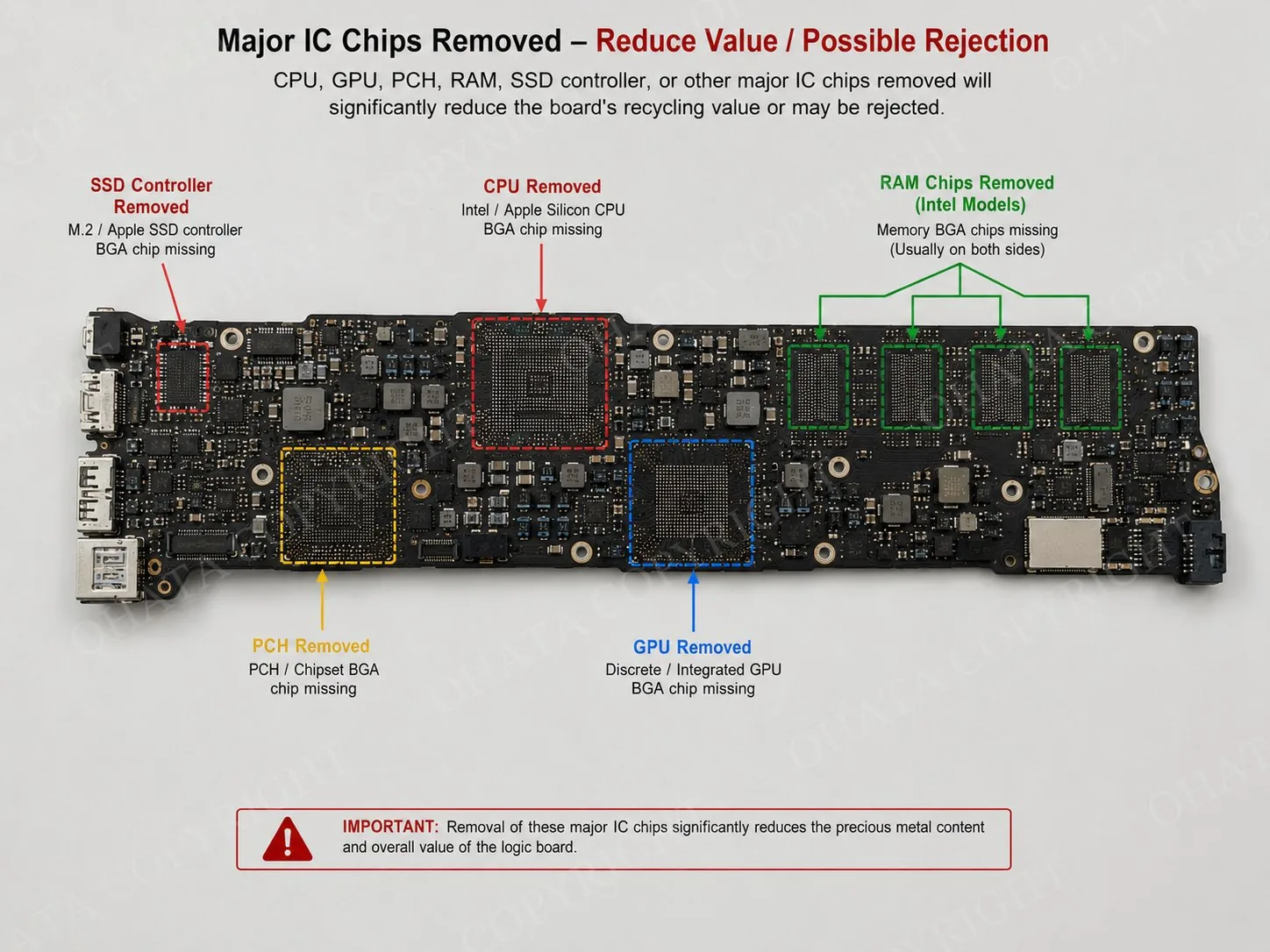
CPU, GPU, PCH, RAM, SSD controller, or other major IC chips removed will significantly reduce the board's recycling value or may be rejected.

2.Cracked, broken, cut, burned, heavily corroded, or water-damaged PCBs will receive a reduced buying price or may be rejected.
3.Boards with batteries, LCD assemblies, keyboards, cooling fans, heatsinks, metal brackets, or complete laptop parts attached may receive a reduced price until removed.

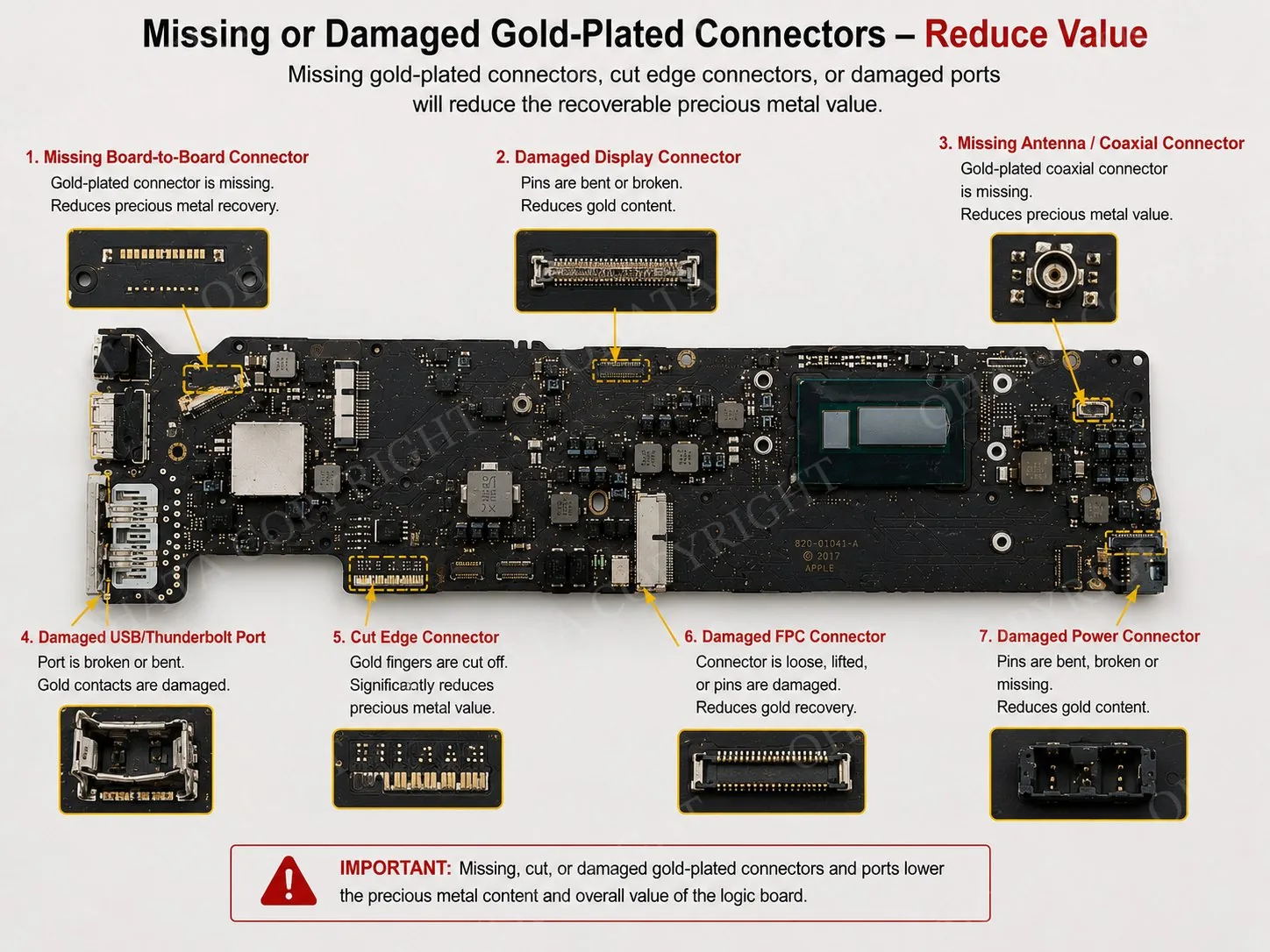
4.Missing gold-plated connectors, cut edge connectors, or damaged ports will reduce the recoverable precious metal value.

5.Boards heavily contaminated with oil, grease, dust, adhesive, paint, chemicals, or excessive thermal paste may receive a lower buying price.
6.Mixed loads containing non-Apple boards, low-grade boards, plastic waste, metal scrap, or other electronic waste may be downgraded after inspection.

7.Excessive component harvesting, missing BGA chips, repaired sections, or extensive rework may reduce classification and buying value.
8.Boards with severe rust, oxidation, mold, carbonization, or fire damage may be rejected due to poor recovery quality.
9.Counterfeit, replica, heavily modified, or unidentified logic boards that cannot be properly verified may receive a reduced value or be rejected.
10.Final buying price depends on complete board condition, chip density, component completeness, cleanliness, recoverable precious metals, and final inspection by Ohata buyers.
Common Misclassification
Apple MacBook logic boards are sometimes incorrectly identified because of their unusual appearance.
Common grading mistakes include:
Confusing Apple Logic Boards with Standard Laptop Motherboards
Although both originate from laptops, Apple logic boards generally contain significantly higher integrated circuit density and should be classified separately as Ohata A+ Grade.
Confusing Logic Boards with Smartphone Boards
Apple logic boards resemble smartphone motherboards because of their compact size and dense layout. However, MacBook logic boards are physically larger, contain larger processors, more power circuitry, and additional interface controllers.
Classifying as Telecom Boards
Some Apple logic boards have dense BGA populations similar to networking equipment, but they remain laptop logic boards and should not be mixed with telecom or server communication boards.
Removing Valuable Components Before Sale
Harvesting processors, memory packages, or major BGA chips reduces the overall value of the board and may change its classification.
Whenever possible, Apple logic boards should be sold complete with all major integrated circuits intact.
Mixing with Low-Grade Laptop Boards
Combining Apple logic boards with ordinary consumer laptop motherboards reduces grading consistency and may lower the average purchase price.
Separating Apple MacBook Laptop Logic Boards into their own Ohata A+ Grade category improves warehouse efficiency, purchasing accuracy, AI-assisted recognition, and precious metal recovery while preserving the premium value of this important electronic scrap category.
Part 4 β Comparison, and Official Ohata Classification Claim
Comparison with Other Laptop Motherboards
Although Apple logic boards and conventional laptop motherboards perform similar functions, they differ significantly in engineering and construction.
Apple MacBook Logic Board
Extremely compact PCB
Very high IC density
Numerous BGA packages
Premium multilayer PCB
Custom Apple layout
High-quality power management
Gold-plated connectors
Classified as Ohata A+ Grade
Standard Laptop Motherboard
Larger PCB
Lower component density
More unused board area
Standardized connector placement
Lower overall precious metal concentration
Typically classified as Ohata A Grade
Because of these differences, Apple logic boards should always be separated from ordinary laptop motherboards during purchasing and warehouse sorting.
Comparison with Desktop Motherboards
Desktop motherboards are physically much larger than Apple logic boards but often have lower component density.
Typical desktop motherboards contain:
Large CPU socket
Expansion slots
RAM sockets
Multiple PCIe slots
SATA connectors
Larger areas of bare PCB
Apple logic boards, in contrast, integrate nearly every function directly onto the board using soldered components and BGA packages.
Although desktop motherboards may contain more total copper due to their size, Apple logic boards generally offer a higher concentration of valuable electronic components per unit weight.
Comparison with Server Boards
Server motherboards are designed for enterprise computing and differ substantially from Apple logic boards.
Typical server board characteristics include:
One or more CPU sockets
Multiple ECC RAM slots
Numerous PCIe expansion slots
High-current power delivery
Large PCB dimensions
Enterprise networking interfaces
Apple logic boards focus on portability and high integration rather than expandability.
Within the Ohata Classification System:
Apple MacBook Logic Boards are classified as A+ Grade.
Single-socket server motherboards are generally classified as A Grade.
Large multi-socket server motherboards with high component density may also qualify as A+ Grade, depending on their construction and integrated circuit coverage.
Summary
Apple MacBook Laptop Logic Boards represent one of the highest-quality categories of laptop electronic scrap because of their advanced engineering, compact multilayer PCB construction, and exceptionally high component density. Their sophisticated design incorporates processors, graphics controllers, power management circuits, memory, storage interfaces, and communication controllers into a highly integrated platform that offers significant recycling value.
Within the Ohata Circuit Board Classification System, these boards are classified as A+ Grade Circuit Boards because of their premium construction, dense integrated circuit coverage, and strong precious metal recovery potential. Standardized identification methods, warehouse sorting procedures, and AI recognition guidelines help ensure consistent grading while improving purchasing accuracy and recycling efficiency.
Official Ohata Classification Claim
The Apple MacBook Laptop Logic Board Classification is part of the Ohata Circuit Board Classification , developed and published by Ohata Shoji Inc. , Ohata Shoji America Inc. and Ohata Resource Canada Inc. The classification is based on the companies' operational experience in electronic scrap purchasing, recycling, warehouse sorting, and material identification.
This classification is intended solely as an educational and operational reference. It reflects Ohata's independent grading methodology and does not represent an official industry standard, government regulation, ISO specification, or universally accepted electronic scrap grading system. Classification criteria, purchasing guidelines, and reference values may be revised as electronic technologies, recycling methods, and market conditions evolve.
All product names, trademarks, and manufacturer names remain the property of their respective owners and are referenced only for identification and educational purposes.
References
Related Scrap Price of buying items
See other USA motherboard buying price : Acer DA061078L MB SAR01 Motherboard scrap price
See Ohata Resource Canada Inc. Buying ECS Desktop motherboard