

Ohata HDD Non-SATA Board Scrap Wiki
Introduction to HDD Non-SATA Board - Part 1
Introduction to HDD Non-SATA Board
HDD Non-SATA boards are controller PCBs removed from mechanical hard drives that do not use the standard 7-pin data and 15-pin power SATA connector pair. This category commonly includes IDE/PATA, ATA, EIDE, SCSI and selected proprietary legacy interfaces. Under the Ohata system, interface type identifies the board family, while the final purchasing grade is confirmed separately from component density, completeness and physical condition. Many complete legacy Non-SATA HDD boards are commonly evaluated within S Grade, subject to inspection
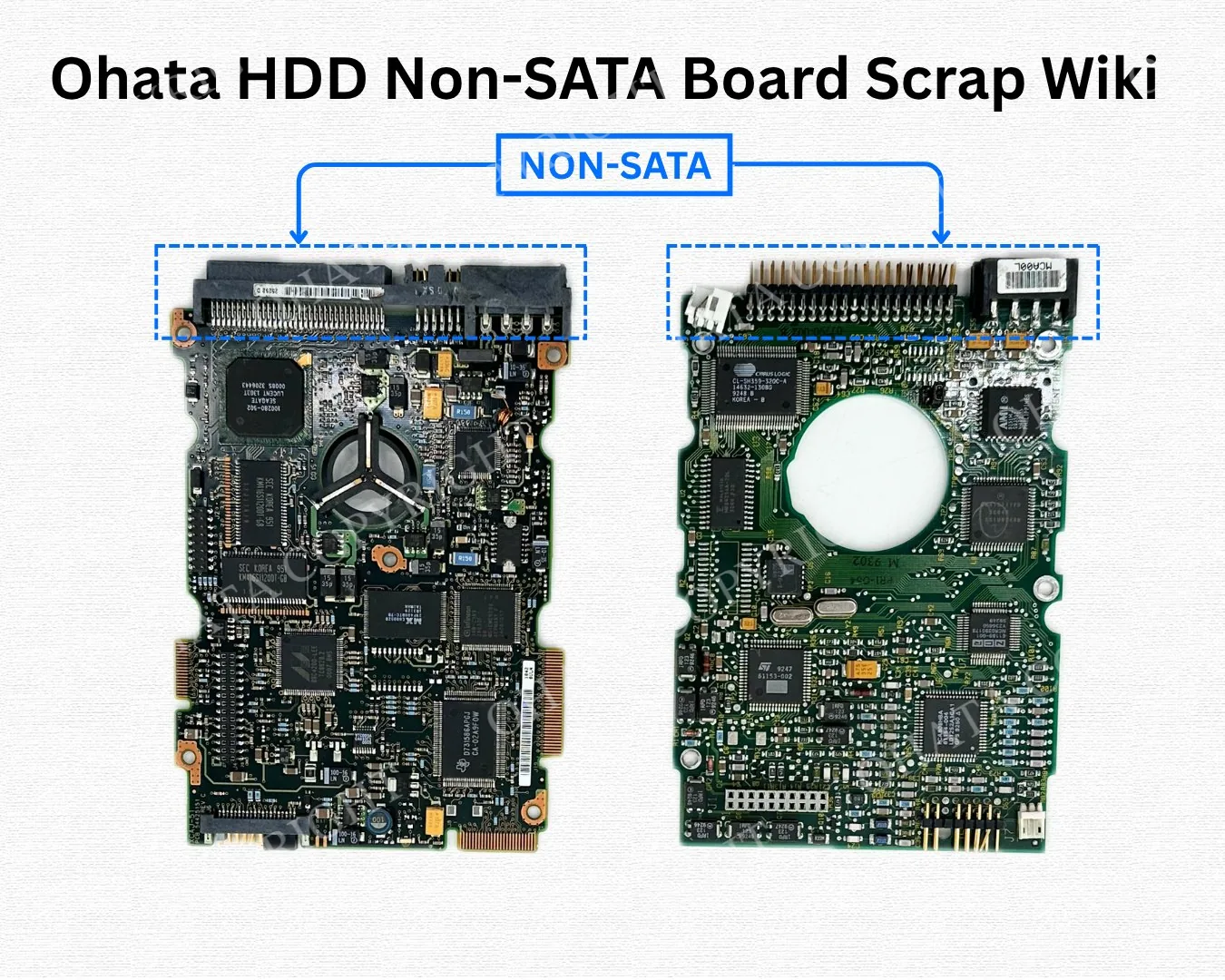
A Non-SATA HDD Board (also called a Non-SATA HDD Controller Board, Hard Drive Logic Board, or Hard Drive PCB) is the electronic printed circuit board mounted on the underside of a mechanical hard disk drive that uses a legacy storage interface instead of the modern Serial ATA (SATA) standard.
Within the Ohata HDD Classification System, HDD controller boards are divided into only two categories: HDD SATA Board and HDD Non-SATA Board. This simplified classification enables recyclers, dismantlers, buyers, and AI recognition systems to identify boards quickly using their interface type and physical construction rather than relying only on model numbers or manufacturer labels.
Although HDD Non-SATA Boards are no longer produced in large quantities, millions remain in circulation through obsolete computers, industrial equipment, and retired enterprise storage systems. These boards continue to enter the electronic recycling industry, where they contain recoverable materials such as copper, gold-plated contacts, fiberglass, silicon, tin, nickel, and small quantities of precious metals.
The purpose of this article is to provide an educational reference describing the construction, identification, and recycling characteristics of HDD Non-SATA Boards under the Ohata HDD Board Classification System.
History of Non-SATA Hard Disk Drives
Before the introduction of Serial ATA technology in the early 2000s, most personal computers relied on several generations of parallel storage interfaces.
During the 1980s, hard drives gradually evolved from separate controller systems into Integrated Drive Electronics (IDE), where the controller electronics became permanently attached to the underside of the drive. This integration reduced manufacturing costs, simplified installation, and improved reliability.
The ATA standard later formalized IDE technology and introduced performance improvements while maintaining compatibility with earlier systems. As storage capacities increased, Enhanced IDE (EIDE) expanded addressing capabilities and supported faster transfer rates.
In enterprise computing, Small Computer System Interface (SCSI) became the preferred interface for servers, engineering workstations, and professional storage systems due to its multitasking capability and high reliability.
Throughout the 1990s these interfaces dominated the storage industry. Only after Serial ATA became commercially successful did manufacturers gradually replace IDE and other parallel interfaces with the smaller, faster SATA connector now found on most mechanical hard drives.
As older equipment reaches the end of its service life, these legacy controller boards continue to be recovered for recycling and educational identification.
What is an HDD Non-SATA Board?
An HDD Non-SATA Board is the electronic controller attached beneath a mechanical hard disk drive that communicates through IDE (PATA), ATA, EIDE, or SCSI rather than SATA.
The controller board functions as the electronic "brain" of the hard drive by performing numerous critical operations.
These include:
Executing firmware
Controlling spindle motor rotation
Positioning read/write heads
Managing cache memory
Communicating with the host computer
Monitoring drive status
Performing error correction
Regulating electrical power
Although PCB layouts differ among manufacturers, every HDD Non-SATA Board performs these essential electronic functions.
Within the Ohata HDD Board Classification System, all legacy HDD controller boards using non-SATA interfaces belong to the HDD Non-SATA Board category.
HDD Non-SATA Board Construction
HDD Non-SATA Boards are constructed using multilayer fiberglass printed circuit boards designed to withstand years of continuous operation.
Most boards include:
FR-4 fiberglass substrate
Copper signal layers
Copper power planes
Gold-plated contacts
Surface-mounted components
Through-hole interface connectors
Protective solder mask
White silkscreen markings
The controller board is fastened directly beneath the hard drive using Torx screws. Gold-plated internal contact pads connect the PCB to the spindle motor and read/write head assembly without requiring soldered wiring.
Although layouts vary between manufacturers, the overall architecture remains remarkably consistent across most legacy hard drives.
Major Electronic Components
Nearly every HDD Non-SATA Board contains a common set of electronic assemblies responsible for drive operation.
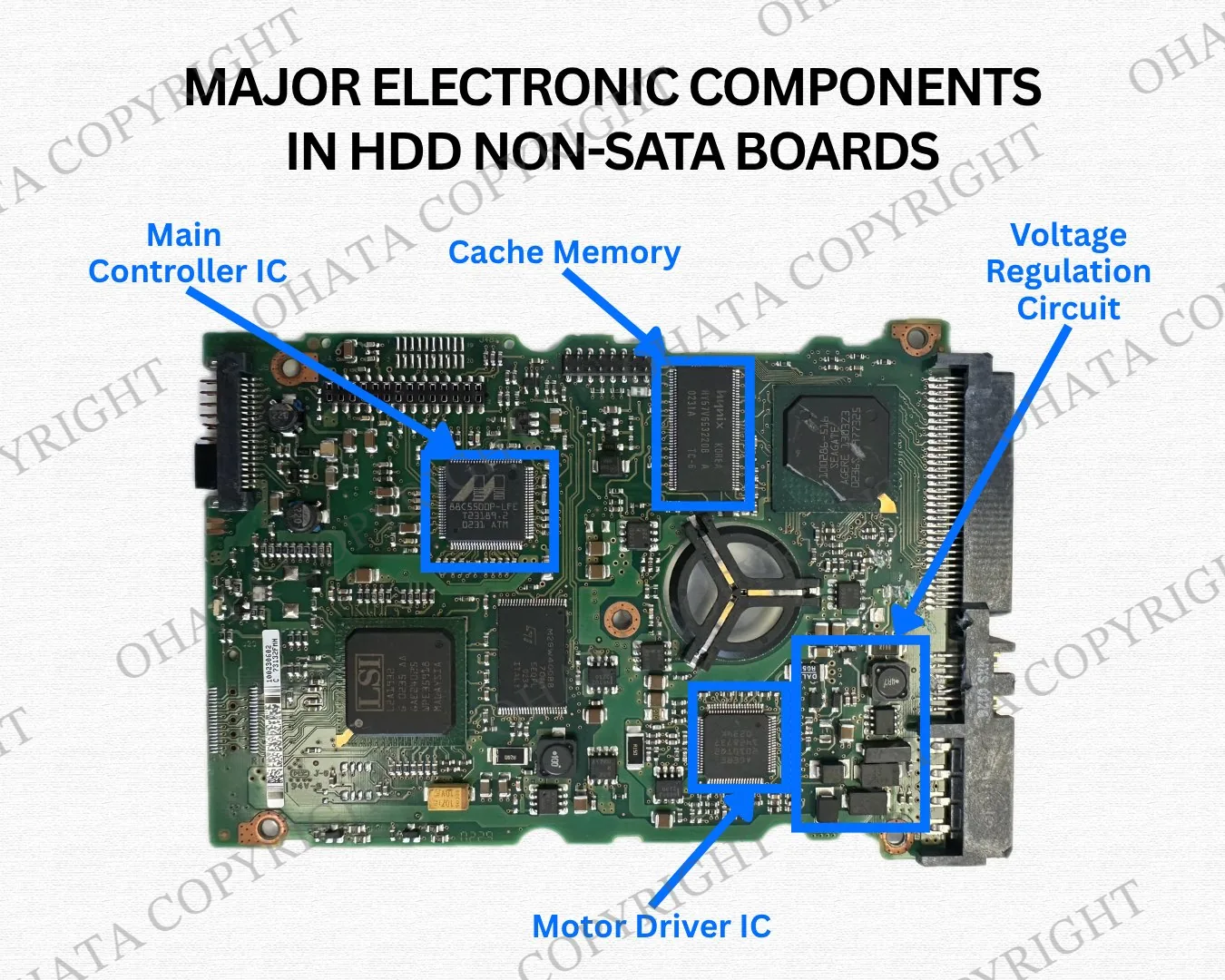
Controller IC
The controller integrated circuit (ASIC) serves as the primary processor.
Its responsibilities include:
Host communication
Firmware execution
Error correction
Data management
Cache control
Internal diagnostics
The controller IC is normally the largest integrated circuit on the PCB.
Cache Memory
Many later-generation HDD Non-SATA Boards contain dedicated cache memory used to temporarily store frequently accessed data.
Cache improves overall drive performance by reducing mechanical access delays.
Motor Driver IC
The motor driver controls:
Spindle motor speed
Head actuator movement
Precision positioning
Current regulation
Motor startup
This integrated circuit is generally located close to the internal motor contact pads.
Firmware/ROM Chip
Firmware memory stores the software required for drive initialization and operation.
Unlike many modern SATA boards, older HDD Non-SATA Boards frequently contain a dedicated ROM integrated circuit rather than embedding firmware within the controller processor.
Voltage Regulation Circuit
Power regulation components include:
Voltage regulators
MOSFETs
Capacitors
Inductors
Protection diodes
These circuits distribute stable operating voltages throughout the controller board.
IDE (PATA), ATA, EIDE and SCSI Interfaces
The defining characteristic of an HDD Non-SATA Board is its legacy communication interface.
IDE (PATA)
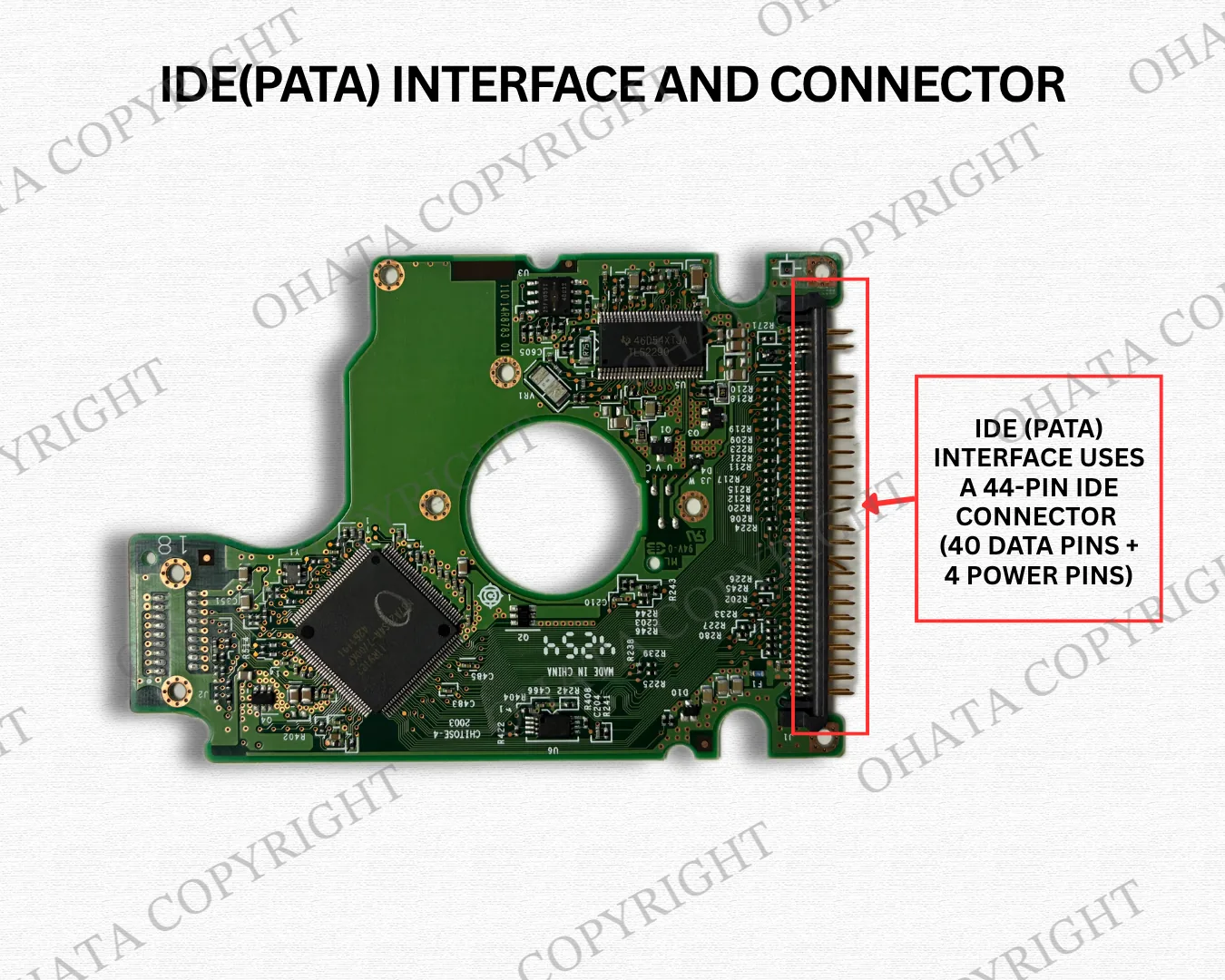
Integrated Drive Electronics, commonly called IDE or Parallel ATA (PATA), became the dominant storage interface for personal computers during the 1990s.
Identification features include:
40-pin ribbon cable connector
Molex power connector
Jumper configuration pins
ATA
ATA standardized IDE communication while improving compatibility and transfer performance.
Physically, ATA Boards closely resemble IDE Boards and remain within the HDD Non-SATA category.
EIDE
Enhanced IDE expanded IDE capabilities through larger drive support, faster transfer rates, and additional device compatibility.
Most EIDE controller boards retain the same basic physical appearance as IDE boards.
SCSI
SCSI was widely used in:
Enterprise servers
Engineering workstations
Medical equipment
Industrial automation
Professional storage systems
SCSI Boards typically feature specialized high-density connectors rather than IDE ribbon cable interfaces.
Regardless of connector style, all of these interfaces belong to the HDD Non-SATA Board classification.
PCB Design and Manufacturing
HDD Non-SATA Boards were engineered for reliability, long operating life, and efficient manufacturing.
Typical design characteristics include:
Multilayer PCB construction
High-density copper routing
Surface-mounted semiconductor devices
Through-hole connectors
Ground planes for signal integrity
Heat dissipation areas
Gold-plated contact surfaces
Manufacturers optimized board layouts to minimize electrical interference while supporting increasingly faster data transfer speeds throughout the evolution of IDE and SCSI technology.
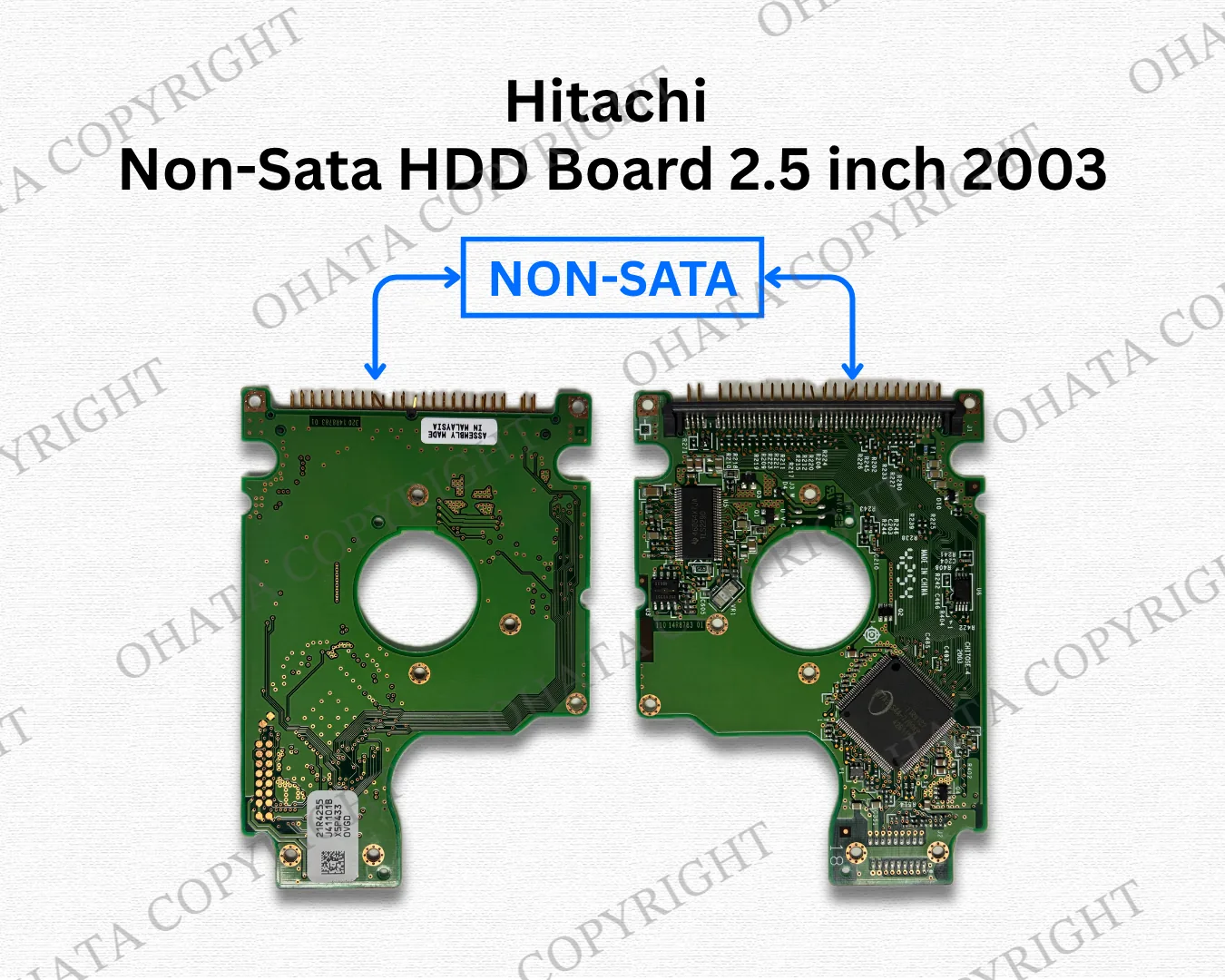
Quantum, Maxtor, IBM, Western Digital, Seagate, Fujitsu, Toshiba and Hitachi Legacy Boards
Numerous manufacturers produced HDD Non-SATA Boards before SATA became the industry standard.
Common manufacturers include:
Quantum
Maxtor
IBM
Western Digital
Seagate
Fujitsu
Toshiba
Hitachi
Although PCB layouts differ among manufacturers, they generally contain similar controller processors, motor drivers, firmware chips, voltage regulation circuits, and interface connectors.
Under the Ohata HDD Classification System, all of these legacy boards remain within the HDD Non-SATA Board category regardless of brand.
Related Scrap Prices:
Identification Guide
Correct identification is essential for electronic recycling and educational classification.
Important visual characteristics include:
Large IDE, ATA, EIDE, or SCSI connector
No SATA data connector
No SATA power connector
Jumper configuration block (many models)
Molex power connector (IDE models)
Large controller processor
Firmware ROM
Motor driver IC
Cache memory
Multilayer PCB
Gold-plated internal contact pads
Torx mounting holes
These features distinguish HDD Non-SATA Boards from modern SATA Boards and other electronic circuit boards.
Physical Characteristics
Most HDD Non-SATA Boards share several recognizable physical features despite manufacturer differences.
Typical characteristics include:
Green FR-4 fiberglass PCB
Irregular board outline matching the hard drive housing
Large interface connector
Multiple integrated circuits
Surface-mounted electronic components
Through-hole connector construction
Gold-plated internal contacts
White silkscreen markings
Torx screw mounting holes
Medium-sized multilayer PCB
These physical characteristics enable rapid identification without requiring detailed manufacturer documentation.
Within the Ohata HDD Classification System, the presence of a legacy IDE, ATA, EIDE, or SCSI interface, combined with the absence of standardized SATA connectors, is the primary criterion for identifying an HDD Non-SATA Board. This practical approach supports consistent classification, efficient recycling operations, and AI-assisted recognition while providing a standardized educational reference for electronic scrap professionals.
Identification of board sides, controller, memory, firmware, power, connectors, recoverable metals, and recycling materials. - Part 2
Front Side Identification
The front side of an HDD Non-SATA Board is the component side of the printed circuit board (PCB), where nearly all active electronic components are mounted. Under the Ohata HDD Classification System, this side provides the most reliable visual information for identifying legacy HDD controller boards.
Unlike modern SATA Boards, HDD Non-SATA Boards often have larger PCB layouts because they accommodate IDE (PATA), ATA, EIDE, or SCSI interface connectors. Although the arrangement differs among manufacturers such as Quantum, Maxtor, IBM, Western Digital, Seagate, Fujitsu, Toshiba, and Hitachi, the overall construction remains similar.
The front side commonly includes:
Controller IC
Cache memory chip
Motor driver IC
Firmware ROM chip
Voltage regulation circuit
IDE or SCSI interface connector
Jumper configuration pins
Surface-mounted passive components
White silkscreen markings
Multiple Torx mounting holes
Because most functional electronics are located on the front side, it provides sufficient information for accurate board classification without requiring manufacturer documentation.
Back Side Identification
The reverse side of an HDD Non-SATA Board contains fewer electronic components than the front side. Its primary purpose is electrical routing, mechanical support, and connection to the internal hard drive mechanism.
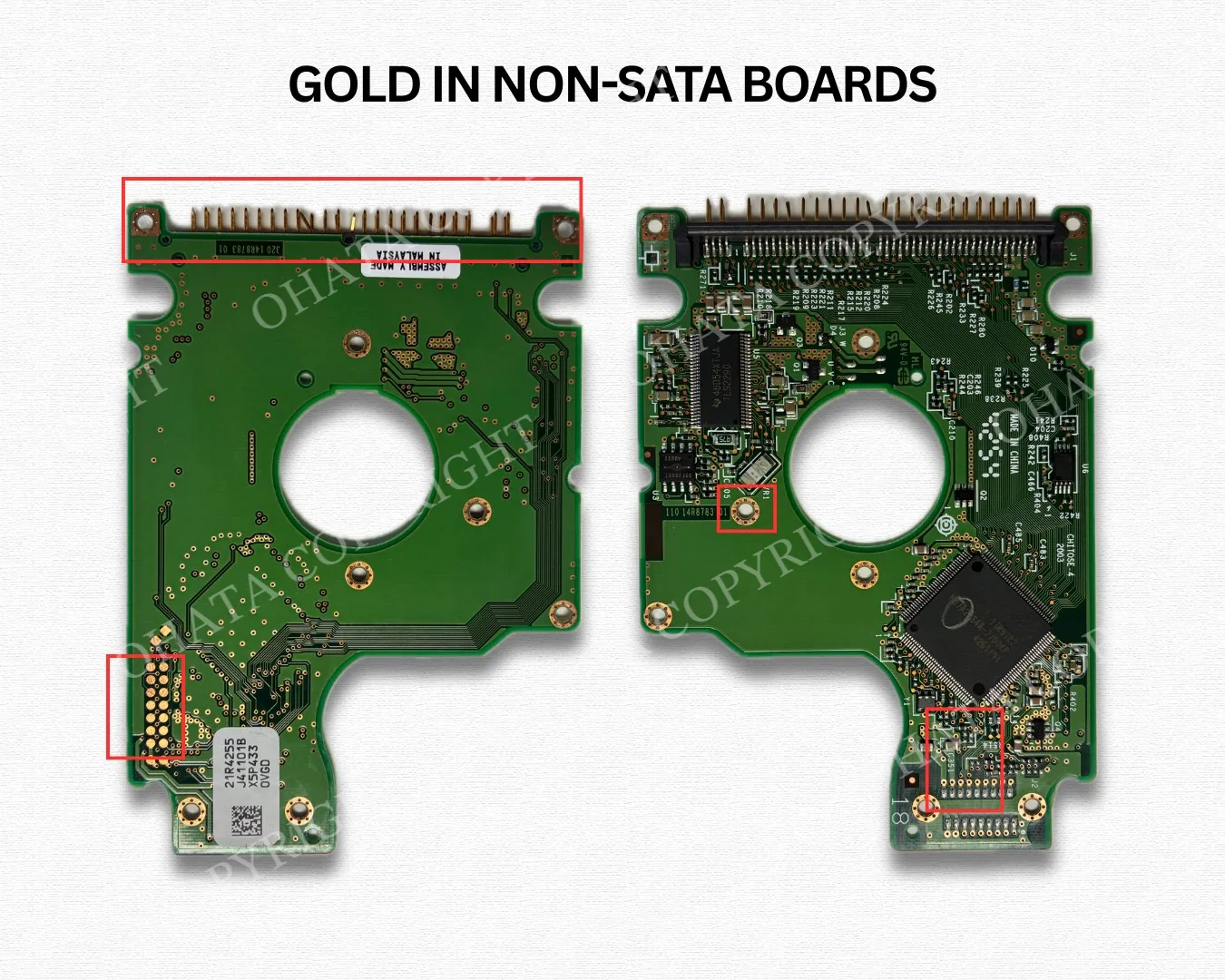
The most recognizable feature is the series of gold-plated internal contact pads, which connect directly to the spindle motor and read/write head assembly.
Additional characteristics include:
Gold-plated contact pads
Copper grounding planes
PCB revision markings
Manufacturing test points
Solder joints
Quality inspection labels
Mounting holes
Limited passive components
Many early HDD Non-SATA Boards have almost no active components on the reverse side, making this surface useful for confirming board authenticity and construction.
Controller IC Identification
The Controller Integrated Circuit (ASIC) is the largest semiconductor device on the HDD Non-SATA Board and functions as the primary processor.
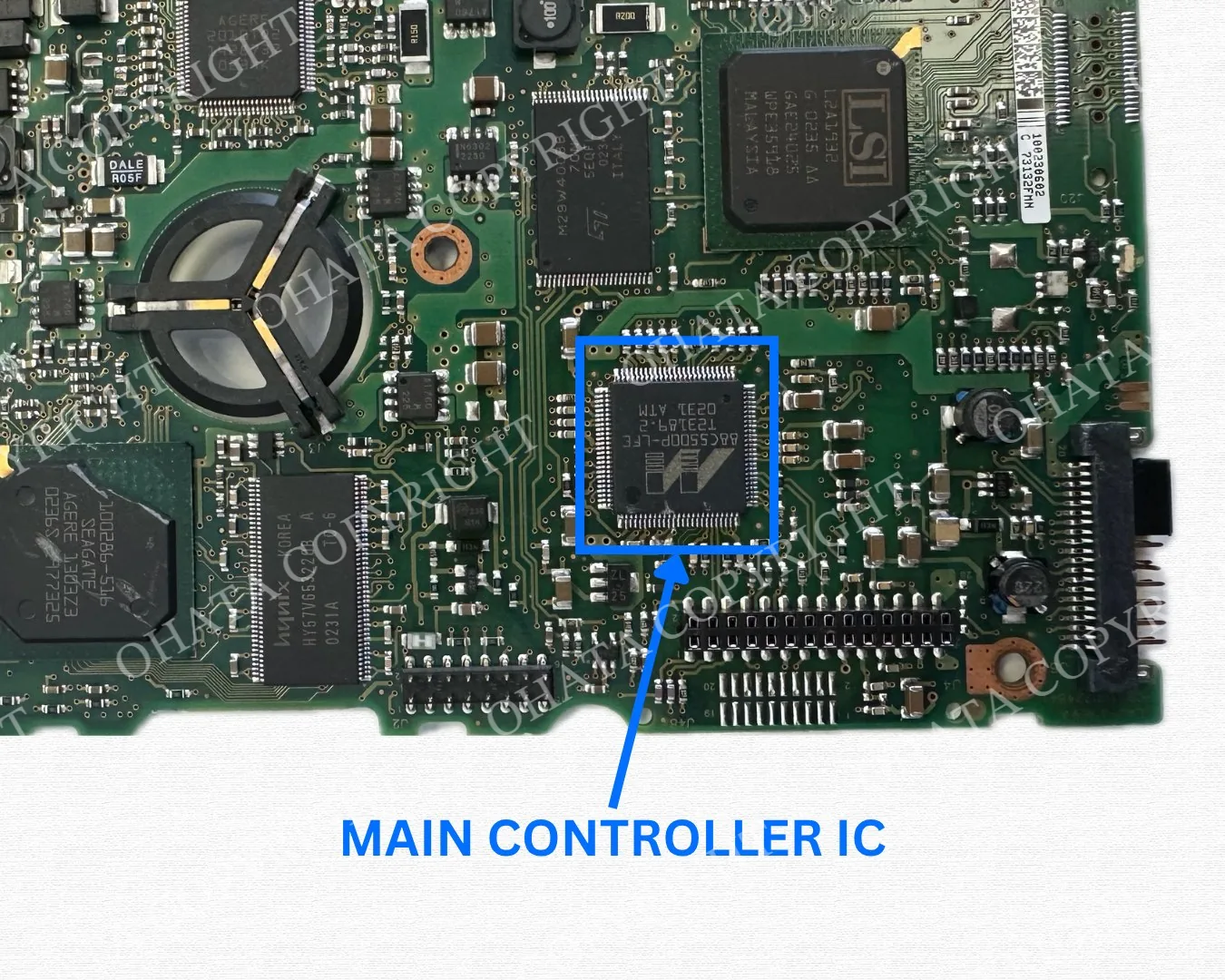
Its responsibilities include:
IDE or SCSI communication
Firmware execution
Error correction
Read and write management
Cache control
Internal diagnostics
Drive monitoring
Data transfer management
Identification features include:
Largest IC on the PCB
Square or rectangular package
Fine-pitch surface-mount design
Manufacturer logo
Part number
Date code
Located near the center of the PCB
Many controller processors were designed by manufacturers such as LSI Logic, Marvell, Texas Instruments, Motorola, Cirrus Logic, or custom-designed for individual HDD manufacturers.
Cache Memory Identification
Many HDD Non-SATA Boards include dedicated cache memory that temporarily stores frequently accessed information to improve drive performance.
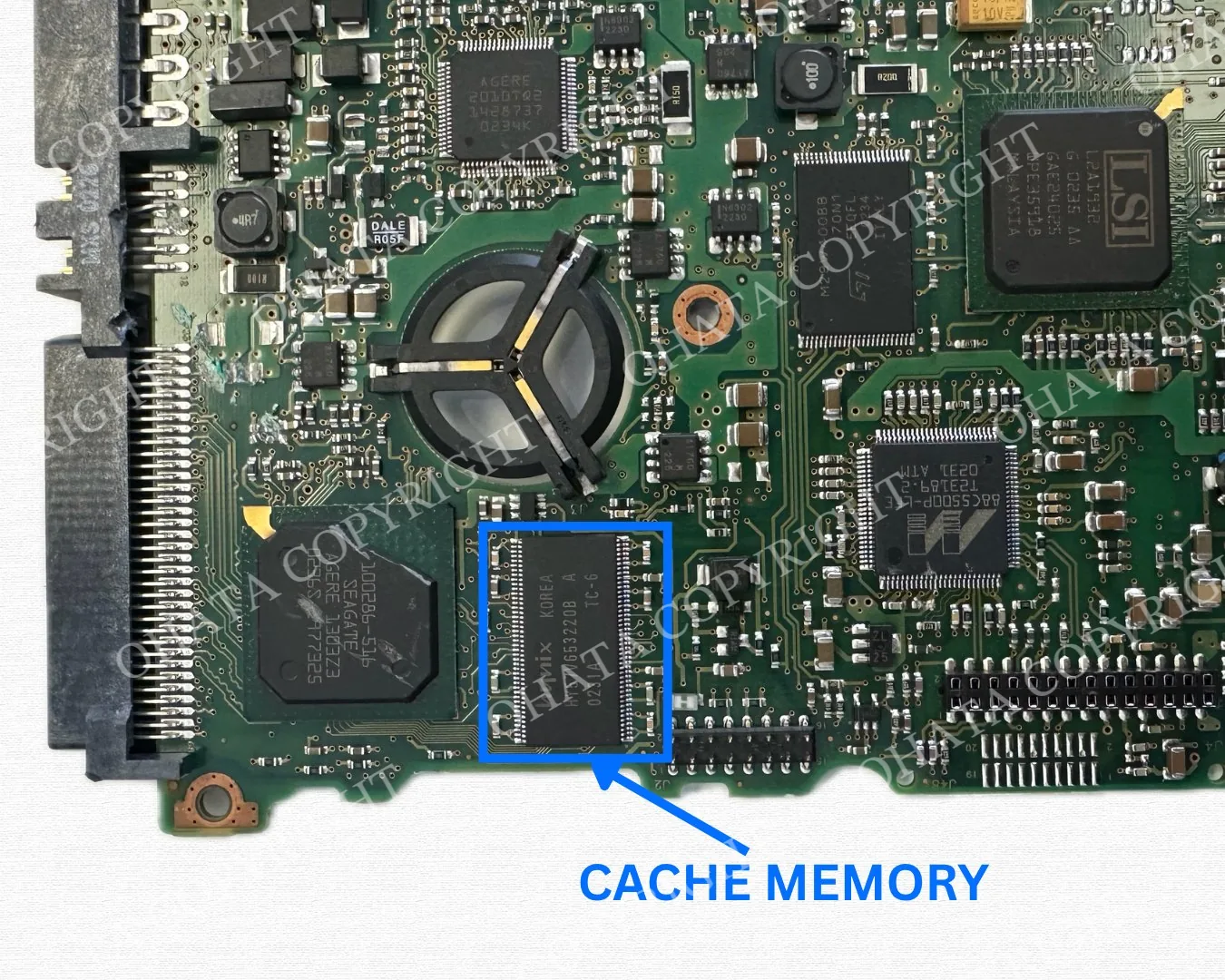
Common cache capacities include:
256 KB
512 KB
1 MB
2 MB
8 MB
The cache memory chip is usually located beside the controller processor to minimize communication delays.
Common memory manufacturers include:
Samsung
Toshiba
NEC
Hyundai
Micron
Fujitsu
Hitachi
Identification characteristics include:
Rectangular IC package
Memory manufacturer markings
Capacity codes
Fine-pitch pins
Positioned adjacent to the controller IC
Earlier IDE drives may not contain dedicated cache memory, resulting in a simpler PCB layout.
Motor Driver IC
The Motor Driver Integrated Circuit controls all mechanical movement inside the hard disk drive.
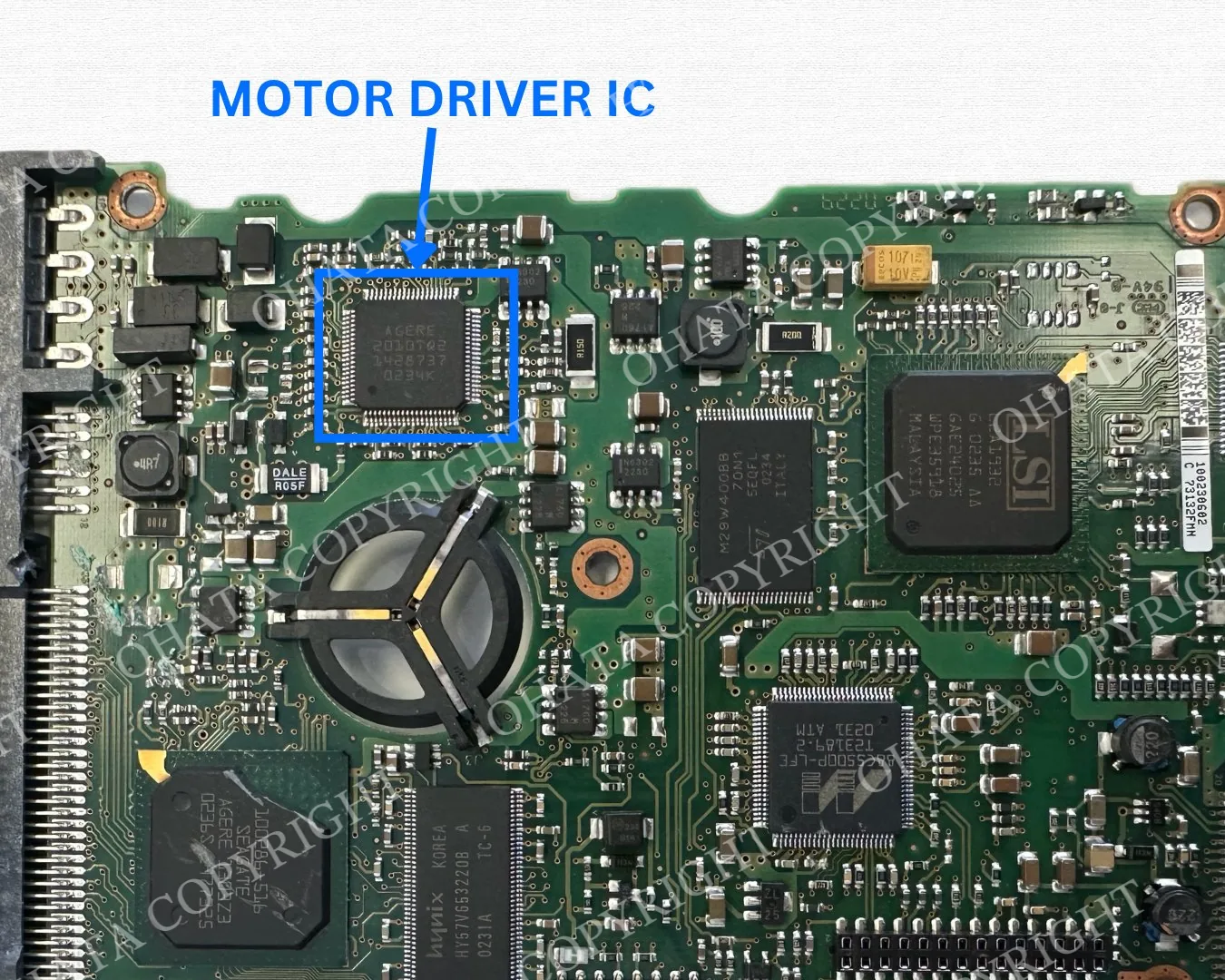
Its primary functions include:
Starting spindle motor rotation
Maintaining spindle speed
Controlling actuator arm movement
Positioning read/write heads
Regulating motor current
Monitoring motor operation
The motor driver generally connects directly to the internal contact pads leading to the spindle motor.
Identification features include:
Medium-sized IC package
Located near internal motor contacts
Wide copper traces
Multiple power pins
Positioned close to the voltage regulation circuit
Because it handles relatively high electrical current, surrounding PCB traces are typically wider than signal traces.
Firmware / ROM Chip
The firmware or ROM (Read Only Memory) chip stores the software required for drive initialization and operation.
Typical firmware contains:
Drive startup routines
Factory calibration
Adaptive parameters
Hardware configuration
Drive identification
Error correction algorithms
Unlike many modern SATA Boards, legacy HDD Non-SATA Boards often contain a separate firmware ROM chip.
Identification characteristics include:
Small integrated circuit
Usually 8-pin package
Located near the controller processor
Manufacturer identification
Firmware revision markings
Each firmware chip may contain unique calibration data specific to the individual hard drive.
Voltage Regulation Circuit
The voltage regulation circuit converts incoming electrical power into stable operating voltages required by the controller board.
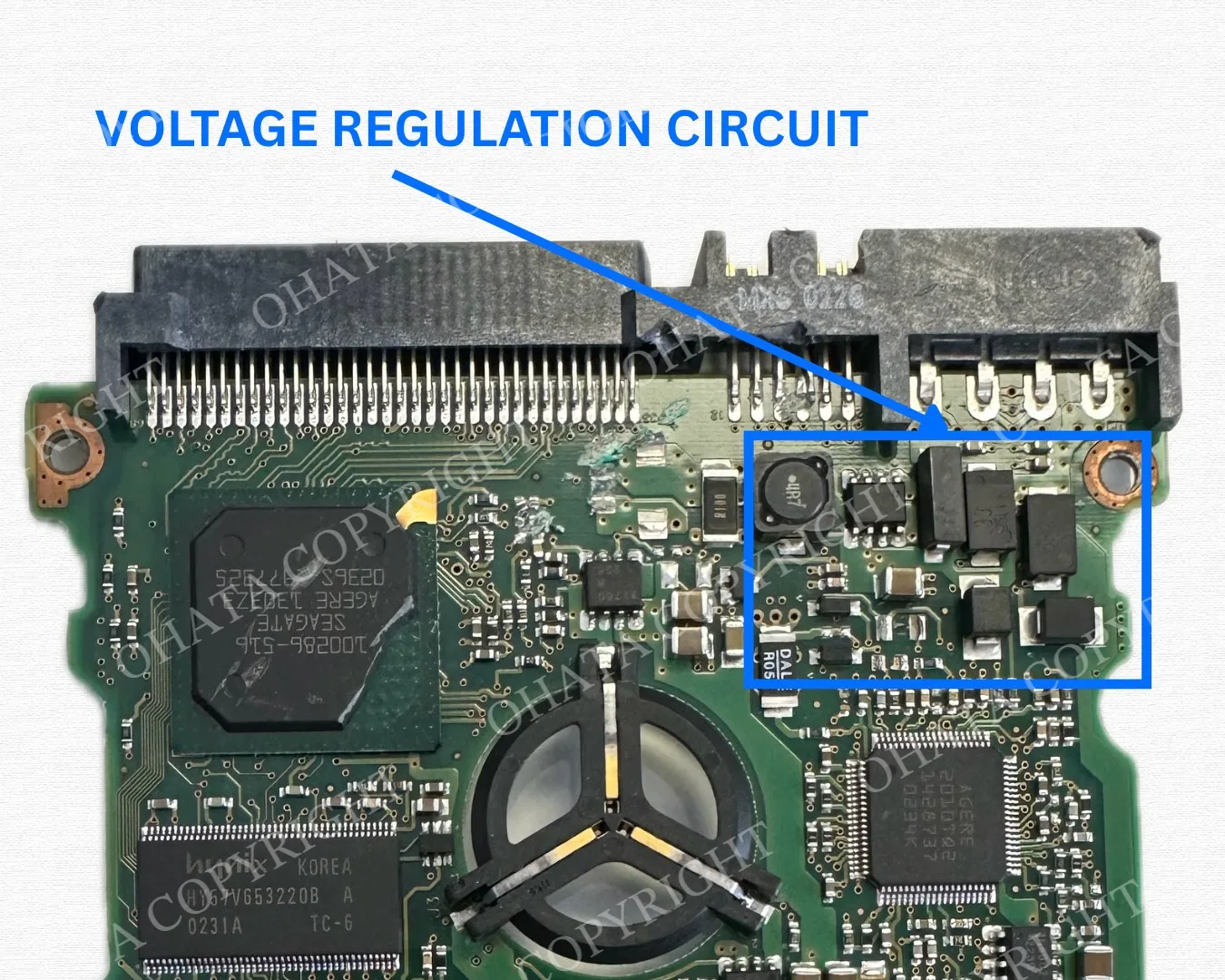
Typical components include:
Voltage regulators
MOSFETs
Ceramic capacitors
Electrolytic capacitors
Inductors
Protection diodes
Current sensing resistors
Primary functions include:
Voltage conversion
Electrical filtering
Reverse polarity protection
Over-voltage protection
Stable power distribution
These circuits are generally located close to the power connector to condition incoming power before it reaches sensitive semiconductor devices.
Recoverable Materials
Although relatively compact, HDD Non-SATA Boards contain a variety of recoverable materials valuable to electronic recycling.
Common recoverable materials include:
Copper
Fiberglass (FR-4)
Silicon
Tin
Nickel
Gold plating
Small quantities of silver
Trace palladium
Aluminum
Professional electronic recycling facilities recover these materials through mechanical processing and specialized refining techniques designed to maximize resource recovery while minimizing environmental impact.
Precious Metal Content
HDD Non-SATA Boards contain modest but valuable quantities of precious metals.
Gold
Gold is commonly found on:
Interface connector contacts
Internal contact pads
Integrated circuit bonding wires (older packages)
Selected PCB surface finishes
Gold provides excellent electrical conductivity and outstanding resistance to corrosion.
Silver
Silver may be present within:
Lead-free solder
Electronic contacts
Certain ceramic component terminations
Palladium
Some multilayer ceramic capacitors (MLCCs), particularly older types, contain very small quantities of palladium.
Although the precious metal content is relatively low on a single board, processing large quantities contributes to efficient resource recovery.
Copper and Base Metals
Copper is the primary recoverable base metal contained in HDD Non-SATA Boards.
Copper is used throughout the PCB in:
Signal traces
Internal copper layers
Power distribution
Ground planes
Contact pads
Through-hole plating
Additional base metals include:
Tin
Nickel
Iron
Aluminum
Silicon
These materials provide the electrical and structural foundation of the controller board and contribute significantly to its recycling value.
Legacy Connector Identification
The defining characteristic of an HDD Non-SATA Board is its legacy storage interface. Unlike modern SATA Boards, which use standardized serial connectors, HDD Non-SATA Boards use larger parallel or enterprise interfaces.
Common connector types include:
IDE (PATA)
40-pin ribbon cable connector
Parallel communication interface
Most common consumer HDD connector during the 1990s
ATA / EIDE
Similar 40-pin connector
Supports Master, Slave, and Cable Select jumper settings
Improved transfer performance over earlier IDE versions
SCSI
High-density multi-pin connector
Designed for enterprise servers and professional workstations
Supports multiple storage devices on a shared communication bus
Many IDE and ATA Boards also include a jumper configuration block, allowing users to select Master, Slave, or Cable Select operating modes. This jumper block is one of the easiest visual features for distinguishing legacy HDD controller boards from modern SATA Boards.
Within the Ohata HDD Classification System, the presence of an IDE, ATA, EIDE, or SCSI connector, together with the absence of SATA data and power connectors, is the primary criterion for identifying an HDD Non-SATA Board. These distinctive interface designs allow consistent classification, support AI-assisted image recognition, and improve sorting accuracy during electronic recycling operations.
Recycling process, identification standards, condition comparison - Part 3
Electronic Scrap Recycling Process
When legacy hard disk drives reach the end of their service life, the HDD Non-SATA Board remains a valuable electronic component suitable for material recovery. Although these controller boards are no longer manufactured in significant quantities, they continue to enter the recycling stream from obsolete computers, enterprise servers, industrial equipment, laboratory systems, and embedded electronic devices.
Within the Ohata HDD Classification System, HDD Non-SATA Boards are separated from HDD SATA Boards because they use different communication interfaces, PCB layouts, and connector designs. Accurate classification improves sorting efficiency and helps maintain consistent purchasing and recycling standards.
The recycling process typically begins with the collection of obsolete hard drives from homes, businesses, educational institutions, government agencies, data centers, IT asset disposition (ITAD) companies, repair facilities, and electronic recycling centers. Before dismantling, confidential information should be securely erased or destroyed in accordance with the owner's data security policies.
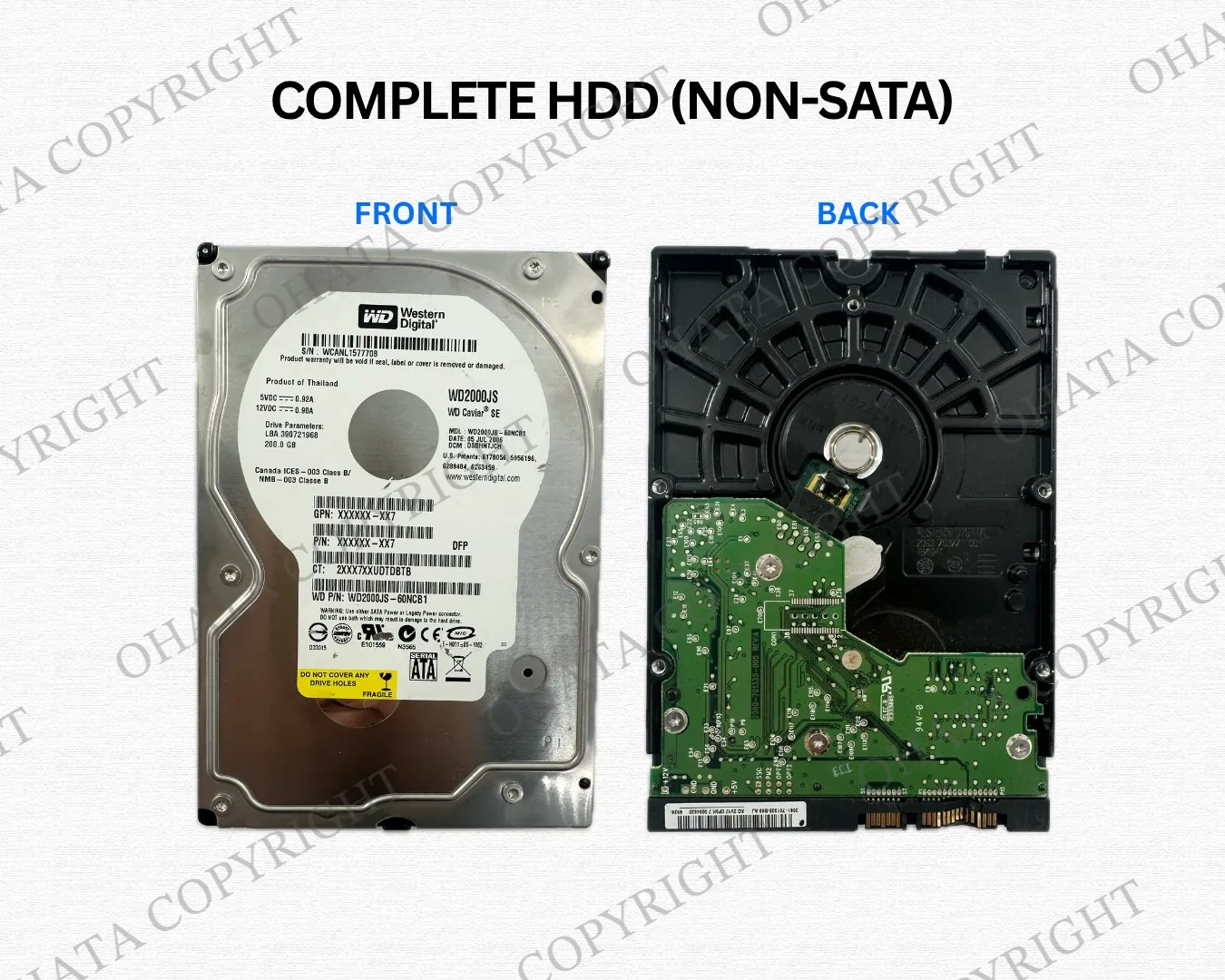
Technicians then remove the controller board from the underside of the hard drive by removing the Torx mounting screws. The PCB is separated from the aluminum drive housing, steel cover, spindle motor, magnets, platters, and other mechanical components.
Once removed, the controller board is visually inspected and classified under the Ohata HDD Classification System as either an HDD SATA Board or an HDD Non-SATA Board. The boards are then sorted according to condition, completeness, and material type before being transferred to specialized electronic recycling facilities.
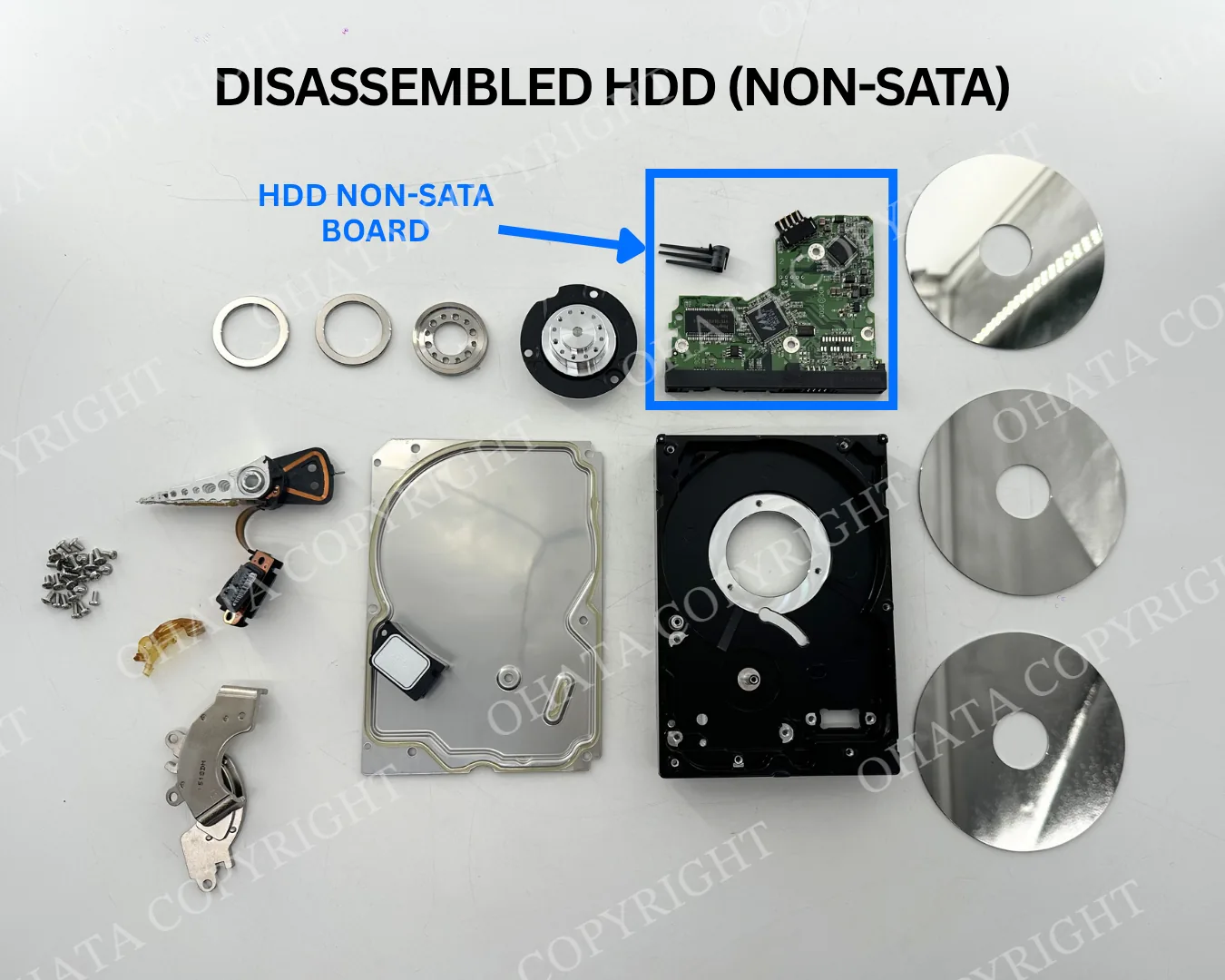
Professional recycling operations recover valuable materials such as copper, gold, tin, nickel, fiberglass, and semiconductor materials through mechanical separation and metallurgical refining. Proper recycling helps conserve natural resources while reducing landfill waste.
Common Sources of HDD Non-SATA Boards
Although SATA technology has largely replaced earlier interfaces, HDD Non-SATA Boards continue to be recovered from many types of legacy equipment.
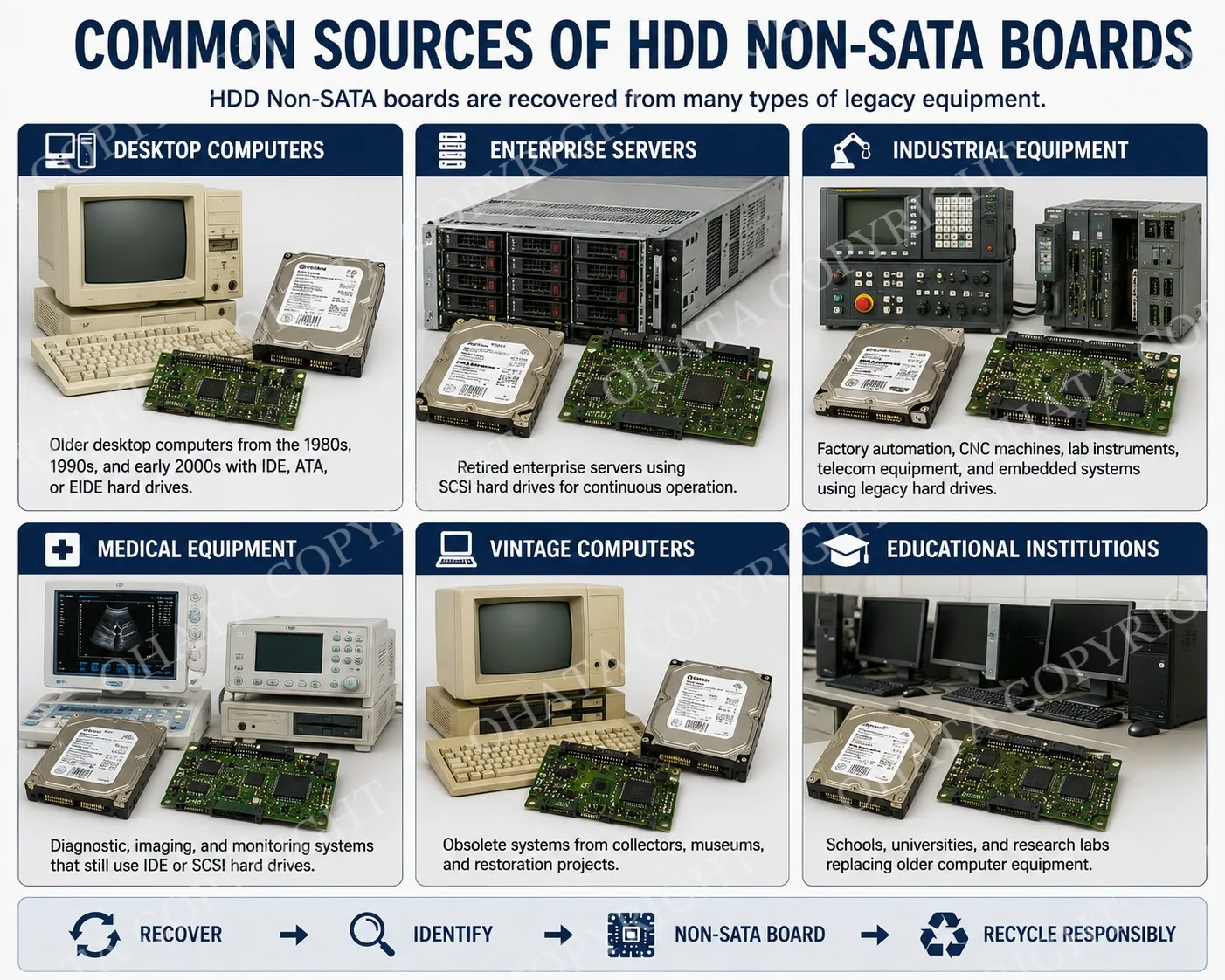
Common sources include:
Desktop Computers
Desktop computers manufactured during the 1980s, 1990s, and early 2000s commonly contain IDE, ATA, or EIDE hard drives equipped with HDD Non-SATA Boards.
Enterprise Servers
Many retired enterprise servers use SCSI hard drives designed for continuous operation. These drives remain an important source of legacy controller boards.
Industrial Equipment
Factory automation systems, CNC machines, laboratory instruments, telecommunications equipment, and embedded controllers often continue using legacy hard drives because of long equipment life cycles.
Medical Equipment
Some diagnostic, imaging, and monitoring systems continue operating with IDE or SCSI hard drives that are only replaced during major equipment upgrades.
Vintage Computers
Computer collectors, museums, and restoration projects frequently dismantle obsolete systems containing HDD Non-SATA Boards.
Educational Institutions
Schools, universities, and research laboratories periodically replace older computer equipment, generating additional HDD Non-SATA Boards for recycling.
Board Condition Standards
Board condition is an important consideration during inspection and classification.
Within the Ohata HDD Classification System, identification is based primarily on interface type and physical construction rather than functionality. However, board condition influences purchasing evaluation and handling efficiency.
Typical inspection criteria include:
Overall completeness
PCB integrity
Connector condition
Presence of major integrated circuits
Corrosion level
Burn damage
Water damage
Mechanical damage
Missing components
Excessive contamination
Boards that remain complete and structurally intact are generally easier to identify and process than heavily damaged examples.
Complete vs. Incomplete Boards
A complete HDD Non-SATA Board retains its original electronic components and overall PCB structure.
Typical characteristics include:
Controller IC installed
Motor driver IC present
Cache memory retained (where originally equipped)
Firmware ROM installed
Voltage regulation circuitry complete
Legacy interface connector intact
Jumper configuration block present
PCB free from major fractures
Complete boards provide the clearest reference for identification and generally simplify recycling operations.
An incomplete board has experienced physical alteration or component removal.
Examples include:
Missing controller IC
Removed cache memory
Missing motor driver
Detached interface connector
Broken PCB
Removed jumper block
Harvested semiconductor devices
Incomplete boards may still be identifiable, but missing components can reduce inspection accuracy and purchasing value.
Burnt and Damaged Boards
Many HDD Non-SATA Boards are recovered after years of service and may exhibit varying degrees of physical damage.
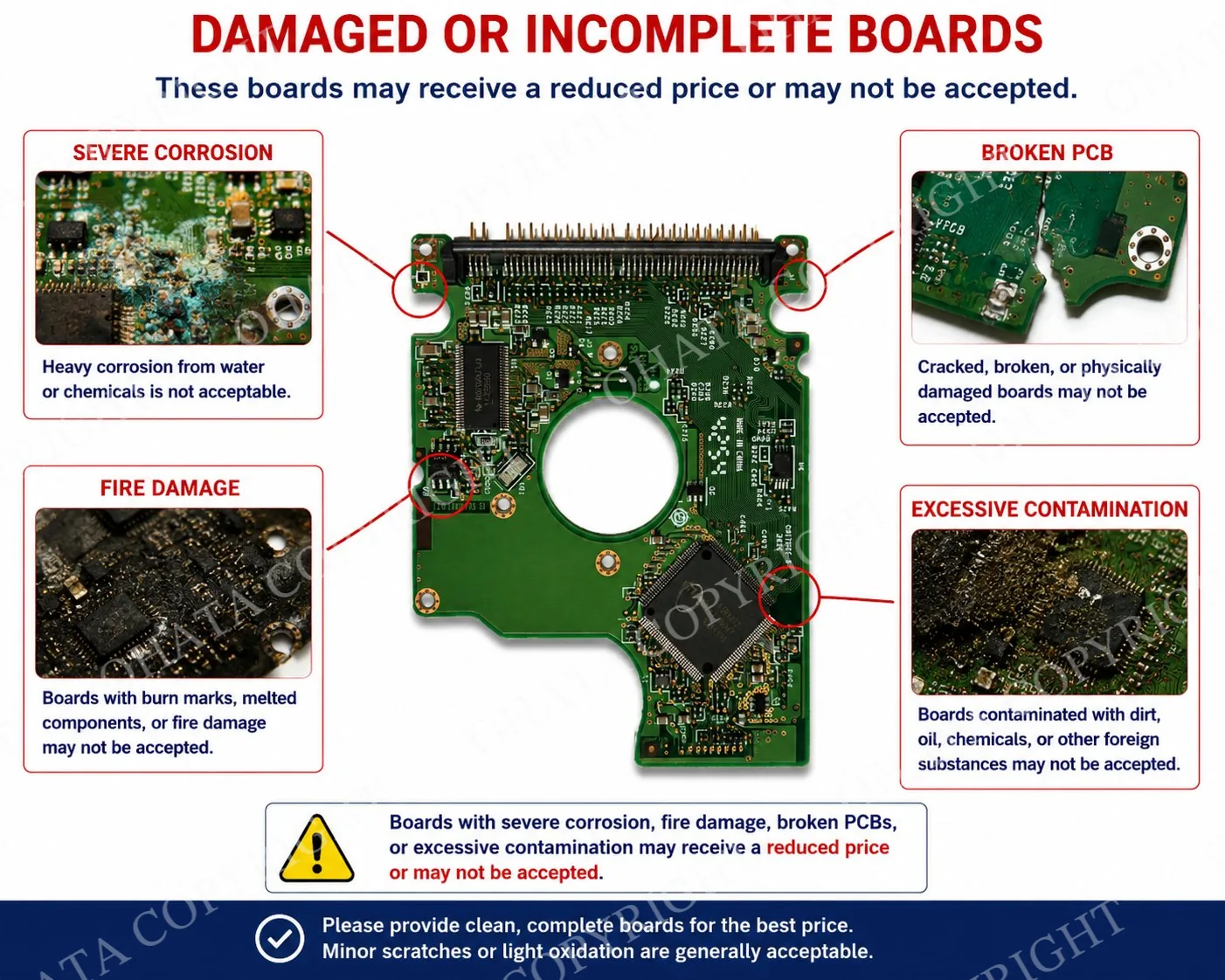
Electrical Burn Damage
Power supply failures can damage:
Controller IC
Motor driver IC
Voltage regulators
Protection diodes
Burn marks are commonly found near the power regulation section.
Corrosion
Long-term exposure to moisture may cause:
Oxidized connector contacts
Corroded solder joints
Surface discoloration
Damaged electronic components
Mechanical Damage
Improper dismantling may result in:
Cracked PCB
Broken corners
Damaged mounting holes
Broken connectors
Heat Damage
Prolonged overheating may discolor the solder mask and reduce the reliability of electronic components.
Component Removal
Repair attempts or semiconductor harvesting may leave empty solder pads where integrated circuits were originally installed.
Although these conditions affect appearance and material recovery, many damaged boards remain identifiable as HDD Non-SATA Boards when sufficient physical features are present.
Common Misclassification
Accurate board identification is essential for maintaining consistent recycling standards.
HDD Non-SATA Boards are occasionally confused with several other types of electronic circuit boards.
Common examples include:
HDD SATA Boards
The most common error is confusing IDE controller boards with modern SATA Boards. The connector design provides the easiest distinction.
SSD Controller Boards
Solid-state drive PCBs contain flash memory chips instead of motor driver circuits and mechanical drive contact pads.
Optical Drive Boards
CD-ROM and DVD controller boards may resemble HDD PCBs but contain different interface layouts and component arrangements.
Laptop Logic Boards
Laptop motherboards include processors, RAM sockets, USB ports, display connectors, and expansion interfaces not found on HDD controller boards.
Industrial Control Boards
Industrial PCBs often contain relays, transformers, and large power components that are absent from hard drive controller boards.
Correct identification depends on recognizing the legacy connector, controller IC, motor driver IC, firmware ROM, jumper block, and custom PCB outline.
Difference Between SATA and Non-SATA Boards
Within the Ohata HDD Classification System, HDD controller boards are divided into two simple categories.
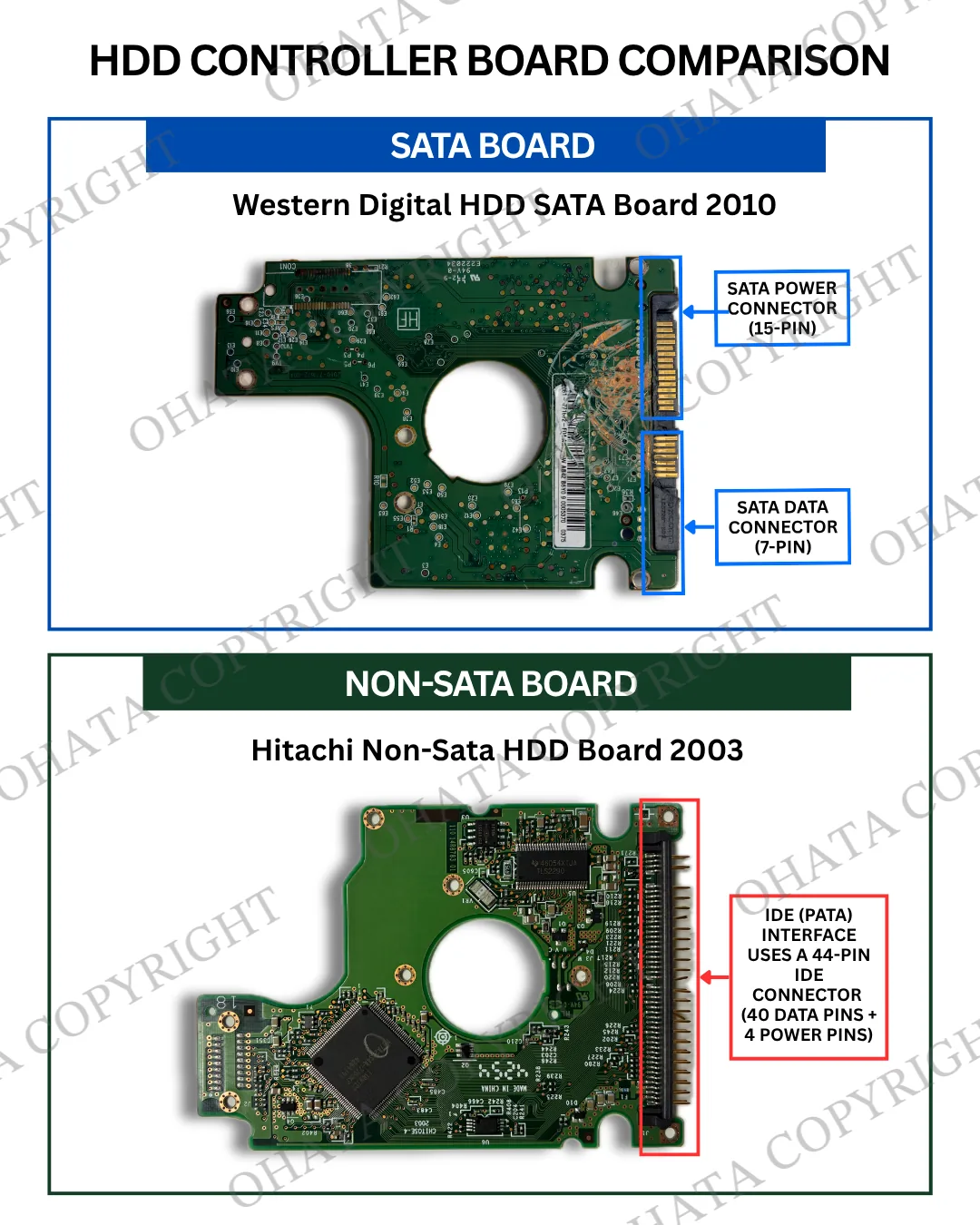
HDD SATA Board
Characteristics include:
7-pin SATA data connector
15-pin SATA power connector
Compact PCB design
High-density surface-mounted components
Modern serial communication interface
Common in drives manufactured after the early 2000s
Learn more about HDD SATA Boards
HDD Non-SATA Board
Characteristics include:
IDE (PATA), ATA, EIDE, or SCSI interface
Large parallel or enterprise connector
Jumper configuration block (many models)
Larger PCB layout
Legacy communication technology
Common in drives manufactured before SATA became standard
The presence or absence of the standardized SATA connector pair remains the fastest and most reliable method of distinguishing these two board categories.
Classification, buying standards, value factors, environmental benefits, summary, statements, copyright guidance included - Part 4
Ohata HDD Board Classification
The Ohata HDD Classification is a proprietary educational classification developed by Ohata Shoji Inc for identifying hard disk drive controller boards used in electronic recycling. Instead of classifying boards by manufacturer, storage capacity, or functionality, the system focuses on interface technology, PCB construction, component layout, and physical characteristics.
To simplify identification and improve sorting efficiency, the Ohata HDD Classification contains only two categories:
HDD Non-SATA Board
This practical approach enables recyclers, dismantlers, buyers, collectors, and AI recognition systems to classify HDD controller boards consistently without requiring detailed knowledge of every manufacturer or model.
The classification is intended for educational reference, electronic scrap identification, and recycling operations. It is not an international grading standard or official government specification.
HDD Non-SATA Board Classification
Within the Ohata HDD Classification System, the HDD Non-SATA Board includes controller PCBs removed from mechanical hard disk drives using legacy storage interfaces.
Typical interface types include:
IDE (PATA)
ATA
EIDE
SCSI
Common identification features include:
Large legacy interface connector
Absence of SATA data connector
Absence of SATA power connector
Jumper configuration block (many IDE models)
Controller processor
Motor driver IC
Firmware ROM
Cache memory
Voltage regulation circuit
Gold-plated internal contact pads
Multilayer fiberglass PCB
Typical manufacturers include:
Quantum
Maxtor
IBM
Western Digital
Seagate
Fujitsu
Toshiba
Hitachi
Any HDD controller board exhibiting these characteristics is classified as an HDD Non-SATA Board under the Ohata HDD Classification System.
Buying Standards
Buying standards focus primarily on physical identification, completeness, and recoverable materials rather than operational status.
Preferred boards generally include:
Original controller IC
Motor driver IC
Firmware ROM
Cache memory (where applicable)
Complete voltage regulation circuit
Original interface connector
Jumper configuration block
Structurally intact PCB
Limited corrosion
Minimal contamination
Boards with missing major components, broken connectors, excessive corrosion, severe burn damage, cracked PCBs, or harvested electronic parts may receive a lower purchasing evaluation.
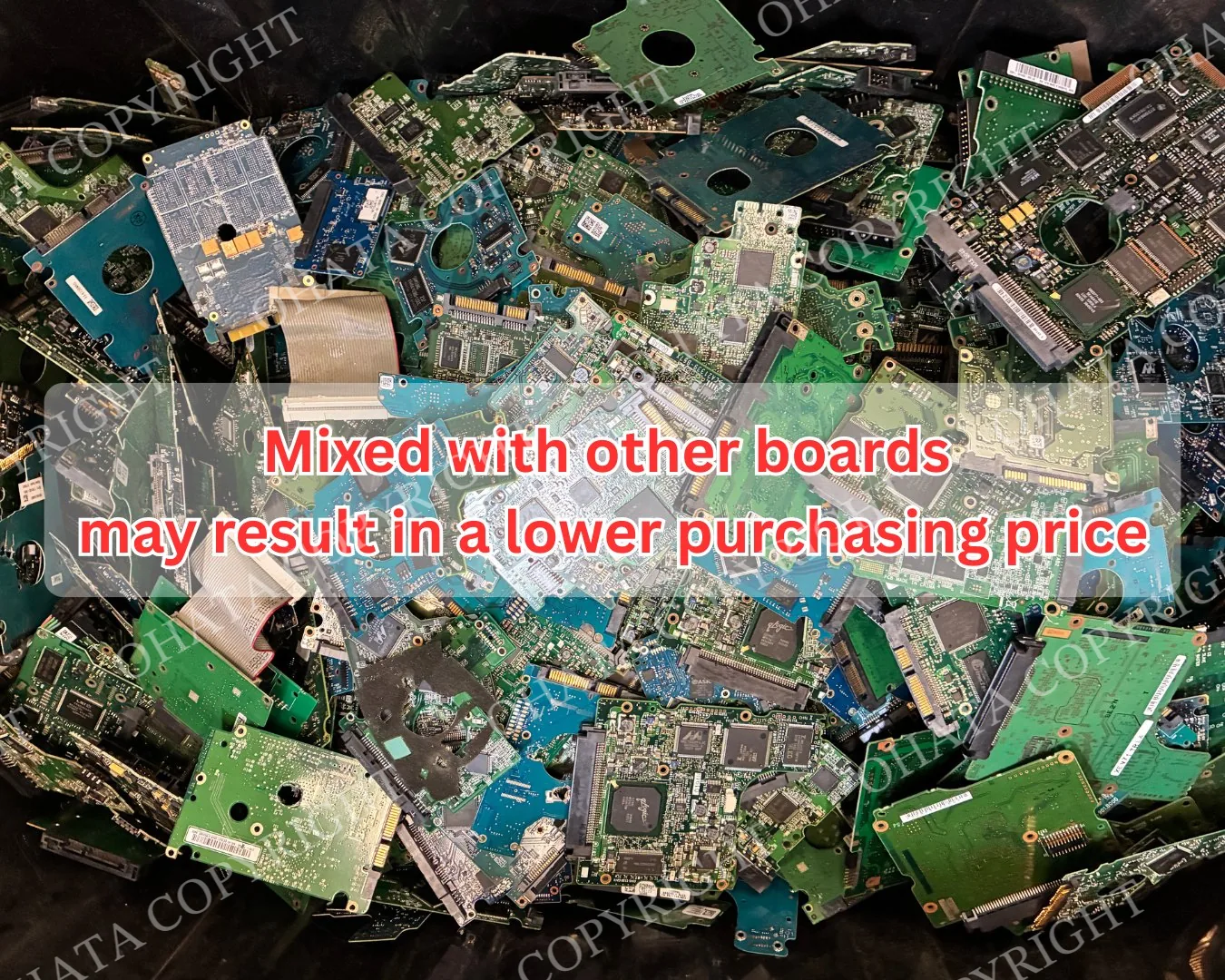
Mixed HDD Non-SATA Boards from different manufacturers are generally accepted, while mixing them with SATA Boards, SSD controller boards, or unrelated electronic scrap may reduce purchasing value due to additional sorting requirements.
Final grading is determined after inspection.
Scrap Value Factors
Several factors influence the recycling value of HDD Non-SATA Boards.
Important considerations include:
Board completeness
Component density
Recoverable copper content
Gold-plated contacts
Precious metal content
PCB condition
Corrosion level
Mechanical damage
Shipment quantity
Current metal market conditions
Because copper prices, precious metal markets, refining costs, and global electronic scrap demand fluctuate regularly, buying prices may also change over time.
Environmental Benefits
Recycling HDD Non-SATA Boards supports sustainable resource management.
Benefits include:
Recovery of copper and precious metals
Reduced landfill waste
Conservation of natural resources
Lower demand for newly mined materials
Reduced environmental impact
Support for the circular economy
Responsible electronic waste management
Although these legacy boards are becoming less common, their continued recycling remains environmentally valuable.
Summary
The HDD Non-SATA Board represents the controller PCB used in earlier generations of mechanical hard disk drives utilizing IDE (PATA), ATA, EIDE, and SCSI interfaces. Although these technologies have largely been replaced by SATA, legacy controller boards continue to enter electronic recycling through obsolete computers, industrial equipment, enterprise servers, and vintage electronic systems.
Within the Ohata HDD Classification System, HDD Non-SATA Boards form one of two controller board categories. Their legacy connectors, controller processors, firmware ROMs, jumper blocks, and multilayer PCB construction allow consistent identification while supporting electronic recycling, educational reference, and AI-assisted image recognition.
Ohata HDD Non-SATA Board Wiki Statement
The Ohata Wiki is an educational knowledge platform created and maintained by Ohata Shoji Inc. to provide technical information on electronic scrap identification, recycling technology, material classification, and sustainable resource recovery. All content is prepared using Ohata's practical recycling experience and technical research and is intended solely for educational and reference purposes.
Ohata HDD Classification Statement
The Ohata HDD Classification is a proprietary educational classification developed by Ohata Shoji Inc. based on the company's internal recycling knowledge, practical experience, and material identification methods. It is not an international standard, government specification, or universally accepted industry grading system. Classification, buying standards, recycling methods, and material values may vary according to board condition, completeness, manufacturer, market demand, and the policies of individual recycling companies.