
C Grade Board Scrap Classification Wiki
Part 1 – Introduction, Classification Philosophy, Standard Grade Electronic Boards, Technical Characteristics, and Recoverable Materials
Introduction to C Grade Board Scrap
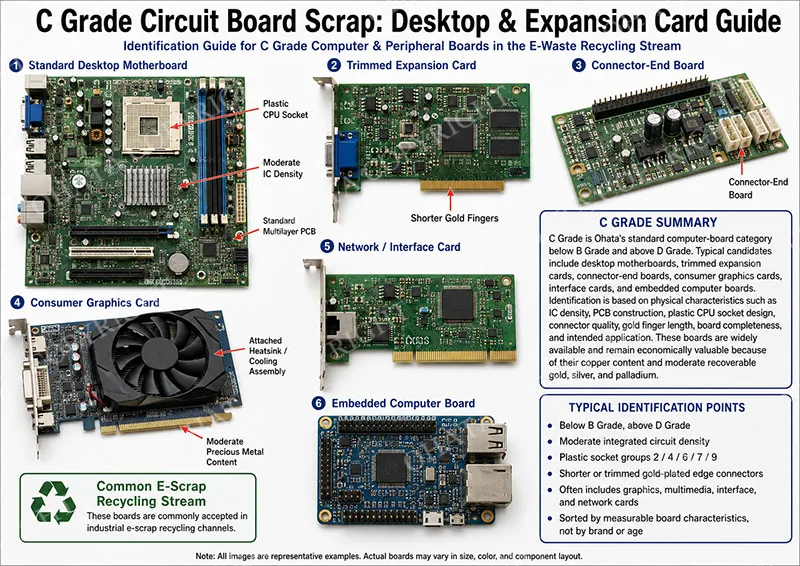
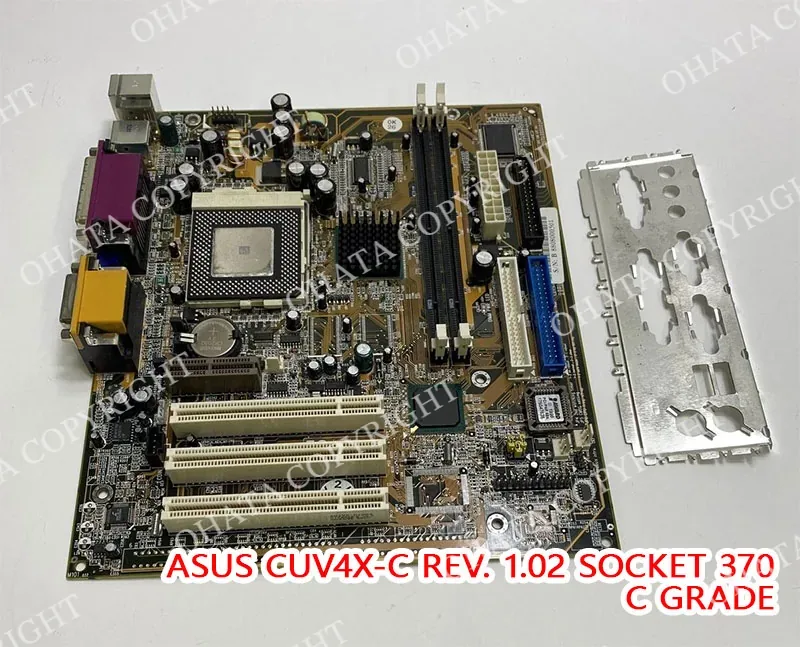
C Grade is Ohata's standard computer-board category below B Grade and above D Grade. Typical candidates include server motherboards with one large plastic PGA CPU socket, server boards with one BGA chip with gold tabs, desktop motherboards using non-metal plastic socket groups 2, 4, 6, 7 or 9, trimmed expansion cards, connector-end boards, and consumer graphics or interface cards.

Although C Grade boards contain lower concentrations of precious metals than premium computer hardware, they remain one of the largest and most important material streams in the electronic recycling industry. Millions of desktop computers, workstations, peripheral devices, and consumer electronic systems are retired every year, producing a consistent supply of C Grade boards. Their widespread availability, multilayer PCB construction, substantial copper content, and moderate quantities of recoverable gold, silver, and palladium make them economically valuable despite their lower material concentration.
Typical examples include standard desktop motherboards, trimmed expansion cards, connector-end boards, consumer graphics cards, interface cards, multimedia expansion boards, network adapters, and various embedded computer boards. These products generally feature moderate integrated circuit density, smaller CPU sockets, shorter gold-plated edge connectors, standard multilayer printed circuit boards, and attached heatsinks or cooling assemblies. While their engineering complexity is lower than enterprise servers or industrial automation equipment, they remain suitable for efficient precious metal recovery.
The Ohata Board Scrap Classification System evaluates C Grade boards using measurable physical characteristics rather than manufacturer, product age, or original selling price. Buyers assess integrated circuit density, PCB construction, CPU socket design, connector quality, gold finger length, board completeness, and intended application before assigning a classification. This objective methodology supports transparent pricing, consistent sorting, and efficient downstream refining.
Why C Grade Exists
Electronic circuit boards vary significantly in both engineering complexity and recoverable material content. While premium industrial systems and enterprise computing platforms contain dense semiconductor layouts and extensive gold plating, many standard consumer computer boards provide moderate recoverable value through balanced construction and durable PCB design.
The C Grade category was created to identify these standard electronic boards. Without a dedicated classification, desktop motherboards and consumer expansion cards could easily become mixed with higher-grade enterprise hardware or lower-value appliance control boards, reducing pricing consistency and processing efficiency.
By recognizing C Grade as a distinct category, the Ohata Board Scrap Classification System allows recyclers to separate standard computer hardware from both premium and low-grade materials. This improves inventory management, purchasing accuracy, and refining performance while providing suppliers with fair and consistent pricing.
Because standard desktop computers remain one of the largest sources of electronic scrap worldwide, C Grade continues to play an essential role within the global recycling industry.
The Ohata Classification Philosophy
The Ohata Board Scrap Classification System is based on objective engineering evaluation rather than subjective appearance or market value. Every board is classified according to measurable physical characteristics that remain relatively stable throughout its service life.
For C Grade boards, classification considers multiple factors simultaneously, including:
Integrated circuit density
PCB construction quality
CPU socket design
Gold-plated connector length
Semiconductor coverage
Component completeness
Copper content
Intended application
Overall engineering complexity
No single characteristic determines classification. Instead, buyers evaluate the complete electronic assembly to estimate its recoverable material value. This systematic approach enables similar boards from different manufacturers to receive consistent classifications regardless of changing precious metal prices or technological trends.
The philosophy also recognizes that many consumer computer boards are designed to balance performance with manufacturing cost. Although they may contain fewer premium materials than enterprise hardware, they remain valuable because of their durable PCB construction and recoverable metals.
Standard Grade Electronic Boards
C Grade boards are commonly found in desktop computers, home office equipment, educational computer systems, multimedia devices, and general-purpose commercial electronics. These products are engineered to provide dependable computing performance while maintaining economical manufacturing costs.
Typical applications include:
Personal desktop computers
Office workstations
Home computing systems
Consumer graphics hardware
Multimedia controllers
Audio processing boards
Communication interface cards
Embedded computing platforms
Peripheral controller boards
Unlike industrial automation systems or enterprise servers, these products typically emphasize affordability and mass production. As a result, they generally contain fewer integrated circuits, smaller processors, and less extensive gold plating while still maintaining good PCB quality and recoverable copper content.
Typical C Grade Board Types
Several board categories are commonly classified as C Grade within the Ohata system.
Standard desktop motherboards represent the largest source of C Grade material. These boards typically support mainstream consumer processors, standard memory configurations, integrated chipsets, and common expansion interfaces.
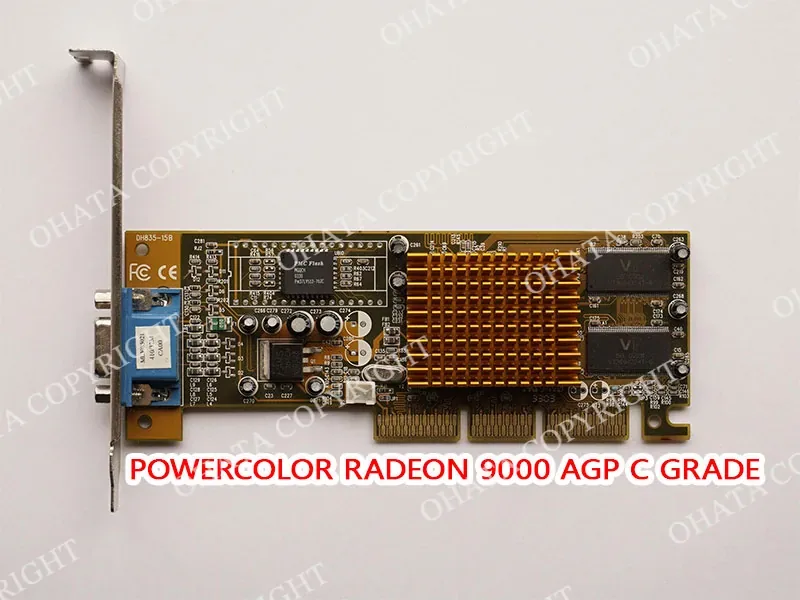
Trimmed expansion cards often retain usable electronic components but have shortened or partially removed gold fingers. Their reduced connector value generally places them below premium expansion cards.
Connector-end boards consist primarily of communication interfaces and edge connectors with moderate integrated circuit density.
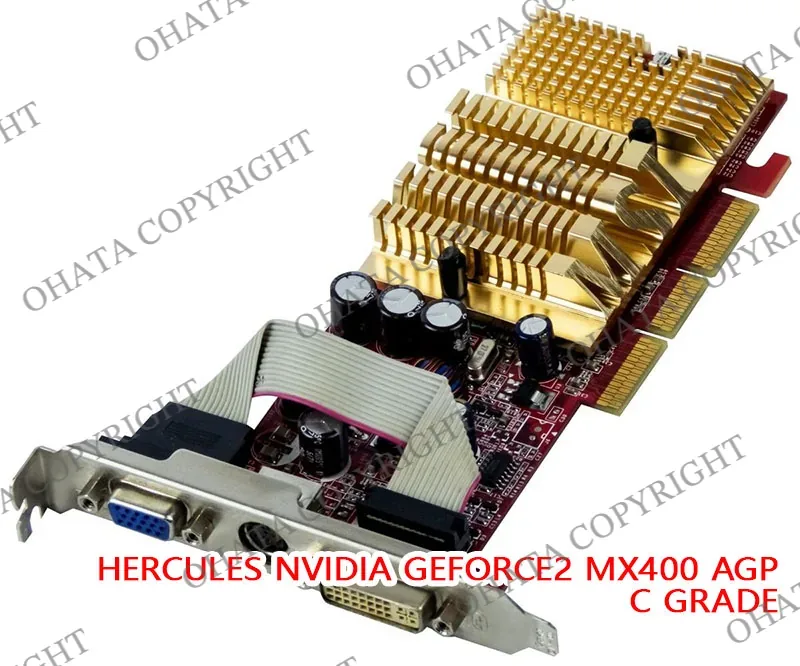
Consumer graphics cards commonly contain one graphics processor, memory chips, voltage regulation circuits, and cooling assemblies. While valuable, many standard graphics cards contain less recoverable precious metal than professional workstation or server hardware.
Interface cards provide additional communication capabilities such as USB, serial, parallel, Ethernet, or storage connectivity. Their moderate semiconductor density and standard PCB construction make them typical C Grade products.
Technical Characteristics
Several engineering characteristics consistently distinguish C Grade boards from higher classifications.
Moderate Integrated Circuit Density
Most C Grade boards contain a moderate number of integrated circuits distributed across the PCB. Common components include:
Central processing units
Chipsets
Memory devices
Audio controllers
Ethernet controllers
USB controllers
Power management ICs
Storage interfaces
Compared with A or B Grade boards, semiconductor coverage is generally less dense and more centralized around the primary chipset.
Standard Multilayer PCB Construction
Most C Grade products utilize fiberglass multilayer printed circuit boards designed for reliable consumer computing applications.
Typical construction features include:
Two- to six-layer PCB structures
Standard copper routing
Fiberglass laminate substrates
Precision solder masks
Surface-mounted electronic assemblies
Durable mounting locations
Although these boards are not as heavily reinforced as enterprise or industrial hardware, they remain mechanically stable and provide excellent copper recovery.
Consumer CPU Socket Designs
Desktop motherboards commonly feature consumer-oriented CPU sockets manufactured primarily from engineering plastics with metal electrical contacts.
Typical characteristics include:
Single processor support
Compact socket dimensions
Standard retention mechanisms
Integrated chipset architecture
Moderate power delivery systems
These socket designs reflect mainstream consumer computing rather than enterprise processing requirements.
Shorter Gold Fingers and Cooling Assemblies
Many C Grade expansion cards feature shorter gold-plated edge connectors than premium communication boards. Graphics cards and multimedia adapters also commonly retain:
Aluminum heatsinks
Cooling fans
Plastic air ducts
Thermal interface materials
These components generally contain little recoverable precious metal and are often removed before downstream processing to improve transportation efficiency.
Recoverable Materials
Although C Grade boards contain lower concentrations of precious metals than premium electronic assemblies, they still provide significant recoverable resources.
Copper
Copper is the primary recoverable material by weight. Internal power planes, signal traces, and grounding layers contribute substantial copper recovery during refining.
Gold
Gold is commonly recovered from:
Edge connectors
CPU socket contacts
Memory interfaces
Communication connectors
Integrated circuit bond wires
Gold plating is generally thinner and less extensive than on higher-grade boards but remains economically valuable when processed in large volumes.
Silver
Silver may be present in selected electrical contacts, connector materials, and solder alloys used throughout consumer computer hardware.
Palladium
Multilayer ceramic capacitors installed on desktop motherboards and expansion cards frequently contain small quantities of palladium that contribute to overall refining value.
Tin and Nickel
Tin-based solder and nickel-plated connector materials provide additional recyclable metals during downstream processing.
Why C Grade Boards Retain Recycling Value
C Grade boards remain one of the most important categories within the electronic recycling industry because they combine high availability with dependable recoverable material value. Although they contain fewer premium semiconductor packages and lower concentrations of precious metals than enterprise or industrial hardware, their multilayer PCB construction, substantial copper content, moderate gold plating, and large production volumes make them economically attractive for recycling.
Accurate separation of C Grade materials from both higher-grade computer boards and lower-grade appliance electronics improves purchasing consistency, simplifies inventory management, and increases refining efficiency. For these reasons, the Ohata Board Scrap Classification System recognizes C Grade as a distinct category that serves as the foundation of standard computer board recycling while supporting efficient resource recovery throughout the global electronic recycling industry.
Part 2 – Desktop Motherboards, Graphics Cards, Expansion Cards, Interface Boards, Manufacturers, and Identification Methods
Standard Desktop Motherboards
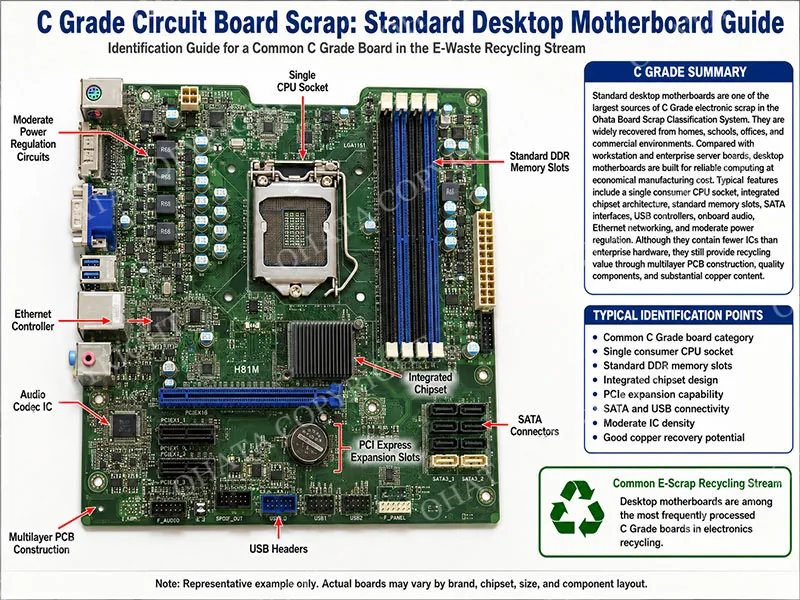
Standard desktop motherboards represent the largest source of C Grade electronic scrap within the Ohata Board Scrap Classification System. Millions of desktop computers are retired every year from homes, schools, offices, and commercial environments, making these boards one of the most common PCB categories processed by electronic recyclers.

Unlike workstation or enterprise server motherboards, standard desktop boards are designed to provide reliable computing performance while maintaining economical manufacturing costs. Most feature a single consumer CPU socket, integrated chipset architecture, standard memory slots, SATA storage interfaces, USB controllers, onboard audio, and Ethernet networking.
Typical characteristics include:
Single CPU socket
Standard DDR memory slots
Integrated chipset
PCI Express expansion slots
SATA connectors
USB headers
Audio codec ICs
Ethernet controller
Moderate power regulation circuits
Although these boards generally contain fewer integrated circuits than enterprise hardware, they still incorporate multilayer printed circuit boards, quality electronic components, and substantial copper content that contribute to their recycling value.
Consumer Graphics Cards
Graphics cards are another common C Grade category. These boards accelerate image rendering, video processing, gaming, multimedia applications, and general display functions.
Most consumer graphics cards contain:
Graphics Processing Unit (GPU)
Video memory (VRAM)
Power regulation modules
Display interface controllers
HDMI or DisplayPort connectors
PCI Express edge connector
Cooling fan
Aluminum heatsink
Compared with professional workstation GPUs or specialized accelerator cards, consumer graphics cards generally contain moderate integrated circuit density and standard PCB construction. The large heatsinks and cooling assemblies contribute little recoverable value and are commonly removed before downstream processing.
Modern graphics cards often feature compact, highly integrated semiconductor designs. Although they contain advanced processors, the overall recoverable precious metal content is usually lower than that found in industrial controllers or telecommunications equipment.
Trimmed Gold Finger Expansion Cards
Expansion cards equipped with shortened or trimmed gold fingers are commonly assigned to the C Grade category.
Examples include:
Older graphics adapters
Sound cards
TV tuner cards
Basic network adapters
USB expansion cards
FireWire controllers
Serial communication cards
Unlike premium expansion cards with long, clean gold-plated connectors, trimmed cards contain reduced quantities of recoverable gold. Their semiconductor layouts are also generally less complex, with fewer controller ICs and support components.
Even so, these boards remain valuable because they continue to contain:
Copper
Integrated circuits
Gold bond wires
Gold-plated contacts
Memory devices
Controller chips
Accurate identification helps maintain consistent grading while preventing premium cards from being mixed with lower-value materials.
Connector-End Boards
Connector-end boards are small electronic assemblies designed primarily to provide external interfaces between computers and peripheral equipment.
Typical connector boards include:
USB interface boards
Audio jack boards
Front panel controllers
Power button boards
Display connector boards
Network port modules
Card reader boards
Although physically small, these boards often contain quality PCB construction and several integrated circuits. Their value depends primarily on connector quality, copper content, and semiconductor density rather than board size.
Because they generally contain fewer electronic components than complete motherboards, connector-end boards are typically assigned to the C Grade category.
Multimedia Expansion Cards
Multimedia expansion boards provide specialized audio and video processing functions for desktop computers.
Examples include:
Professional sound cards
Video capture boards
Television receiver cards
Multimedia interface boards
Streaming controllers
These products usually contain:
Audio processors
Digital signal processors
Memory devices
Communication interfaces
Gold-plated edge connectors
Voltage regulation circuits
Their moderate integrated circuit density and consumer-oriented design generally place them within the C Grade classification.
Audio Cards
Dedicated audio cards continue to appear in electronic recycling streams despite increasing motherboard integration.
Typical audio boards contain:
Audio codec ICs
DSP processors
Analog amplifiers
Capacitors
Crystal oscillators
Gold-plated connectors
Although compact, these products remain valuable because of their quality PCB construction and recoverable semiconductor materials.
Network Interface Cards
Network Interface Cards (NICs) provide wired communication between computers and local area networks.
Consumer NICs generally include:
Ethernet controller
Communication PHY
Transformer module
PCI Express connector
Flash memory
Crystal oscillator
While enterprise networking adapters may qualify for higher grades, standard desktop NICs usually belong to the C Grade category because of their moderate semiconductor density.
Consumer Interface Boards
Consumer interface boards connect desktop computers with external hardware and storage devices.
Examples include:
SATA controller cards
USB controllers
PCI communication boards
Legacy serial adapters
Parallel interface cards
IEEE-1394 (FireWire) adapters
These boards typically contain one or two controller ICs together with moderate PCB construction and limited gold plating.
Embedded Computer Boards
Many embedded computer systems also qualify as C Grade.
Applications include:
Retail terminals
Information kiosks
Home automation
Digital signage
Security systems
Consumer appliances
These boards often contain compact embedded processors, flash memory, communication controllers, and standard multilayer PCB construction. Their moderate component density places them between premium industrial controllers and low-grade appliance electronics.
Representative Manufacturers
Although the Ohata Board Scrap Classification System classifies boards according to engineering characteristics rather than manufacturer, several companies commonly produce hardware found within the C Grade category.
Dell
Dell Inspiron, Vostro, and OptiPlex desktop systems frequently contribute C Grade motherboards after commercial replacement cycles.
HP
HP Pavilion, ProDesk, and consumer desktop platforms commonly feature standard multilayer PCB construction and moderate integrated circuit density.
Lenovo
ThinkCentre and IdeaCentre desktop systems are widely encountered in recycling facilities and often qualify as C Grade.
Acer
Acer consumer desktop computers and office systems commonly contain standard motherboard designs with moderate recoverable material value.
ASUS
ASUS consumer desktop motherboards and mainstream graphics cards frequently exhibit the technical characteristics associated with C Grade.
Gigabyte
Gigabyte consumer motherboards and multimedia expansion cards commonly contain balanced PCB construction suitable for this classification.
MSI
MSI gaming and office computer hardware often appears within the C Grade category, particularly mainstream desktop motherboards and graphics cards.
Intel
Intel-branded consumer motherboards remain common examples of standard desktop computer hardware.
ASRock
ASRock desktop motherboards emphasize cost-effective consumer computing while maintaining reliable PCB quality and moderate semiconductor density.
Foxconn
Foxconn manufactures OEM desktop motherboards for numerous global computer brands. Many of these products fit within the C Grade category because of their standardized construction.
Identification Methods
Correct identification of C Grade boards requires evaluating multiple engineering characteristics rather than relying on appearance alone.
Component Density Analysis
Integrated circuit density remains one of the most useful indicators of board quality.
Inspectors evaluate:
Total IC count
Processor size
Memory devices
Controller chips
Power management ICs
Semiconductor distribution
Compared with A or B Grade boards, C Grade products generally contain fewer large semiconductor packages and simpler controller architectures.
PCB Construction
Most C Grade boards utilize standard multilayer fiberglass PCB construction.
Typical characteristics include:
Fiberglass laminate
Internal copper routing
Surface-mounted components
Standard solder masks
Consumer-grade power planes
Reinforced mounting holes
These construction methods provide dependable electrical performance while supporting efficient copper recovery.
CPU Socket Identification
CPU socket design provides valuable information during board classification.
Inspectors examine:
Socket generation
Socket size
Plastic retention mechanism
Consumer versus enterprise architecture
Single processor support
Chipset arrangement
Consumer-oriented sockets combined with moderate semiconductor density generally indicate C Grade.
Gold Finger Evaluation
Expansion cards are also evaluated according to their edge connectors.
Important inspection criteria include:
Gold finger length
Gold plating thickness
Number of contacts
Surface wear
Physical damage
Connector cleanliness
Trimmed or shorter gold fingers generally indicate lower recoverable gold content than premium expansion cards. When combined with component density, PCB construction, CPU socket design, and board completeness, gold finger evaluation provides an important reference for assigning accurate C Grade classifications within the Ohata Board Scrap Classification System.
Part 3 – Recycling Value, Buying Standards, Board Condition, Common Misclassification, AI Recognition, Grade Comparison, Summary and Ohata C Board Classification Disclaim
Recycling Value
C Grade circuit boards represent one of the highest-volume material categories in the electronic recycling industry. Although they generally contain lower concentrations of precious metals than B Grade, A Grade, A+ Grade, S Grade, or SS Grade boards, they remain an important source of recyclable metals because of their widespread availability. Every year, millions of desktop computers, office workstations, consumer graphics cards, multimedia devices, and expansion boards are retired, creating a steady supply of C Grade material for recyclers worldwide.

The primary recoverable material in C Grade boards is copper, which is present throughout the multilayer printed circuit board in signal traces, power distribution layers, and grounding planes. Standard desktop motherboards and graphics cards often contain substantial copper despite having fewer premium electronic components than enterprise hardware.
Additional recoverable materials include:
Gold-plated edge connectors
Gold-plated CPU socket contacts
Gold bond wires inside integrated circuits
Silver-bearing electrical contacts
Palladium contained within multilayer ceramic capacitors
Nickel-plated connectors
Tin-based solder alloys
Although the concentration of precious metals is generally moderate, the large volume of C Grade material processed each year makes it an economically significant resource. Proper sorting allows refiners to recover metals efficiently while maintaining predictable processing yields.
Buying Standards
The Ohata Board Scrap Classification System establishes standardized buying conditions to improve consistency throughout the electronic recycling supply chain.
Classification should be based on measurable engineering characteristics rather than product brand or original purchase price. Buyers should evaluate:
Integrated circuit density
PCB construction
CPU socket design
Gold finger quality
Connector condition
Copper content
Board completeness
Intended application
Overall electronic complexity
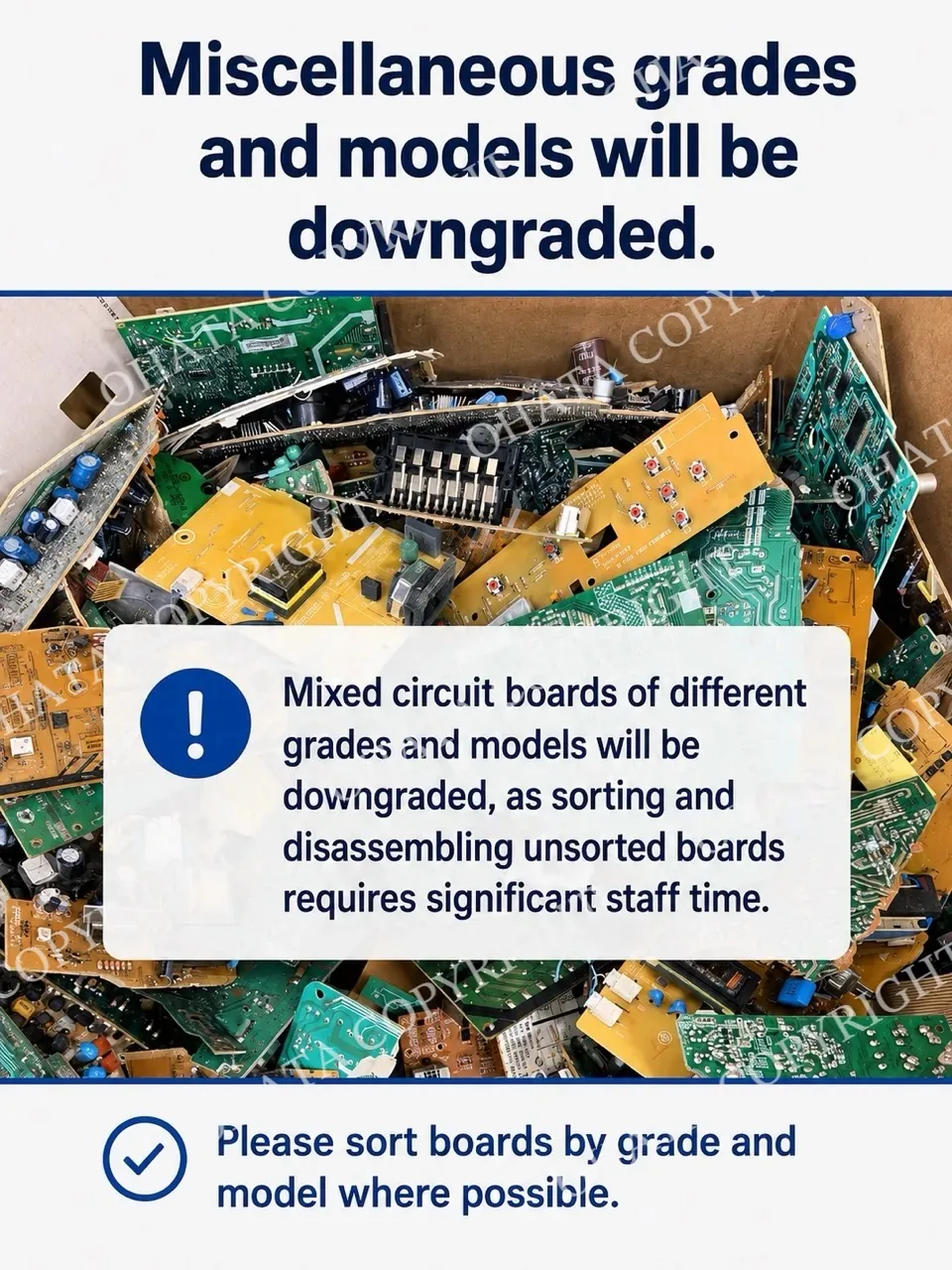
Maintaining consistent sorting standards prevents C Grade boards from being mixed with higher-value computer hardware or lower-grade appliance electronics.
Before shipment, unnecessary accessories should be removed whenever practical, including:
Cooling fans
Aluminum heatsinks
Steel mounting brackets
Plastic covers
Loose batteries
External shielding
Removing these items reduces shipping weight, improves visual inspection, and simplifies downstream processing without affecting the PCB classification.
Preferred Board Condition
Electronic boards do not need to remain operational because their value is based primarily on recoverable materials rather than functionality. However, boards should remain complete enough for accurate identification.
Preferred C Grade boards are:
Structurally intact
Reasonably clean and dry
Free from severe corrosion
Retaining major integrated circuits
Retaining CPU sockets
Retaining principal connectors
Free from major PCB fractures
Free from excessive contamination
Minor cosmetic wear, faded markings, dust, or surface scratches generally do not influence classification.
Acceptable and Unacceptable Damage
Certain removable components generally do not reduce classification.
Acceptable removals include:
Cooling fans
Heatsinks
Replaceable memory modules
Metal slot brackets
Plastic retention clips
Loose shielding
Classification may be reduced when boards exhibit:
Missing chipset ICs
Removed graphics processors
Broken PCB sections
Heavy oxidation
Battery leakage
Burn damage
Severe water damage
Missing controller ICs
Large cut sections
Oil or chemical contamination
Maintaining board integrity helps preserve recoverable material value while allowing buyers to evaluate component density accurately.
Common Classification Mistakes
Several common mistakes occur during the sorting of C Grade boards.
One of the most frequent errors is confusing standard desktop motherboards with appliance control boards. Although both may contain plastic connectors and moderate integrated circuit density, desktop motherboards generally feature multilayer PCB construction, larger processors, higher copper content, and greater recoverable precious metal value.
Another mistake is classifying consumer graphics cards according to their resale value instead of their recoverable material content. A high-performance gaming graphics card may command a significant second-hand market price, but if it contains standard PCB construction, moderate gold plating, and typical consumer component density, it may still fit within the C Grade category for recycling purposes.
Expansion cards also require careful inspection. Long, clean gold fingers and dense controller layouts may justify a higher classification, while trimmed or worn edge connectors generally remain within C Grade.
Finally, classification should never rely solely on manufacturer names. Companies such as Dell, HP, ASUS, MSI, Gigabyte, Lenovo, and Intel produce products across multiple grade levels. Each board should be evaluated individually according to the Ohata classification criteria.
AI Board Recognition
Artificial intelligence is expected to improve electronic scrap identification by increasing speed, consistency, and accuracy.
Modern computer vision systems can analyze photographs of circuit boards and compare them with extensive reference databases to recognize technical characteristics associated with each classification.
Future AI systems may automatically evaluate:
CPU socket type
Gold finger length
Integrated circuit density
Graphics processor location
PCB dimensions
Connector arrangement
Component completeness
Manufacturer markings
PCB revision numbers
Overall board architecture
The Ohata Board Scrap Classification Wiki is intended to support these technologies by providing standardized descriptions, reference photographs, and objective grading criteria. As the database expands, AI-assisted identification will become increasingly effective in helping buyers recognize C Grade boards and distinguish them from similar-looking materials.
AI is expected to complement experienced inspectors by reducing inspection time, improving consistency, and assisting with the identification of unfamiliar or obsolete electronic boards.
C Grade vs. B Grade
Although both categories include standard computer hardware, B Grade boards generally exhibit greater engineering complexity.
Typical B Grade boards include:
Entry-level server motherboards
Lower-grade telecommunications equipment
Commercial interface boards
Medium-grade desktop motherboards
Compared with C Grade, B Grade boards usually contain:
Higher integrated circuit density
Better multilayer PCB construction
More enterprise-grade connectors
Greater copper content
Higher recoverable precious metal value
C Grade vs. Appliance Board A
Appliance Board A typically consists of electronic control boards used in household and commercial appliances.
Examples include:
Washing machines
Refrigerators
Microwave ovens
Dishwashers
Air conditioning systems
Compared with Appliance Board A, C Grade boards generally contain:
Larger processors
More integrated circuits
Better PCB construction
Longer gold-plated connectors
Greater copper recovery potential
C Grade vs. Appliance Board B
Appliance Board B represents the lower end of the Ohata Board Scrap Classification System.
These boards usually contain:
Small microcontrollers
Low integrated circuit density
Minimal gold plating
Thin PCB construction
Limited recoverable precious metals
Compared with Appliance Board B, C Grade boards contain substantially more electronic components, thicker multilayer PCBs, greater copper content, and significantly better recovery potential.
Summary
The C Grade within the Ohata Board Scrap Classification System represents standard computer and consumer electronic boards that combine high availability with dependable recycling value. Typical examples include desktop motherboards, consumer graphics cards, trimmed expansion cards, connector-end boards, multimedia interface cards, network adapters, and embedded computer systems.
These boards are characterized by moderate integrated circuit density, standard multilayer PCB construction, consumer CPU sockets, shorter gold-plated edge connectors, attached cooling assemblies, and substantial copper content. Although they contain lower concentrations of precious metals than higher-grade computer hardware, they remain one of the most important material streams within the global electronic recycling industry due to their large processing volumes and consistent recoverable value.
By applying standardized evaluation criteria—including integrated circuit density, PCB construction, connector quality, CPU socket design, gold finger condition, board completeness, and intended application—the Ohata Board Scrap Classification System provides buyers, suppliers, recyclers, and refiners with a consistent framework for identifying C Grade boards. This objective methodology supports transparent purchasing, efficient sorting, improved precious metal recovery, and the continued development of standardized electronic scrap classification worldwide.
Ohata C Circuit Board Classification Disclaimer
The Ohata C Circuit Board Classification is an internal grading system developed by Ohata Shoji Inc. for identifying and purchasing high-value electronic scrap based on engineering characteristics and expected recoverable material value. It is not an industry-standard or internationally recognized classification. Examples, product names, and manufacturers are provided for identification only and do not guarantee an C Grade classification. Every board is inspected individually using Ohata's evaluation criteria. Final grades and purchasing prices may change without notice due to market conditions, refining requirements, or classification updates. Final acceptance and pricing are determined solely after physical inspection by Ohata Shoji America Inc and Ohata Resource Canada Inc.