

Introduction, Construction, Components, and Recycling Value
1.1 Introduction to the Intel D865GLC Motherboard
Start with the Intel AA number and the Socket 478 plastic ZIF socket. The D865GLC belongs to the Intel 865G/ICH5 generation; do not confuse it with later LGA775 boards or Dell Dimension 4700 hardware.
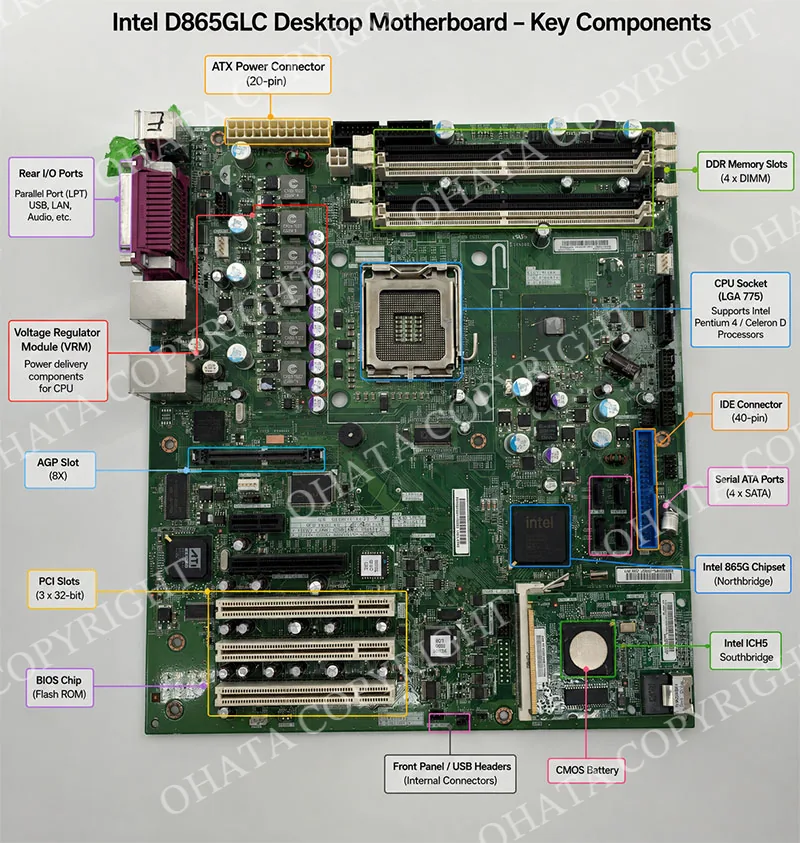
This distinction is fundamental for accurate scrap grading. Laptop motherboards typically feature highly compact layouts, soldered Ball Grid Array (BGA) processors, and unique proprietary form factors. In contrast, the D865GLC utilizes a standard ATX layout, offering standardized expansion slots, removable processor sockets, and a physical size that accommodates larger power delivery components and legacy interfaces. This desktop-class construction directly influences both the recoverable material weight and the ease of manual sorting.
1.2 Motherboard Construction and Form Factor
The physical construction of the Intel D865GLC is characterized by a standard ATX printed circuit board (PCB). This measures approximately 305mm by 244mm (12 inches by 9.6 inches), a dimension that was the industry standard for office and home desktop computers of that generation.
PCB Material: The board utilizes an FR-4 fiberglass laminate with a standard green solder mask. The six-layer PCB construction includes internal copper power and ground planes, which contribute significantly to the overall copper recovery weight.
Power Delivery: The board is designed for the ATX 1.3 power supply specification, featuring a 20-pin ATX main power connector located on the right-hand edge, and a dedicated 4-pin ATX 12V auxiliary power connector positioned near the CPU socket to supply dedicated power to the processor.
The layout is highly functional, placing the memory slots and the CPU socket in proximity to the Northbridge chipset, minimizing trace lengths for signal integrity—a hallmark of mid-range desktop engineering of the 2000s.
1.3 Core Components and Technical Specifications
The following technical specifications are critical for identification and scrap valuation:
Central Processing Unit (CPU) Socket: The board features an LGA 775 socket (also known as Socket T). This is a "metal socket" configuration with a metal retention bracket and a lever-based locking mechanism. The physical dimensions of the CPU package supported by this socket are 37.5mm x 37.5mm. It supports the Intel Pentium 4, Pentium D, and Celeron D series processors. For recyclers, the presence of a CPU installed in this socket drastically multiplies the scrap value, as it protects the gold-plated contacts and provides additional semiconductor recovery material.
Chipset: The board is powered by the Intel 865G Northbridge and the Intel ICH5 Southbridge. The 865G chipset supports an 800 MHz Front Side Bus (FSB) and integrates the Intel Extreme Graphics 2 controller. The ICH5 Southbridge introduces support for Serial ATA (SATA) interfaces.
Memory Interface: There are four 184-pin DIMM sockets arranged in two color-coded banks (black and white). These slots support DDR SDRAM memory, specifically DDR 400, DDR 333, and DDR 266 speeds. The maximum supported capacity is 4 GB, though typical 32-bit operating systems of the era utilized 2 GB to 3 GB.
Expansion Slots: The board features a legacy expansion interface:
1x AGP 8x slot (Accelerated Graphics Port). This brown slot is a key identifier of the era, predating the PCI Express (PCIe) standard.
5x standard PCI slots. These white 32-bit slots are used for legacy add-on cards such as sound cards, network cards, and TV tuners.
Storage Interfaces:
2x SATA 1.0 ports (Serial ATA) operating at 1.5 Gb/s.
1x ATA-100 (IDE) port, supporting parallel ATA hard drives and optical drives.
1x FDD (Floppy Disk Drive) connector, a remnant of early 2000s storage technology.
I/O Ports (Rear Panel): The rear I/O panel is comprehensive for its time, including a 15-pin VGA port, a parallel port (LPT), a serial port (COM), four USB 2.0 ports, a 10/100 Mbps Ethernet port (RJ-45), and audio line-in/line-out jacks.
1.4 Market Context and Usage Profile
The Intel D865GLC is not a rare collector's item, but it holds a "golden age" status in the DIY computer building community and the second-hand corporate market.
OEM Brand Usage: This specific motherboard model was a primary OEM component in Dell Dimension 4700 and HP Pavilion desktop PCs during the years 2004 to 2005. It was also used by many regional system integrators and third-party computer manufacturers for their business desktop lineups.
DIY and Enthusiast Assembly: Beyond commercial branding, this board was the cornerstone of many early "computer enthusiast" builds. Because its price was relatively accessible, it became a popular target for system builders who paired it with high-clocked Northwood-core Pentium 4 processors and high-end AGP graphics cards.
1.5 Recyclable Material Inventory
The value of the D865GLC in the recycling stream is derived from a combination of precious metals, base metals, and semiconductor materials. The non-ferrous metal content is significant:
Copper: This is the largest recoverable element by weight. It is found extensively in the six copper layers of the PCB, the power delivery inductors (chokes) located around the CPU socket, the transformer section of the Ethernet port, and the internal routing layers.
Gold: While not as heavily plated as industrial telecommunication boards, gold is present on the LGA 775 socket contact pins, the memory DIMM slot contacts, the AGP and PCI slot gold fingers, and the internal gold bond wires contained within the integrated circuits (such as the 865G chipset and the ICH5 southbridge).
Silver: Silver is often present within the solder joints of high-frequency components and the contact points of the onboard crystal oscillators and the CMOS battery circuit.
Palladium: Multilayer ceramic capacitors (MLCCs) distributed across the board contain trace amounts of palladium, which becomes valuable during bulk refining.
Aluminum: The board often features an attached aluminum heatsink on the Northbridge chipset, which is recoverable as clean aluminum scrap.
Part 2 – Ohata D Grade Classification, Identification Guide, and Specific Board Types
2.1 Official Ohata D Grade Classification
Based strictly on the internal Ohata Board Grade Class.txt and the supporting detailed classification documents, the Intel D865GLC is officially categorized as Ohata D Grade.
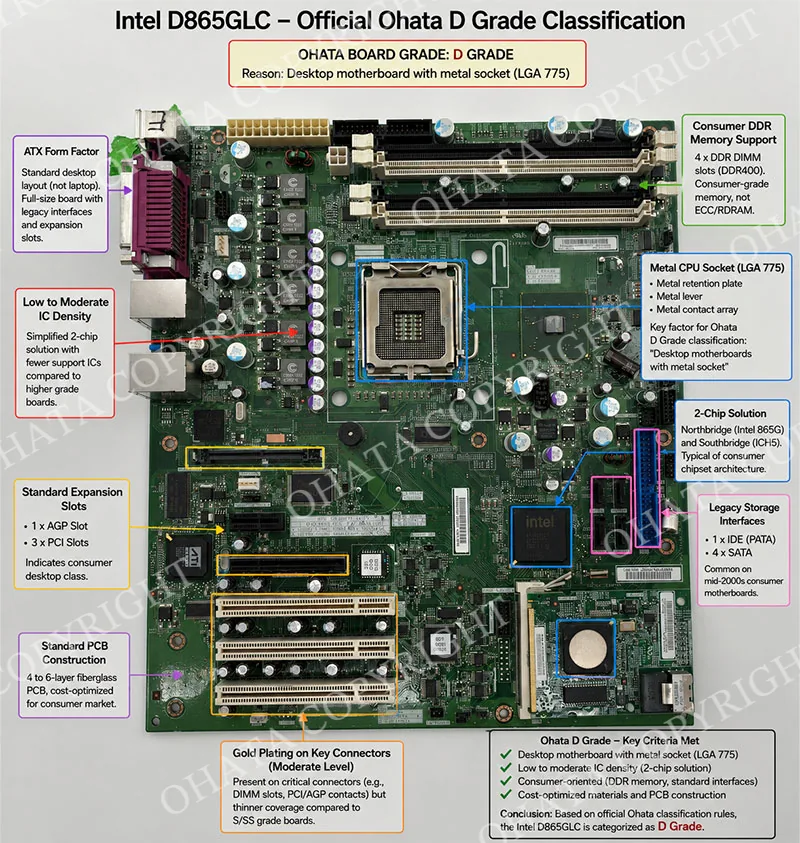
The primary factor for this classification is the physical nature of the processor socket. The Ohata system distinguishes consumer desktop motherboards significantly based on the CPU socket construction. According to the Ohata D Grade Board Scrap Classification rules, the category specifically includes "Desktop motherboards with metal socket". The LGA 775 socket is structurally a metal socket, featuring a metal retention plate, a metal lever, and a metallic contact array. This contrasts sharply with earlier plastic sockets (Socket 1, 3, 5, 8, etc.) or later highly integrated entry-level boards.
Furthermore, the D Grade classification is reinforced by the following criteria present on the Intel D865GLC:
Low to Moderate Integrated Circuit Density: Compared to A+ Grade industrial controllers or B Grade enterprise motherboards, the D865GLC uses a simplified 2-chip solution (Northbridge/Southbridge) and fewer support chips, limiting the overall semiconductor population.
Consumer-Oriented Engineering: The board utilizes standard four-to-six-layer fiberglass PCB construction and supports consumer-grade DDR memory, rather than the high-end RDRAM or ECC memory found in enterprise segments.
Cost-Optimized Materials: While the board uses gold plating on critical connectors, the plating thickness and coverage are significantly reduced compared to premium S Grade or SS Grade telecommunications hardware.
2.2 Distinguishing D Grade from Lower Grades
It is essential to differentiate Ohata D Grade from Appliance Board A and Appliance Board B. While consumer desktop boards and appliance control boards might appear visually similar in color and scale, their engineering functions are vastly different.
Appliance Boards (Washing machines, microwaves, etc.) contain large relay circuits, high-voltage transformers, triacs, and power-handling electronics for motor control. They lack CPU sockets and complex computing chipsets.
Intel D865GLC (D Grade) is a digital computing platform. It features a dedicated CPU interface, discrete memory controllers, AGP graphics interfaces, and a complex chipset hierarchy. It is these digital computing elements—particularly the LGA 775 socket—that elevate it to D Grade rather than a low-value appliance grade.
2.3 Distinguishing D Grade from C and B Grades
The classification boundary between D Grade and C/B Grade often confuses inexperienced sorters.
C Grade typically includes boards with specific "plastic socket" numbers (e.g., Socket 2, 4, 6, 7, 9) or boards that have been heavily modified, such as "trimmed gold finger cards."
B Grade usually encompasses multi-socket server boards (plastic or metal retention) and desktop boards with Socket 1, 3, 5, 8.
D Grade is specifically positioned to capture the later-generation consumer hardware (such as the Intel LGA 775 and AMD AM/FM platforms) that feature metal socket retention mechanisms and high production volumes but lower precious metal yields compared to earlier or enterprise hardware.
Therefore, the Intel D865GLC fits perfectly into the D Grade category due to its metal socket design, its integrated 2000s chipset architecture, and its lack of specialized enterprise features like IPMI management or multi-socket configurations.
2.4 Identification Markings on the Board
When processing this board for recycling, the following markings assist in verifying the correct classification:
Board Model Number: The text "D865GLC" is printed directly on the PCB, usually near the PCI slots or the DIMM sockets.
Intel Branding: The Intel logo is clearly visible on the Southbridge chip (ICH5) and often on the board itself.
Socket Labeling: Markings around the CPU socket often include "LGA 775" or "Socket T," confirming the metal socket design.
Date Codes: 2004 or 2005 date codes printed on the PCB confirm the production era, aligning it with the D Grade "later-generation" classification window.
Part 3 – Recoverable Materials, Buying Standards, and Handling
3.1 Primary and Secondary Recoverable Materials
Recycling the Intel D865GLC yields a diverse material stream. The approximate material composition for recovery includes:
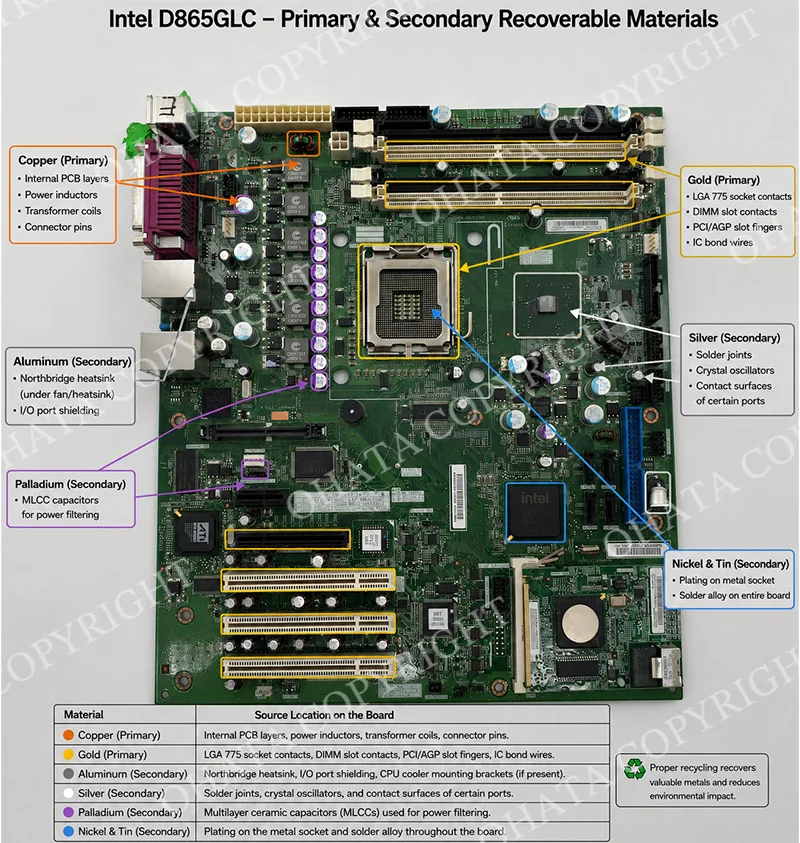
MaterialSource Location on the BoardCopperInternal PCB layers, power inductors, transformer coils, connector pins.GoldLGA 775 socket contacts, DIMM slot contacts, PCI/AGP slot fingers, IC bond wires.AluminumAttached Northbridge heatsink, CPU cooler mounting brackets (if present).SilverSolder joints, crystal oscillators, and contact surfaces of certain ports.PalladiumMultilayer ceramic capacitors (MLCCs) used for power filtering.Nickel & TinPlating on the metal socket and solder alloy throughout the board.
3.2 Critical Value Factor: The CPU Socket Integrity
The single most important factor defining the value of a D Grade motherboard like the D865GLC is the presence of the CPU within the socket.
When an LGA 775 CPU is installed, the processor pins press against the gold-plated contacts in the motherboard socket. This constant contact prevents oxidation and preserves the gold plating quality. Furthermore, the CPU itself contains a ceramic or organic substrate with internal gold bond wires, and the contact pads (lands) on the bottom of the CPU are gold-plated.
Scrap Value Impact:
Board with CPU installed: The board is evaluated at the top of the D Grade value range because of the additional semiconductor weight, gold content from the CPU substrate, and protected socket pins.
Bare board (No CPU): If the CPU is removed, the LGA 775 socket is exposed. While the contacts still contain gold, they are prone to oxidation and physical damage. The recoverable gold weight is reduced, and the board drops to the lower-middle pricing tier of D Grade.
3.3 Board Integrity and Damage Thresholds
The Ohata classification system strictly enforces condition guidelines to maintain pricing consistency. A complete, structurally sound Intel D865GLC will command a higher price per unit than a heavily damaged or heavily stripped one.
Acceptable Board Condition:
The board must be dry and free of severe biological contamination (mold, moisture).
Minor dust accumulation is acceptable.
The PCB must be largely intact without major cracks across the main body.
The plastic connectors (SATA, IDE, power headers) can be present; removing them is acceptable but does not increase value.
Unacceptable Conditions (Rejection):
Heavy Burn Damage: Boards with charred PCB sections, melted plastic sockets, or blown traces are rejected. The heavy metal content is compromised, and melted plastics create hazardous impurities in the refining process.
Severe Battery Leakage: The CR2032 CMOS battery, if heavily corroded and leaking, contaminates the PCB with alkaline chemicals. This degrades the copper traces and lowers the classification to Appliance Board B or outright rejection if the corrosion has destroyed vital circuits.
Major PCB Fractures: Boards that are physically snapped in half or have large sections broken off cannot be accepted. Significant copper and gold recovery is lost from the fragmented pieces.
Conditions Leading to Reduced Grade (Downgrading):
Missing Key Integrated Circuits: If the large 865G Northbridge or ICH5 Southbridge chips have been violently removed, the board's recoverable material value drops drastically. The gold bond wires inside the removed chip are lost, and the board becomes a "stripped core" which is downgraded to Appliance Board B.
Missing CPU: As mentioned, this lowers the board's valuation within the D Grade itself.
Heavy Corrosion from Water Damage: Boards soaked in water and left to rust develop oxidized copper traces. While some copper can still be recovered, processing costs rise, lowering the final payout.
Mixing with Contaminants: Boards that arrive mixed with non-board debris (plastic cases, heavy steel brackets, loose cables, or trash) are subject to sorting fees.
3.4 Non-Accepted Materials and Preparation Requirements
To ensure smooth purchasing and accurate grading, specific materials must be removed from the Intel D865GLC before it is brought to the recycling facility:
Mounting Brackets: The steel I/O shield plate or metal motherboard standoffs must be removed. These are low-value steel and add unnecessary weight to the shipment.
Optical and Floppy Drives: Do not send the motherboard attached to a hard drive, optical drive, or floppy disk drive casing. Only the motherboard itself is graded.
External Cables: Any peripheral cabling (power cables, IDE ribbons, fan connectors) should be removed. While flexible cables contain copper, they are considered a separate recycling category and not part of D Grade board scrap.
Preparation Guidelines for Suppliers:
Remove the CMOS battery to prevent leakage during shipping.
Remove the heatsink from the Northbridge chipset. While the aluminum is recyclable, it obscures the visual inspection of the semiconductor package underneath.
Do not cut the motherboard. Leaving the PCB in its original rectangular form preserves the maximum copper yield and prevents loss of small components.
Leave the CPU installed wherever possible. This is the strongest factor in maximizing the per-board payout.
Part 4 – Comparison, and Official Ohata Classification
4.1 Comparative Analysis: D Grade vs. Other Board Categories
Understanding the exact position of the Intel D865GLC in the hierarchy is essential for scrap processors.
Comparison with C Grade (Standard Motherboards):
While C Grade includes various consumer motherboards, specific sub-categories of C Grade are designated for boards with plastic sockets numbered 2, 4, 6, 7, and 9. The LGA 775 does not fall into these plastic socket categories, confirming its shift to D Grade. C Grade boards also often include "trimmed gold finger cards." The D865GLC, with its full-size gold-finger AGP and PCI slots, remains technically better physically than some C Grade, yet its mass-produced nature and lower overall material density classify it slightly lower than typical B Grade, settling it firmly in D Grade.
Comparison with Appliance Board A:
This is a fundamental distinction. Appliance Board A relies heavily on recoverable copper from large transformer cores and thick heavy-duty tracks for motor switching. It contains almost no gold-bearing digital computing sockets. The Intel D865GLC, while lower in value than A+ or S grades, is vastly more valuable per pound than Appliance Board A because of the gold-rich LGA 775 contacts and the semiconductor value of the Intel chipset.
4.2 Official Ohata Classification Disclaimer
It is critical to note that the Ohata Board Scrap Classification System is an internal proprietary framework used exclusively by Ohata Resource to standardize the pricing, sorting, and processing of electronic scrap.
This standard is not an international, ISO, or governmental standard. It is a practical business instrument designed to ensure fair, transparent, and rapid transactions between Ohata and its suppliers. The grading criteria—including the D Grade definition—are subject to change based on fluctuations in the precious metal markets, refining technological advancements, and the ever-evolving landscape of electronics manufacturing. Incoming batches of the Intel D865GLC will be evaluated by trained sorters using this framework, and the physical condition of the board at the time of delivery will be the final determining factor for the purchase price.
Ohata MotherBoard Scrap Wiki Claim
The Ohata Wiki is an educational knowledge base developed and maintained by Ohata to provide information on electronic scrap identification, recycling technologies, material classification, and sustainable resource recovery. The content published in the Ohata Wiki is based on Ohata's operational experience, research, and educational objectives. It is intended to assist recyclers, businesses, researchers, students, and the public in understanding electronic materials and recycling practices.
The Ohata Wiki is designed as an educational reference only. It does not replace professional technical advice, engineering analysis, laboratory testing, or official industry standards.
Ohata MotherBoard Classification Claim
The Ohata MotherBoard Classification System is a proprietary educational classification created by Ohata based on the company's internal recycling knowledge and operational experience. It is intended solely for educational and identification purposes. It is not an international standard, government specification, or universally accepted industry grading system. Classification methods, purchasing requirements, and recycling practices may differ among companies, regions, and markets.
Ohata MotherBoard Scrap Wiki Page Copyright
© 2026 Ohata. All Rights Reserved.
Record the AA number, BIOS, CPU presence, socket measurements and board condition before assigning an Ohata grade. Keep the classification under review until the plastic-socket rule is reconciled with the C Grade and Large Plastic Socket guides.