

SS Grade vs. S Grade Circuit Boards: Scrap Identification & Recycling Guide
Introduction
SS Grade is primarily associated with high-performance telecommunications, enterprise networking, advanced communication equipment, smartphone logic boards, server backplanes, and other densely populated electronic assemblies. These boards are generally valued for their compact component layout, numerous integrated circuits, large BGA packages, high-quality connectors, and technologically advanced construction.
S Grade is more commonly associated with premium computer boards, legacy computing equipment, non-SATA hard drive boards, and motherboards containing multiple ceramic or gold-tab processor packages. These boards may not always have the same modern networking architecture as SS Grade material, but they can still have substantial recycling value because older electronic hardware often contains larger ceramic semiconductor packages, extensive gold edge connectors, and high-value CPU configurations.
Overview of SS Grade Circuit Boards
What Is an SS Grade Circuit Board?
SS Grade is a high-value category intended mainly for advanced telecommunications, enterprise networking, communication infrastructure, and densely populated electronic boards. Typical SS Grade material is built for demanding data processing, signal transmission, switching, optical communication, or wireless communication applications.
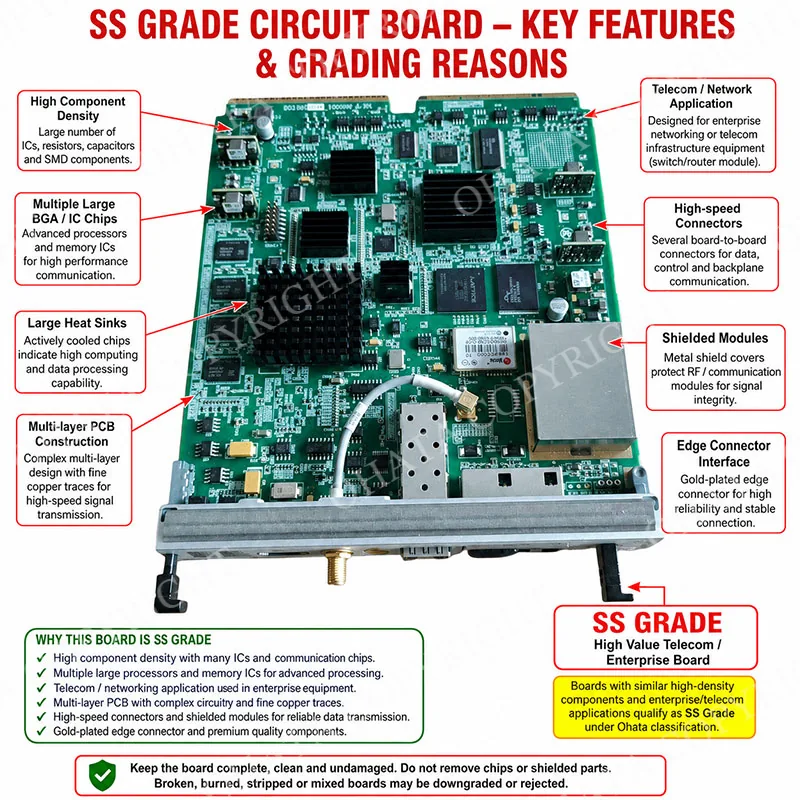
Common SS Grade board sources include:
Cell phone boards
Smartphone logic boards
Server backplanes
Enterprise network switch control boards
Telecommunications switching boards
Fiber optic communication boards
Optical transport equipment boards
Cellular base station control boards
Advanced network infrastructure boards
Selected high-CPU-count server motherboards
Equipment manufactured for enterprise networking and telecommunications often contains several large processors, numerous BGA devices, dense surface-mounted components, high-quality multilayer PCB construction, and premium board-to-board connectors. Boards from network switches, telecom switching systems, fiber optic platforms, and cellular base stations may therefore qualify for SS Grade when their construction and component population meet Ohata’s purchasing requirements.
Main Electronic Components Found on SS Grade Boards
SS Grade boards are generally identified by high component density rather than by PCB size alone. A relatively small smartphone logic board may contain a greater concentration of valuable semiconductor packages than a much larger low-grade appliance control board.
Important SS Grade components may include:
Large BGA processors
Gold-tab BGA packages
Communication processors
Network switching chipsets
Optical communication controllers
Memory ICs
Power-management ICs
High-density surface-mounted components
Premium board-to-board connectors
Gold-plated contact points
Multilayer copper circuitry
Specialized telecom interface components
Large BGA processors are especially important because they indicate that the board was designed to perform complex computing, switching, or communication functions. Multiple large IC packages distributed across the PCB generally increase the board’s technical complexity and potential recycling value.
SS Grade Server Motherboard Requirements
Under the Ohata classification standard, an SS Grade server motherboard must contain a minimum of four qualifying CPUs or processor packages.
Accepted SS Grade server motherboard configurations include:
One large plastic PGA CPU socket together with three gold-tab BGA CPUs.
Two large plastic PGA CPU sockets together with two gold-tab BGA CPUs.
The required processor count is a key distinction between SS Grade and lower classifications. A server motherboard should not be classified as SS Grade merely because it is physically large or because it originally came from enterprise equipment. The relevant CPU sockets, BGA processors, and other important components must remain present and identifiable.
An otherwise high-quality server board may be downgraded when:
A large PGA CPU socket has a large metal retention frame.
The plastic PGA socket measures less than approximately 5 cm × 5 cm.
The board uses an LGA CPU socket with a metal frame.
One or more required processors have been removed.
Large BGA packages are missing.
The PCB has been cut, broken, or heavily stripped.
These downgrade rules reflect the importance of socket construction and processor configuration within the Ohata pricing system.
Overview of S Grade Circuit Boards
What Is an S Grade Circuit Board?
S Grade consists primarily of premium computer boards and legacy high-value electronic boards containing multiple ceramic processors, gold-tab BGA packages, large plastic PGA sockets, or significant gold-plated connection areas.
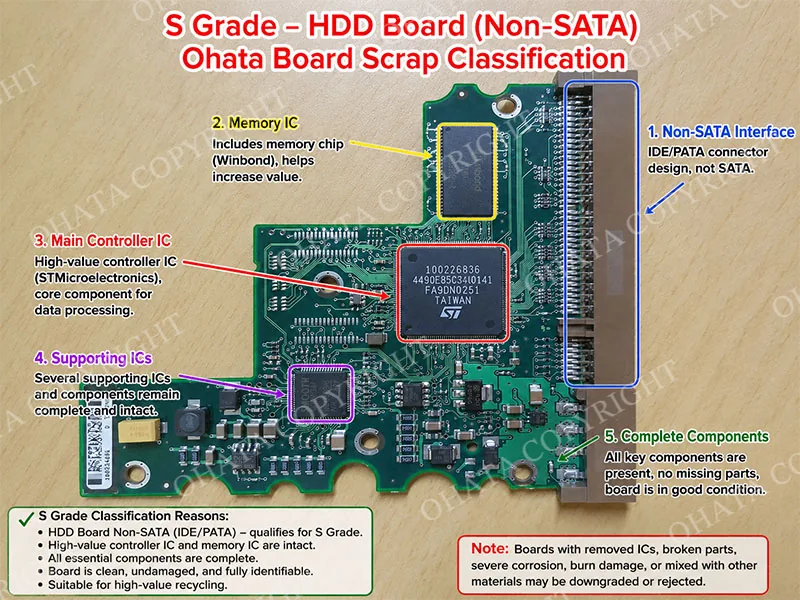
Typical S Grade sources include:
Circuit boards with three or more purple ceramic CPUs
Legacy desktop motherboards
Older enterprise computer boards
Specialized computer control boards
Premium multi-processor motherboards
Non-SATA hard disk drive boards
Selected server motherboards
Selected desktop motherboards
Some older computer boards contain larger ceramic IC packages and more visibly gold-plated contacts than many modern consumer boards. Although their processing technology may be older, their material composition can make them highly attractive for electronic scrap recovery.
Non-SATA hard drive boards may also qualify as S Grade. These older controller boards can contain dense IC populations, gold-plated connectors, and component structures that differ significantly from newer SATA hard drive boards.
Main Electronic Components Found on S Grade Boards
S Grade material is commonly recognized by the presence and combination of large CPU packages rather than by telecom-oriented component density alone.
Important S Grade features may include:
Three or more large purple ceramic BGA CPUs
Large plastic PGA CPU sockets
Gold-tab BGA processors
Multiple processor packages
Gold edge connectors
High-quality capacitors
Legacy computer chipsets
Dense integrated circuit populations
Non-SATA hard drive controller interfaces
Multilayer copper-bearing PCB construction
Purple ceramic CPUs are particularly important identifiers. Their ceramic bodies and associated contacts distinguish them from ordinary black plastic IC packages. A board containing three or more qualifying ceramic CPU packages may meet the S Grade threshold when the processors remain complete and the board is otherwise acceptable.
S Grade Server Motherboard Requirements
An S Grade server motherboard must contain a minimum of three qualifying CPUs or processor packages.
Accepted configurations include:
Three large purple ceramic BGA CPUs.
One large plastic PGA CPU socket with two gold-tab BGA CPUs.
Two large plastic PGA CPU sockets with one gold-tab BGA CPU.
A large plastic PGA socket measuring at least approximately 5 cm × 5 cm, when the complete processor arrangement meets the required standard.
A server motherboard may be downgraded when:
A large PGA CPU socket has a large metal retention frame.
The plastic PGA socket is smaller than approximately 5 cm × 5 cm.
The board contains an LGA CPU socket with a metal frame.
Required ceramic or gold-tab processors are missing.
Important CPU areas have been stripped or damaged.
S Grade Desktop Motherboard Requirements
The S Grade rules for desktop motherboards also require a minimum of three qualifying CPUs or processor packages.
Accepted configurations include:
Three large purple ceramic BGA CPUs.
One large plastic PGA CPU socket with two gold-tab BGA CPUs.
Two large plastic PGA CPU sockets with one gold-tab BGA CPU.
A large plastic PGA socket measuring at least approximately 5 cm × 5 cm, provided the overall processor configuration remains compliant.
Desktop motherboards may be downgraded when:
A large PGA processor area has a large metal retention frame.
The plastic PGA socket is smaller than approximately 5 cm × 5 cm.
An LGA socket with a metal frame is present.
The board’s BGA chipset and ceramic CPU configuration does not correspond to the required S Grade arrangement.
Ceramic processors, gold-tab processors, sockets, or other essential components have been removed.
SS Grade vs. S Grade: Key Identification Differences
Primary Equipment Source
SS Grade boards are most often recovered from communication and enterprise infrastructure. Their original functions may include routing data, switching network traffic, controlling telecommunications systems, processing optical signals, or managing cellular communication equipment.
S Grade boards are more frequently recovered from premium legacy computers, older enterprise computing systems, multi-processor desktop or server platforms, specialized computer hardware, and non-SATA hard drives.
In practical terms, SS Grade is more strongly associated with telecommunications and dense enterprise electronics, while S Grade is more strongly associated with high-value computer boards and legacy processor-rich assemblies.
Component Density
SS Grade boards commonly contain a very high density of surface-mounted components and several large BGA processors. The PCB may be covered by memory ICs, controllers, power-management devices, communication processors, and complex connectors.
S Grade boards may also be densely populated, but their value is often more directly connected to the presence of large ceramic CPUs, large plastic PGA sockets, gold-tab BGA packages, and visible gold edge connectors.
Therefore, SS Grade identification generally emphasizes advanced IC density and communication-board construction, while S Grade identification emphasizes qualifying CPU combinations and legacy high-value processor packages.
Minimum CPU Configuration
For qualifying server motherboards:
SS Grade requires a minimum of four qualifying CPUs or processor positions.
S Grade requires a minimum of three qualifying CPUs or processor positions.
This difference is one of the clearest grading boundaries. A board with only three qualifying processors may meet S Grade requirements but fail to reach SS Grade. A board that originally supported four processors may also fail SS Grade inspection when one processor or important BGA package has been removed.
Socket Construction
Large plastic PGA sockets without heavy metal retention structures are more desirable within these high-value classifications. Socket size is also important. Plastic PGA sockets smaller than approximately 5 cm × 5 cm may cause a board to be downgraded.
LGA sockets with metal frames are specifically identified as downgrade factors. Large metal retention hardware adds weight without providing the same expected value as qualifying plastic PGA socket structures and associated processor configurations.
Recycling Value
SS Grade normally occupies the higher pricing position because of its advanced applications, dense semiconductor population, multiple large processors, premium connectors, and complex PCB construction.
S Grade remains a premium category, particularly when a board contains three or more ceramic processors, multiple gold-tab BGA packages, large plastic PGA sockets, or older gold-rich connection systems. However, it generally ranks below SS Grade because its component arrangement or industry application does not meet the higher SS Grade threshold.
Final purchasing value depends on the actual board condition, component completeness, contamination level, sorting quality, and compliance with Ohata’s inspection requirements. A grade name alone does not guarantee a final price.
Board Completeness and Components That Increase Value
High-grade circuit boards should be supplied as complete electronic assemblies. Sellers should not remove processors, chipsets, gold fingers, connectors, IC packages, or other valuable components before inspection.
For SS Grade boards, value is better preserved when the board retains:
All large BGA processors
Gold-tab BGA packages
Communication and switching chipsets
Memory ICs
Board-to-board connectors
Gold-plated contact areas
Large qualifying CPU sockets
Uncut PCB edges
Original semiconductor coverage
For S Grade boards, value is better preserved when the board retains:
All purple ceramic CPUs
Gold-tab BGA processors
Large plastic PGA CPU sockets
Legacy chipsets
Gold edge connectors
Non-SATA controller components
Memory and support ICs
Original connectors
Complete PCB sections
A motherboard with an empty CPU area, removed chipset, missing ceramic processors, or scraped IC locations may lose the characteristics that qualified it for a premium grade. Removal of apparently reusable components before recycling can therefore reduce the remaining scrap board’s classification and purchasing value.
Heatsinks, fans, oversized steel brackets, loose batteries, and unrelated attachments may also interfere with inspection. Where removal is safe and permitted, unnecessary non-board attachments should be separated without damaging the PCB or removing valuable electronic components.
Damage and Conditions That Lower Recycling Value
Broken or Incomplete Boards
Broken, cracked, cut, or incomplete boards have lower recycling value because part of the original PCB, copper circuitry, connectors, or semiconductor population has been lost.
Value may be reduced when a board has:
Broken corners
Missing PCB sections
Deep cracks
Cut processor areas
Separated connector sections
Removed gold fingers
Missing sockets
Scraped IC locations
Missing BGA processors
Severe physical deformation
A board that originally met SS Grade or S Grade requirements may be downgraded when its damage prevents inspectors from confirming the original processor configuration or when significant valuable material is missing.
Burned Boards
Boards with severe burn damage, black carbonized areas, melted connectors, or destroyed PCB layers may be rejected. Burning can damage electronic components, weaken the board structure, create unsafe residues, and make accurate grading difficult.
Minor localized heat discoloration may still result in a downgrade, while extensive fire damage may make the material unacceptable.
Water Damage and Corrosion
Heavy water damage, corrosion, oxidation, battery leakage, or chemical contamination can reduce recoverable value and create handling concerns. Corrosion may destroy gold-plated contacts, copper traces, solder joints, component leads, and identification markings.
Boards with extensive corrosion around processors, connectors, or edge contacts may no longer qualify for their original high-value grade.
Contamination
Boards should be reasonably clean and free from mud, oil, chemical residue, household garbage, hazardous materials, and excessive non-electronic debris.
Material may be downgraded or rejected when it is:
Covered with heavy dirt or mud
Contaminated with oil
Mixed with unknown chemicals
Attached to excessive plastic or steel
Packed with loose batteries
Mixed with household waste
Unsafe to handle
Impossible to identify accurately
Clean and identifiable boards allow more consistent inspection, sorting, weighing, and processing.
Mixed Loads and Downgrade Risks
SS Grade and S Grade boards should be separated before delivery. Mixing premium boards with lower-grade motherboards, appliance boards, metal-framed server boards, wires, fans, batteries, plastic housings, or unrelated electronic scrap can lower the purchasing value of the entire load.
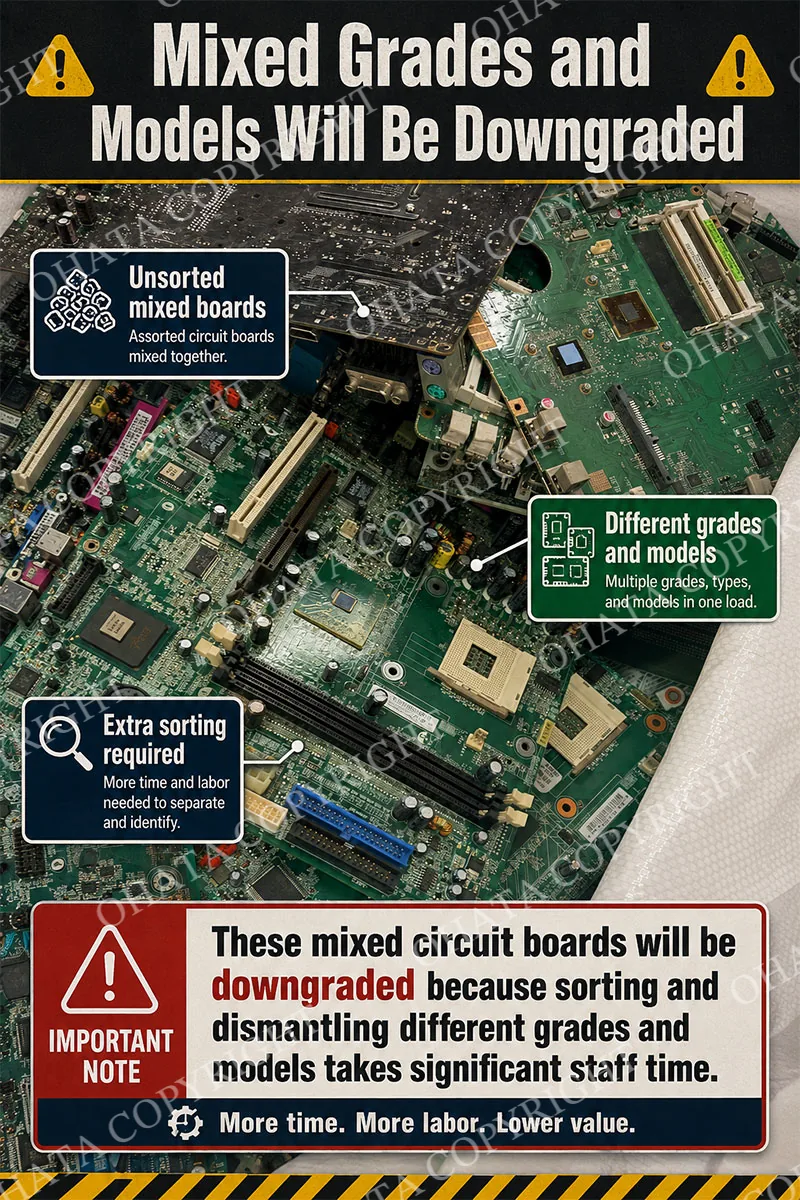
Mixed material requires additional labor to identify, separate, inspect, and weigh. It can also conceal damaged, stripped, or contaminated boards. For these reasons, mixed grades or mixed models may be purchased at a lower blended grade instead of at the highest visible grade.
To protect value:
Keep SS Grade separate from S Grade.
Separate high-grade boards from appliance boards.
Remove unrelated plastic and steel scrap.
Do not mix loose batteries with circuit boards.
Keep broken boards separate from complete boards.
Separate burned or contaminated material.
Avoid mixing stripped boards with complete boards.
Sort non-SATA hard drive boards separately from ordinary modern drive boards.
Keep processor-rich legacy boards identifiable.
A carefully sorted load allows each category to be evaluated according to its actual characteristics. Poorly sorted mixed scrap may be downgraded even when several high-value boards are present.
Official Ohata Classification Statement
The Ohata Board Scrap Classification System is a company-specific purchasing and pricing framework. SS Grade and S Grade are not internationally standardized definitions, and other recyclers may use different grade names, inspection methods, or pricing structures.
Within Ohata’s system, SS Grade generally represents high-value telecommunications, enterprise networking, smartphone, optical communication, cellular infrastructure, server backplane, and qualifying four-CPU server motherboard material.
S Grade generally represents premium legacy computer boards, qualifying three-CPU server or desktop motherboards, boards with three or more purple ceramic CPUs, combinations of large plastic PGA sockets and gold-tab BGA processors, and qualifying non-SATA hard drive boards.
Classification is based on the board that is physically presented for inspection. Original equipment specifications do not override the actual condition of the scrap. Missing CPUs, removed chipsets, metal-framed sockets, undersized plastic PGA sockets, broken PCB areas, burn damage, corrosion, contamination, and mixed loads may all result in a lower grade, reduced price, or rejection.
For maximum recycling value, SS Grade and S Grade boards should remain complete, clean, dry, identifiable, and properly separated. All qualifying processors, ceramic packages, gold-tab BGA devices, sockets, connectors, and important ICs should remain attached. Broken, incomplete, stripped, burned, contaminated, or mixed circuit boards should not be expected to receive the same value as complete and correctly sorted premium boards.