

S Grade vs A+ Grade: Scrap Identification & Recycling Guide
Overview
S Grade and A+ Grade are two high-value categories within the Ohata Board Scrap Classification System. This classification is not an international, universal, or industry-wide grading standard. It is Ohata’s internal pricing-grade standard for purchasing, sorting, and evaluating recyclable printed circuit boards. Final acceptance and pricing depend on the actual condition, component configuration, completeness, cleanliness, and recoverable material content of each board or shipment.
Although both grades contain valuable integrated circuits, gold-plated contacts, copper, and other recoverable materials, they represent different types of electronic scrap. S Grade is primarily associated with premium legacy computer boards and certain high-value server motherboards. A+ Grade covers a broader range of advanced industrial, enterprise, telecommunications, medical, robotic, and Apple computing boards.
S Grade Definition
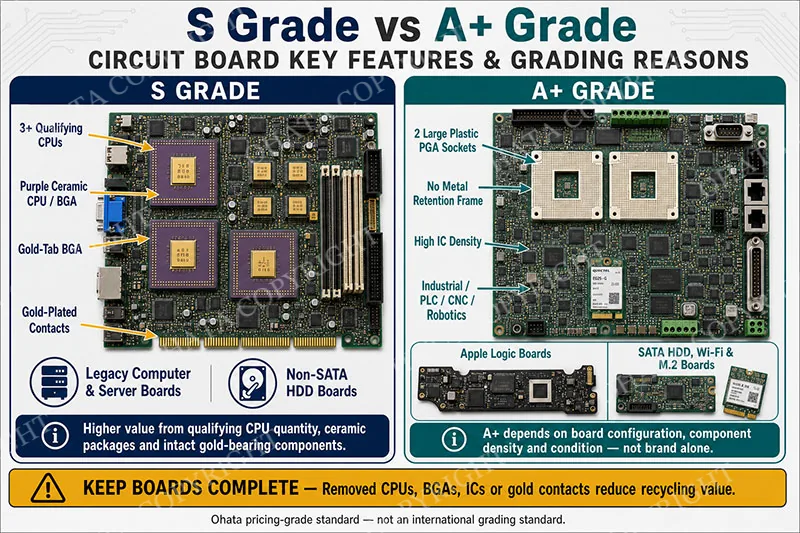
S Grade consists mainly of premium computer and legacy electronic boards with a high concentration of valuable semiconductor packages and precious-metal-bearing components. These boards often originate from older computer systems manufactured during periods when processors, connectors, pins, and internal component structures used comparatively generous amounts of gold and other valuable metals.
Typical S Grade material includes:
Circuit boards fitted with three or more large purple ceramic CPUs or ceramic BGA processors.
Premium legacy desktop motherboards with qualifying multi-processor configurations.
Older enterprise computer boards containing several valuable CPU packages.
Server motherboards meeting the minimum three-CPU requirement and the accepted processor combinations.
Non-SATA hard disk drive controller boards.
Specialized legacy computing boards with dense integrated circuits and substantial gold-plated contacts.
The high recycling value of S Grade does not come from board size alone. Its value is driven by the number and type of CPUs, ceramic packages, gold-tab BGA processors, gold-plated connectors, integrated circuits, and other recoverable electronic components remaining on the board.
A+ Grade Definition
A+ Grade includes advanced industrial and enterprise boards that normally have strong component density, high-quality construction, and useful concentrations of recoverable metals. Unlike S Grade, which is focused heavily on premium legacy computer hardware and qualifying multi-CPU layouts, A+ Grade includes several specialized applications.
Common A+ Grade sources include:
Industrial automation equipment.
PLC CPU modules and programmable controller boards.
CNC machine controller boards.
Robotics control systems.
Medical equipment control boards.
Professional telecommunications and industrial networking equipment.
Enterprise computing systems.
Large multi-socket server motherboards.
Apple laptop logic boards and Apple iMac desktop logic boards.
SATA hard disk drive controller boards.
Wi-Fi and M.2 boards with gold fingers, including portable Wi-Fi modules.
Boards with integrated circuit coverage exceeding approximately 90%.
Industrial brands associated with equipment that may contain A+ Grade boards include Siemens, Allen-Bradley, Mitsubishi Electric, Fanuc, Honeywell, ABB, Rockwell Automation, Omron, Schneider Electric, and Yaskawa. The brand name alone does not guarantee the grade. The actual board configuration must satisfy the applicable component, socket, density, and condition requirements.
Primary Difference Between S Grade and A+ Grade
The clearest distinction is the board’s component configuration and original application.
S Grade is generally reserved for premium legacy computer boards containing at least three qualifying CPUs or an equivalent high-value processor arrangement. Purple ceramic processors and gold-tab BGA packages are especially important identification features. These older packages can contain valuable bonding materials, plated contacts, and recoverable precious metals.
A+ Grade is more application-diverse. It includes advanced industrial controllers, Apple logic boards, high-density full-IC boards, specialized telecom boards, and server motherboards with two qualifying large plastic PGA sockets. An A+ board may be technologically advanced and densely populated while still having fewer qualifying CPUs than an S Grade board.
In practical sorting terms, S Grade is defined more narrowly by premium CPU quantity and package type. A+ Grade is defined more broadly by industrial or enterprise use, board quality, IC density, and specific accepted configurations.
S Grade Server Motherboard Requirements
An S Grade server motherboard must contain a minimum of three qualifying CPUs or processor positions in an accepted configuration. Qualifying arrangements include:
Three large purple ceramic BGA processors.
One large plastic PGA CPU socket combined with two gold-tab BGA processors.
Two large plastic PGA CPU sockets combined with one gold-tab BGA processor.
Large plastic PGA sockets measuring at least approximately 5 × 5 centimeters, provided the overall processor configuration meets the S Grade requirement.
The required CPUs, BGA packages, and sockets should remain securely attached to the motherboard. Empty spaces where processors or valuable packages were removed do not provide the same recoverable content and should not be counted as complete qualifying components.
A server motherboard may be downgraded from S Grade when:
A large PGA CPU area has a large metal retention frame.
A plastic PGA socket is smaller than approximately 5 × 5 centimeters.
An LGA CPU socket has a metal frame.
One or more qualifying CPUs or BGA packages have been removed.
The board no longer meets the minimum three-CPU configuration.
Metal retention frames add non-target weight and usually indicate a socket construction with lower value under Ohata’s pricing system. Their presence can therefore change the accepted grade even when the motherboard is large or densely populated.
S Grade Desktop Motherboard Requirements
An S Grade desktop motherboard also requires a minimum of three qualifying CPUs. Accepted arrangements include three large purple ceramic BGA processors, one large plastic PGA socket with two gold-tab BGA processors, or two large plastic PGA sockets with one gold-tab BGA processor.
Large plastic PGA sockets should measure at least approximately 5 × 5 centimeters. Smaller sockets, metal-framed LGA sockets, and large metal retention structures can lead to a downgrade.
For desktop boards, the relationship between BGA chipsets and ceramic CPUs must also be evaluated carefully. A board should not be promoted merely because several processor-shaped components are visible. The packages must be genuine qualifying ceramic or gold-tab processor components, and the complete motherboard must satisfy the Ohata S Grade configuration.
A+ Grade Server Motherboard Requirements
A qualifying A+ Grade server motherboard may contain two large plastic PGA CPU sockets without metal retention frames. This is one of the most useful distinctions between A+ and S Grade server boards.
A two-socket board may qualify as A+ when both sockets are large, plastic, and free from disqualifying metal frames. The same board generally does not qualify as S Grade unless it also contains the required third qualifying processor element, such as a gold-tab BGA processor.
An A+ server motherboard may be downgraded when it contains:
Only one large plastic PGA socket and one BGA processor.
Two ceramic BGA processors without a qualifying large plastic PGA socket arrangement.
A large LGA socket fitted with a large metal retention frame.
Plastic PGA sockets smaller than approximately 5 × 5 centimeters.
Any metal-framed LGA CPU socket.
Missing processors, removed ICs, or an incomplete qualifying socket configuration.
A large board is not automatically A+ Grade. Modern server motherboards with extensive steel retention hardware but relatively limited gold-bearing component content may be assigned a lower grade.
A+ Grade Desktop and Specialized Board Requirements
An A+ desktop motherboard may qualify when it contains two large plastic PGA sockets without metal frames. Apple iMac desktop logic boards are also included in the A+ category when they are complete, identifiable, and in acceptable recycling condition.
Apple laptop logic boards are normally treated as A+ material rather than ordinary non-Apple laptop motherboards because of their construction, component density, and compact coverage of integrated circuits. However, removed chips, cut sections, missing connector areas, or severe physical damage can reduce their price or cause reclassification.
Industrial control boards may qualify as A+ when they retain their principal CPUs, memory packages, BGA devices, IC arrays, gold-plated connectors, communication modules, and other valuable components. An industrial nameplate or machine origin alone is insufficient if the board has been stripped.
Electronic Component Differences
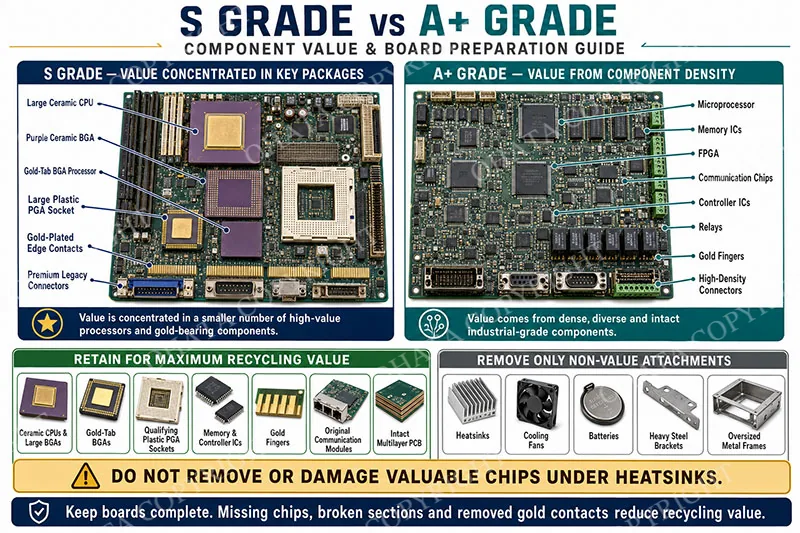
S Grade boards are commonly distinguished by large ceramic CPUs, purple ceramic BGA packages, gold-tab BGA processors, large plastic PGA sockets, and premium legacy connectors. Their value is concentrated in a relatively small number of highly desirable processor packages and gold-bearing components.
A+ Grade boards more often derive value from the combined density of many components. These may include microprocessors, memory ICs, FPGAs, communication chips, controller ICs, relays, high-quality connectors, gold fingers, and densely mounted surface components. Industrial boards may also contain specialized control processors and robust connectors designed for long service life.
For maximum recycling value, boards should retain:
Ceramic CPUs and large BGA processors.
Gold-tab BGA packages.
Large qualifying plastic PGA sockets.
Memory and controller ICs.
Gold fingers and gold-plated edge connectors.
High-density connector blocks.
Original communication and control modules.
Valuable chips located beneath removable heatsinks.
Intact multilayer PCB sections containing copper pathways.
Heatsinks, cooling fans, batteries, heavy steel brackets, and oversized metal frames do not necessarily increase value. Depending on the category, these attachments may need to be removed because they add non-board weight or conceal the actual component configuration. Valuable electronic components beneath them must not be removed or damaged during preparation.
Board Integrity and Recycling Value
Completeness is essential when recycling S Grade and A+ Grade boards. A complete board permits accurate identification and preserves the recoverable material on which the price is based. Broken, cut, drilled, crushed, or partially stripped motherboards contain less recoverable material and may be downgraded.
The following damage can reduce recycling value:
Missing CPUs, BGAs, ICs, or gold-finger sections.
Sawed-off or snapped connector edges.
Broken corners affecting component areas.
Removed gold-plated pins or sockets.
Deep scratches that destroy conductive layers.
Burn damage, charring, or melted components.
Severe corrosion or water contamination.
Excessive solder residue or unauthorized component harvesting.
Boards crushed together with metal housings.
Missing sections that prevent reliable grade identification.
Minor cosmetic marks may not change the grade, but any damage that removes precious-metal-bearing material, reduces board weight, or destroys key identifying features can affect the purchase price.
Mixed Material and Shipment Quality
S Grade and A+ Grade boards should be sorted separately. Mixed miscellaneous scrap lowers recycling value because it increases inspection, separation, and processing costs. A container labeled as S Grade should not include A+ boards, lower-grade computer motherboards, appliance boards, power supply boards, loose metal, plastic housings, wires, fans, batteries, or unrelated electronic waste.
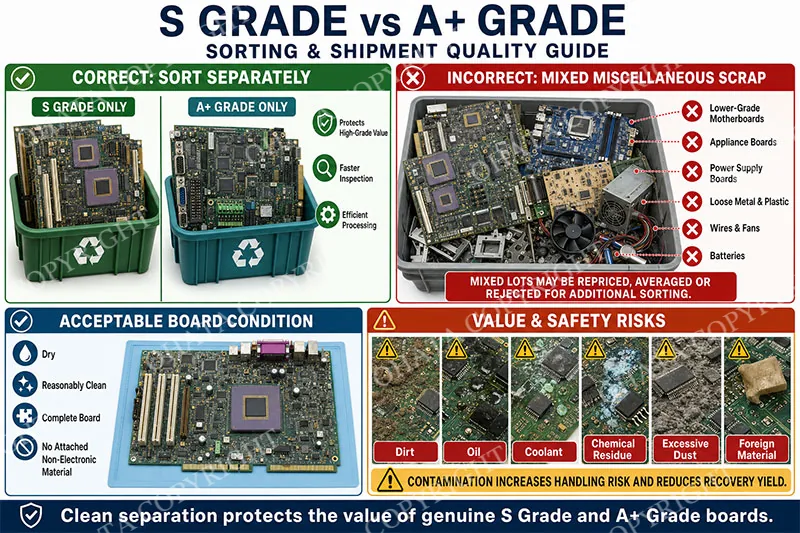
Mixed lots may be repriced according to the lowest significant grade, purchased at an averaged mixed-board rate, or rejected for additional sorting. Clean separation protects the value of genuinely high-grade boards.
Boards should also be dry and reasonably clean. Dirt, oil, coolant, chemical residue, excessive dust, and attached non-electronic material can increase handling risk and reduce usable recovery yield.
Rejected Motherboard Conditions
A motherboard may be refused when its condition makes safe handling, identification, or material recovery impractical. Possible rejection conditions include:
Batteries that are swollen, leaking, punctured, or still attached where removal is required.
Boards contaminated with oil, chemicals, sewage, biological material, or unidentified residue.
Burned boards containing heavy soot or extensively melted plastic.
Radioactive, medical, military, or industrial material requiring special documentation or controlled disposal.
Wet boards or shipments with free liquid.
Boards mixed with hazardous waste, sealed containers, gas cylinders, or unknown substances.
Counterfeit loads containing metal plates or filler intended to increase weight.
Material so heavily stripped that it no longer resembles a complete motherboard.
Crushed mixed scrap that cannot be safely or reliably classified.
Loads containing excessive steel, aluminum, plastic, cables, or other foreign material.
Boards with insufficient information for legally compliant transport or recycling.
Rejection is different from downgrading. A downgrade means the board remains recyclable but is assigned a lower pricing grade. Rejection means Ohata may decline the board or shipment because of safety, contamination, legal, documentation, or severe quality problems.
Classification Summary
A board is most likely to qualify as S Grade when it is a premium legacy computer or server motherboard with at least three accepted CPUs, including large purple ceramic processors, qualifying large plastic PGA sockets, or gold-tab BGA packages in the specified combinations.
A board is more likely to qualify as A+ Grade when it is a complete advanced industrial, Apple, telecom, medical, robotic, PLC, CNC, enterprise, or high-density board, or when it is a server motherboard with two large plastic PGA sockets and no disqualifying metal frames.
Final classification must be based on the actual board rather than its label, brand, age, or equipment source. Maintaining motherboard integrity, preserving valuable processors and ICs, removing inappropriate foreign attachments, and separating grades carefully are the most effective ways to protect recycling value under the Ohata Board Scrap Classification System.