

A+ Grade vs A Grade: Scrap Identification & Recycling Guide
Overview
A+ Grade and A Grade are two pricing categories used by Ohata Company to evaluate recyclable printed circuit boards. These classifications are based on the probable recovery value of the boards, their original applications, component density, CPU socket design, semiconductor packages, gold-plated contacts, and overall physical condition.
This classification system is not an international, governmental, or universally accepted grading standard. It is Ohata Company’s own purchasing and pricing system for circuit-board scrap. Another recycler may use different grade names, acceptance rules, or valuation methods for the same board.
A+ Grade generally covers advanced industrial, enterprise, telecommunications, medical, robotics, and selected Apple boards with dense or specialized electronic construction. A Grade primarily covers high-quality computer motherboards, expansion cards, drive controller boards, and other computer-related boards that retain good recycling value but normally contain fewer premium components or less recoverable precious metal than A+ Grade.
A+ Grade Definition
A+ Grade consists of advanced boards commonly recovered from professional, industrial, enterprise, and specialized electronic equipment. These boards usually contain a high concentration of integrated circuits, large processor sockets, gold-plated interfaces, multilayer PCB construction, and complex control components.
Although not every A+ Grade board contains the same quantity of precious metals, this category generally provides stronger recoverable value than ordinary high-grade computer scrap. The value may come from gold-plated contacts, semiconductor packages, copper-rich multilayer construction, palladium-bearing components, and densely populated control circuitry.
Main Sources of A+ Grade Boards
A+ Grade boards may originate from:
Industrial automation systems
Programmable logic controllers
CNC machines
Robotics equipment
Medical equipment
Enterprise servers
Telecommunications switching equipment
Industrial network systems
Apple laptops and iMac computers
SATA hard disk drives
Wireless communication modules
Fiber, data, or process-control equipment
Common industrial manufacturers associated with this type of equipment include Siemens, Allen-Bradley, Mitsubishi Electric, Fanuc, Honeywell, ABB, Rockwell Automation, Omron, Schneider Electric, and Yaskawa. The manufacturer name alone does not determine the grade; the actual board construction and retained components must still be inspected.
Typical A+ Grade Board Types
The following materials may qualify as A+ Grade when complete and consistent with Ohata’s purchasing requirements:
Wi-Fi and M.2 boards with visible gold fingers
Portable Wi-Fi modules with gold-plated contacts
Server motherboards with two or more large PGA processor sockets
Middle-grade telecommunications boards
Apple iMac desktop logic boards
Boards with integrated-circuit coverage above approximately 90%
Industrial control boards
PLC CPU boards
CNC machine controller boards
Telecommunications switching boards
Industrial networking boards
Robotics controller boards
Medical-equipment controller boards
A board should not be assigned A+ Grade solely because it came from expensive machinery. Some industrial devices contain simple power, relay, or interface boards with relatively low component density. The grade is determined by the physical characteristics of the individual board, not the original price of the complete machine.
A+ Grade Motherboard Identification
A+ Grade Server Motherboards
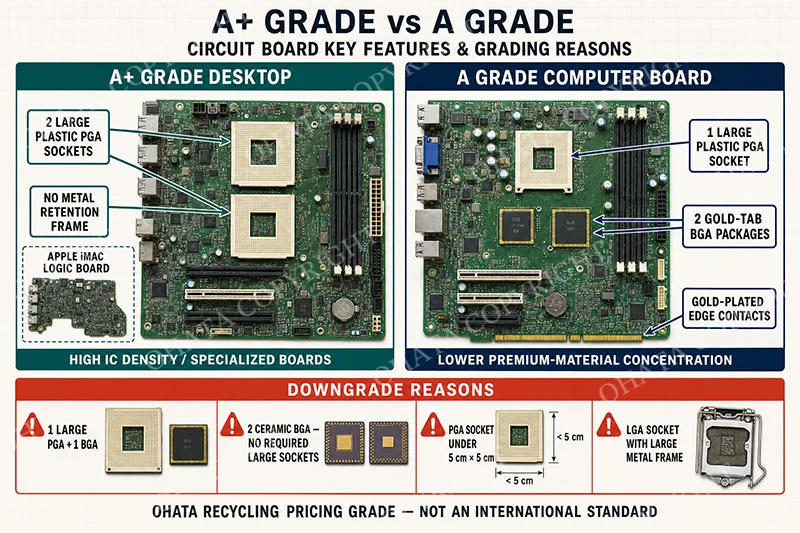
A server motherboard may qualify as A+ Grade when it retains two large plastic PGA CPU sockets without metal retention assemblies. The sockets and surrounding processor circuitry should remain attached to the motherboard.
Large plastic PGA sockets are important because their design, contact structure, and associated circuitry can indicate a higher-value generation of server hardware. A socket measuring less than approximately 5 cm by 5 cm does not satisfy the large-socket requirement.
The following conditions may cause an expected A+ server motherboard to be downgraded:
Only one large plastic PGA socket is present together with one BGA processor.
Two ceramic BGA processors are present, but there is no qualifying large plastic PGA socket.
A large LGA socket has a substantial metal retention frame.
The plastic PGA socket is smaller than 5 cm by 5 cm.
An LGA processor socket uses a metal frame.
Socket terminology must be checked carefully. PGA sockets normally accept processors with pins, while LGA sockets use contact pads and frequently have metal retention hardware. The amount of attached metal and the precise socket construction can materially affect Ohata’s assigned grade.
A+ Grade Desktop Motherboards
A desktop motherboard may qualify as A+ Grade when it has two large plastic PGA sockets without metal retention hardware. Apple iMac desktop logic boards may also be classified in this category when they remain recognizable and sufficiently complete.
A board may be downgraded when it has only one large plastic PGA socket with one BGA processor, two ceramic BGA processors without the required large socket arrangement, a plastic socket smaller than 5 cm by 5 cm, or any qualifying LGA socket fitted with a large metal frame.
A Grade Definition
A Grade represents high-quality computer boards that contain worthwhile quantities of recoverable metals and electronic components but generally have lower premium-material concentration than A+ Grade. These boards often have moderate to high integrated-circuit density, copper-rich PCB layers, gold-plated edge contacts, and valuable processor or chipset packages.
A Grade is strongly associated with computers and peripheral equipment. In contrast, A+ Grade has a broader concentration of advanced industrial controllers, specialized enterprise hardware, Apple logic boards, and densely populated professional electronics.
Main Sources of A Grade Boards
A Grade material is commonly recovered from:
Non-Apple laptop computers
Single-socket enterprise servers
Desktop computers from earlier generations
Optical disc drives
Computer backplanes
Expansion-card assemblies
PCMCIA laptop accessories
Older NEC desktop computers
Family game machines
Professional computer peripherals
The board must be evaluated after unnecessary attachments are removed. A valuable card fitted with a heavy steel bracket, oversized heatsink, fan, or mixed mechanical assembly may be purchased at a lower grade because those additions increase non-recoverable weight and processing cost.
Typical A Grade Board Types
A Grade may include:
Clean gold-finger expansion cards without fans, heatsinks, or metal brackets
Non-Apple laptop motherboards with two gold-tab BGA packages
Large single-socket server motherboards
CD-ROM and DVD-ROM controller boards
Backplane expansion boards
NEC desktop computer boards manufactured from the 1980s through the 2000s
Computer expansion cards with a gold-tab BGA and no iron bracket
PCMCIA laptop expansion cards without batteries
Selected family game-machine boards
Gold fingers are the plated contact strips found along the edge of many expansion cards. They increase recycling value when they remain intact, clean, and untrimmed. A card with shortened contacts, removed fingers, heavy attachments, or excessive damage may be reassigned to a lower category.
A Grade Motherboard Identification
A Grade Server Motherboards
An A Grade server motherboard may qualify through one of several component arrangements:
One large plastic PGA CPU socket
Two gold-tab BGA processor packages
Two no-metal-frame LGA sockets accompanied by two gold-tab BGA packages
A large single-socket server motherboard is a typical A Grade item. This is a major distinction from A+ Grade, where the expected arrangement is generally two large plastic PGA sockets without metal.
Possible downgrade conditions include:
A plastic PGA socket smaller than 5 cm by 5 cm
An unsuitable or incomplete plastic socket configuration
Any LGA socket with a metal frame
BGA processors without gold tabs
Two no-metal-frame LGA sockets accompanied by only one gold-tab BGA package
The presence of two processor positions does not automatically make a motherboard A+ Grade. Socket type, socket size, metal retention hardware, and the number of gold-tab BGA components must all be considered.
A Grade Desktop Motherboards
A desktop motherboard may qualify through the same principal arrangements used for A Grade server boards: one large plastic PGA socket, two gold-tab BGA processors, or two no-metal-frame LGA sockets with two gold-tab BGA packages. Earlier NEC desktop boards from the 1980s through the 2000s may also qualify.
Metal-framed sockets, small plastic sockets, non-gold-tab BGA packages, or insufficient high-value semiconductor content can result in a lower grade. Modern desktop motherboards with metal CPU socket covers and retention levers are generally not treated as A Grade merely because they are functional or recent.
Key Differences Between A+ Grade and A Grade
The primary distinction is not simply the age, size, or original selling price of the board. Ohata evaluates the combination of application, board construction, component arrangement, and recoverable material content.
A+ Grade is more likely to include specialized industrial controllers, PLC CPU boards, CNC controls, medical boards, robotics boards, middle-grade telecom equipment, Apple logic boards, densely populated full-IC boards, and multi-socket server motherboards. These products often use complex multilayer construction and a large number of semiconductor packages.
A Grade is more closely associated with conventional high-grade computer scrap. Typical examples include non-Apple laptop motherboards, single-socket server boards, clean expansion cards, optical-drive boards, PCMCIA cards, backplanes, and older NEC computer boards.
For server motherboards, two large no-metal plastic PGA sockets generally support A+ Grade, while one large plastic PGA socket is normally associated with A Grade. For portable computers, Apple laptop logic boards are generally placed in A+ Grade, whereas qualifying non-Apple laptop motherboards with two gold-tab BGA components are placed in A Grade.
A+ Grade also covers SATA hard-drive boards and small Wi-Fi or M.2 boards with gold fingers. A Grade includes CD/DVD controller boards and clean full-size gold-finger cards without fans, heatsinks, or iron brackets.
Component Completeness and Recycling Value
Boards should remain as complete as reasonably possible during collection, storage, and shipment. Important electronic components should not be removed merely to reduce size or make the boards easier to transport. Removing high-value components can cause an otherwise qualifying board to be downgraded.
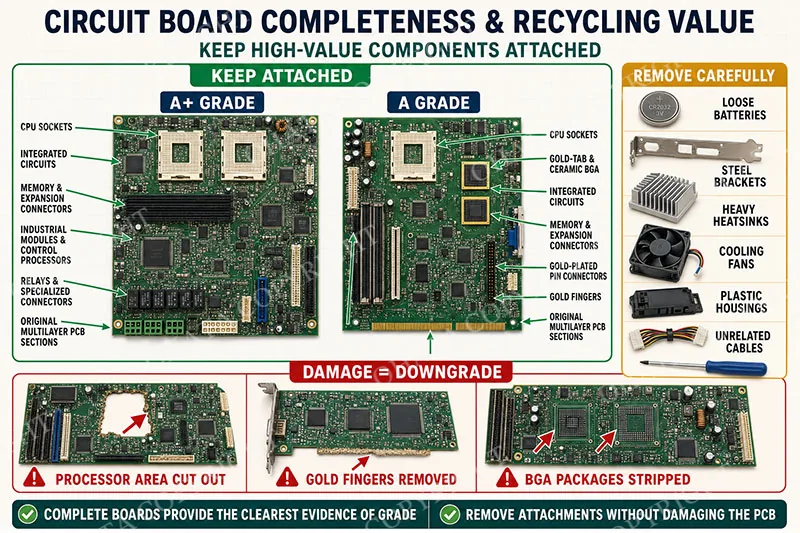
Components that should remain attached include:
CPU sockets
Gold-tab BGA processors and chipsets
Ceramic BGA packages
Integrated circuits
Gold fingers
Gold-plated pin connectors
Memory and expansion connectors
Industrial communication modules
Control processors
Relays and specialized connectors when they are part of the original board
High-value semiconductor packages
Original multilayer PCB sections
The complete board provides the clearest evidence of its grade. A processor area that has been cut out, an expansion card with its gold fingers removed, or a motherboard stripped of its BGAs cannot be evaluated in the same way as an intact unit.
Non-electronic attachments should be handled differently. Loose batteries, oversized steel brackets, heavy aluminum heatsinks, cooling fans, plastic housings, and unrelated cables may add weight without adding corresponding circuit-board value. Where permitted by Ohata’s preparation requirements, these attachments should be separated without damaging the PCB or removing valuable electronic parts.
Damage, Missing Parts, and Mixed Material
Broken, cracked, cut, burned, corroded, or incomplete boards have lower recycling value. Missing processor sockets, removed BGAs, trimmed gold fingers, drilled sections, and stripped integrated circuits can lead to a downgrade because the expected recoverable materials are no longer present.
Moisture, oil, chemical residue, fire damage, and severe oxidation may also reduce value. Contamination complicates safe handling and can interfere with mechanical processing and metal recovery.
Mixed miscellaneous material lowers recycling value. A shipment containing A+ Grade boards mixed with A Grade boards, low-grade appliance boards, automotive boards, wires, transformers, steel panels, plastic housings, power supplies, or general rubbish may be priced according to the lower-quality portion or require additional sorting.
Boards should therefore be separated by grade and packed so that they are not crushed during transportation. Small A+ items such as M.2 and Wi-Fi boards should be contained securely rather than mixed with screws, metal fragments, or low-grade connector pieces.
Rejection Conditions
Ohata may reject a motherboard or shipment when the material cannot be safely or reliably processed, when it does not match the declared category, or when the non-board content is excessive. Potential rejection circumstances include:
Counterfeit or deliberately misrepresented material
Boards with hazardous chemical, oil, or biological contamination
Severely burned or carbonized motherboards
Boards containing swollen, leaking, or damaged batteries
Loads dominated by metal frames, plastic housings, fans, or unrelated waste
Motherboards reduced to fragments that cannot be identified
Boards stripped of nearly all processors, integrated circuits, connectors, or gold contacts
Wet material or material with severe corrosion
Mixed waste containing prohibited or unsafe items
Shipments whose declared grade is materially different from the actual contents
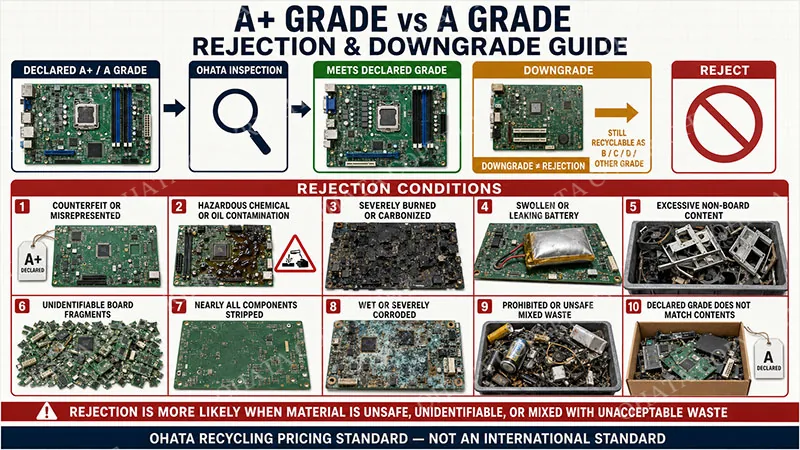
A downgraded board is not necessarily rejected. A motherboard that fails the A+ or A requirements may still be recyclable under B, C, D, or another applicable Ohata category. Rejection is more likely when the board has lost its identifiable structure, contains unsafe contamination, or is mixed with unacceptable waste.
Sorting and Preparation Guidance
Each motherboard should be inspected individually. Identify its original equipment type, count its CPU sockets, determine whether the sockets are PGA or LGA, measure large plastic sockets when necessary, note any metal retention frame, and count gold-tab BGA packages.
Keep A+ Grade industrial and enterprise boards separate from A Grade computer boards. Separate Apple logic boards from non-Apple laptop motherboards. Do not mix clean gold-finger cards with cards carrying heavy fans, oversized heatsinks, or steel brackets. Remove loose batteries and unrelated mechanical waste while preserving the electronic board itself.
Final purchasing decisions remain subject to Ohata Company’s inspection. Maintaining complete boards, retaining valuable electronic components, preventing breakage, and avoiding mixed miscellaneous loads provide the best basis for accurate grading and stronger recycling value.