
Introduction, Classification Philosophy, High-Grade Computer Hardware, Technical Characteristics, Precious Metal Content, and Typical A Grade Boards
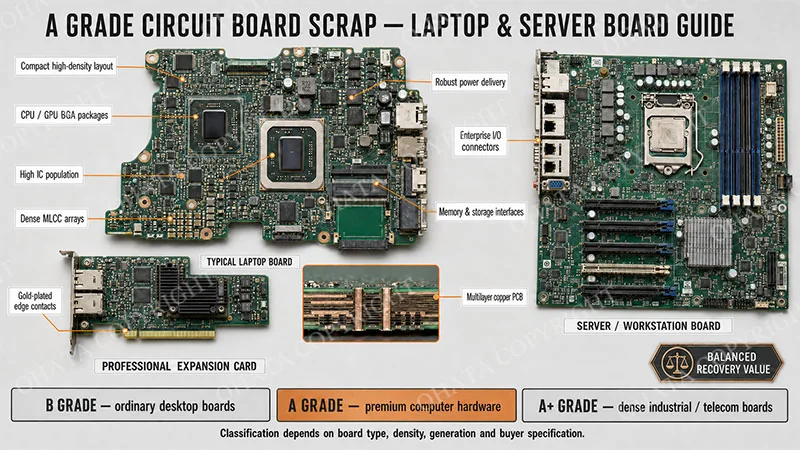
A Grade is Ohata's category for high-quality computer and professional consumer boards below A+ Grade and above B Grade. Typical candidates include non-Apple laptop motherboards, selected server boards with qualifying large plastic PGA socket combinations, complete gold-finger expansion cards, CD/DVD controller boards, selected NEC desktop boards, connector-rich backplanes and listed gaming-console revisions.
Do not assign A Grade from product type, brand, size or a single CPU socket. Apple logic boards and SATA HDD controllers should first be checked against A+ Grade. Non-SATA HDD controllers should be checked against S Grade. Server boards must follow the published A/B/C socket and chipset combination rules.
Why A Grade Exists
Modern electronic products span a wide range of engineering standards. Some boards are designed for mission-critical industrial automation, while others prioritize affordability for consumer markets. Between these extremes lies a large group of professional computer hardware that combines excellent build quality with balanced material composition.
Many notebook computers, enterprise workstations, server systems, gaming consoles, and professional expansion cards contain considerably higher concentrations of recoverable materials than ordinary desktop motherboards. However, they generally lack the exceptionally dense semiconductor layouts, industrial communication hardware, or premium enterprise architecture required for A+ Grade classification.

The A Grade category exists to recognize this important group of electronic assemblies.
Without a dedicated classification, these boards could easily become mixed with lower-value desktop boards or higher-value industrial electronics, reducing pricing accuracy and refining efficiency. By separating them into their own category, recyclers can maintain consistent purchasing guidelines while suppliers receive fair compensation based on engineering quality rather than appearance alone.
The category also improves inventory management throughout the recycling industry. Refiners benefit from more consistent incoming material streams, buyers gain an evaluation framework, and suppliers can more easily identify boards that qualify for premium computer hardware pricing.
The Ohata Classification Philosophy
The Ohata Board Scrap Classification System is founded upon objective engineering evaluation rather than subjective judgment. Every board is classified according to measurable physical characteristics that remain relatively stable throughout its service life regardless of changes in commodity prices or resale value.
Rather than relying on equipment age or manufacturer reputation, inspectors evaluate the complete electronic assembly using several technical criteria, including:
Integrated circuit density
Multilayer PCB construction
Semiconductor package quality
CPU socket configuration
Gold-plated connector coverage
Copper distribution
Board completeness
Overall electronic complexity
Intended application
No single characteristic determines classification. Instead, the entire circuit board is evaluated as a complete engineering product.
This methodology allows similar products from different manufacturers to receive consistent classifications while preventing temporary fluctuations in precious metal markets from influencing grading decisions.
The philosophy also recognizes that physical board size alone does not determine recycling value. A compact notebook motherboard may contain significantly greater semiconductor density than a much larger appliance control board. Likewise, an enterprise expansion card with extensive gold fingers may contain more recoverable precious metals than a larger desktop motherboard.
Because of this engineering-focused methodology, the Ohata Classification System provides a consistent technical language that can be applied internationally across electronic recycling operations.
High-Grade Computer Hardware
A Grade boards are commonly found in professional computer equipment designed for business, education, engineering, creative production, enterprise computing, and advanced consumer electronics.
Unlike entry-level consumer products that emphasize minimum manufacturing cost, these systems generally prioritize durability, stable electrical performance, thermal management, and long operational life.
Examples of hardware commonly classified as A Grade include:
complete non-Apple laptop motherboards that meet the A Grade condition criteria
Enterprise workstation motherboards
Large single-socket server motherboards
RAID controller cards
Network interface cards
Storage controller boards
Professional communication interface cards
CD/DVD optical drive controller boards
Earlier NEC desktop motherboards
Enterprise backplane boards
Selected gaming console motherboards
These products often remain operational for many years before entering electronic recycling streams. Their longer service life reflects higher manufacturing standards and superior electronic construction compared with many low-cost consumer electronics.
Technical Characteristics of A Grade Boards
Although individual products vary considerably, most A Grade boards exhibit several common engineering characteristics.
High Integrated Circuit Density
One of the strongest indicators of A Grade classification is the presence of numerous integrated circuits distributed across much of the PCB surface.
Common semiconductor devices include:
Central processors
Graphics processors
Memory devices
Southbridge and northbridge chipsets
Power management integrated circuits
Communication controllers
Audio processors
Ethernet controllers
Storage controllers
Flash memory
Embedded controller ICs
Unlike simplified consumer electronics that rely on only a few highly integrated chips, A Grade boards often incorporate multiple support processors that increase overall semiconductor coverage and recoverable material value.
Premium Multilayer PCB Construction
Most A Grade products utilize high-quality multilayer fiberglass printed circuit boards designed to support stable electrical performance and long-term reliability.
Typical construction features include:
multilayer construction is common; internal layer count requires technical documentation
Thick internal copper planes
Precision signal routing
Reinforced mounting points
Durable solder masks
High-quality fiberglass laminate
Controlled power distribution
Premium surface finishes
Multilayer construction improves electrical performance while significantly increasing copper recovery during downstream recycling.
Balanced Copper Content
Copper represents the largest recoverable material by weight in nearly every A Grade board.
Copper is present within:
Internal power planes
Ground planes
Signal traces
Voltage regulation circuits
Communication pathways
Connector assemblies
Inductors
Transformer windings
Enterprise server boards and workstation motherboards typically contain thicker copper layers than ordinary desktop boards because of their higher power requirements and greater electrical complexity.
Moderate Gold Plating
Gold remains one of the defining characteristics of A Grade electronics.
Although total gold content is generally lower than A+ Grade, SS Grade, or S Grade materials, A Grade boards still contain economically recoverable quantities throughout the electronic assembly.
Typical gold-bearing locations include:
Expansion card edge connectors
CPU socket contacts
Memory slot contacts
Communication connectors
Storage interfaces
Gold bond wires within integrated circuits
Selected test points
Gold plating is primarily used to improve corrosion resistance, maintain electrical conductivity, and ensure long-term connector reliability.
High-Quality Electronic Components
A Grade boards commonly employ premium electronic components that support stable long-term operation.
Examples include:
Solid-state capacitors
High-quality electrolytic capacitors
Precision oscillators
Ferrite inductors
MOSFET voltage regulators
Surface-mounted resistors
High-frequency ceramic capacitors
Premium connector systems
The quality of these components contributes both to operational reliability and to recoverable recycling value.
Precious Metals Found in A Grade Boards
Several valuable metals are routinely recovered from A Grade circuit boards during downstream refining.
Gold
Gold is recovered primarily from:
Edge connectors
CPU socket contacts
Memory connectors
Storage interfaces
Communication ports
Gold bond wires inside integrated circuits
Although gold is used in relatively thin layers, its exceptional conductivity and corrosion resistance make it indispensable for reliable electronic connections.
Copper
Copper forms the structural foundation of every printed circuit board.
Major sources include:
Internal PCB layers
Ground planes
Signal traces
Power regulation circuits
Voltage distribution networks
Inductors
Connector assemblies
Copper typically represents the greatest recoverable metal by weight.
Silver
Silver may be recovered from:
Selected electrical contacts
Specialized connector materials
Certain solder formulations
Semiconductor construction
Although present in smaller quantities than copper, silver contributes additional refining value.
Palladium
Many multilayer ceramic capacitors contain trace quantities of palladium.
When processed in industrial volumes, these components contribute measurable precious metal recovery and further increase the overall value of A Grade electronic scrap.
Typical A Grade Boards
Several board types consistently meet the engineering characteristics associated with A Grade classification.
Common examples include:
Laptop motherboards (Non-Apple logic boards)
Large single-socket server motherboards
Clean expansion cards with full-length gold fingers
RAID controller cards
Fibre Channel interface boards
Enterprise network interface cards
CD/DVD drive controller boards
Earlier-generation NEC desktop motherboards
Enterprise backplane boards
Sony PlayStation 1 (PS1)
Sony PS One
Sony PSX
Sony PlayStation 2 (PS2)
Nintendo GameCube
Nintendo DS
Sega Dreamcast
These products combine dense semiconductor layouts, multilayer PCB construction, substantial copper content, moderate gold plating, and high-quality electronic components. Collectively, they form one of the most important sources of premium computer hardware processed by electronic recyclers worldwide.
Within the Ohata Board Scrap Classification System, these engineering characteristics—rather than collector value, original retail price, or brand recognition—determine their classification as A Grade Board Scrap. This objective approach ensures consistent identification, transparent purchasing, and efficient precious metal recovery throughout the global electronic recycling industry.
Detailed Board Types, Manufacturers, Identification Methods, and Engineering Analysis
Laptop Motherboard Classification
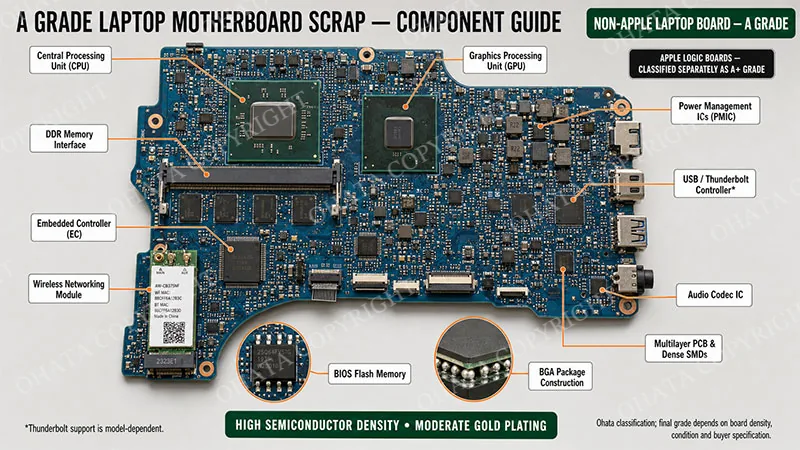
Laptop motherboards represent one of the largest categories of A Grade Board Scrap within the Ohata Board Scrap Classification System. Modern notebook computers integrate processors, memory controllers, storage interfaces, graphics functions, wireless communication modules, and power management circuits into compact multilayer printed circuit boards. Although physically smaller than desktop motherboards, their electronic component density is often considerably higher.

Most non-Apple laptop motherboards classified as A Grade contain:
Central Processing Unit (CPU)
Graphics Processing Unit (GPU) or integrated graphics controller
Embedded controller IC
DDR memory interface
Power management integrated circuits (PMIC)
USB and Thunderbolt controllers
Wireless networking modules
Audio codec ICs
Embedded BIOS flash memory
The compact layout requires extensive use of Ball Grid Array (BGA) semiconductor packages, multilayer PCB construction, and precision surface-mounted components. Their high semiconductor density, quality PCB construction, and moderate gold plating distinguish them from lower-grade desktop boards.
Apple logic boards are classified separately under A+ Grade because they generally exhibit even greater component density, premium PCB design, and higher recoverable material value.
Qualifying Plastic PGA Server Motherboard Combinations
Enterprise servers frequently utilize large single-processor motherboards designed for continuous operation in business, cloud computing, and data center environments.
Compared with consumer desktop boards, these products typically feature:
Enterprise-grade CPU sockets
Larger PCB dimensions
ECC memory support
High-capacity voltage regulation modules
Multiple PCI Express slots
Redundant storage interfaces
High-speed Ethernet controllers
Server management processors
SAS and RAID connectivity
Although single-socket server boards generally contain fewer processors than multi-socket enterprise systems classified as A+ Grade, they retain substantial semiconductor density and excellent copper recovery, making them representative A Grade materials.
Gold Finger Expansion Cards
Expansion cards equipped with long, clean, and undamaged gold fingers are among the most recognizable examples of A Grade board scrap.
Common examples include:
RAID controller cards
Fibre Channel adapters
High-speed Ethernet adapters
Professional sound cards
Video capture boards
Industrial interface cards
SCSI controller boards
SAS controller cards
The gold-plated edge connector significantly contributes to recoverable precious metal value. Buyers evaluate not only the length of the gold fingers but also plating quality, connector condition, integrated circuit density, and PCB construction.
Expansion cards with shortened or trimmed gold fingers generally fall into lower classifications because of reduced recoverable gold.
CD/DVD Drive Controller Boards
Although optical storage devices have largely been replaced by flash memory and cloud storage, CD-ROM, DVD, and Blu-ray controller boards remain common within electronic recycling streams.
Typical controller boards include:
Optical drive controller IC
Flash memory
Motor driver ICs
Laser control electronics
Servo controllers
Interface connectors
Voltage regulation circuits
Crystal oscillators
These compact boards exhibit good integrated circuit density relative to their size and maintain consistent recoverable copper and precious metal content.
NEC Desktop Motherboards from the 1990s and 2000s
Earlier-generation NEC desktop motherboards frequently qualify as A Grade because of their high-quality PCB construction and balanced semiconductor layout.
Typical characteristics include:
Durable multilayer fiberglass PCB
Multiple controller ICs
Premium capacitors
Full-size CPU sockets
Gold-plated memory connectors
Expansion slots
Robust voltage regulation circuits
Many NEC systems manufactured during the late 1990s and early 2000s contain higher recoverable precious metal concentrations than later budget desktop computers, making them valuable electronic scrap.
Enterprise Backplane Boards
Backplane boards provide communication pathways between processors, storage devices, and expansion modules in enterprise servers and telecommunications equipment.
Typical features include:
Multiple high-density connectors
Heavy copper power distribution
Thick multilayer PCB construction
Gold-plated backplane connectors
High-speed communication pathways
Signal integrity management
Although they may contain relatively few active semiconductor devices, their premium connector systems and extensive copper content support A Grade classification.
PlayStation and Gaming Console Motherboards
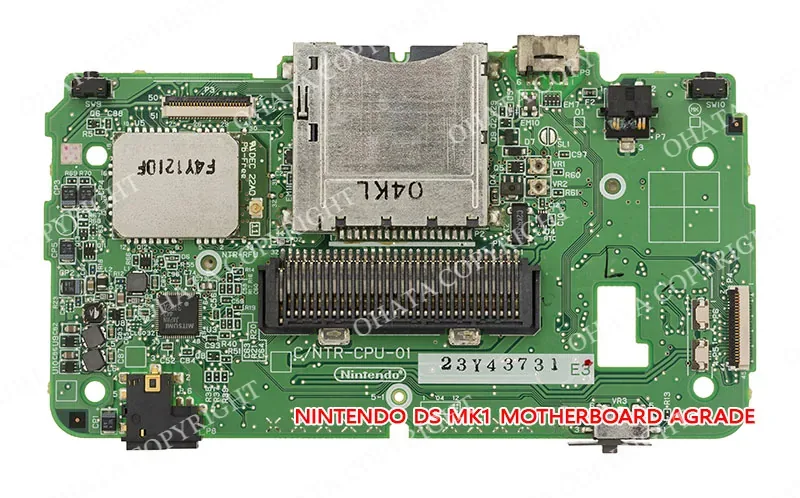
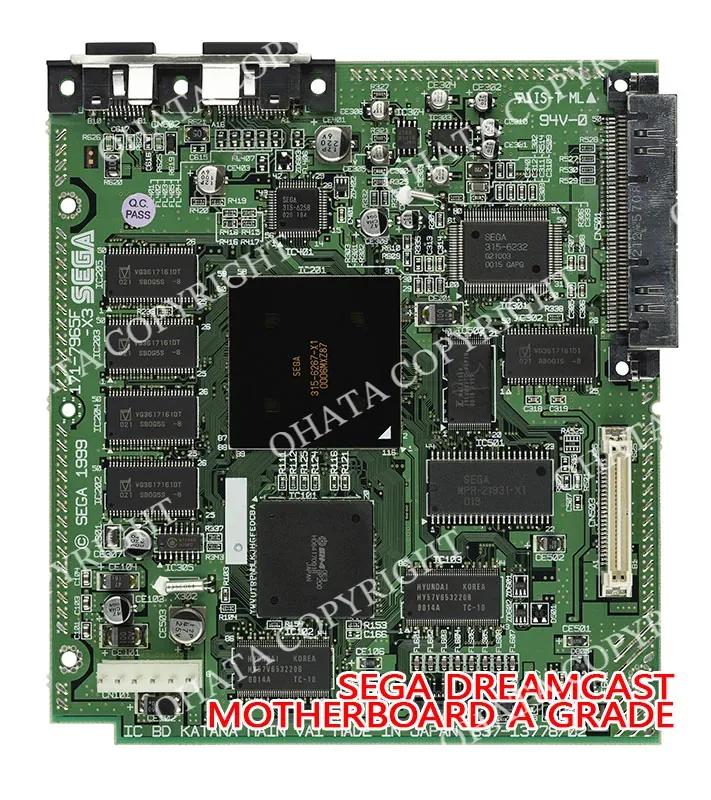
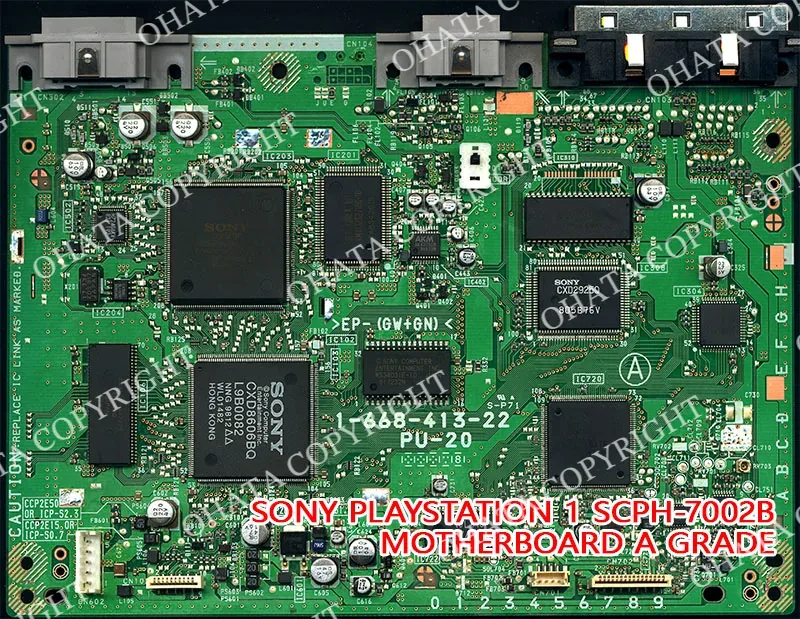
Several gaming consoles produced during the late 1990s and early 2000s are classified as A Grade Board Scrap because of their advanced engineering and high integrated circuit density. According to the Ohata A Grade Board Scrap Classification, this category includes the Sony PlayStation 1 (PS1), PS One, Sony PSX, PlayStation 2 (PS2), Nintendo GameCube, Nintendo DS, and Sega Dreamcast. These systems feature multilayer fiberglass PCBs, multiple processors, quality electronic components, and balanced recoverable precious metal content.
Sony PlayStation 1 (PS1)
The original PlayStation motherboard introduced advanced 32-bit gaming architecture and optical media support.
Typical components include:
Sony R3000 processor
Graphics processor
Sound processor
Memory ICs
BIOS ROM
CD-ROM controller
Controller ports
Memory card interfaces
Its balanced semiconductor layout and durable PCB construction contribute to its A Grade classification.
Sony PS One
The PS One is a compact redesign of the original PlayStation featuring a smaller motherboard with improved component integration and simplified power architecture. Despite its reduced size, it retains similar recoverable material value because of its dense electronic layout.
Sony PSX
Sony PSX integrates PlayStation 2 gaming with digital video recording functionality.
Additional components include:
HDD controller
DVD recording controller
Video processing ICs
Audio processors
Communication controllers
The additional multimedia electronics increase semiconductor density and support its A Grade classification.
Sony PlayStation 2 (PS2)
The PlayStation 2 motherboard contains multiple advanced semiconductor devices, including the Emotion Engine CPU, Graphics Synthesizer, Rambus memory, DVD controller, USB controller, and audio DSP. Selected models also include Ethernet interfaces. This balanced architecture provides excellent recycling potential.
Nintendo GameCube
Nintendo GameCube utilizes a compact motherboard built around an IBM PowerPC processor and ATI graphics processor, together with memory ICs, optical drive controllers, and voltage regulation modules. Despite its relatively small size, it demonstrates excellent semiconductor density.
Nintendo DS
Nintendo DS boards are highly integrated and include dual ARM processors, graphics controllers, wireless communication modules, touchscreen controllers, and power management circuits. Their high component density relative to board size supports their placement within A Grade.
Sega Dreamcast
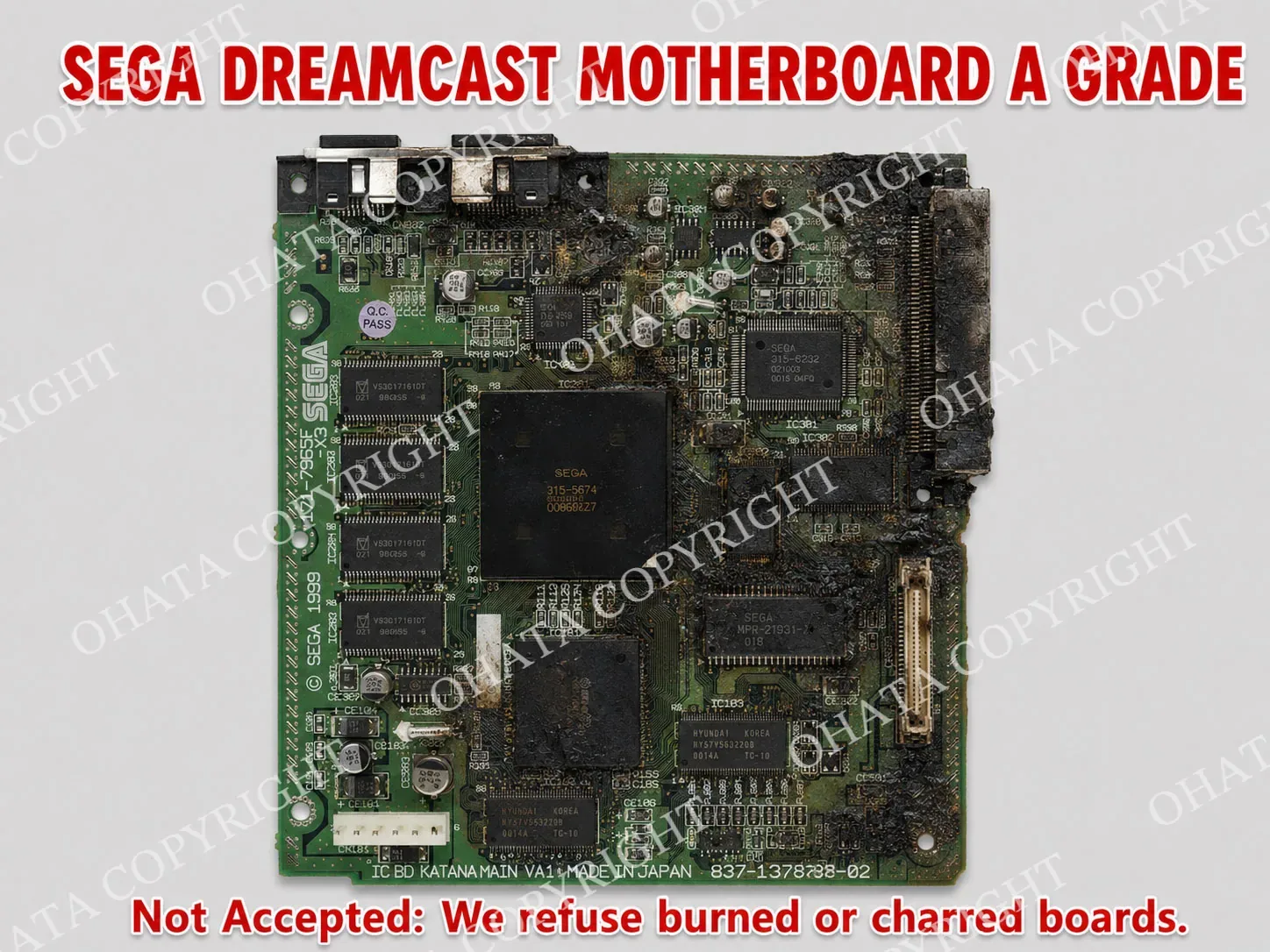
The Sega Dreamcast motherboard combines a Hitachi SH-4 processor, PowerVR graphics processor, GD-ROM controller, memory chips, communication interfaces, and voltage regulation circuits within a compact multilayer PCB. This balanced design makes it a valuable source of electronic scrap.
Representative Manufacturers
Although the Ohata Board Scrap Classification System does not classify boards according to manufacturer alone, several companies frequently produce products found within the A Grade category.
Representative manufacturers include:
Dell
HP
Lenovo
NEC
ASUS
Gigabyte
MSI
Intel
Supermicro
Sony
Nintendo
Sega
Each manufacturer produces products across multiple classifications; therefore, engineering characteristics—not brand names—determine the final grade.
Identification Methods
Correct identification of A Grade boards requires evaluating several engineering characteristics together rather than relying on appearance or product type alone.
Component Density Analysis
Inspectors evaluate:
Total integrated circuit count
Processor size
Memory devices
Controller ICs
Power management circuits
Semiconductor distribution
A Grade boards typically exhibit dense but well-organized semiconductor layouts that distinguish them from B or C Grade products.
PCB Construction Analysis
Most A Grade boards utilize premium multilayer fiberglass PCB construction.
Typical characteristics include:
Four to twelve PCB layers
Thick copper routing
Reinforced mounting points
Precision solder masks
High-quality laminate materials
Durable surface finishes
These features support reliable operation and efficient copper recovery during recycling.
CPU Socket Identification
CPU socket configuration provides valuable classification evidence.
Inspectors examine:
Socket dimensions
Contact quality
Processor generation
Enterprise versus consumer design
Retention mechanisms
Memory architecture
Large single-socket server boards and notebook processor layouts commonly indicate A Grade construction.
Gold Finger Evaluation
Expansion cards receive additional evaluation based on their gold-plated edge connectors.
Buyers inspect:
Gold finger length
Plating thickness
Surface condition
Connector density
Contact wear
Physical damage
Long, clean, and undamaged gold fingers generally indicate higher recoverable precious metal content than trimmed or worn connectors.
Engineering Analysis
Rather than evaluating a single component, the Ohata Classification System considers the entire engineering design of the board. Inspectors assess the relationship between integrated circuit density, PCB quality, connector systems, copper distribution, power regulation, and intended application.
Notebook motherboards, enterprise server boards, gaming console motherboards, backplane boards, and premium expansion cards each exhibit distinctive engineering characteristics, yet all share the balanced construction, quality electronic components, and recoverable material content that define A Grade Board Scrap. This systematic evaluation enables buyers, suppliers, and refiners to classify boards consistently while supporting transparent purchasing, accurate pricing, and efficient resource recovery throughout the global electronic recycling industry.
Recycling Value, Buying Guideline, Board Condition, Common Misclassification, AI Recognition, Comparison with A+ Grade, Summary and Ohata A board classification Disclaim.
Recycling Value
A Grade boards occupy an important position within the Ohata Board Scrap Classification System because they combine excellent engineering quality with consistent recoverable material value. Although they generally contain lower concentrations of precious metals than A+ Grade industrial boards, they remain highly desirable to electronic recyclers due to their balanced construction, high integrated circuit density, quality PCB materials, and substantial copper content.

Most A Grade boards originate from enterprise computers, notebook systems, professional expansion cards, storage devices, and gaming consoles that were manufactured during periods when manufacturers emphasized durability and long service life. These products typically contain multilayer fiberglass printed circuit boards, numerous semiconductor devices, quality capacitors, and gold-plated connectors, all of which contribute to their recycling value.
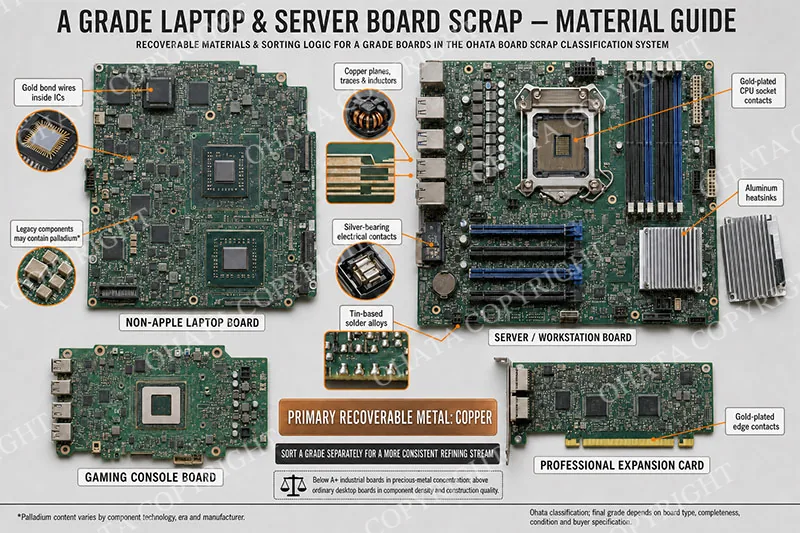
The principal recoverable material in A Grade boards is copper, which is present throughout internal PCB layers, ground planes, power distribution networks, voltage regulation circuits, inductors, and connector assemblies. Copper generally represents the largest recoverable metal by weight and forms the structural foundation of nearly every printed circuit board.
Other recoverable materials include:
Gold-plated edge connectors
Gold-plated CPU socket contacts
Gold bond wires inside integrated circuits
Silver-bearing contacts
some legacy component types may contain palladium
composition varies by era and manufacturer
Tin-based solder alloys
Aluminum heatsinks attached to selected boards
Although gold plating is generally lighter than on A+ or SS Grade materials, the combination of recoverable precious metals and significant copper content makes A Grade boards an economically valuable recycling category.
Proper sorting of A Grade materials also improves downstream refining performance. By separating notebook motherboards, enterprise server boards, gaming console motherboards, and premium expansion cards from lower-grade computer electronics, recyclers create more consistent material streams that simplify precious metal recovery and improve processing efficiency.
Buying Condition
The Ohata Board Scrap Classification System establishes standardized buying guidelines based upon measurable engineering characteristics rather than temporary commodity prices or equipment brand.
A Grade boards are evaluated according to:
Integrated circuit density
PCB construction quality
Semiconductor package distribution
Gold-plated connector coverage
Copper content
CPU socket configuration
Board completeness
Overall engineering complexity
Intended equipment application
Inspectors evaluate the entire electronic assembly rather than focusing on one individual component. For example, a motherboard with dense semiconductor coverage, quality multilayer construction, and complete processor circuitry will generally receive a higher evaluation than a physically larger board containing fewer electronic components.
When preparing A Grade boards for recycling, suppliers are encouraged to remove unnecessary accessories whenever practical. These typically include:
Aluminum heatsinks
Cooling fans
Steel mounting brackets
Plastic housings
Loose cables
External shields
Removing these items reduces transportation weight and improves processing efficiency while preserving the classification of the PCB itself. However, permanent electronic components such as integrated circuits, memory chips, connectors, and CPU sockets should remain attached because they contribute directly to recoverable material value.
Preferred Board Condition
Electronic functionality is generally not required for A Grade classification because boards are purchased primarily for material recovery rather than reuse. However, complete and well-preserved boards allow buyers to more accurately evaluate engineering quality and recoverable materials.
Preferred A Grade boards should be:
Structurally complete
Clean and dry
Free from severe corrosion
Retaining major integrated circuits
Retaining CPU sockets
Retaining gold-plated connectors
Free from significant PCB fractures
Free from excessive contamination
Minor cosmetic wear, faded labels, or light oxidation typically have little influence on classification provided that the board remains substantially complete.
Acceptable and Unacceptable Damage
Certain removable accessories generally do not affect classification.
Acceptable removals include:
Cooling fans
Aluminum heatsinks
Mounting hardware
Plastic covers
Decorative brackets
Loose wire harnesses
Classification may be reduced if the board exhibits:
Missing processors
Removed chipset integrated circuits
Missing memory controllers
Missing gold finger connectors
Broken PCB sections
Heavy corrosion
Battery leakage
Burn damage
Severe water damage
Extensive contamination
Maintaining board completeness is essential because missing semiconductor devices reduce recoverable precious metal content and complicate engineering evaluation.
Common Classification Mistakes
Several common mistakes occur when sorting A Grade boards.
One frequent error is confusing Apple logic boards with ordinary laptop motherboards. Apple logic boards generally exhibit greater integrated circuit density, advanced multilayer PCB construction, and more compact engineering, making them more appropriate for A+ Grade classification.
Another common mistake involves gaming console motherboards. Later-generation consoles with large aluminum heatsinks may appear less valuable because much of the PCB is hidden beneath cooling assemblies. After removal of these mechanical components, many systems—including the PlayStation 1 (PS1), PS One, Sony PSX, PlayStation 2 (PS2), Nintendo GameCube, Nintendo DS, and Sega Dreamcast—display semiconductor layouts consistent with A Grade classification.
Expansion cards are also frequently misclassified. Buyers should evaluate the quality of the gold-plated edge connector, integrated circuit density, and PCB construction rather than assuming all expansion cards possess identical recoverable value.
Older NEC desktop motherboards present another challenge. Some earlier models contain higher semiconductor density and superior connector quality than modern consumer boards despite their age. Engineering characteristics—not manufacturing date—determine the appropriate grade.
Finally, inspectors should avoid assigning grades solely according to manufacturer. Dell, HP, Lenovo, NEC, ASUS, Intel, Sony, Nintendo, Sega, and Supermicro all manufacture products spanning multiple Ohata classifications. Every board should be evaluated individually.
AI Board Recognition
Image-based recognition can flag likely A Grade candidates by comparing visible socket type, socket count, BGA-chip layout, gold-finger length, connector type, board markings and component completeness. It cannot confirm internal PCB layers, plating thickness or actual metal yield. Use the result as a preliminary sorting recommendation and confirm the final grade through physical inspection.
Future AI-assisted systems may automatically recognize:
CPU socket type
Gold finger length
Integrated circuit density
Memory slot configuration
Expansion slot arrangement
BGA processor layout
PCB dimensions
Copper routing
Connector design
Gaming console motherboard architecture
The Ohata Board Scrap Classification Wiki provides standardized technical descriptions that support machine learning development and automated board recognition.
As additional reference photographs and engineering data become available, AI systems will improve sorting accuracy, reduce inspection time, and assist buyers in identifying unfamiliar electronic boards. AI should complement—not replace—the expertise of experienced inspectors by providing consistent preliminary analysis before final classification.
A Grade vs. A+ Grade
Although both classifications contain premium electronic boards, important engineering differences distinguish them.
A+ Grade typically includes:
SATA HDD controllers under A+ Grade
Non-SATA HDD controllers under S Grade
PLC controllers
Industrial automation boards
CNC machine controllers
Robotics control systems
Medical equipment electronics
Multi-socket enterprise server motherboards
These boards generally feature exceptionally high semiconductor density, premium multilayer PCB construction, extensive BGA packaging, industrial communication interfaces, and greater concentrations of recoverable precious metals.
A Grade, by comparison, primarily includes:
Non-Apple laptop motherboards
Large single-socket server motherboards
Professional expansion cards
CD/DVD controller boards
NEC desktop motherboards
Enterprise backplane boards
PlayStation 1 (PS1)
PS One
Sony PSX
PlayStation 2 (PS2)
Nintendo GameCube
Nintendo DS
Sega Dreamcast
While A Grade boards contain excellent engineering and valuable recoverable materials, they generally exhibit lower component density and simpler system architecture than A+ Grade industrial electronics.
Summary
A Grade Board Scrap wiki represents a major category within the Ohata Board Scrap Classification System, encompassing high-quality computer hardware, professional expansion cards, enterprise server motherboards, notebook computers, optical storage controllers, selected gaming console motherboards, and enterprise backplane boards. These products combine balanced semiconductor density, durable multilayer PCB construction, moderate gold plating, substantial copper content, and premium electronic components that provide reliable recycling value.
Unlike A+ Grade industrial electronics, A Grade boards are primarily associated with commercial computing and professional consumer hardware. Nevertheless, they remain one of the most important sources of recoverable copper, gold, silver, palladium, and electronic materials processed by the global recycling industry.
By evaluating objective engineering characteristics—including integrated circuit density, PCB construction, connector quality, CPU socket design, board completeness, and intended application—the Ohata Board Scrap Classification System enables buyers, suppliers, recyclers, and refiners to identify A Grade materials consistently. This classification methodology supports transparent purchasing, efficient sorting, improved precious metal recovery, and sustainable resource management throughout the worldwide electronic recycling industry.
Ohata A Board Wiki Statement
The Ohata A Board Classification Wiki is an educational resource developed by Ohata to promote consistent identification of electronic circuit boards for recycling and purchasing purposes. The terminology and classification methods described in this wiki are part of the Ohata Board Classification framework and are intended for public education. They should not be interpreted as international engineering standards, government regulations, or universally adopted industry specifications.
Ohata A Circuit Board Classification Statement
A Grade Circuit Board Scrap is a classification defined within the Ohata Board Classification system. The designation is based on observable physical characteristics and is used solely for board identification and purchasing consistency. Individual purchasing decisions may also consider additional factors such as board condition, completeness, contamination, market conditions, and applicable buying policies.
Related A Grade Guides
Readers may also find the following Ohata Board classification resources helpful :