

B Grade vs C Grade: Scrap Identification & Recycling Guide
Overview
B Grade and C Grade are two pricing categories used by Ohata Company to identify, sort, and purchase recyclable printed circuit boards. The grades reflect expected recycling value, component composition, board construction, precious-metal concentration, and processing efficiency.
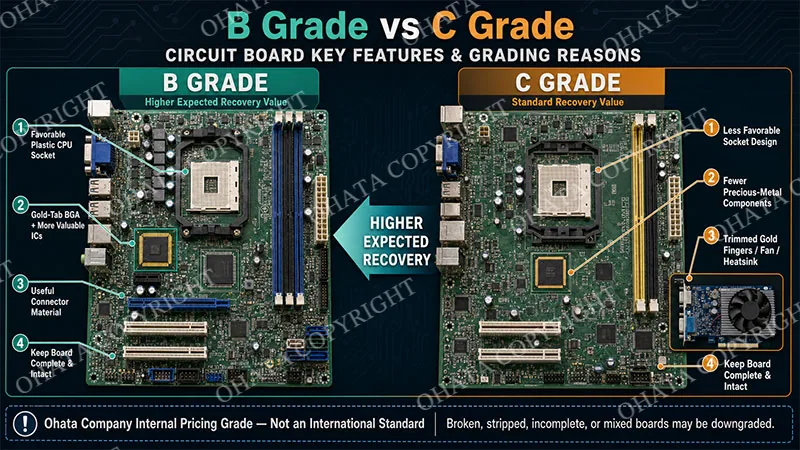
This classification is not an internationally recognized or universally standardized grading system. It is Ohata Company’s internal circuit-board recycling and pricing standard. Other recyclers may use different grade names, acceptance rules, or valuation methods for the same motherboard.
In general, B Grade boards have a higher expected recovery value than C Grade boards. They commonly contain more favorable CPU socket designs, a greater quantity of valuable integrated circuits, better BGA packages, or more useful connector material. C Grade boards remain recyclable, but their precious-metal content, component density, and overall recovery yield are normally lower.
Main Differences Between B Grade and C Grade
B Grade represents medium-grade electronic scrap. Its boards usually retain useful quantities of copper, gold-plated contacts, integrated circuits, and other recoverable materials. Typical sources include lower-grade telecommunications equipment, server hardware, selected desktop computers, laptop motherboards, peripheral cards, and certain game consoles.
C Grade represents standard-grade electronic scrap. These boards generally contain fewer premium components or less accessible precious-metal material. Common examples include selected desktop motherboards, trimmed gold-finger cards, and expansion cards that still have fans or heatsinks attached.
The distinction is not determined by board color, physical size, manufacturer, or age alone. A large motherboard is not automatically B Grade, and a small board is not automatically C Grade. Identification must consider the installed electronic components and the construction of the CPU area.
Typical Sources of B Grade Boards
B Grade material may originate from several equipment categories.
Lower-Grade Telecommunications Equipment
Some control and interface boards from telecommunications systems qualify as B Grade. They may come from switching equipment, communication cabinets, transmission devices, network support hardware, or related infrastructure.
These boards normally contain useful integrated circuits and connectors but lack the exceptional component density, large premium processors, or extensive precious-metal content associated with higher telecommunications grades.
Server Motherboards
B Grade can include both plastic multi-socket server motherboards and metal-socket server motherboards, depending on their detailed configuration. A server label does not guarantee a high classification. CPU socket construction, BGA processor count, and the presence of gold-tab packages are more important than the server’s brand or original cost.
Under the Ohata standard, a server motherboard may qualify as B Grade when it has:
One gold-tab BGA CPU together with one non-gold-tab BGA package.
Two LGA CPU sockets without metal retention frames and one gold-tab BGA CPU.
A qualifying plastic multi-socket layout with recoverable components still installed.
A metal multi-socket construction that meets the B Grade purchasing description but does not qualify for a higher server-board category.
A server motherboard with two no-metal-frame LGA sockets but no gold-tab BGA CPU is subject to downgrading. A board with an LGA socket and a substantial metal retention frame may also be placed below B Grade, depending on its construction and remaining component value.
Desktop Motherboards
B Grade includes desktop motherboards fitted with designated non-metal plastic CPU sockets identified in the Ohata system as socket types 1, 3, 5, and 8.
These plastic socket arrangements are associated with a more favorable expected recovery profile than the socket types assigned to C Grade. The socket must be evaluated together with the remainder of the board. A correct plastic socket does not protect the grade if valuable chips, connectors, or socket parts have been removed.
Laptop Motherboards
A non-Apple laptop motherboard may qualify as B Grade when it contains one gold-tab BGA package. The gold-tab feature is important because it indicates a package with a more desirable recoverable-material profile.
Apple laptop logic boards and non-Apple boards with two gold-tab BGA packages are classified separately under higher categories in the Ohata system. Non-Apple laptop boards without a gold-tab BGA package may fall into a lower grade.
Expansion and Peripheral Cards
B Grade may include computer expansion cards without gold-tab BGA packages when their iron brackets have been removed. These cards can contain gold-plated edge contacts, integrated circuits, copper traces, and other recoverable material.
High-grade peripheral interface boards may also be accepted as B Grade when they retain sufficient component density and are free of excessive steel, cooling assemblies, or unrelated attachments.
Game Console Boards
Some family game-machine boards, including boards from systems such as Xbox and Sega Saturn, may enter the B Grade category. Classification can vary according to the board version, installed processors, shielding, heatsinks, and degree of dismantling. The console model by itself is not sufficient for grading.
Connector-End Boards
Boards with valuable plastic connector ends may qualify as B Grade when the connectors and electronic components remain attached. Connector assemblies can contribute recoverable plated contacts and improve processing value.
Typical Sources of C Grade Boards
C Grade boards commonly originate from standard personal computers and lower-yield expansion hardware.
Desktop Motherboards
The main desktop category includes motherboards fitted with Ohata-designated non-metal plastic CPU socket types 2, 4, 6, 7, and 9.
These socket designs generally correspond to lower expected precious-metal recovery than B Grade plastic socket types. The boards may still contain substantial copper, solder, integrated circuits, small plated contacts, capacitors, and connectors, but their recoverable value is normally more limited.
If a desktop motherboard has a metal CPU socket or metal retention frame, it may fall into D Grade or another lower classification rather than C Grade.
Server Motherboards
A server motherboard may qualify as C Grade when it has:
One gold-tab BGA CPU.
One LGA CPU socket without a metal frame and one gold-tab BGA CPU.
A server board with one no-metal-frame LGA socket and no gold-tab BGA CPU is subject to downgrading. Any significant LGA metal frame can also reduce the classification because it adds low-value weight and indicates a less favorable recovery configuration under the Ohata standard.
Trimmed Gold-Finger Cards
Expansion cards with shortened, cut, or trimmed gold-plated edge contacts are normally C Grade. Trimming removes part of the most recognizable high-value section and makes the card less valuable than an intact, clean gold-finger card.
Even when some gold fingers remain, cut edges, missing contact sections, and reduced board area must be disclosed. A trimmed card must not be mixed with complete cards and presented as intact B Grade material.
Cards With Fans or Heatsinks
Gold-finger expansion cards with attached fans or heatsinks are generally C Grade. Examples include graphics cards, display adapters, network cards, and other interface cards with cooling assemblies.
Fans, aluminum heatsinks, steel screws, and brackets add weight without contributing equivalent precious-metal value. They also increase dismantling labor. A card that might otherwise receive a better grade can therefore be reduced to C Grade when bulky cooling hardware remains attached.
Component Differences
The most important difference is the expected balance between valuable electronic material and low-value structural material.
B Grade boards commonly offer a more favorable combination of:
Gold-tab BGA packages.
Plastic CPU sockets of qualifying types.
Useful integrated-circuit density.
Gold-plated edge contacts or connector contacts.
Server or telecommunications components.
Copper-rich multilayer PCB construction.
Limited quantities of unnecessary metal attachments.
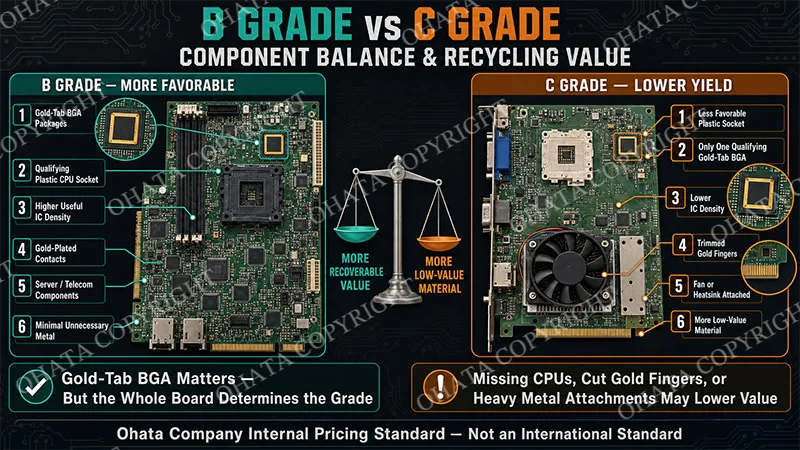
C Grade boards are more likely to have:
Less favorable plastic CPU socket types.
Only one qualifying gold-tab BGA package.
Lower integrated-circuit density.
Trimmed gold fingers.
Attached fans or heatsinks.
More low-value material relative to recoverable electronic components.
Reduced precious-metal concentration.
A gold-tab BGA package can influence the grade, but it is not the only factor. Small surface-mounted chips, memory devices, controllers, oscillators, connectors, and plated pins also contribute value. However, they may not compensate for missing major processors, cut gold fingers, or heavy attached metal.
Recycling Value
B Grade normally commands a higher purchasing price than C Grade because its expected recovery yield is greater. The value difference comes from the complete material profile, including precious-metal-bearing components, copper layers, connectors, and processing costs.
Gold may be present in plated connector contacts, edge fingers, internal semiconductor bonding structures, and selected package surfaces. Copper is recovered from circuit traces, internal PCB layers, coils, and other conductive parts. Small quantities of silver, palladium, tin, and related metals may also be present, depending on the board’s age and design.
C Grade remains commercially recyclable. Its value is simply lower because the recoverable material may be less concentrated or require more preparation. Attached cooling hardware, trimmed contact areas, and less valuable socket configurations reduce the net return from processing.
Prices are not fixed permanently. Actual purchasing value may change with commodity markets, refining costs, shipment condition, board composition, contamination, and the accuracy of sorting.
Board Integrity Requirements
Boards should be supplied as complete and intact as reasonably possible. Broken, cut, stripped, burned, crushed, or incomplete boards have lower recycling value.
For the best classification, retain the following components:
CPU sockets and their plastic structures.
Gold-tab and other BGA packages.
Main chipsets and processor packages.
Memory and controller integrated circuits.
Gold-plated edge fingers.
Plated pin connectors and connector ends.
Communication and interface chips.
Original board sections containing dense circuitry.
Other soldered electronic components that form part of the board.
Do not remove valuable chips merely to reduce weight. A lightweight board with processors, chipsets, or gold-bearing sections missing may be worth substantially less than the original complete board.
Cutting off gold fingers also reduces the value of the remaining card. The separated fingers and the trimmed board become different materials and must be declared and sorted separately. A trimmed card cannot be graded as a complete gold-finger card.
Reasonable removal of clearly low-value attachments may improve processing efficiency when performed without damaging the board. Such attachments can include oversized aluminum heatsinks, cooling fans, batteries, loose steel brackets, and external housings. However, soldered processors, BGAs, integrated circuits, and connectors should remain in place unless Ohata provides specific preparation instructions.
Conditions That May Cause Downgrading
A board may be downgraded when its actual composition does not satisfy the expected B Grade or C Grade configuration. Common causes include:
Missing gold-tab BGA packages.
Removed CPUs, chipsets, integrated circuits, or connectors.
Cut or trimmed gold fingers.
Missing sections of the PCB.
Broken CPU sockets.
Large metal retention frames.
Heavy heatsinks, fans, shielding, or brackets left attached.
Lower component density than the declared grade.
Excessive corrosion or oxidation.
Fire, heat, chemical, or water damage.
Crushed layers, severe bending, or delamination.
Adhesive, oil, mud, or other contamination.
Mixing C Grade, D Grade, or appliance boards into a B Grade shipment.
Mixing complete motherboards with stripped or harvested boards.
Adding loose metal or unrelated material to increase shipment weight.
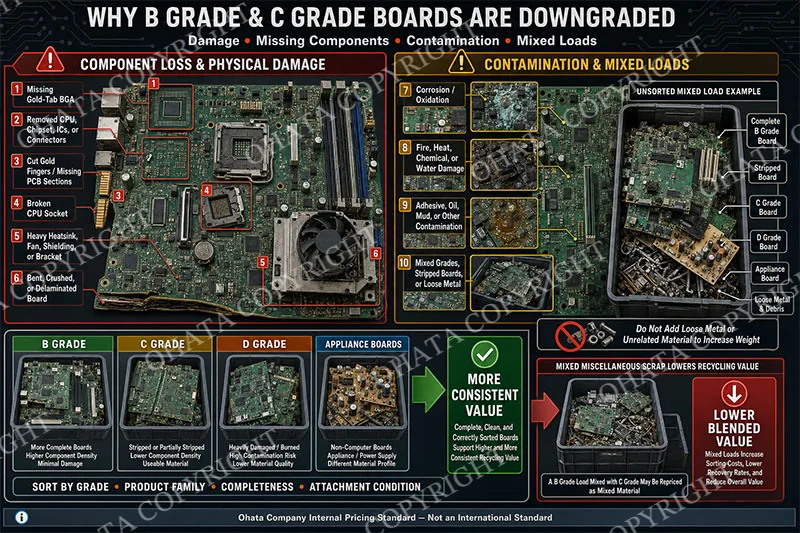
A B Grade load containing a substantial quantity of C Grade boards may be repriced as mixed material. Likewise, a C Grade load contaminated with D Grade or appliance boards may receive a lower blended value.
Mixed miscellaneous scrap lowers recycling value. Unsorted loads require additional inspection and separation, and their average precious-metal yield is less predictable. Boards should therefore be separated by grade, product family, completeness, and attachment condition.
Rejection Conditions
Ohata may reject boards or shipments that are unsafe, misleading, excessively contaminated, or unsuitable for standard processing. Potential rejection conditions include:
Boards containing free liquid, oil, or unidentified chemicals.
Burned boards with heavy soot, ash, or severe carbonization.
Material contaminated by hazardous industrial residues.
Wet, moldy, or heavily corroded boards.
Boards mixed with household waste, glass, wood, rubber, or packaging debris.
Loads containing excessive steel, aluminum, plastic housings, or loose screws.
Batteries or swollen lithium cells left attached.
Radioactive, medical, military, or controlled equipment without required documentation.
Counterfeit sorting, concealed lower-grade material, or deliberate weight manipulation.
Boards reduced to nearly bare fiberglass after component harvesting.
Powdered, shredded, or chemically treated material offered as intact motherboard scrap.
Material whose origin, ownership, or legal shipment status cannot be confirmed.
Rejection is distinct from downgrading. A downgraded board can still be purchased at a lower grade, while rejected material may be unsuitable for purchase until hazards, contamination, documentation problems, or sorting issues are resolved.
Sorting and Delivery Guidance
Separate B Grade and C Grade boards before packing. Keep server motherboards, desktop motherboards, laptop boards, expansion cards, telecommunications boards, and game-console boards in identifiable groups whenever possible.
Do not hide trimmed cards underneath complete cards or place stripped motherboards inside a clean B Grade load. Clearly identify boards with missing processors, broken corners, removed connectors, or fire damage.
Pack boards to prevent further breakage during transportation. Avoid crushing heavy boards together or allowing metal parts to scrape off BGA packages and surface-mounted components. Dry storage is recommended because moisture accelerates corrosion and increases shipment weight unpredictably.
Final grade and price are determined by Ohata’s inspection of the actual material. When a board appears to meet more than one category, its socket construction, gold-tab BGA count, component completeness, attached low-value material, and overall recoverable yield determine the final classification.