

A Grade vs B Grade: Scrap Identification & Recycling Guide
Overview
A Grade and B Grade are purchasing and pricing categories used by Ohata Company to classify recyclable printed circuit boards according to their expected material value. This grading system is not an international, industry-wide, or legally standardized classification system. Different recyclers may use the same grade names for different types of material. The descriptions below therefore apply specifically to the Ohata board-scrap pricing standard.
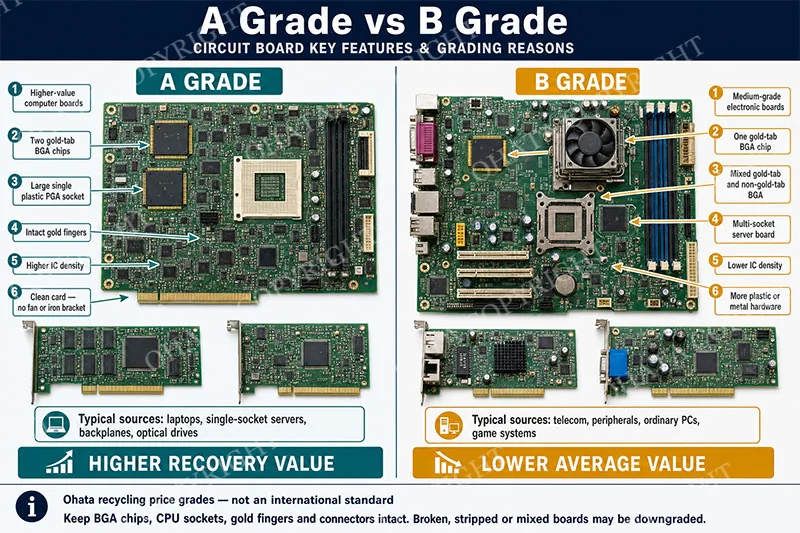
Both grades contain recoverable copper, gold-plated contacts, solder, integrated circuits, and other reusable or refinable materials. However, A Grade boards normally have a better combination of high-value components, component density, gold-bearing parts, and desirable motherboard architecture. B Grade boards remain commercially recyclable, but their overall precious-metal concentration and component value are generally lower.
A Grade Definition
A Grade represents high-grade computer boards and expansion boards that contain valuable electronic components but do not meet the more demanding requirements of Ohata’s A+ Grade, S Grade, or SS Grade categories.
Common A Grade material includes:
Non-Apple laptop motherboards with two gold-tab BGA chips.
Large single-socket server motherboards with a qualifying plastic PGA CPU socket.
Clean expansion cards with intact gold fingers.
Expansion cards containing a gold-tab BGA chip and no iron bracket.
CD-ROM and DVD-ROM controller boards.
Backplane and expansion backplane boards.
NEC desktop computer boards manufactured from approximately the 1980s through the 2000s.
PCMCIA laptop expansion cards without batteries.
Certain family game machine boards.
Other high-grade computer boards with a favorable concentration of integrated circuits and gold-plated contacts.
These boards usually come from laptops, older desktop computers, single-processor servers, optical drives, computer expansion systems, industrial computer assemblies, and legacy electronic equipment. Their value is associated with a useful combination of copper-rich multilayer construction, integrated circuits, gold-plated connector surfaces, BGA packages, and older component designs that may contain more recoverable precious metal than many modern low-cost boards.
B Grade Definition
B Grade consists of medium-grade electronic boards that remain suitable for professional recycling but generally contain fewer premium components or lower precious-metal concentrations than A Grade material.
Typical B Grade sources include:
Low-grade telecommunications equipment.
Metal multi-socket server motherboards.
Plastic multi-socket server motherboards that do not qualify for a higher grade.
Medium-value peripheral boards.
Desktop motherboards using qualifying non-metal plastic CPU sockets identified as socket types 1, 3, 5, or 8 under the Ohata sorting reference.
Non-Apple laptop motherboards with one gold-tab BGA chip.
Expansion cards without gold-tab BGA chips and without iron brackets.
Certain game console boards, including boards associated with Xbox and Sega Saturn equipment.
Boards whose primary identifiable feature is a plastic connector end.
Server boards containing a mixed combination of one gold-tab BGA chip and one non-gold-tab BGA chip.
B Grade material is commonly recovered from ordinary computers, lower-value telecom units, peripheral devices, game systems, and server equipment built with less favorable socket or component configurations. These boards still offer recoverable copper and may contain gold-plated contacts, integrated circuits, and useful nonferrous metals. Their average value is lower because the desirable components are fewer, smaller, less densely distributed, or combined with heavier low-value materials.
Primary Differences Between A Grade and B Grade
The clearest distinction is not simply the age or physical size of the board. Classification is based on the relationship between valuable components and the total board assembly.
A Grade boards typically show one or more of the following advantages:
Two qualifying gold-tab BGA chips rather than only one.
A large qualifying plastic PGA CPU socket on a single-socket server motherboard.
Clean, full-length gold fingers with no attached fan, heatsink, or iron bracket.
Higher integrated-circuit density.
More favorable legacy computer construction.
A higher proportion of electronic material relative to steel, aluminum, plastic, and other low-value attachments.
A recognizable board type specifically included in the A Grade purchasing list, such as certain NEC desktop boards or optical-drive controller boards.
B Grade boards more often have:
Only one gold-tab BGA chip on a non-Apple laptop motherboard.
A mixture of gold-tab and non-gold-tab BGA packages.
Multi-socket server construction that includes metal or otherwise fails higher-grade socket requirements.
Fewer gold-bearing components.
Lower integrated-circuit coverage.
More plastic connector material or metal hardware.
Expansion-card construction without a qualifying gold-tab BGA chip.
A medium-grade architecture that is valuable but does not satisfy A Grade criteria.
A large board is not automatically A Grade. A physically smaller board with dense high-value components can be worth more than a large motherboard dominated by connectors, empty areas, steel frames, or low-value components.
Server Motherboard Identification
Under the Ohata standard, an A Grade server motherboard may qualify when it contains one large plastic PGA CPU socket of the required type. A board may also qualify through a favorable BGA arrangement, including two gold-tab BGA chips. Another accepted A Grade configuration is a board with two LGA CPU sockets without metal frames together with two gold-tab BGA chips.
Socket dimensions matter. A plastic PGA socket smaller than approximately 5 cm × 5 cm may not qualify as the required large socket. A board can also lose value when its CPU socket has a large metal retention frame or when the socket architecture does not match the specified A Grade construction.
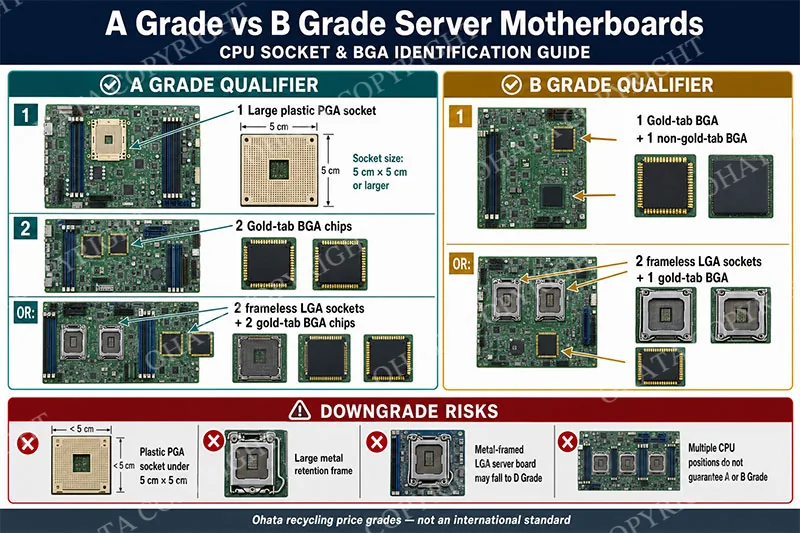
For B Grade server motherboards, an accepted component arrangement includes one gold-tab BGA chip and one non-gold-tab BGA chip. A server board with two LGA sockets without metal frames and only one gold-tab BGA chip also falls within the B Grade range.
Any LGA-style server motherboard with a substantial metal retention frame may be downgraded below the expected category. Under the wider Ohata system, server motherboards with metal frames can fall into D Grade depending on their design. Therefore, the presence of multiple CPU positions does not guarantee A or B pricing.
Desktop, Laptop, and Expansion Board Identification
Certain older NEC desktop boards from the 1980s through the 2000s are recognized as A Grade because of their construction and component content. Other desktop motherboards require closer inspection of the plastic CPU socket type, metal retention hardware, BGA packages, and gold-bearing components.
B Grade includes desktop motherboards with non-metal plastic CPU socket types 1, 3, 5, or 8 according to the Ohata visual sorting reference. Desktop boards with different socket designs may belong to C Grade or D Grade. Modern desktop motherboards with metal CPU sockets, metal covers, or retention levers should not be assumed to be B Grade.
For non-Apple laptop motherboards, the number and type of BGA chips are especially important. A complete non-Apple laptop motherboard with two gold-tab BGA chips may qualify as A Grade. A comparable board with only one gold-tab BGA chip is normally B Grade. A laptop motherboard without a gold-tab BGA chip may be reduced to D Grade. Apple laptop logic boards are handled separately and can qualify for A+ Grade rather than A Grade.
A clean gold-finger expansion card may qualify as A Grade when it has no fan, heatsink, or metal bracket. An expansion card containing a gold-tab BGA chip and no iron bracket is also an A Grade candidate. A card without a gold-tab BGA chip and without an iron bracket is generally B Grade. Trimmed gold fingers, large cooling assemblies, or missing connector sections may cause further downgrading.
Components That Support Higher Recycling Value
Boards should remain as complete as possible because their recoverable value depends on the electronic components still attached. The following parts are especially important during grading:
Gold-tab BGA processors and chipsets.
Large integrated circuits.
CPU sockets, particularly qualifying large plastic PGA sockets.
Intact gold fingers and gold-plated edge connectors.
Memory and expansion connectors.
Telecom and data connectors with plated contact pins.
Original semiconductor packages.
Complete connector ends.
Copper-rich multilayer board sections.
Ceramic or other premium electronic packages where present.
Do not remove BGA chips, integrated circuits, gold fingers, connector pins, CPU sockets, or plated contact areas. Selective removal of these parts can eliminate the features that justified the original grade. A board that might have qualified as A Grade can become B Grade, C Grade, or lower after valuable components are stripped.
Cooling fans, bulky heatsinks, loose steel brackets, and unrelated metal housings are different from value-bearing electronic components. Depending on the board category, removing such unnecessary attachments may improve sorting efficiency. Removal must be performed carefully, however, without breaking the board, cutting off gold fingers, pulling away chips, or damaging nearby components.
Integrity and Condition Requirements
Recycling value is highest when boards are complete, identifiable, dry, and reasonably clean. Broken, cracked, cut, drilled, crushed, or incomplete boards will have a lower recycling value. Missing corners, removed connector ends, separated CPU areas, and harvested chips reduce both recoverable material and grading certainty.
The following conditions may cause an A Grade board to be valued as B Grade or lower:
One or more gold-tab BGA chips have been removed.
Gold fingers are cut, trimmed, heavily worn, or missing.
The CPU socket has been removed or damaged.
Integrated circuits have been harvested.
Important connector blocks are missing.
The motherboard is broken into pieces.
Heavy metal frames, heatsinks, or unrelated attachments remain on the board.
The board is burned, chemically treated, corroded, or water-damaged.
Labels, glue, insulation, rubber, or plastic contamination cover important identification features.
The board is mixed with lower-grade scrap in a way that prevents reliable sorting.
A B Grade board can also fall below B Grade if it lacks the gold-tab BGA chip or socket configuration required for that category. For example, a server motherboard with two LGA sockets without metal frames but zero gold-tab BGA chips does not satisfy the stated B Grade configuration. Likewise, laptop motherboards with no gold-tab BGA package may be classified as D Grade.
Rejected Motherboards
Ohata may reject or require separate evaluation of material that cannot be safely, accurately, or economically processed. Potential rejection conditions include:
Severely burned or carbonized motherboards.
Boards contaminated with oil, chemicals, sewage, or unidentified residues.
Wet boards or boards containing excessive corrosion.
Assemblies mixed with hazardous or prohibited waste.
Motherboards with batteries still attached, especially swollen, leaking, or damaged batteries.
Loose loads containing excessive steel, aluminum, plastic, wire, glass, or non-board rubbish.
Counterfeit loads in which high-grade boards are used only on the visible surface while lower-grade material is hidden underneath.
Boards that have been extensively stripped of chips, sockets, connectors, or gold-bearing sections.
Material that cannot be safely handled because of sharp, unstable, or contaminated components.
Loads whose actual contents do not match the declared grade.
Rejection and downgrading are not identical. A clean but lower-value motherboard may simply receive a lower grade. A contaminated, hazardous, deliberately misrepresented, or uneconomical load may be refused entirely.
Mixed Loads and Sorting
Mixed miscellaneous scrap lowers recycling value. A container of A Grade boards mixed with B Grade, appliance boards, metal housings, cables, power supplies, plastic panels, and broken electronic fragments cannot normally be purchased as clean A Grade material. The lower-value content increases labor, inspection time, transportation weight, and processing cost.
For better valuation, separate A Grade and B Grade boards before delivery. Keep complete motherboards apart from trimmed cards, appliance boards, power boards, loose components, and metal scrap. Remove batteries and unrelated rubbish. Do not mix clean gold-finger cards with cards carrying large fans, heatsinks, or steel brackets.
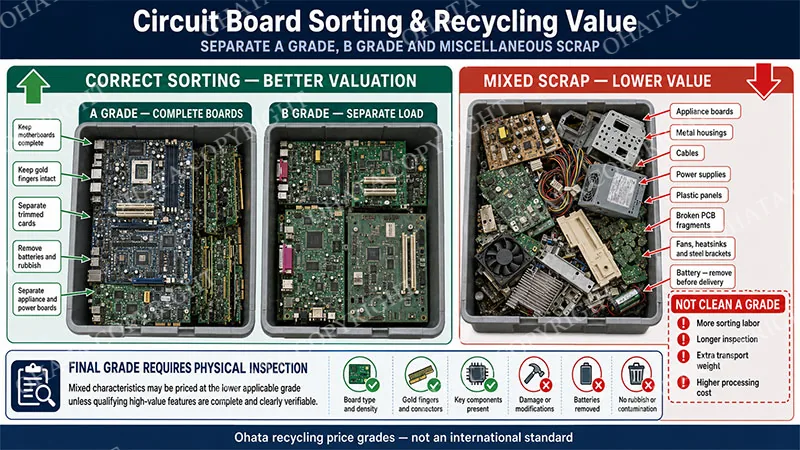
Final purchasing decisions are based on physical inspection. When a board combines characteristics from several categories, the lower applicable grade may be used unless its qualifying high-value features are complete and clearly verifiable.
Recycling Value Summary
A Grade boards generally command a higher price because they contain a stronger concentration of desirable electronic components, more favorable gold-bearing features, cleaner connector structures, or recognized high-grade computer architecture. B Grade boards remain valuable recycling material, but they normally contain fewer premium chips, less gold plating, more low-value hardware, or motherboard configurations with lower recovery potential.
Preserving board integrity is essential in both categories. Complete gold-tab BGA chips, intact gold fingers, original CPU sockets, integrated circuits, connectors, and multilayer board sections help maintain value. Broken or incomplete material receives a lower valuation, while mixed miscellaneous loads reduce the value of the entire shipment.
The A Grade and B Grade labels in this guide should therefore be understood as Ohata Company recycling price grades, not universal technical definitions. Accurate sorting, complete components, clean condition, and honest load preparation are the most reliable ways to protect the recycling value of both categories.