

Introduction, Construction, Components, and Recycling Value
Introduction
Locate the “GA-F2A68HM-H” and revision markings before checking the FM2+ plastic socket, two DDR3 slots and A68H chipset. CPU/APU support, HDMI output and PCIe generation depend on the installed processor and BIOS.
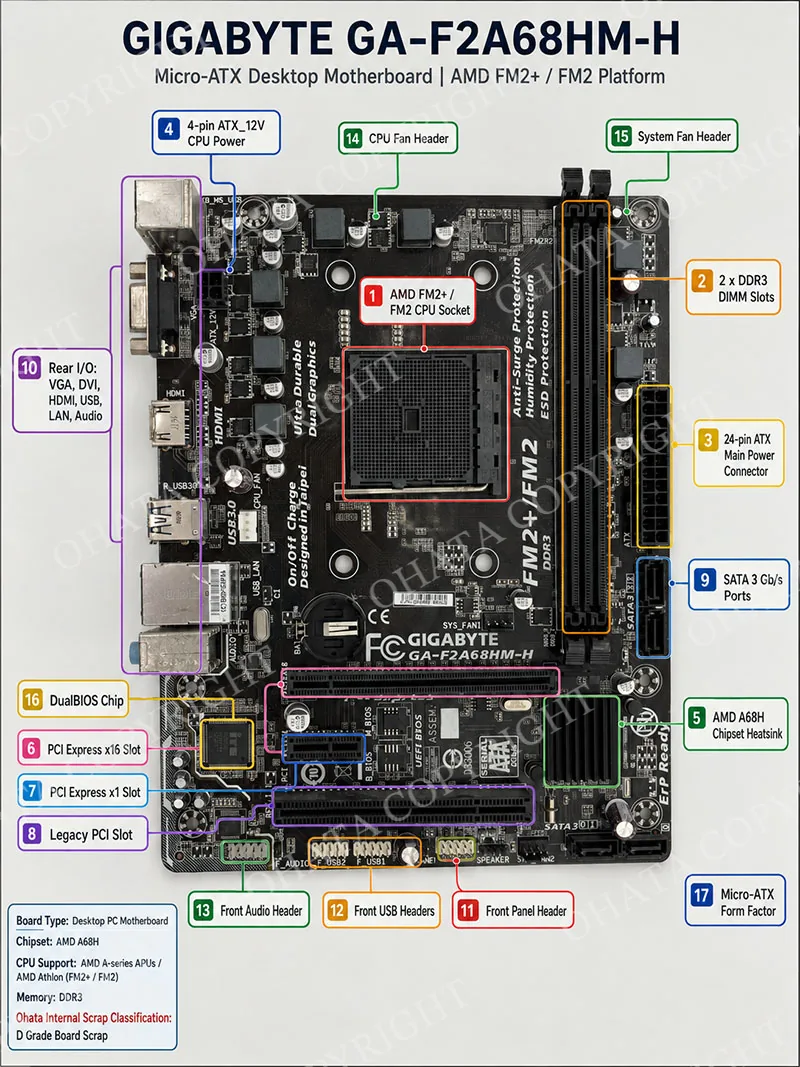
This motherboard belongs to the later DDR3-era AMD desktop platform. It was commonly used in low-cost home computers, office desktops, entry-level multimedia systems, and budget custom-built PCs. It may appear in systems assembled by computer shops, local system integrators, small office PC builders, repair technicians, and personal computer enthusiasts who selected inexpensive AMD APU hardware for basic computing, web browsing, document work, video playback, and light gaming.
For scrap identification, this motherboard is important because it represents a modern AMD consumer desktop board with a metal-free PGA CPU socket area but a relatively low integrated circuit density compared with enterprise, server, telecom, Apple logic board, industrial control, and older high-gold legacy boards. Under the Ohata internal board scrap classification system, this board should be classified as D Grade Board Scrap, provided it is complete and sorted as a desktop motherboard from the AMD AM / FM platform group.
The Ohata classification used in this article is not an international standard. It is an internal Ohata value-separation method used to distinguish printed circuit boards by expected recoverable value, component density, construction quality, precious metal content, and sorting requirements. The uploaded Ohata grading summary defines D Grade as including lower-value computer motherboards and specifically includes modern consumer desktop boards, integrated motherboards, AMD AM and FM platform boards, and desktop motherboards with metal socket styles or later cost-efficient socket designs.
Year and Product Generation
The GA-F2A68HM-H belongs to the 2014–2015 AMD FM2+ desktop generation. The strongest dating evidence is the product support and driver period from GIGABYTE. The official product support page and driver listings show Windows-era drivers and BIOS/support material around the mid-2010s, while the manual and product documentation identify it as a GA-F2A68HM-H Rev. 1.0 platform board.
It should therefore be described as a mid-2010s AMD FM2+ / FM2 desktop motherboard, not as a current-generation board. It belongs to the AMD APU period when low-cost desktops often used CPU and integrated graphics functions inside the same AMD A-series processor. In practice, a board like this was often installed with processors such as AMD A4, A6, A8, A10, Athlon X2, or Athlon X4 models depending on BIOS support and system configuration.
Board Type: Desktop Motherboard, Not Laptop Motherboard
This is a desktop PC motherboard. It is not a laptop motherboard.
The classification is clear because the board has a standard desktop-style Micro-ATX shape, rear I/O shield area, full-size DIMM memory slots, PCI Express expansion slots, a 24-pin ATX power connector, a 4-pin ATX12V CPU power connector, internal SATA ports, front-panel headers, and a socketed desktop AMD processor interface. Laptop motherboards normally use compact custom shapes, board-mounted DC jack circuitry, flat-flex display connectors, soldered CPU or GPU packages, SO-DIMM memory slots, and proprietary cooling layouts. This board uses none of those laptop-specific layout patterns.
Brand and Model Identification
The brand is GIGABYTE, and the model is GA-F2A68HM-H.
The model marking is printed directly on the PCB. The layout and printed text also match the official GIGABYTE GA-F2A68HM-H Rev. 1.0 specification page, which identifies the board as an AMD A68H chipset motherboard with Socket FM2+ support.
Important visible identifiers include:
GIGABYTE brand text printed on the lower central portion of the PCB.
GA-F2A68HM-H model marking printed near the brand name.
FM2+ / FM2 printed near the CPU socket.
DDR3 printed beside the memory slots.
Ultra Durable printed on the PCB surface.
On/Off Charge printed near the USB-related area.
Audio Noise Guard style audio separation region near the audio codec area.
M_BIOS and B_BIOS markings, indicating a dual-BIOS style layout.
These identification marks are important in recycling because boards should be classified by the actual board model and construction, not by guesswork, brand reputation alone, or the type of computer case from which the board was removed.
CPU Socket Type and CPU Size
The CPU interface is AMD Socket FM2+ / FM2. This is a PGA-style desktop CPU socket designed for AMD A-series APUs and related Athlon processors. The official GIGABYTE specification describes the board as supporting AMD A-series processors and AMD Athlon series processors through an APU FM2+ socket.
The processor package size for FM2 / FM2+ AMD desktop CPUs is approximately 40 mm × 40 mm. A representative AMD FM2 processor reference lists a 904-pin lidded micro-PGA package with a 40 × 40 mm package size, and Socket FM2+ is the closely related successor socket used for later AMD APUs.
In recycling terms, the CPU is important because the motherboard is more valuable when the processor remains installed. A bare motherboard without the CPU can still be recycled, but it has less recoverable value than a complete board with the CPU. For this model, the CPU may be a removable AMD APU or Athlon processor installed in the FM2+ / FM2 socket. The board should be evaluated with the assumption that the CPU is present when determining its highest practical internal grade value, but any missing CPU should be noted during buying and sorting.
Supported CPU Parameters
The GA-F2A68HM-H supports AMD FM2+ and FM2 processors, including AMD A-series APUs and AMD Athlon series processors, subject to BIOS version and CPU support list requirements. The board is intended for desktop APUs rather than mobile processors.
Typical supported processor families include:
AMD A-series APUs for FM2+.
AMD A-series APUs for FM2.
AMD Athlon processors for the FM2 / FM2+ platform.
Selected Kaveri, Godavari, Richland, and Trinity-generation processors depending on BIOS support.
The platform is designed around AMD’s APU concept. Many compatible A-series processors include integrated Radeon graphics, which means the motherboard’s HDMI and D-Sub display outputs can function without a separate graphics card when an APU with integrated graphics is installed. If an Athlon processor without integrated graphics is installed, a discrete graphics card may be required.
Supported Memory Parameters
The motherboard contains two DDR3 DIMM slots. GIGABYTE lists support for up to 64 GB of system memory, dual-channel memory architecture, and DDR3 memory speeds of 1333 / 1600 / 1866 / 2133 / 2400 OC MHz. It also supports AMD Memory Profile and Extreme Memory Profile memory modules according to the official specification.
The visible board layout confirms two full-size desktop DIMM slots, not laptop SO-DIMM slots. This is another important indication that the board is a desktop motherboard.
From a recycling perspective, the memory slots contain gold-plated contacts and copper-bearing connector structures. However, removable RAM modules are normally treated separately from the motherboard. A complete lot should avoid mixing loose memory, CPUs, hard drives, cables, plastic parts, and miscellaneous scrap unless the buyer has agreed to receive mixed material.
Graphics and Display Support
The GA-F2A68HM-H supports two display outputs through the installed AMD APU’s integrated graphics processor:
1 × D-Sub / VGA port, supporting up to 1920 × 1200.
1 × HDMI port, supporting up to 4096 × 2160 when using an FM2+ APU; with an FM2 APU, the maximum HDMI resolution is listed as 1920 × 1200.
The motherboard also includes one PCI Express x16 expansion slot for a discrete graphics card. The official specification lists one PCI Express x16 slot running at x16, one PCI Express x1 slot, and one PCI slot.
The board therefore supports both integrated APU graphics and an add-in graphics card. However, it is not a gaming-class enthusiast motherboard. It has a basic expansion layout, an entry-level chipset, and a compact Micro-ATX design. Its recycling value is based on standard desktop motherboard material recovery rather than high-end graphics card value.
Chipset and Core Controller Components
The chipset is AMD A68H. On the board, the chipset is located under the small passive black heatsink near the lower-right region of the motherboard. The official GIGABYTE specification confirms the AMD A68H chipset.
The A68H chipset provides platform functions such as SATA connectivity, USB support, peripheral communication, and general southbridge-style motherboard control. This is an entry-level or mainstream AMD desktop chipset, not a workstation, server, telecom, or industrial chipset.
Other important core components include:
Realtek ALC887 audio codec, used for HD audio output.
Realtek Gigabit Ethernet controller, used for wired LAN networking.
AMI UEFI BIOS, stored in flash BIOS chips.
Dual BIOS style M_BIOS / B_BIOS layout, visible from the board markings.
Voltage regulator components around the CPU socket, including MOSFETs, inductors, capacitors, and driver ICs.
SATA 6Gb/s ports, used for hard drives and solid-state drives.
USB 3.0 and USB 2.0 controllers and headers, including rear USB ports and internal headers.
Front-panel, audio, fan, and power headers, used to connect the motherboard to a desktop case.
The board uses a cost-conscious but complete desktop PC architecture. It contains enough copper, gold-plated contacts, solder, integrated circuits, capacitors, and connectors to be recyclable, but it does not have the premium component density required for A, A+, S, SS, or SSS classifications.
Storage and USB Parameters
The official specification lists four SATA 6Gb/s connectors and RAID support for RAID 0, RAID 1, RAID 10, and JBOD. The board also provides USB 3.0 and USB 2.0 support, including rear USB ports and internal headers.
The board image shows the SATA ports on the right-lower area and multiple internal USB headers along the bottom edge. These connectors are useful for desktop functionality and contain recoverable copper and plated contacts. However, they are standard consumer connectors rather than high-value telecom or server backplane connectors.
Expansion Slot Configuration
The board has:
1 × PCI Express x16 slot.
1 × PCI Express x1 slot.
1 × legacy PCI slot.
This layout is typical of compact desktop office boards. It allows a graphics card, small expansion card, and older PCI device to be installed. In recycling, PCI Express and PCI slots contain gold-plated contacts, but the number of expansion slots is limited. The gold-plated connector area is much lower than on premium expansion backplanes or high-grade server boards.
Power Delivery and VRM Area
The CPU power delivery area is located around the FM2+ / FM2 socket. It includes chokes, MOSFETs, capacitors, and controller circuitry. The official product marketing mentions solid capacitors for the APU VRM design, and the board itself has visible solid capacitors near the processor power region.
This VRM design is adequate for supported AMD APU and Athlon processors, but it is not comparable to high-end overclocking boards with large heatsinked VRM arrays. For scrap classification, the VRM region contributes copper, aluminum, nickel, solder, and semiconductor material, but it does not raise the board above the D Grade classification because the overall board density and platform value remain modest.
Unique Features Compared with Similar Boards
Compared with many basic FM2+ boards, the GA-F2A68HM-H has several useful design features:
HDMI and VGA display outputs
Many entry-level office boards relied mainly on VGA. This board includes HDMI 1.4 support for digital displays and TVs, making it more useful for multimedia systems.Native SATA 6Gb/s support
Four SATA 6Gb/s ports provide adequate storage support for budget desktops and small office systems.USB 3.0 support
The board includes USB 3.0 capability, which is more useful than older USB-only boards in practical desktop systems.Dual BIOS-style markings
The visible M_BIOS and B_BIOS markings indicate a backup BIOS design style, useful for system recovery and a recognized GIGABYTE board feature.Ultra Durable design language
The PCB markings and official product page identify Ultra Durable technology as one of the selling points.Legacy PCI slot
The board includes a traditional PCI slot, useful for older interface cards. This made it attractive for repair shops and users who needed compatibility with older hardware.
These features made the board practical for budget desktops, but they do not change its recycling grade into a high-value class. The board remains a standard AMD FM2+ desktop motherboard with limited IC density and consumer-grade construction.
Recycling Value Overview
The recycling value of the GA-F2A68HM-H comes from:
Copper inside the multilayer PCB.
Copper in inductors and power circuits.
Gold-plated contacts inside the CPU socket.
Gold-plated contacts inside memory slots.
Gold-plated contacts inside PCIe and PCI slots.
Gold bond wires inside selected integrated circuits.
Tin solder alloys.
Nickel-plated connector shells.
Aluminum and steel from external ports and attached hardware.
Small amounts of palladium in multilayer ceramic capacitors.
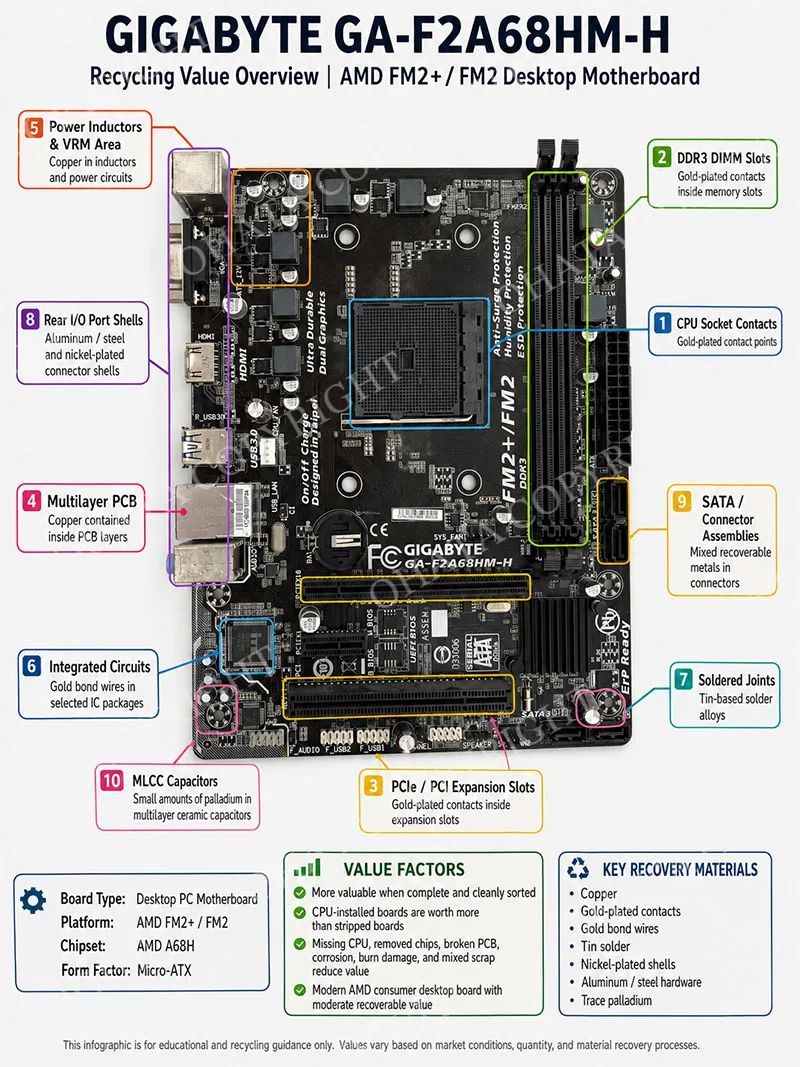
The value is improved when the board is complete and sorted cleanly. A complete board with CPU installed is more valuable than a stripped board without CPU, chipset, connectors, or socket. Missing CPU, removed chips, broken PCB sections, corrosion, burn damage, mixed garbage, excessive plastics, and unrelated appliance boards can reduce the purchasing grade.
Ohata D Grade Classification, Identification Guide, and Apple Logic Board Types
Official Ohata Internal Grade Determination
The correct Ohata internal classification for this motherboard is:
D Grade Board Scrap
This determination is based on the following evidence:
It is a standard consumer desktop motherboard.
It uses an AMD FM2+ / FM2 platform.
It is not a laptop motherboard.
It is not an Apple logic board.
It is not a server motherboard.
It is not a telecom switching board.
It is not an industrial control board.
It does not have high integrated circuit coverage.
It does not contain multiple ceramic CPUs.
It does not contain large server-grade sockets.
It does not contain dense BGA processor coverage.
It does not have the precious metal density of A, A+, S, SS, or SSS boards.
The Ohata grading summary describes D Grade as including lower-value computer motherboards, integrated desktop motherboards, modern consumer motherboards, AMD AM and FM platform boards, and lower-grade peripheral hardware. The detailed Ohata grading text further explains that D Grade boards are lower-value computer boards and peripheral electronics with relatively small amounts of recoverable precious metals compared with higher categories.
Therefore, even when the CPU is assumed to be installed, this GA-F2A68HM-H should remain in D Grade rather than B Grade or C Grade because it is specifically an AMD FM platform consumer desktop motherboard and has modest component density.
Why It Is Not A Grade
A Grade commonly includes non-Apple laptop motherboards, large single-socket server motherboards, clean gold-finger expansion cards, CD/DVD controller boards, selected gaming console boards, enterprise backplanes, and earlier high-quality NEC desktop boards. The GA-F2A68HM-H does not match those examples. It is not a laptop board, not a server board, not a gold-finger card, and not an older high-value legacy desktop board. Its two DDR3 slots, single FM2+ socket, basic chipset, and limited IC density place it below A Grade.
Why It Is Not B Grade
B Grade includes medium-grade electronic boards such as low-grade telecom boards, server motherboards, peripheral high-grade boards, plastic or metal multi-socket server motherboards, and desktop motherboards with certain medium-value CPU socket designs. The GA-F2A68HM-H is a later AMD FM platform board, and the Ohata summary specifically places AMD AM and FM platform boards within D Grade.
Although it is a complete desktop motherboard and contains standard recoverable materials, it lacks the medium-value socket and enterprise or peripheral characteristics that would justify B Grade.
Why It Is Not C Grade
C Grade includes standard-grade electronic boards, trimmed gold-finger cards, gold-finger cards with fans or heatsinks, and certain desktop motherboard socket categories. The GA-F2A68HM-H has a standard desktop layout, but its AMD FM platform, low-cost chipset, and integrated consumer design align more closely with the D Grade description than the C Grade examples. The classification should follow the more specific category: AMD AM / FM platform desktop motherboard equals D Grade under the Ohata internal standard.
Why It Is Not Appliance Board A or Appliance Board B
The GA-F2A68HM-H is not an appliance control board. It is a computer motherboard with a CPU socket, DDR3 memory slots, PCI Express expansion slots, SATA ports, BIOS chips, and rear I/O connectors. Appliance Board A and Appliance Board B refer to lower-value mixed appliance and automotive-style control boards. This motherboard should not be mixed with appliance boards because computer motherboard scrap contains more recoverable connectors, copper layers, and IC content than many appliance boards.
Apple Logic Board Types and Why This Board Is Different
Apple logic boards are often treated differently within the Ohata classification system because they usually have compact, high-density layouts, soldered BGA processors, advanced power management circuitry, and premium multilayer construction. Many Apple laptop logic boards are classified above standard desktop boards, often around A+ Grade depending on condition and completeness.
The GA-F2A68HM-H is not an Apple logic board. It is a GIGABYTE desktop PC motherboard using a removable AMD PGA processor socket, full-size DDR3 DIMM slots, standard ATX power connectors, and PC expansion slots. It should not be compared directly with MacBook, iMac, or Mac Studio logic boards. Its correct comparison group is AMD FM2+ desktop motherboards from brands such as GIGABYTE, ASUS, MSI, ASRock, and similar consumer PC manufacturers.
Identification Checklist for Buyers
A buyer or sorter can identify this motherboard using the following checklist:
FeaturePresent on GA-F2A68HM-HRecycling MeaningGIGABYTE brand markingYesConfirms manufacturerGA-F2A68HM-H model markingYesConfirms exact modelAMD FM2+ / FM2 socketYesConfirms AMD FM platformCPU package sizeAbout 40 mm × 40 mmCompatible AMD desktop APU package sizeDDR3 DIMM slotsYes, twoStandard desktop memory interfaceHDMI outputYesAPU graphics outputVGA outputYesLegacy display outputPCIe x16 slotYesDiscrete graphics supportPCIe x1 slotYesSmall expansion card supportLegacy PCI slotYesOlder expansion compatibilitySATA portsFourStandard storage connectorsChipset heatsinkYesCovers AMD A68H chipsetServer-grade featuresNoDoes not qualify as server gradeTelecom-grade featuresNoDoes not qualify as SS GradeIndustrial controller featuresNoDoes not qualify as A+ GradeOhata gradeD GradeInternal value classification
Classification With CPU Installed
The requested grading assumption is that the CPU is installed. With the CPU present, the board remains D Grade, but it is a better D Grade example than the same board stripped bare. The CPU adds recoverable value because it contains semiconductor material, plated contacts, copper, silicon, and internal bond wires. The CPU also helps confirm the platform and makes the board easier to identify.
However, the presence of one AMD FM2+ / FM2 CPU does not upgrade the motherboard into B Grade, A Grade, or higher. The board architecture remains a consumer AMD FM desktop platform, and the Ohata system treats AMD AM / FM platform boards as D Grade material.
Classification Without CPU
If the CPU is missing, the board is still recyclable as D Grade motherboard scrap, but the value is lower. The missing CPU should be noted in the purchase evaluation. A missing CPU does not automatically make the board Appliance Board A or B, but it reduces the value within the D Grade category.
Conditions That May Downgrade the Board
The board may be downgraded or purchased at a lower value if it has:
Missing CPU.
Missing chipset.
Removed BIOS chips.
Removed CPU socket.
Removed memory slots.
Removed PCIe or PCI slots.
Removed rear I/O connectors.
Broken PCB corners.
Cracked CPU socket.
Burned VRM area.
Heavy corrosion or battery leakage.
Water damage.
Oil or chemical contamination.
Excessive dust mixed with debris.
Attached heavy steel brackets or non-electronic garbage.
Mixed appliance boards, plastic scrap, wires, fans, batteries, and unrelated waste in the same lot.
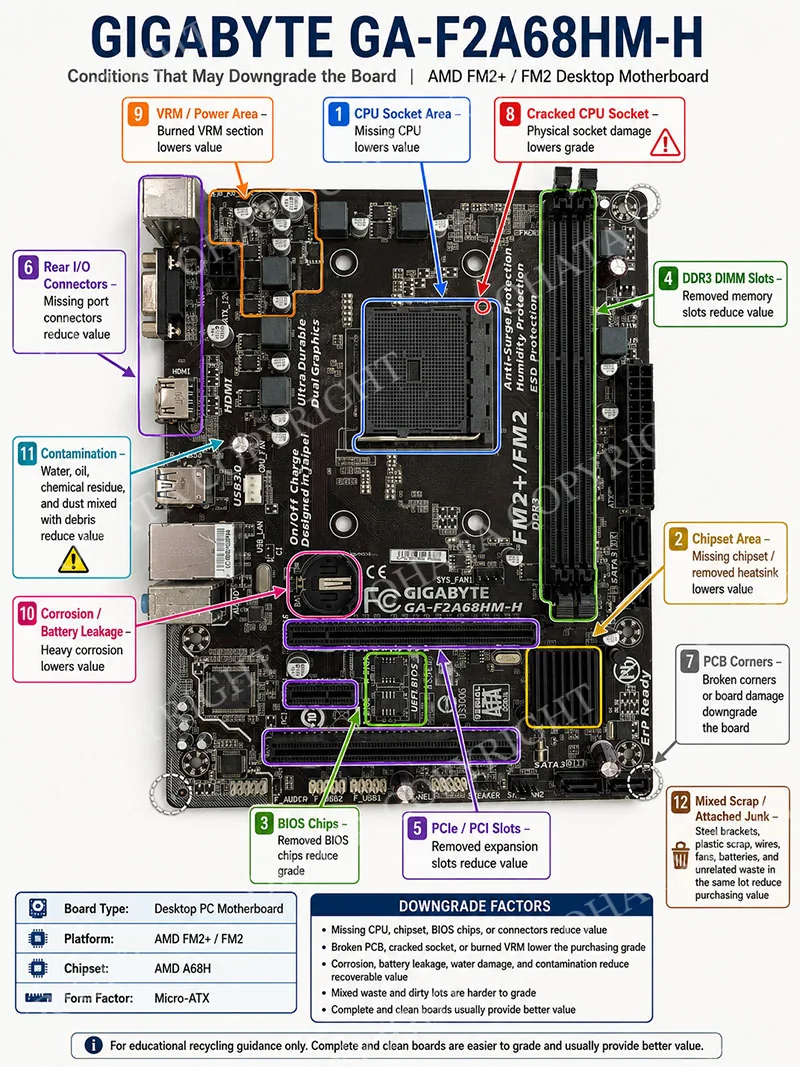
Complete and clean boards are easier to grade and usually provide better value.
Recoverable Materials, Buying Standards, and Handling
Recoverable Materials
The GA-F2A68HM-H contains multiple recyclable material groups. Although it is not a high-grade precious-metal board, it still has recoverable value as a desktop motherboard.
Copper
Copper is the largest recoverable metal by weight. It is present in:
Internal PCB layers.
Signal traces.
Ground planes.
Power planes.
Inductors.
Connector pins.
Rear I/O shells and contacts.
CPU VRM circuitry.
Copper recovery is the main reason standard desktop motherboards remain recyclable even when precious metal content is limited.
Gold
Gold is present in small but important areas:
CPU socket contacts.
DDR3 memory slot contacts.
PCI Express slot contacts.
PCI slot contacts.
HDMI and USB connector contact areas.
Internal bond wires inside certain IC packages.
Possible plated test points or small connector surfaces.
The amount of gold is lower than in telecom boards, Apple logic boards, server boards, or older ceramic CPU boards, but it still contributes to value.
Silver
Silver may be found in solder alloys, electrical contacts, and selected internal component structures. The quantity is small but relevant in bulk refining.
Palladium
Palladium may be present in multilayer ceramic capacitors. Each capacitor contains only a small amount, but large volumes of boards can provide meaningful recovery.
Nickel, Tin, Steel, and Aluminum
Nickel appears in connector plating and shielding. Tin is present in solder. Steel appears in port shells, brackets, and reinforcement pieces. Aluminum may appear in heatsinks if attached, although heatsinks are often removed before motherboard recycling.
Silicon and Semiconductor Materials
The CPU, chipset, BIOS chips, audio codec, LAN controller, and power management ICs contain silicon and package materials. In high-volume processing, these components are part of the board’s recoverable material value.
Buying Standards
For Ohata internal buying and sorting, this motherboard should be purchased and recorded as D Grade Board Scrap when it is complete and clean.
Preferred condition:
Complete motherboard.
CPU included when available.
CPU socket intact.
Chipset present.
Memory slots present.
Expansion slots present.
Rear I/O ports present.
SATA ports present.
BIOS chips present.
No severe corrosion.
No water damage.
No burn damage.
No broken PCB sections.
No mixed trash.
Non-electronic materials should be removed where practical. Examples include loose plastic housings, loose steel brackets, external cables, batteries, packaging material, and unrelated mixed waste.
Importance of Keeping the CPU
The CPU should remain with the motherboard when possible because it increases recovery value and helps identify the platform. The CPU contains semiconductor material and metal-bearing contacts. A motherboard with the CPU installed is generally more desirable than a bare motherboard.
For this model, the CPU is a removable AMD FM2+ / FM2 processor. It should not be confused with a soldered laptop BGA processor. If the CPU is removed and sold separately, the motherboard should be graded as a bare D Grade desktop board.
Accepted Material Condition
Acceptable GA-F2A68HM-H motherboard scrap may include:
Non-working boards.
Obsolete boards.
Boards removed from desktop PCs.
Boards with normal dust.
Boards with minor scratches.
Boards missing RAM modules.
Boards missing external cables.
Boards with removed heatsinks, if major electronic components remain.
Functionality is not required. The board is purchased for material recovery, not for reuse.
Rejected or Problematic Material
The following conditions may lead to rejection or reduced value:
Burned motherboard sections.
Severe corrosion.
Battery leakage damage.
Wet or moldy boards.
Oil-contaminated boards.
Chemical contamination.
Broken boards in multiple pieces.
Boards with major ICs removed.
Boards mixed with household garbage.
Boards mixed with lithium batteries.
Boards mixed with appliance control boards without separation.
Boards containing excessive plastic, steel, or non-electronic material.
Hazardous materials, swollen batteries, loose garbage, and contaminated waste should not be mixed with motherboard scrap.
Handling and Packaging
To preserve value:
Keep boards dry.
Avoid breaking corners.
Do not cut the PCB.
Do not remove the CPU socket.
Do not remove integrated circuits.
Separate desktop motherboards from appliance boards.
Separate laptop motherboards from desktop motherboards.
Remove loose batteries.
Remove large non-electronic attachments when practical.
Pack boards flat to reduce physical damage.
Mixed lots reduce grading accuracy. If D Grade AMD desktop boards are mixed with appliance boards, broken boards, plastic, metal brackets, wires, and random electronics, the lot may be purchased at a lower mixed-material value.
Why Completeness Matters
Completeness matters because buyers evaluate the visible components to estimate recoverable value. A complete board provides copper, connectors, ICs, socket contacts, and attached semiconductor packages. A stripped board contains less recoverable material and is harder to identify accurately.
The most valuable version of this board for recycling is:
Complete GA-F2A68HM-H motherboard with CPU installed, chipset present, connectors intact, and no serious contamination.
The lower-value version is:
Bare or stripped GA-F2A68HM-H motherboard without CPU, with removed connectors, missing chips, corrosion, breakage, or mixed trash contamination.
Comparison, and Official Ohata Classification
Comparison with Higher-Grade Boards
Compared with SSS Grade
SSS Grade boards are ultra-high-value military, aerospace, satellite, and mission-critical boards with extremely dense IC layouts, ceramic packages, gold-pin connectors, and premium construction. The GA-F2A68HM-H is a consumer desktop board and does not share those characteristics.
Compared with SS Grade
SS Grade boards include telecom infrastructure, enterprise networking boards, smartphone logic boards, fiber optic communication boards, server backplanes, and cellular base station boards. They contain high-density communication ASICs, large BGA processors, and premium connectors. The GA-F2A68HM-H has standard desktop I/O and lacks telecom architecture.
Compared with S Grade
S Grade includes premium legacy computer boards, boards with multiple ceramic CPUs, and non-SATA hard drive boards. The GA-F2A68HM-H is a later AMD desktop board with one consumer socket and no ceramic CPU array.
Compared with A+ Grade
A+ Grade includes Apple logic boards, PLC CPU boards, CNC controllers, robotics controllers, medical electronics, industrial control boards, and large multi-socket server motherboards. The GA-F2A68HM-H is not industrial, medical, Apple, or multi-socket server hardware.
Compared with A Grade
A Grade includes non-Apple laptop motherboards, large single-socket server boards, clean gold-finger cards, CD/DVD drive boards, and certain high-quality console boards. The GA-F2A68HM-H is a standard desktop motherboard and does not meet those higher-value examples.
Compared with B Grade
B Grade includes medium-grade boards, some lower-grade telecom boards, server motherboards, peripheral boards, and certain desktop motherboard socket groups. The GA-F2A68HM-H remains below B Grade because it is an AMD FM platform consumer desktop motherboard.
Compared with C Grade
C Grade includes standard desktop motherboards and trimmed or lower-value gold-finger cards. Some desktop boards may fall into C Grade, but the Ohata internal description specifically identifies AMD AM and FM platform boards as D Grade. Therefore, the more specific classification should be used.
Compared with Appliance Boards
Appliance boards are generally lower-value control boards from household appliances or automotive systems. The GA-F2A68HM-H is a computer motherboard and should be kept separate from appliance boards. It is more structured and component-rich than most appliance boards, but still belongs in D Grade rather than higher computer grades.
Official Ohata Classification
Official internal classification: D Grade Board Scrap
Reason: The board is a GIGABYTE GA-F2A68HM-H AMD FM2+ / FM2 Micro-ATX desktop motherboard based on the AMD A68H chipset. It is a modern consumer AMD FM platform board with modest IC density, standard DDR3 memory slots, standard desktop I/O, and no server, telecom, Apple, industrial, military, or high-density enterprise characteristics. The Ohata classification summary places AMD AM and FM platform boards within D Grade.
Final Identification Statement
The board is a GIGABYTE GA-F2A68HM-H desktop motherboard, using AMD Socket FM2+ / FM2, AMD A68H chipset, DDR3 memory, and a Micro-ATX form factor. It supports AMD A-series APUs and AMD Athlon processors, two DDR3 DIMM slots, HDMI and D-Sub display output through compatible APUs, and one PCI Express x16 graphics slot. For Ohata internal recycling classification, it should be sorted as D Grade Board Scrap, preferably with the CPU installed and all major components intact.
Ohata MotherBoard Scrap Wiki Claim
The Ohata Wiki is an educational knowledge base developed and maintained by Ohata to provide information on electronic scrap identification, recycling technologies, material classification, and sustainable resource recovery. The content published in the Ohata Wiki is based on Ohata's operational experience, research, and educational objectives. It is intended to assist recyclers, businesses, researchers, students, and the public in understanding electronic materials and recycling practices.
The Ohata Wiki is designed as an educational reference only. It does not replace professional technical advice, engineering analysis, laboratory testing, or official industry standards.
Ohata MotherBoard Classification Claim
The Ohata MotherBoard Classification System is a proprietary educational classification created by Ohata based on the company's internal recycling knowledge and operational experience. It is intended solely for educational and identification purposes. It is not an international standard, government specification, or universally accepted industry grading system. Classification methods, purchasing requirements, and recycling practices may differ among companies, regions, and markets.
Ohata MotherBoard Scrap Wiki Page Copyright
© 2026 Ohata. All Rights Reserved.
Record the revision, BIOS, installed APU/CPU, socket dimensions and POST result. Confirm the current Ohata rule priority for AMD FM boards before applying D Grade, then compare repair value with the live recycling price.