

Introduction, Construction, Components, and Recycling Value
Introduction
Photograph the DA0ZQKMB6E0 Rev. E marking, Acer part-number label and soldered SoC before identifying this board. The PCB layout suggests an Acer all-in-one platform, but the exact processor, memory limit and system compatibility must be tied to the visible chip marking and Acer documentation.
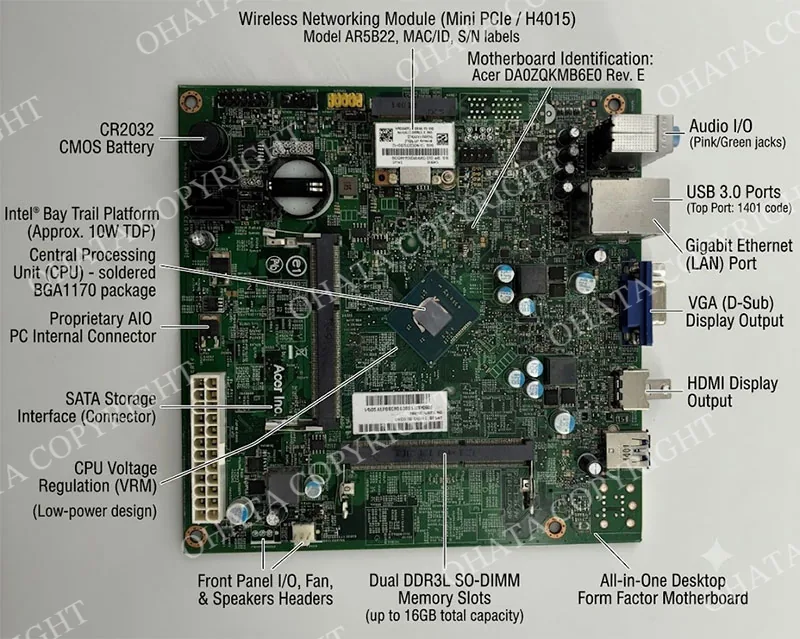
Although physically smaller than a traditional desktop motherboard, the board combines many desktop-oriented features with notebook-derived technologies. It provides dual DDR3L SO-DIMM memory slots, SATA storage interfaces, Gigabit Ethernet connectivity, HDMI and VGA display outputs, USB 3.0 support, and an integrated Mini PCIe wireless networking module. This hybrid architecture makes it representative of a generation of all-in-one desktop systems that emphasized low power consumption while retaining the connectivity expected from a desktop computer.
It is important to distinguish this motherboard from notebook logic boards. Although it uses SO-DIMM memory sockets and a soldered processor similar to many laptop platforms, the overall construction, rear I/O arrangement, power delivery system, and standard desktop connectors identify it as an all-in-one desktop motherboard rather than a portable computer motherboard.
Motherboard Construction
The motherboard is manufactured using a multilayer FR-4 fiberglass printed circuit board with internal copper planes designed for signal routing and power distribution. Surface-mount technology dominates the assembly, allowing high component density while maintaining a relatively compact board footprint. The power regulation circuitry is optimized for Intel Bay Trail processors with approximately 10 W thermal design power, reducing the number of voltage regulation phases required compared with mainstream desktop platforms.
The processor is mounted using the Intel BGA1170 package. Unlike LGA desktop sockets, the processor is permanently soldered to the PCB during manufacturing and is not intended for field replacement. The processor package measures approximately 35 × 35 mm, while the exposed silicon die itself is significantly smaller. This soldered architecture improves mechanical reliability and reduces manufacturing cost but limits upgrade possibilities.
The motherboard includes two DDR3L SO-DIMM sockets supporting low-voltage memory modules operating at 1.35 V. Depending on the installed processor and firmware revision, total memory capacity typically reaches up to 16 GB using two compatible modules. This configuration provides greater flexibility than many entry-level Bay Trail systems that were equipped with only a single memory slot.
Ohata A Grade Classification, Identification Guide, and Apple Logic Board Types
Ohata A Grade Classification
Internal Ohata Classification: A Grade Desktop / All-in-One Motherboard
The Acer DA0ZQKMB6E0 Rev. E motherboard is classified as an A Grade motherboard under the Ohata internal recycling classification system when the board remains substantially complete and retains its factory-installed processor and primary electronic components. This classification reflects the balance between component density, recoverable material content, construction quality, and overall recycling value.
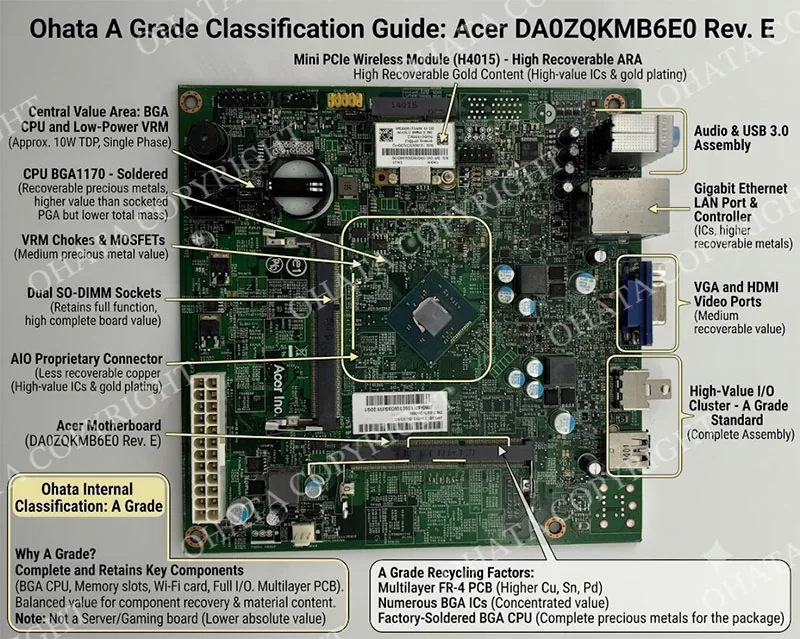
Unlike workstation, enterprise server, or premium gaming motherboards that incorporate large processor sockets, multiple PCI Express x16 slots, extensive voltage regulation circuitry, and numerous high-value integrated circuits, this motherboard is designed for a compact, energy-efficient desktop environment. Nevertheless, its multilayer PCB construction, numerous BGA integrated circuits, dual memory sockets, wireless networking module, Gigabit Ethernet controller, and complete rear I/O assembly provide a recycling value that is significantly higher than entry-level consumer motherboards.
Identification Guide
Correct identification is important because several Acer all-in-one motherboards share similar layouts. The following features distinguish this board:
PCB identification: DA0ZQKMB6E0 Rev. E
Acer assembly part number: MB.SN711.001
Intel Bay Trail platform
BGA1170 soldered processor footprint
Dual DDR3L SO-DIMM sockets
Two SATA ports
Mini PCIe wireless networking slot populated with an AzureWave module
HDMI and VGA display outputs
Standard 24-pin desktop power connector
Compact all-in-one desktop motherboard layout
These characteristics collectively identify the motherboard as an Acer all-in-one desktop motherboard rather than a notebook logic board or a conventional ATX motherboard.
Intended Computer Systems
This motherboard was commonly installed in Acer all-in-one desktopf computers using Intel Bay Trail processors. Typical factory configurations were intended for:
Home computingf
Educational environments
Office productivity
Point-of-sale systems
Reception terminals
Digital signage
Light multimedia applications
Although originally developed for OEM systems, surplus boards are also used by electronics enthusiasts, repair technicians, embedded system developers, and hobbyists who repurpose compact desktop hardware for laboratory projects, lightweight servers, automation controllers, and custom computing applications.
CPU Interface and Package
The processor interface is:
Intel BGA1170
Unlike LGA desktop processors, the CPU is permanently soldered to the motherboard during manufacturing.
Approximate processor package dimensions:
35 mm × 35 mm
Because the processor is soldered, replacement requires professional BGA rework equipment and is generally not considered a field-serviceable operation.
Apple Logic Board Types
This motherboard is not an Apple Logic Board.
The heading is retained only for consistency with the standard Ohata Wiki template.
Typical Apple Logic Boards differ significantly in several respects:
Custom PCB geometry
Proprietary connector systems
High-density mobile component integration
Different processor architectures
Different repair methodology
Therefore, this motherboard should always be identified as an OEM All-in-One Desktop Motherboard rather than an Apple Logic Board.
Factors Increasing Recycling Value
The recycling value increases when the motherboard retains:
Original BGA processor
Wireless module
LAN controller
Audio codec
BIOS ROM
Rear I/O connectors
Complete SATA connectors
Memory sockets
Polymer capacitors
Power regulation circuitry
The processor is particularly important because it contributes additional semiconductor materials, substrate materials, solder balls, and precious-metal-bearing internal interconnections.
Downgrade Conditions
A motherboard may be downgraded from A Grade if one or more of the following conditions are observed:
CPU removed
Major BGA chips removed
Broken memory sockets
Missing SATA connectors
Missing rear I/O assembly
Burn damage
Heavy corrosion
Moisture damage
Severe oxidation
Multiple lifted pads
Large areas of missing components
Broken PCB substrate
Mechanical deformation
Excessive contamination
Mixed electronic scrap attached to the board
Minor cosmetic scratches generally do not affect grading provided that the structural integrity of the motherboard remains intact.
Rejection Conditions
The following conditions may result in rejection or classification as low-grade electronic scrap:
PCB fractured into multiple pieces
Extensive fire damage
Severe water damage with widespread corrosion
Significant missing copper layers
Nearly all integrated circuits removed
Heavy contamination by oils, chemicals, adhesives, or concrete
Hazardous contamination
Excessive carbonization from electrical failure
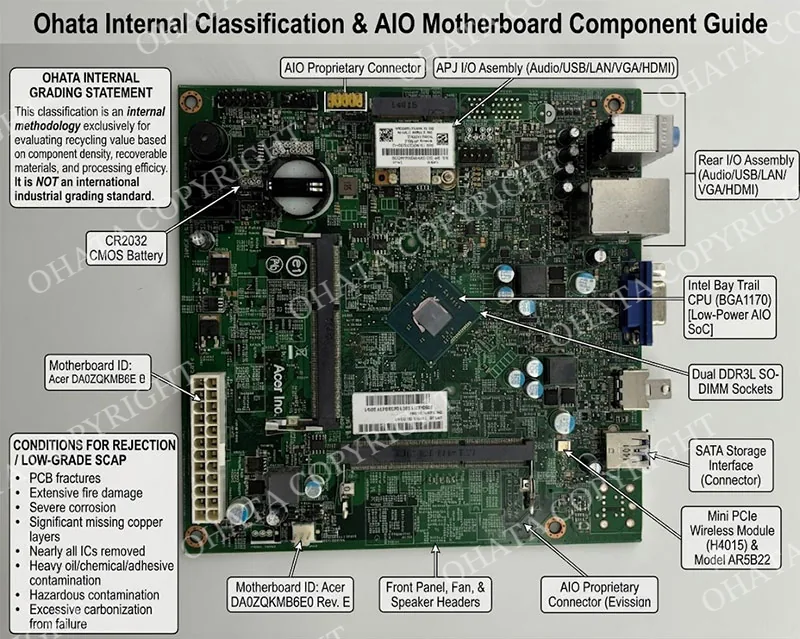
Boards in these conditions typically require manual sorting before entering conventional recycling streams.
Internal Classification Statement
The Ohata motherboard grading system is not an international recycling standard.
It is an internal classification methodology developed exclusively by Ohata for evaluating the relative recycling value of electronic circuit boards based on component density, recoverable materials, structural completeness, and processing efficiency. It should not be interpreted as an internationally recognized industrial grading specification.
Recoverable Materials, Buying Standards, and Handling
Recoverable Materials
The Acer DA0ZQKMB6E0 motherboard contains a diverse mixture of recoverable engineering materials commonly found in modern multilayer computer motherboards.
Copper
Copper represents one of the largest recoverable material fractions.
Primary sources include:
Internal multilayer PCB planes
Power distribution traces
Voltage regulation inductors
Connector terminals
Internal wiring
Gold
Gold is present in relatively small quantities but contributes disproportionately to recycling value.
Typical locations include:
Edge contacts
CPU package interconnections
BGA package bonding structures
Integrated circuit bonding wires
Connector plating
Memory socket contacts
Silver
Silver may be present in:
Solder alloys
Electronic contacts
Certain multilayer ceramic capacitors
Nickel
Nickel is commonly recovered from:
Connector plating
Component lead frames
Shielding structures
Aluminum
Recoverable aluminum is primarily found in:
Electrolytic capacitor cans
Selected shielding components
Silicon
Silicon exists within nearly every semiconductor device, including:
Processor
Network controller
Audio codec
BIOS ROM
Voltage regulators
Logic devices
Tin
Tin is recovered primarily from:
Lead-free solder joints
Surface mount assembly
Iron
Steel and ferrous materials are present in:
Connector shells
Mounting brackets
Shield structures
Buying Standards
Ohata generally assigns the highest purchase value when the motherboard retains:
Original CPU
Complete PCB
Original chipset
Complete I/O connectors
Memory sockets
Wireless module
No significant corrosion
No structural damage
Missing processors do not necessarily result in rejection but typically reduce purchasing value.
Handling Recommendations
To maximize recycling value:
Store boards in dry conditions.
Avoid stacking heavy objects directly on exposed components.
Protect BGA packages from mechanical impact.
Prevent moisture exposure.
Avoid mixing with steel scrap or household waste.
Separate damaged boards from complete boards before shipment.
Maintain traceability when sorting different motherboard generations.
Proper handling reduces unnecessary mechanical damage and preserves recoverable materials for downstream processing.
Comparison, and Official Ohata Classification
Comparison with Similar Motherboards
Compared with traditional Micro-ATX desktop motherboards, the Acer DA0ZQKMB6E0 occupies considerably less physical space while integrating many functions directly into the processor platform. The soldered Intel Bay Trail processor eliminates the need for a socket and simplifies power delivery, resulting in lower overall power consumption.
Compared with notebook motherboards, however, this design offers several desktop-oriented advantages, including a standard 24-pin power connector, dual memory slots, full-size rear I/O connectors, and greater service accessibility within an all-in-one chassis.
Compared with industrial embedded boards, the DA0ZQKMB6E0 provides broader consumer connectivity through HDMI, VGA, Gigabit Ethernet, USB 3.0, SATA, and integrated wireless networking, making it suitable for a wide range of desktop computing applications.
Recycling Characteristics
From a recycling perspective, the board provides a favorable combination of:
High multilayer copper content
Numerous integrated circuits
Gold-plated connector contacts
Dense surface-mounted components
Complete networking subsystem
Standardized desktop connectors
Although it contains fewer high-value components than workstation or server motherboards, it remains substantially more valuable than many low-density consumer electronic boards.
Maintaining the processor, wireless module, chipset, and major integrated circuits significantly improves the overall recoverable value. Conversely, removal of these components, severe physical damage, excessive corrosion, or mixed electronic scrap contamination can substantially reduce the board's classification and purchasing value.
Official Ohata Classification
ItemClassificationBoard TypeAll-in-One Desktop MotherboardPlatformIntel Bay Trail-DPCB ModelDA0ZQKMB6E0 Rev. ECPU InterfaceIntel BGA1170CPU Package SizeApproximately 35 × 35 mmGraphicsIntegrated Intel HD Graphics (processor-dependent)MemoryDual DDR3L SO-DIMMStorageDual SATANetworkGigabit Ethernet + Mini PCIe Wi-FiPrimary ApplicationAcer All-in-One Desktop ComputersInternal Ohata Recycling GradeA Grade
Final Assessment
The Acer DA0ZQKMB6E0 Rev. E motherboard represents a well-integrated all-in-one desktop platform combining low-power Intel architecture with desktop-class connectivity. Its multilayer PCB construction, compact layout, and concentration of recoverable electronic components provide a balanced recycling profile suitable for Ohata Internal A Grade classification when substantially complete.
Preserving the original processor, wireless module, memory sockets, major BGA integrated circuits, and rear I/O assembly is strongly recommended, as these components contribute directly to recoverable material value and improve purchasing consistency. Boards exhibiting major structural damage, heavy corrosion, extensive component removal, or mixed electronic waste contamination should be evaluated separately and may be downgraded or rejected according to Ohata's internal purchasing criteria.
Classification Notice: The Ohata motherboard grading system described in this document is an internal valuation methodology developed solely for Ohata's electronic recycling operations. It is intended to support purchasing consistency and material assessment and should not be interpreted as an international or industry-wide classification standard.
Ohata MotherBoard Scrap Wiki Claim
The Ohata Wiki is an educational knowledge base developed and maintained by Ohata to provide information on electronic scrap identification, recycling technologies, material classification, and sustainable resource recovery. The content published in the Ohata Wiki is based on Ohata's operational experience, research, and educational objectives. It is intended to assist recyclers, businesses, researchers, students, and the public in understanding electronic materials and recycling practices.
The Ohata Wiki is designed as an educational reference only. It does not replace professional technical advice, engineering analysis, laboratory testing, or official industry standards.
Ohata MotherBoard Classification Claim
The Ohata MotherBoard Classification System is a proprietary educational classification created by Ohata based on the company's internal recycling knowledge and operational experience. It is intended solely for educational and identification purposes. It is not an international standard, government specification, or universally accepted industry grading system. Classification methods, purchasing requirements, and recycling practices may differ among companies, regions, and markets.
Ohata MotherBoard Scrap Wiki Page Copyright
© 2026 Ohata. All Rights Reserved.
Record the SoC marking, BIOS label, power connector, SATA ports, wireless module and POST result. Apply the current Ohata AIO rule only after reconciling the A-grade laptop rule with the D-grade integrated-desktop rule, then compare repair value with the live scrap price.