

Introduction, Construction, Components, and Recycling Value
Introduction
Dell sold the OptiPlex 790 in Mini Tower, Desktop, Small Form Factor and Ultra Small Form Factor versions, and their motherboards are not interchangeable. Identify a scrap board by its chassis type, Dell DP/N, board layout, LGA1155 socket and Q65 chipset before applying Ohata's D Grade rule. The board shown on this page should be named by its exact form factor and part number; do not generalize its memory or expansion-slot layout to every OptiPlex 790
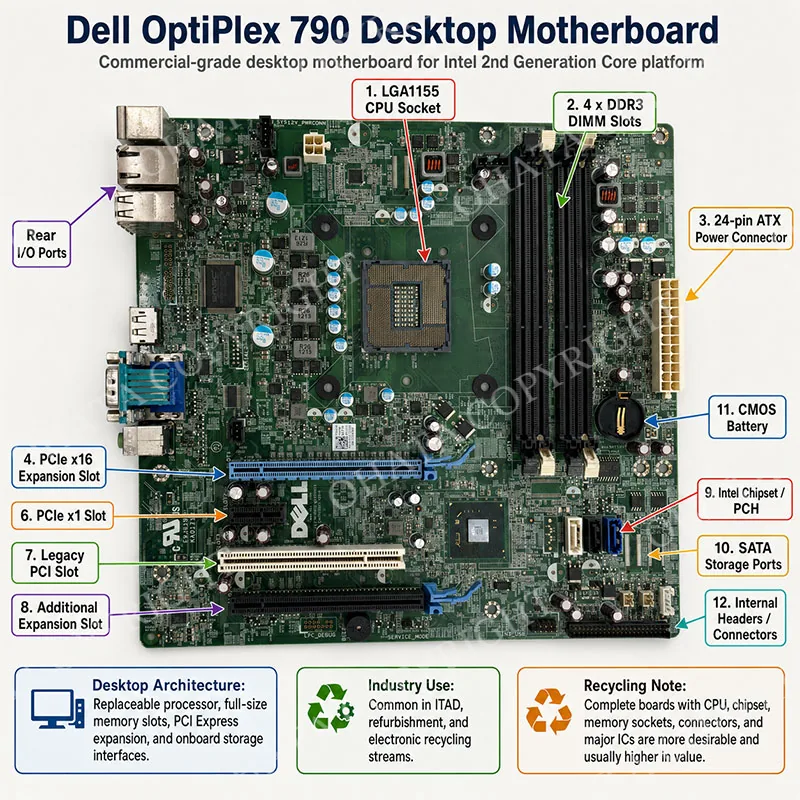
Unlike notebook logic boards, this motherboard adopts a standard desktop architecture with a replaceable processor, full-size DDR3 DIMM memory slots, PCI Express expansion capability, SATA storage interfaces, and numerous onboard connectors for internal peripherals. These characteristics make the motherboard valuable not only for refurbishment and secondary-market computer rebuilding, but also for electronic component recovery and precious metal recycling.
Due to the large production volume of Dell OptiPlex business computers, the OptiPlex 790 motherboard has become a frequently encountered product within the global IT asset disposition (ITAD), refurbishment, and electronic recycling industries.
When evaluated for recycling, a complete motherboard containing its original processor, chipset, memory sockets, connectors, and major integrated circuits is significantly more desirable than a board with missing components or structural damage. Proper identification and grading therefore play an important role in determining purchasing value.
Motherboard Type
Motherboard Type: Desktop Motherboard
Platform: Intel Sandy Bridge Business Platform
Original Application: Dell OptiPlex 790 Desktop Computer
Typical Usage:
Business desktop computers
Office workstations
Educational computer laboratories
Government desktop systems
Commercial office deployments
Refurbished desktop computers
Personal desktop builds for hardware enthusiasts using the Intel LGA1155 platform
Although originally manufactured for Dell desktop computers, this motherboard is also popular among PC enthusiasts, repair technicians, and collectors because of its excellent compatibility with Intel Sandy Bridge processors and DDR3 memory.
Release Information
Release Year: 2011
The motherboard belongs to Intel's 6-Series chipset generation and was introduced alongside Intel's second-generation Core processor family. During its commercial lifecycle, the platform became one of Dell's most widely deployed enterprise desktop solutions.
CPU Platform
The motherboard utilizes the Intel LGA1155 (Socket H2) processor interface.
CPU Socket Specifications
Socket Type: Intel LGA1155
Socket Contacts: 1,155 lands
Socket Dimensions: The board uses an LGA1155 socket with 1,155 contact positions for supported second-generation Intel Core, Pentium and Celeron processors. Confirm CPU support against the Dell manual and BIOS.
Retention Mechanism: Intel Standard Independent Loading Mechanism (ILM)
The socket is designed for removable desktop processors rather than soldered CPUs, allowing future upgrades and easier refurbishment.
Supported Processor Families
Supported processors include:
Intel Core i3 (2nd Generation)
Intel Core i5 (2nd Generation)
Intel Core i7 (2nd Generation)
Intel Pentium
Intel Celeron
Representative processors include:
Intel Core i3-2100
Intel Core i3-2120
Intel Core i5-2300
Intel Core i5-2400
Intel Core i5-2500
Intel Core i7-2600
Intel Pentium G620
Intel Pentium G840
Intel Celeron G530
The motherboard itself does not permanently include a processor. During recycling inspections, the presence of an installed CPU generally increases both resale potential and overall purchasing value.
Chipset
The Dell OptiPlex 790 motherboard is based on the Intel Q65 Express Chipset.
Primary chipset functions include:
Memory controller communication
PCI Express management
SATA controller
USB controller
LPC interface
SMBus
Integrated audio communication
Gigabit Ethernet interface
BIOS communication
The Intel Q65 platform was specifically designed for commercial desktop environments emphasizing reliability and long operational life.
Memory Architecture
The motherboard contains four standard desktop DIMM slots.
Memory Type: DDR3 SDRAM
Memory Slots: Four
Memory Channel: Dual Channel
Supported Frequency:
DDR3-1066
DDR3-1333
Maximum Capacity: 32 GB
Each slot supports up to 8 GB DDR3 memory.
Compared with notebook SO-DIMM connectors, full-size DIMM sockets contain longer gold-plated contacts, contributing modestly to recycling value.
Expansion Capability
Expansion interfaces include:
One PCI Express x16 slot
One PCI Express x1 slot
One legacy PCI slot
The PCI Express x16 slot allows installation of dedicated graphics cards, RAID controllers, network adapters, capture cards, and other expansion devices.
Although intended primarily for office environments, many hardware enthusiasts continue to use this motherboard for economical desktop computer builds.
Storage Interfaces
Storage connectivity consists of SATA interfaces supporting traditional storage devices.
Supported devices include:
Hard Disk Drives
SATA Solid State Drives
Optical Drives
Storage controller features include:
AHCI Mode
Native Command Queuing
Hot Plug support on supported configurations
Rear I/O Interfaces
Typical external interfaces include:
USB ports
VGA
DisplayPort
RJ45 Gigabit Ethernet
Audio jacks
Serial interface (configuration dependent)
Internal Connectors
Internal motherboard headers typically include:
Front USB
Front Audio
Front Panel
SATA
CPU Fan
System Fan
Speaker
CMOS jumper
Power connector
Major Integrated Components
The motherboard contains numerous semiconductor devices including:
Intel Q65 Platform Controller Hub
SPI BIOS ROM
Super I/O Controller
Audio Codec
Gigabit Ethernet Controller
Voltage Regulation MOSFET Arrays
PWM Controller
Clock Generator
Ferrite Chokes
Polymer Capacitors
These devices collectively provide stable system operation while also contributing to recoverable material content.
Construction
The motherboard uses a multilayer fiberglass epoxy PCB containing multiple internal copper layers.
Construction highlights include:
Heavy copper traces
Gold-plated connector contacts
High-density multilayer PCB
Lead-free solder
Solid-state capacitors
Ferrite inductors
Surface-mount integrated circuits
Enterprise-oriented design prioritizes durability over cosmetic appearance.
Recycling Value
From a recycling perspective, this motherboard is considered a relatively valuable desktop motherboard due to:
Large PCB area
Four memory sockets
Large processor socket
High integrated circuit density
Numerous gold-plated connectors
Enterprise-grade construction
Multiple power regulation components
Boards retaining their original CPU generally possess greater market value than boards with missing processors.
Ohata D Grade Classification, Identification Guide, and Apple Logic Board Types
Official Ohata Grade
Classification:D Grade Desktop Motherboard
After evaluating the motherboard according to the Ohata desktop motherboard grading criteria, this model is classified as:
Ohata Grade:D
The classification is based upon:
Desktop motherboard architecture
Intel LGA processor socket
Four DDR3 DIMM slots
Enterprise PCB quality
Multiple large integrated circuits
Significant connector density
Commercial-grade electronic components
The motherboard does not qualify as SS or S Grade because desktop business motherboards generally contain fewer high-density BGA devices than premium server, workstation, or telecommunications boards.
Grade Confirmation
Based upon visual identification and structural characteristics:
CPU Socket:Present
Memory Slots:Four
Chipset:Present
Voltage Regulation:Complete
Expansion Slots:Complete
Connector Density:High
PCB Construction:Enterprise Grade
Overall Component Density:High
The board therefore remains appropriately classified as:
Ohata Grade:D
Identification Guide
Identification features include:
Dell OEM layout
Intel LGA1155 processor socket
Four DDR3 memory slots
Intel business chipset
PCI Express x16 expansion slot
PCI Express x1 slot
Legacy PCI slot
CMOS battery holder
Enterprise voltage regulation section
Desktop Motherboard Identification
This motherboard is a desktop motherboard.
Identification characteristics include:
Replaceable desktop CPU
Full-size DIMM sockets
Standard PCI Express slots
Standard SATA connectors
Large PCB dimensions
Notebook logic boards differ significantly by using compact SO-DIMM memory sockets, integrated thermal assemblies, and highly condensed layouts.
Importance of Component Completeness
Complete boards consistently achieve higher purchasing values.
Important components include:
CPU
Chipset
Memory sockets
Voltage regulators
BIOS ROM
Audio controller
Ethernet controller
Expansion slots
Removing major components reduces refurbishment potential as well as precious metal recovery efficiency.
Recoverable Materials, Buying Standards, and Handling
Recoverable Materials
Primary recoverable materials include:
Gold
Copper
Silver
Nickel
Palladium
Tin
Aluminum
Steel
Fiberglass
Epoxy resin
Gold is primarily found within:
CPU socket contacts
DIMM connector contacts
PCI Express contacts
Edge connectors
Integrated circuit bond wires
Copper exists throughout:
PCB internal layers
Voltage regulation inductors
Power planes
Ground planes
Buying Standards
Highest purchasing values are generally assigned when:
CPU remains installed
Motherboard is structurally complete
Chipset remains attached
DIMM slots remain intact
No broken PCB
No missing integrated circuits
No corrosion
No severe contamination
CPU Value
An installed Intel processor generally increases purchasing value because it provides:
Additional resale opportunities
Recoverable precious metals
Complete hardware configuration
Improved refurbishment potential
Boards missing processors usually receive lower purchasing prices.
Conditions That Lower Value
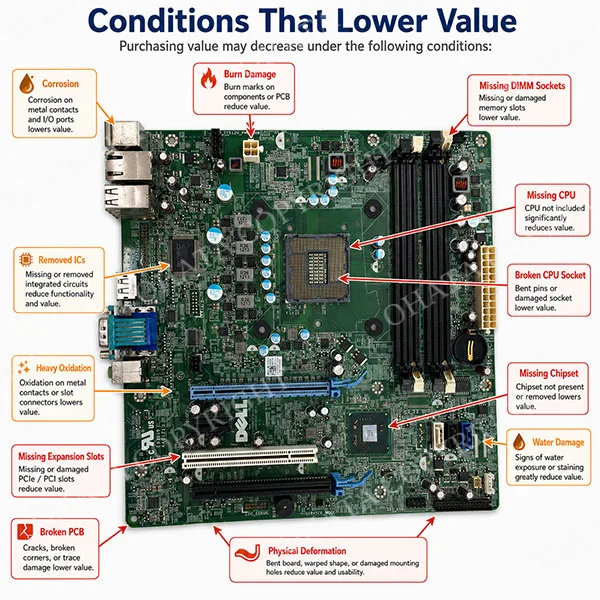
Purchasing value may decrease under the following conditions:
Missing CPU
Missing chipset
Broken CPU socket
Missing DIMM sockets
Removed ICs
Broken PCB
Water damage
Corrosion
Burn damage
Missing expansion slots
Heavy oxidation
Physical deformation
Rejected Boards
Boards may be rejected if they exhibit:
Extensive fire damage
Severe corrosion
Multiple removed integrated circuits
Large PCB fractures
Heavy chemical contamination
Hazardous material contamination
Structural damage preventing recycling
Mixed Electronic Scrap
Mixing valuable desktop motherboards with miscellaneous electronic scrap may reduce purchasing value.
Examples include:
Power supplies
Household electronics
Plastic scrap
Steel scrap
Low-grade electronic boards
Broken peripheral devices
Sorting boards by grade before shipment helps maintain accurate purchasing prices.
Handling Recommendations
Recommended handling procedures include:
Store indoors
Avoid moisture exposure
Prevent physical impact
Protect CPU socket contacts
Avoid stacking excessive weight
Separate boards by recycling grade
Remove excessive dust before shipment
Proper handling preserves both refurbishment opportunities and recycling value.
Comparison, and Official Ohata Classification
Comparison with Similar Desktop Motherboards
Compared with entry-level consumer desktop motherboards, the Dell OptiPlex 790 motherboard offers superior long-term reliability, enterprise-grade PCB quality, and a higher concentration of integrated components. Its four DIMM memory slots provide greater memory expansion capability than many budget H61 motherboards, while its Intel Q65 business chipset emphasizes platform stability and commercial deployment rather than enthusiast overclocking.
Unlike gaming-oriented Z68 or Z77 motherboards, the OptiPlex 790 platform focuses on reliability, compatibility, and long service life. This makes it especially attractive in refurbishment projects where dependable operation is valued more highly than advanced tuning features.
Within the electronic recycling industry, the motherboard is considered a desirable business desktop board because of its relatively large PCB area, multiple connector assemblies, extensive copper content, and numerous precious-metal-bearing contacts.
Typical Applications
The motherboard was originally installed in Dell OptiPlex desktop computers used for:
Business offices
Financial institutions
Educational environments
Government organizations
Industrial administration
Professional office workstations
Today, it is also commonly reused by:
Computer repair professionals
Refurbishment companies
Electronics recyclers
Hardware collectors
Vintage PC enthusiasts
Hobbyists assembling economical Intel LGA1155 desktop systems
Its support for standard desktop components makes it suitable for continued use in legacy computing environments where DDR3 memory and second-generation Intel Core processors remain readily available.
Overall Recycling Assessment
The Dell OptiPlex 790 desktop motherboard represents a high-quality enterprise motherboard with favorable recycling characteristics. Its multilayer printed circuit board, numerous integrated circuits, gold-plated connector contacts, voltage regulation circuitry, and enterprise-grade construction provide a balanced combination of refurbishment potential and recoverable material value.
Maintaining the motherboard in complete condition significantly improves purchasing value. The presence of the original CPU, intact chipset, undamaged CPU socket, complete DIMM slots, functional expansion slots, and all major integrated circuits contributes positively to grading.
Conversely, broken PCBs, missing processors, removed electronic components, corrosion, burn damage, excessive contamination, and mixed low-grade electronic scrap can substantially reduce purchasing prices or result in rejection.
Proper identification, careful handling, and accurate grading remain essential for maximizing both resale opportunities and precious metal recovery.
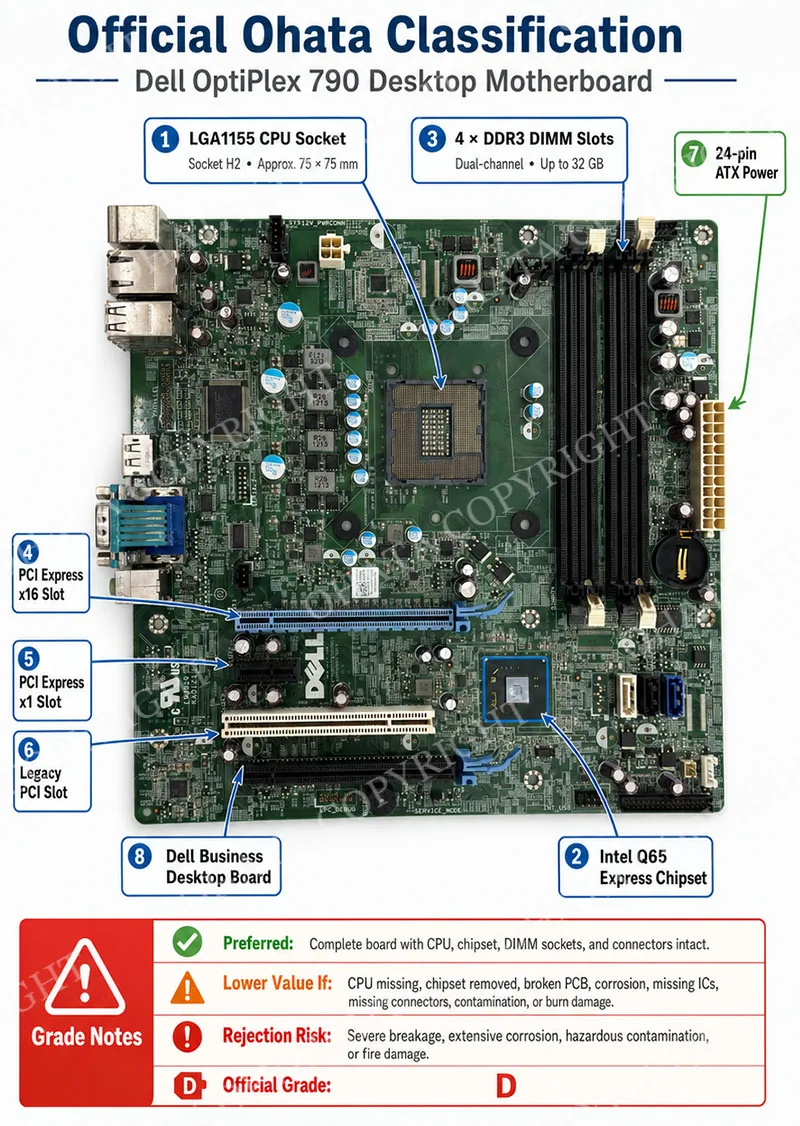
Official Ohata Classification
Board Type: Desktop Motherboard
Model: Dell OptiPlex 790
Platform: Intel Business Desktop Platform
Release Year: 2011
CPU Socket: Intel LGA1155 (Socket H2)
CPU Socket Dimensions: The board uses an LGA1155 socket with 1,155 contact positions for supported second-generation Intel Core, Pentium and Celeron processors. Confirm CPU support against the Dell manual and BIOS.
Chipset: Intel Q65 Express
Memory: Four DDR3 DIMM slots, dual-channel architecture, maximum capacity 32 GB
Expansion: One PCI Express x16 slot, one PCI Express x1 slot, one legacy PCI slot
Typical Processor Support: Intel Core i3, Intel Core i5, Intel Core i7, Intel Pentium, and Intel Celeron processors compatible with the LGA1155 socket
Typical Computer Brand: Dell OptiPlex desktop computers
Enthusiast Usage: Frequently selected for economical desktop builds, hardware restoration projects, educational laboratories, and legacy Intel LGA1155 systems
Preferred Recycling Condition: Complete motherboard with CPU installed, all major integrated circuits present, intact CPU socket, complete connectors, and no structural damage
Conditions That Reduce Grade: Missing CPU, broken PCB, corrosion, removed chipsets, missing connectors, missing integrated circuits, heavy contamination, burn damage, or mixed low-grade electronic scrap
Typical Rejection Conditions: Severe structural breakage, extensive corrosion, multiple missing semiconductor devices, hazardous contamination, or fire-damaged boards
Official Ohata Recycling Grade:D
Ohata MotherBoard Scrap Wiki Claim
The Ohata Wiki is an educational knowledge base developed and maintained by Ohata to provide information on electronic scrap identification, recycling technologies, material classification, and sustainable resource recovery. The content published in the Ohata Wiki is based on Ohata's operational experience, research, and educational objectives. It is intended to assist recyclers, businesses, researchers, students, and the public in understanding electronic materials and recycling practices.
The Ohata Wiki is designed as an educational reference only. It does not replace professional technical advice, engineering analysis, laboratory testing, or official industry standards.
Ohata MotherBoard Classification Claim
The Ohata MotherBoard Classification System is a proprietary educational classification created by Ohata based on the company's internal recycling knowledge and operational experience. It is intended solely for educational and identification purposes. It is not an international standard, government specification, or universally accepted industry grading system. Classification methods, purchasing requirements, and recycling practices may differ among companies, regions, and markets.
Ohata MotherBoard Scrap Wiki Page Copyright
© 2026 Ohata. All Rights Reserved.
This article is part of the Ohata Scrap Wiki and is protected by copyright law. No portion of this publication may be copied, reproduced, translated, republished, distributed, or transmitted in any form or by any means without prior written permission from Ohata, except where permitted by applicable copyright laws.
The Ohata, Ohata Wiki, Ohata MotherBoard Classification, and related names, logos, classifications, and educational content are proprietary intellectual property of Ohata. Unauthorized commercial use, reproduction, or modification is prohibited.