

Part 1 – Introduction, Construction, Components, and Recycling Value
Introduction to the Lenovo IB250CX Motherboard
The Lenovo IB250CX is a proprietary OEM desktop motherboard identified by the "IB250CX" and revision markings printed on the PCB. Visible features include an LGA1151 socket, Intel B250 PCH, two DDR4 DIMM slots, one PCIe x16 slot, one PCIe x1 slot and Lenovo-specific power connectors. Under Ohata's internal rules, the board is treated as D Grade; confirm whether a missing CPU changes only the price or also the grade before quoting. Match the board label and Lenovo FRU to a machine type before naming compatible ThinkCentre systems.
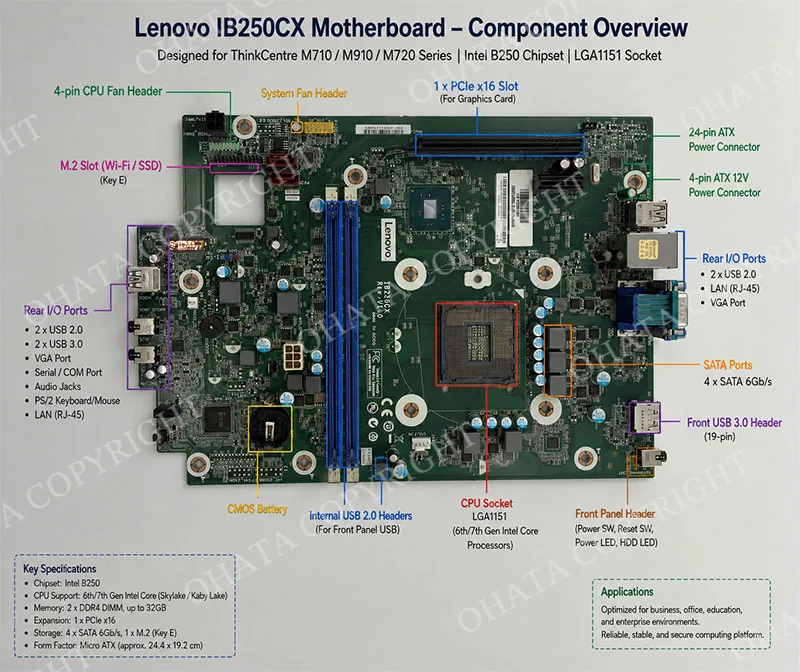
The IB250CX motherboard is built around the Intel B250 chipset, a mainstream business-oriented platform released in the first quarter of 2017. This chipset was designed to support Intel's sixth-generation (Skylake) and seventh-generation (Kaby Lake) Core processors, making it a versatile foundation for a wide range of computing tasks from basic office productivity to light multimedia work.
Physical Construction and Form Factor
The Lenovo IB250CX conforms to a micro-ATX-like form factor, though it follows Lenovo's proprietary OEM layout rather than strict industry-standard dimensions. The board is constructed using a fiberglass-reinforced epoxy laminate (FR-4) substrate with multilayer PCB architecture. Typical desktop motherboards of this era utilize four to six copper layers, with internal power and ground planes that contribute significantly to the board's recoverable copper content.
The PCB is finished with a standard solder mask, typically green in color, and features surface-mounted components throughout both sides of the board. The back side contains the CPU socket retention bracket, solder joints for through-hole components, and extensive copper trace routing that forms the electrical pathways between the various components mounted on the front side.
Core Components and Interfaces
CPU Socket
The IB250CX features an LGA1151 socket, which is a land grid array (LGA) socket type where the contact pins are located in the socket itself rather than on the processor package. The socket measures approximately 37.5 mm × 37.5 mm, consistent with the standard dimensions for LGA1151 processors. This socket supports Intel's sixth-generation Core processors (Skylake) and seventh-generation Core processors (Kaby Lake), including Core i7, i5, i3, Pentium, and Celeron variants.
The LGA1151 socket features a metal retention mechanism with a load plate and lever, which is characteristic of Intel's desktop processor sockets. This metal socket design is an important identification feature for recyclers, as it distinguishes the board from lower-grade plastic-socket motherboards that fall into different Ohata classification categories.
Chipset
The Intel B250 chipset (Platform Controller Hub, or PCH) is the central hub for all I/O functions on the motherboard. It provides:
Up to 12 PCIe 3.0 lanes
Support for up to six USB 3.0 ports and twelve USB 2.0 ports
Six SATA III (6 Gb/s) ports
Intel Rapid Storage Technology
Intel Management Engine (ME)
Intel Virtualization Technology for Directed I/O (VT-d)
Trusted Platform Module (TPM) support
The B250 chipset is housed in a BGA package located near the lower-right portion of the board, typically covered by a small aluminum heatsink.
Memory Subsystem
The board is equipped with two DDR4 DIMM slots, supporting dual-channel memory configurations. The maximum supported memory capacity is 32 GB when both slots are populated with 16 GB modules. Supported memory frequencies include DDR4-2133 MHz and DDR4-2400 MHz, with the actual speed determined by the installed processor's integrated memory controller.
The DIMM slots feature gold-plated contacts, which contribute to the board's recoverable precious metal value. The slots are typically colored blue or black, consistent with Lenovo's OEM design language.
Expansion Slots
The IB250CX provides the following expansion interfaces:
One PCIe 3.0 x16 slot: This full-length slot is designed for graphics cards and other high-bandwidth expansion cards. It contains gold-plated edge connector contacts that are valuable for precious metal recovery.
One PCIe 3.0 x1 slot: A shorter slot for lower-bandwidth expansion cards such as network adapters or sound cards.
Storage Interfaces
The board features two SATA III (6 Gb/s) connectors, typically colored red or blue. These connectors are used for connecting hard disk drives, solid-state drives, and optical drives. The SATA ports contain gold-plated internal contacts that contribute to the board's overall recoverable material value.
Rear I/O Panel
The integrated I/O panel typically includes:
VGA port: An analog video output for legacy monitors
DisplayPort: A digital video output for modern displays
RJ-45 Ethernet port: Gigabit Ethernet connectivity, typically driven by an Intel I219-V controller
USB ports: A combination of USB 2.0 and USB 3.0 ports
Audio jacks: 3.5 mm audio input/output for headphones, microphones, and speakers
Power Connectors
The IB250CX uses a proprietary Lenovo OEM power connector rather than the standard 24-pin ATX power connector found on retail motherboards. This is a critical consideration for anyone attempting to repurpose or test the board outside of its original Lenovo chassis. The CPU power connector, located near the processor socket, uses a standard 4+4-pin EPS 12V connector that is compatible with most power supplies.
Recoverable Materials and Recycling Value
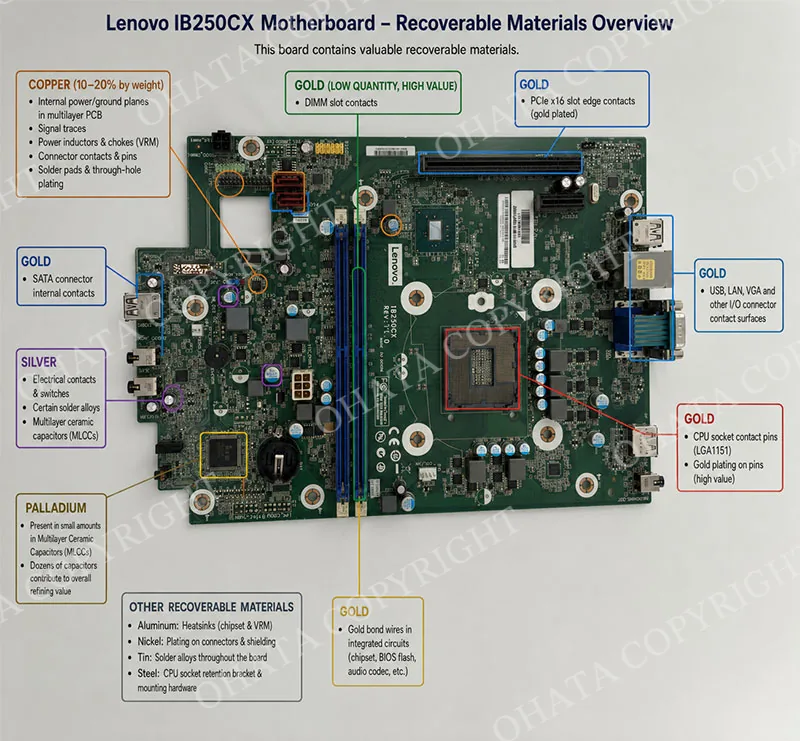
The Lenovo IB250CX motherboard contains a variety of recoverable materials that contribute to its recycling value. These materials are distributed throughout the PCB, components, and connectors.
Copper
Copper is the most abundant recoverable metal by weight, typically accounting for 10–20% of a motherboard's total mass. Copper is found in:
Internal power and ground planes within the multilayer PCB
Signal traces that route data between components
Power inductors and chokes in the voltage regulation module (VRM)
Connector contacts and pins
Solder pads and through-hole plating
Gold
Gold is present in smaller quantities but contributes significantly to the board's value due to its high market price. Gold-bearing locations include:
CPU socket contact pins (LGA1151 socket)
DIMM slot contacts
PCIe x16 and x1 slot edge connectors
SATA connector internal contacts
USB and other I/O connector contact surfaces
Gold bond wires within integrated circuits (chipset, BIOS flash, audio codec)
Silver
Silver may be present in:
Electrical contacts and switches
Certain solder alloys
Multilayer ceramic capacitors (MLCCs)
Palladium
Small quantities of palladium are contained within multilayer ceramic capacitors distributed across the board. While individual capacitors contain微量 amounts, the combined quantity across dozens of capacitors contributes to overall refining value.
Other Recoverable Materials
Aluminum: Heatsinks attached to the chipset and voltage regulation components
Nickel: Plating on connectors and shielding
Tin: Solder alloys used throughout the board
Steel: CPU socket retention bracket and mounting hardware
Why Complete Boards Have Greater Value
The recycling value of the Lenovo IB250CX motherboard is significantly enhanced when the board remains complete and intact. Key components that contribute to higher value include:
CPU: The LGA1151 processor package has contact lands on its underside, while spring contacts are located in the motherboard socket. Do not describe the CPU as having removable pins..
Chipset: The B250 PCH contains semiconductor materials and gold bond wires.
BIOS Flash: The SPI flash memory chip contains semiconductor materials and can sometimes be harvested for reuse.
Voltage Regulation Module (VRM): Power inductors, MOSFETs, and capacitors contain copper, aluminum, and other recoverable metals.
Connectors: Gold-plated connectors in the expansion slots, DIMM slots, and I/O ports contribute to precious metal recovery.
Part 2 – Ohata D Grade Classification, Identification Guide, and Board Types
Ohata D Grade Classification
Based on the Ohata Board Scrap Classification System, the Lenovo IB250CX motherboard is classified as D Grade under standard evaluation conditions (assuming a CPU is installed in the socket).
Classification Rationale
The Ohata D Grade category is defined as follows:
"D Grade includes lower-value computer motherboards and peripheral electronics that contain relatively small amounts of recoverable precious metals. Typical examples include integrated desktop motherboards with limited integrated circuit density, modern consumer motherboards using later-generation socket designs, AMD AM and FM platform boards, and peripheral cards with oversized heatsinks or cooling systems."
The IB250CX exhibits several characteristics consistent with D Grade classification:
CharacteristicIB250CX EvaluationCPU SocketLGA1151 with metal socket retention mechanism—this is a defining feature of D Grade desktop motherboardsChipsetIntel B250—a mainstream consumer/business chipset with moderate integrationIntegrated Circuit DensityModerate; the board uses a highly integrated chipset that consolidates many functions, resulting in fewer individual ICs than older motherboardsGold PlatingPresent on connectors but generally thinner than on enterprise or industrial boardsPCB ConstructionStandard multilayer FR-4 with moderate copper contentIntended ApplicationCommercial desktop computing rather than enterprise servers or industrial automationProcessor GenerationSixth/seventh-generation Intel Core—modern consumer architecture with integrated memory controller and graphics
Detailed Comparison with D Grade Criteria
The Ohata D Grade classification includes specific reference to:
"Desktop motherboards with metal socket."
The IB250CX's LGA1151 socket features a metal retention mechanism, load plate, and lever, which aligns with this criterion.
Furthermore, D Grade encompasses:
"I-Series motherboards, where the CPU socket has a metal cover and lever, and the center base usually has a specific double-L or rectangular slot."
Photograph the IB250CX and revision markings, keep the LGA1151 socket, B250 chipset, memory and PCIe connectors intact, and confirm Ohata's current D Grade rule before delivery.
Comparison with Other Grades
Why Not C Grade?
C Grade is defined as including:
"Desktop Motherboards with CPU Plastic Socket No. 2,4,6,7,9."
The IB250CX's LGA1151 socket is a metal socket, not a plastic socket. Therefore, it does not qualify for C Grade classification.
Why Not B Grade or Higher?
B Grade typically includes:
Low-grade telecommunications equipment
Metal multi-socket server motherboards
Plastic multi-socket server motherboards
Desktop motherboards with medium-value CPU socket designs
The IB250CX is a single-socket consumer/business desktop board rather than a multi-socket server board or specialized telecommunications equipment. It lacks the enterprise-grade components, higher integrated circuit density, and greater precious metal content that would justify B Grade or higher classification.
Identification Guide for Recyclers
When identifying Lenovo IB250CX boards for recycling, inspectors should look for the following features:
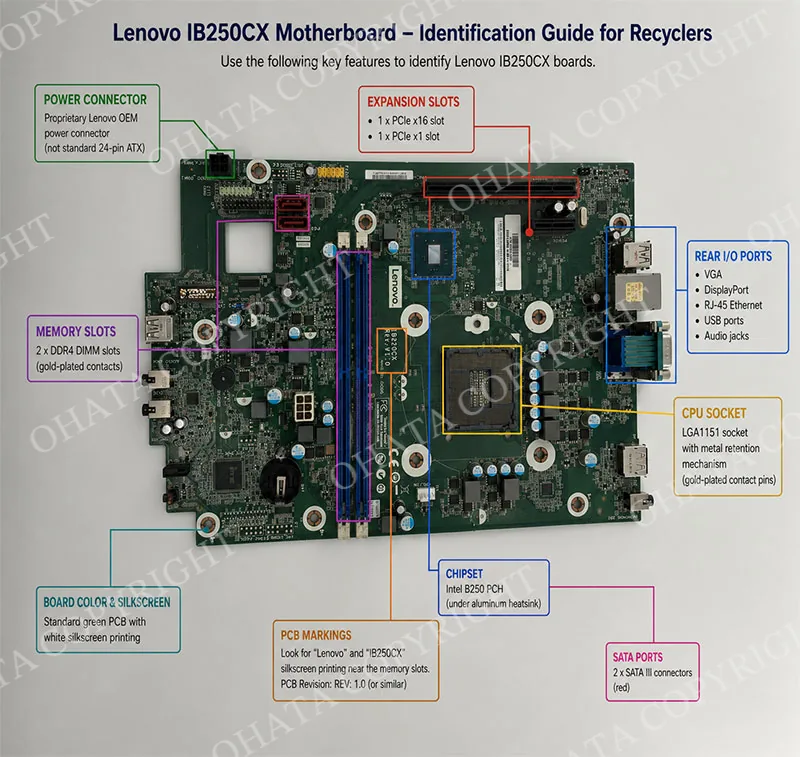
PCB Markings: The board is clearly marked with "Lenovo" and "IB250CX" silkscreen printing, typically located near the memory slots. The PCB revision (REV: 1.0 or similar) is also printed on the board.
CPU Socket: LGA1151 socket with metal retention mechanism. The socket contains gold-plated contact pins.
Chipset: Intel B250 PCH, typically covered by a small aluminum heatsink.
Memory Slots: Two DDR4 DIMM slots with gold-plated contacts.
Expansion Slots: One PCIe x16 slot and one PCIe x1 slot with gold-plated edge connectors.
Power Connector: Proprietary Lenovo OEM power connector (not standard 24-pin ATX).
Rear I/O: VGA, DisplayPort, RJ-45 Ethernet, USB ports, and audio jacks.
SATA Ports: Two SATA III connectors.
Board Color: Standard green PCB with white silkscreen printing.
Common Lenovo Systems Featuring the IB250CX
The IB250CX motherboard is most commonly found in the following Lenovo systems:
ThinkCentre M710 series (including M710e, M710s, M710t, and M710q variants)
ThinkCentre M910 series (selected configurations)
These systems were manufactured between approximately 2017 and 2020. When these systems are decommissioned from corporate environments, the motherboards frequently enter the secondary market and recycling streams.
Aftermarket and Enthusiast Use
While the IB250CX was designed as an OEM component for Lenovo systems, these boards are sometimes acquired by computer enthusiasts and system builders for custom desktop projects. However, several factors limit their appeal for DIY builds:
Proprietary Power Connector: The board requires a Lenovo-specific power supply or an adapter cable, as it does not accept standard ATX 24-pin power connectors.
BIOS Limitations: The OEM BIOS is optimized for Lenovo systems and may not support all features found on retail motherboards.
Form Factor: The board follows Lenovo's proprietary layout, which may not align with standard case mounting points.
Despite these limitations, the IB250CX remains a functional and reliable platform for budget-conscious builders who are aware of these constraints and willing to work around them.
Part 3 – Recoverable Materials, Buying Standards, and Handling
Recoverable Materials Summary
The following table summarizes the primary recoverable materials found in the Lenovo IB250CX motherboard:
MaterialPrimary LocationsRecovery SignificanceCopperPCB layers, power planes, inductors, connectors, tracesHigh (largest by weight)GoldCPU socket pins, DIMM slots, PCIe slots, SATA connectors, I/O ports, chipset bond wiresModerate to HighSilverContacts, solder alloys, MLCCsLow to ModeratePalladiumMultilayer ceramic capacitorsLowAluminumChipset heatsink, VRM heatsinksLow to ModerateNickelConnector plating, shieldingLowTinSolder alloysLow to ModerateSteelCPU socket retention bracket, mounting hardwareLow
Buying Standards and Acceptance Criteria
The Ohata Board Scrap Classification System establishes standardized buying conditions for D Grade motherboards. These standards ensure consistent grading and transparent transactions.
Accepted Materials
The following are accepted as D Grade motherboard scrap:
Complete Lenovo IB250CX motherboards with CPU installed
Complete Lenovo IB250CX motherboards without CPU (value reduced)
Boards with intact chipset, DIMM slots, PCIe slots, and I/O connectors
Boards with minor cosmetic damage, dust, or light oxidation
Boards removed from decommissioned Lenovo systems
Preferred Board Condition
For optimal classification and value, D Grade boards should be:
Structurally complete and intact
Clean and dry
Free from severe corrosion
Retaining major integrated circuits (chipset, BIOS flash, audio codec)
Retaining CPU socket with gold-plated contacts
Retaining DIMM slots and PCIe slots with gold-plated contacts
Retaining I/O connectors and ports
Free from major PCB fractures or physical damage
CPU Installation Requirement
A board with a CPU installed in the socket commands significantly higher value than a bare board. The CPU contains gold-plated contacts, gold bond wires, and semiconductor materials that are valuable for recovery. When evaluating IB250CX boards for recycling, the presence of a compatible LGA1151 processor (sixth- or seventh-generation Intel Core, Pentium, or Celeron) should be confirmed.
Conditions That May Reduce Classification or Value
The following conditions may result in downgrading or reduced value:
Missing CPU: The absence of a processor significantly reduces precious metal content and semiconductor recovery potential. A bare board is worth substantially less than a complete board.
Missing Chipset: If the B250 PCH has been removed, the board's semiconductor value is greatly diminished.
Missing DIMM Slots or PCIe Slots: Removed or damaged gold-plated connectors reduce precious metal recovery.
Broken PCB: Cracks, fractures, or cut sections reduce the board's structural integrity and may result in downgrading to a lower category or rejection.
Severe Corrosion: Water damage, battery leakage, or chemical exposure that has caused significant oxidation or PCB degradation.
Burn Damage: Evidence of electrical failure, overheating, or fire damage.
Heavy Contamination: Oil, grease, dirt, or other contaminants that interfere with inspection and processing.
Missing I/O Connectors: Removed or damaged rear I/O ports reduce connector-based precious metal recovery.
Missing Heatsinks: While aluminum heatsinks are not the primary source of value, their removal indicates the board may have been partially stripped, potentially affecting classification.
Mixed Materials: Boards mixed with non-compatible electronic scrap (appliance boards, power supply boards, etc.) may be subject to downgrading due to contamination of the material stream.
Handling and Preparation Guidelines
To maximize recycling value and ensure proper classification, suppliers should follow these guidelines when preparing IB250CX motherboards for recycling:
Remove Batteries: CMOS batteries should be removed before shipment as they require special handling.
Remove Non-Electronic Accessories: Plastic housings, metal brackets, and other non-electronic components should be removed when practical.
Keep Boards Dry: Moisture can cause corrosion and may lead to downgrading.
Preserve Components: Do not strip CPUs, chipsets, or connectors from the board, as these components contribute significantly to value.
Separate by Grade: Keep D Grade boards separate from higher-grade materials (A, A+, B, C) and lower-grade materials (Appliance Board A, Appliance Board B).
Package Securely: Boards should be packed to prevent damage during transportation.
Non-Accepted Materials
The following materials are generally not accepted as D Grade motherboard scrap and should be removed or sorted separately:
Lithium-ion batteries
Swollen or damaged batteries
Plastic housings or bezels
Mixed loose garbage
Oil-contaminated components
Mercury-containing devices
Hazardous waste materials
Non-PCB electronic waste
Part 4 – Comparison, and Official Ohata Classification
Grade Comparison Summary
The following table provides a comparison of the Lenovo IB250CX motherboard against other Ohata grades:
FeatureD Grade (IB250CX)C GradeB GradeA GradeCPU SocketMetal LGA1151Plastic socketMedium-value socketEnterprise socketChipsetB250 consumerConsumer chipsetEntry-level serverEnterprise/serverIC DensityModerateModerateModerate-HighHighGold ContentModerateModerate-LowModerateModerate-HighPCB Layers4-6 layers4-6 layers6-8 layers6-10+ layersApplicationDesktopDesktopEntry serverEnterprise/industrialProcessor SupportSingleSingleSingle/MultiMulti
Official Ohata Classification Statement
Classification: D Grade
Board Model: Lenovo IB250CX
Classification Rationale:
The Lenovo IB250CX motherboard is classified as D Grade under the Ohata Board Scrap Classification System based on the following objective engineering characteristics:
Metal CPU Socket: The LGA1151 socket features a metal retention mechanism with load plate and lever, which is characteristic of D Grade desktop motherboards.
Consumer Chipset: The Intel B250 chipset is a mainstream consumer/business platform with moderate semiconductor complexity.
Moderate Integrated Circuit Density: The board uses a highly integrated chipset architecture that consolidates many functions, resulting in fewer individual ICs than older or enterprise-grade boards.
Standard PCB Construction: The board utilizes standard FR-4 multilayer construction with moderate copper content.
Commercial Application: The board was designed for office and business computing rather than enterprise servers, telecommunications, or industrial automation.
Processor Generation: The board supports sixth- and seventh-generation Intel processors, representing modern consumer architecture with integrated functionality.
Important Classification Note
The Ohata Board Scrap Classification System is an internal classification standard used by Ohata for evaluating circuit board value. It is not an international standard classification. The system is designed to provide consistent grading for internal purchasing, inventory management, and downstream refining operations. While the Ohata system draws upon industry-recognized engineering principles and material recovery metrics, it should not be confused with official international standards or government-regulated classification systems.
Final Identification Summary
PropertySpecificationBrandLenovoModelIB250CXPCB RevisionREV: 1.0Form FactorOEM micro-ATX-likeCPU SocketLGA1151 (37.5 mm × 37.5 mm)ChipsetIntel B250Memory2× DDR4 DIMM (max 32 GB, 2133/2400 MHz)Expansion1× PCIe x16, 1× PCIe x1Storage2× SATA IIIVideo OutputVGA, DisplayPortNetworkingGigabit Ethernet (Intel I219 series)AudioRealtek HD Audio CodecPowerProprietary Lenovo OEM connectorOhata ClassificationD Grade
Conclusion
The Lenovo IB250CX motherboard is a commercially oriented desktop board that provides moderate recycling value through its copper content, gold-plated connectors, and semiconductor components. Under the Ohata Board Scrap Classification System, it is classified as D Grade based on its metal CPU socket, consumer chipset, moderate integrated circuit density, and standard PCB construction.
To maximize recycling value, boards should remain complete with CPU installed, free from damage and contamination, and properly separated from other material streams. Boards with missing CPUs, significant damage, or heavy contamination may be subject to downgrading or reduced valuation.
Ohata MotherBoard Scrap Wiki Claim
The Ohata Wiki is an educational knowledge base developed and maintained by Ohata to provide information on electronic scrap identification, recycling technologies, material classification, and sustainable resource recovery. The content published in the Ohata Wiki is based on Ohata's operational experience, research, and educational objectives. It is intended to assist recyclers, businesses, researchers, students, and the public in understanding electronic materials and recycling practices.
The Ohata Wiki is designed as an educational reference only. It does not replace professional technical advice, engineering analysis, laboratory testing, or official industry standards.
Ohata MotherBoard Classification Claim
The Ohata MotherBoard Classification System is a proprietary educational classification created by Ohata based on the company's internal recycling knowledge and operational experience. It is intended solely for educational and identification purposes. It is not an international standard, government specification, or universally accepted industry grading system. Classification methods, purchasing requirements, and recycling practices may differ among companies, regions, and markets.
Ohata MotherBoard Scrap Wiki Page Copyright
© 2026 Ohata. All Rights Reserved.
This article is part of the Ohata Scrap Wiki and is protected by copyright law. No portion of this publication may be copied, reproduced, translated, republished, distributed, or transmitted in any form or by any means without prior written permission from Ohata, except where permitted by applicable copyright laws.
The Ohata, Ohata Wiki, Ohata MotherBoard Classification, and related names, logos, classifications, and educational content are proprietary intellectual property of Ohata. Unauthorized commercial use, reproduction, or modification is prohibited.