

Quick Identification
The HP EliteDesk 800 G1 Ultra-slim Desktop uses a proprietary Intel Q87 system board with an LGA1150 socket, two PC3-12800 SODIMM slots, internal mSATA, Mini PCIe and MXM connectors. Under Ohata's internal grading rules, a complete, clean board with the required CPU and major components is D Grade. Use the board label and connector layout below to verify the exact HP spare number before grading.
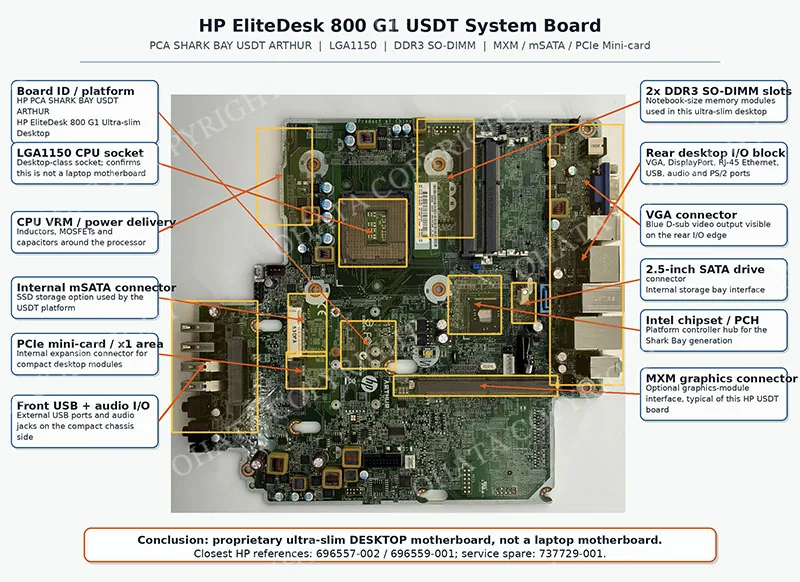
This is a desktop computer motherboard, not a laptop motherboard. It belongs to HP’s compact business desktop category, specifically the Ultra-slim Desktop version of the EliteDesk 800 G1 series. Its use of SO-DIMM memory may look similar to a notebook design, but the CPU socket, rear desktop I/O block, HP business desktop chassis layout, and 2.5-inch internal storage arrangement confirm that it is a proprietary ultra-slim desktop motherboard rather than a portable notebook board. HP’s QuickSpecs describe the EliteDesk 800 G1 Ultra-slim Desktop as a business PC with an internal mSATA connector, internal PCI Express mini-card connector, MXM graphics connector, 2.5-inch internal storage bay, VGA, two DisplayPort connectors, RJ-45 Ethernet, USB ports, audio jacks, and PS/2 keyboard and mouse ports.
The approximate launch period for this motherboard family is 2013. HP’s QuickSpecs for the EliteDesk 800 G1 Ultra-slim Desktop are dated July 18, 2013, placing this board in the first generation of HP EliteDesk 800 business desktops built around Intel’s Haswell “Shark Bay” platform.
The motherboard uses the Intel Q87 Express chipset, which is part of the Haswell-era business desktop platform. HP documentation describes the EliteDesk 800 G1 series as using the Intel Q87 chipset supporting Intel 4th Generation Core processors, integrated Intel HD Graphics, and Intel vPro technology on selected processors. The Q87 Platform Controller Hub is visible as a square BGA chipset on the motherboard and contributes to the board’s recoverable semiconductor value, although it is not considered a high-grade ceramic processor or telecom-grade ASIC.
The memory configuration is compact but business-class. HP specifications list DDR3 non-ECC memory, up to 1600 MT/s, with a maximum capacity of 16 GB using two SO-DIMM slots. The board has two notebook-style memory slots, usually supporting 2 × 8 GB DDR3 or DDR3L SO-DIMM modules depending on processor, BIOS, and HP configuration. These SO-DIMM connectors contain gold-plated contacts and are important visible indicators for scrap inspection.
Graphics support is provided in two ways. First, the motherboard can use Intel integrated HD Graphics, which depends on the installed Haswell processor. Second, the board provides an MXM graphics connector, and HP lists an optional AMD Radeon HD 7650A MXM discrete graphics solution for the Ultra-slim Desktop. When an MXM graphics card is installed in the USDT configuration, HP notes that all three monitor ports can be active. For recycling valuation, the removable MXM card, if present, may be separated and graded as its own graphics board. The motherboard itself remains a desktop motherboard scrap item even when the MXM card is absent.
Important onboard components include the Intel Q87 PCH, LGA1150 CPU socket, two DDR3 SO-DIMM memory slots, mSATA connector, PCI Express mini-card connector, MXM graphics connector, 2.5-inch SATA storage interface, slim optical drive interface, Intel I217LM Gigabit Ethernet controller, Realtek ALC221 HD audio codec, BIOS flash memory, voltage regulation MOSFETs, inductors, polymer capacitors, electrolytic capacitors, USB controllers, clock circuitry, and rear I/O shielding. HP specifications list the Intel I217LM Gigabit Network Connection and Realtek ALC221 audio codec for this platform.
The recycling value comes from several material groups. The most important base metal is copper, located in the internal PCB layers, voltage regulation circuitry, inductors, connector assemblies, and power traces. Gold is present in the CPU socket contacts, SO-DIMM slots, MXM connector, mini-card connector, mSATA connector, rear I/O contacts, and integrated circuit bond wires. Smaller amounts of silver, palladium, nickel, tin, and aluminum may also be recovered from solder alloys, multilayer ceramic capacitors, plated connectors, shielding, and any attached cooling hardware.
Compared with a standard low-cost consumer desktop motherboard, this HP board has several distinctive features: it combines a desktop LGA1150 CPU socket with compact SO-DIMM memory, includes an MXM graphics expansion interface, provides an mSATA slot, and belongs to HP’s business-class Q87 platform rather than a budget H81 or consumer multimedia design. It was normally used in HP EliteDesk 800 G1 Ultra-slim Desktop computers, but computer enthusiasts may also adapt it for custom projects when they can provide compatible HP power input, cooling, front-panel control, and chassis support. Because it is proprietary, it is less convenient for ordinary ATX personal builds than a standard retail motherboard.
Why Ohata Classifies It as D Grade
The official recycling classification for this motherboard is Ohata D Grade Computer Motherboard Scrap, assuming that the CPU is installed in the LGA1150 socket. This classification is based on the board’s identity as a modern Intel i-Series desktop motherboard with a metal load plate and lever-style LGA socket, integrated platform chipset, moderate IC density, compact business desktop construction, and limited precious metal concentration compared with older premium computer boards or industrial electronics. Ohata’s classification guide places later integrated desktop motherboards and i-Series metal-socket desktop boards in D Grade, while higher grades are reserved for boards with stronger enterprise, industrial, telecommunications, Apple logic board, or legacy ceramic CPU value.
This board does not meet A+ Grade because it is not an industrial controller, PLC CPU module, CNC machine controller, robotics controller, medical equipment board, Apple logic board, or large multi-socket enterprise server motherboard. Ohata’s A+ guidance emphasizes high integrated circuit density, premium multilayer PCB construction, industrial or enterprise application, large BGA processors, and specialized professional electronics. The HP ARTHUR board is a business desktop motherboard, not a high-density industrial or Apple logic board.
It also does not meet A Grade because it is not a non-Apple laptop motherboard with high compact density, a large single-socket server motherboard, a premium clean gold-finger expansion card, a CD/DVD controller board, an enterprise backplane, or an earlier high-grade NEC-style desktop motherboard. Ohata’s A Grade category covers high-quality computer boards with balanced semiconductor density and stronger recoverable material value than standard desktop motherboards. This HP motherboard is valuable and well constructed, but its modern integrated design and metal LGA socket place it below that class.
It does not meet B Grade or C Grade under the more detailed socket-based criteria because this board uses a modern Intel LGA socket with a metal retention cover and lever, rather than the older plastic socket categories referenced for many B and C desktop board classifications. B Grade generally includes medium-value boards such as lower-grade telecom boards, peripheral high-grade boards, entry-level server boards, and certain desktop boards with medium-value CPU socket designs. C Grade generally includes standard desktop motherboards, trimmed gold-finger cards, connector-end boards, and graphics/interface cards with moderate component density.
The D Grade decision is further confirmed by the board’s engineering characteristics. Ohata’s D Grade description covers lower-value computer motherboards and modern consumer or business desktop boards that have fewer discrete integrated circuits and lighter precious metal content than older or enterprise hardware. D Grade boards are evaluated by integrated circuit density, PCB construction, CPU socket type, connector coverage, copper distribution, component completeness, cooling hardware, condition, and intended equipment application. This HP ARTHUR board fits that profile closely: it has a modern LGA1150 socket, one main PCH, standard business desktop support chips, two memory slots, several connectors, moderate gold-plated contact areas, and a compact cost-optimized PCB.
The main visual identification features are:
HP branding and ARTHUR board marking: Confirms the HP proprietary system board family.
LGA1150 metal socket: Confirms Intel Haswell desktop CPU support and supports the D Grade classification.
Two DDR3 SO-DIMM slots: Confirms compact desktop construction rather than full-size ATX DIMM architecture.
Intel Q87 PCH: Confirms the HP business desktop Shark Bay platform.
MXM graphics connector: Distinguishes the Ultra-slim Desktop version from many ordinary office desktop boards.
mSATA and PCI Express mini-card connectors: Indicate compact storage and wireless expansion support.
Rear I/O block: VGA, two DisplayPort connectors, RJ-45 Ethernet, USB, audio, and PS/2 match the EliteDesk 800 G1 USDT platform.
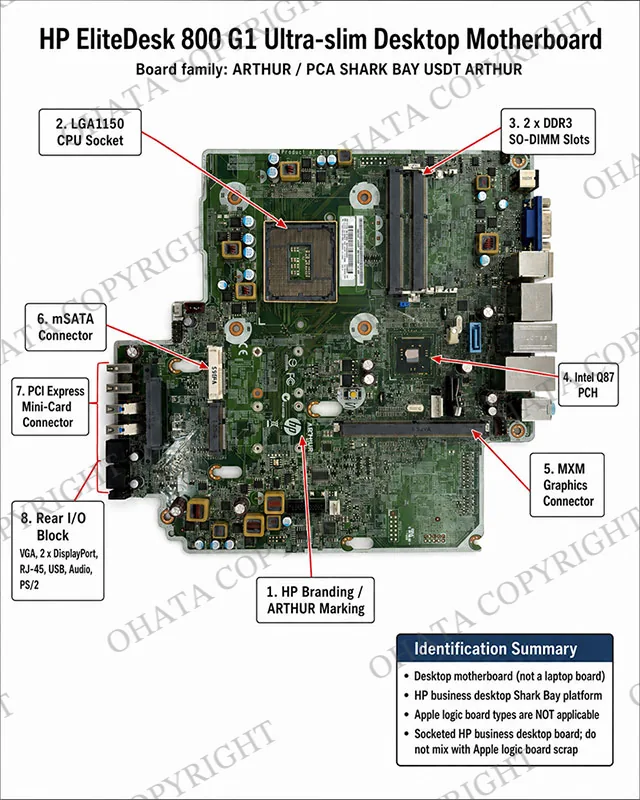
Apple logic board types are not applicable to this motherboard. Apple logic boards are usually compact macOS system boards from MacBook, MacBook Pro, MacBook Air, iMac, Mac Studio, or certain Mac Pro systems, and Ohata guidance commonly places Apple logic boards in A+ Grade because of their high-density BGA processors, advanced power management, multilayer PCB construction, and premium connector layout. The HP ARTHUR motherboard is a socketed HP business desktop board and should not be mixed with Apple logic board scrap.
Condition Rules | Recoverable Areas
The primary recoverable material in this motherboard is copper. Copper appears in the PCB’s internal power planes and signal layers, CPU voltage regulation circuits, chokes, inductors, connector assemblies, rear I/O structures, and ground distribution. Even when the board contains lower precious metal concentration than higher-grade telecom or industrial boards, copper remains the largest material contributor by weight.
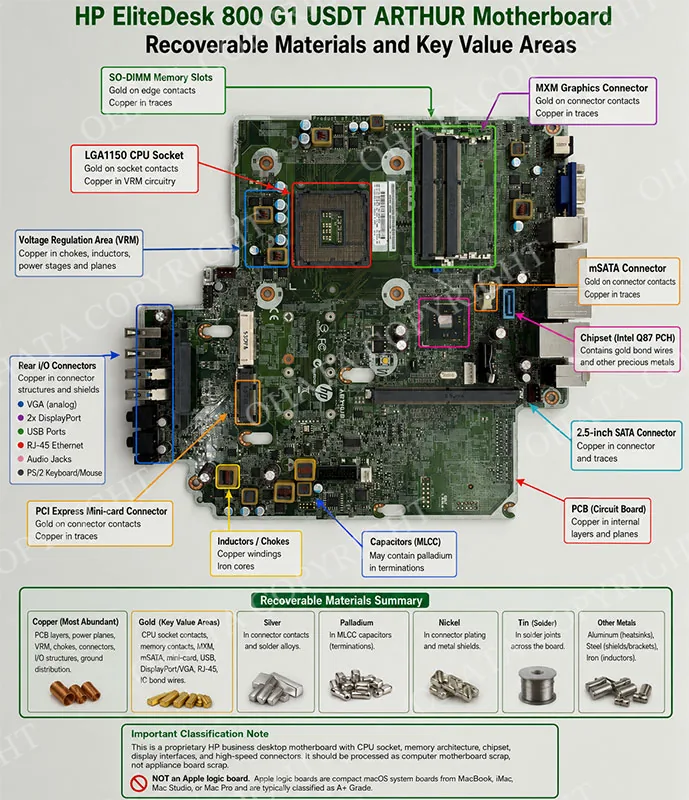
Gold-bearing areas include the LGA1150 CPU socket contacts, SO-DIMM memory contacts, MXM graphics connector, mSATA connector, PCI Express mini-card connector, USB contacts, DisplayPort and VGA-related connector contacts, RJ-45 interface contacts, and bond wires inside integrated circuits. The amount of gold is limited compared with S Grade legacy boards, SS Grade telecom boards, or A+ Grade industrial boards, but it remains meaningful when processed in volume.
Other recoverable materials include silver in selected contacts and solder alloys, palladium in multilayer ceramic capacitors, nickel in connector plating and shields, tin in solder, aluminum in heatsinks if attached, and steel in brackets or I/O shielding. The board should be processed as computer motherboard scrap rather than appliance board scrap because it contains a CPU socket, memory architecture, display interfaces, chipset, high-speed data connectors, and digital computing circuitry.
For buying and grading, the motherboard should remain as complete as possible. Under the assumed grading condition, the CPU should be installed in the LGA1150 socket because an installed processor increases value and provides additional gold-plated contact surfaces, silicon, copper, and precious metal-bearing internal construction. A board without a CPU may still be recyclable, but its value is lower than a CPU-installed board, and a lot quoted specifically as “with CPU” may be downgraded if processors are missing.
Permanent electronic components should not be stripped. The Intel Q87 chipset, BIOS flash, network controller, audio codec, VRM MOSFETs, chokes, capacitors, CPU socket, memory sockets, mSATA connector, mini-card connector, MXM connector, SATA interfaces, and rear I/O ports should remain attached. Ohata’s D Grade buying standard states that permanent electronic components such as processors, memory devices, chipsets, connectors, and voltage regulation circuits directly contribute to recoverable value.
Acceptable removals generally include non-electronic or low-precious-metal mechanical accessories such as aluminum heatsinks, cooling fans, steel brackets, external shields, plastic covers, loose cables, and decorative chassis parts. These items may be removed to reduce shipping weight and improve inspection efficiency. However, removal should not damage the PCB, socket, chipset, or connectors.
Preferred condition for this motherboard is complete, dry, clean, and structurally intact. The board should retain the CPU socket, PCH, all major ICs, memory slots, MXM connector, mSATA connector, rear I/O connectors, and voltage regulation section. Minor dust, faded labels, light scratches, or normal handling wear usually does not affect classification. Severe corrosion, water exposure, burn marks, battery leakage, oil contamination, missing chips, cut board sections, broken corners, lifted pads, removed connectors, or cracked PCB layers can reduce the grade or cause rejection.
Rejected or downgraded conditions include:
Missing CPU when the purchase standard requires CPU-installed boards.
Removed Intel Q87 chipset or other major BGA components.
Broken or cut PCB sections.
Missing CPU socket, SO-DIMM slots, MXM connector, or rear I/O connector block.
Heavy corrosion, burned areas, water intrusion, or chemical contamination.
Mixed garbage such as plastics, wires, batteries, screws, loose metal, appliance boards, and unrelated low-grade electronics.
Boards packed with household waste, oil-contaminated parts, swollen batteries, or hazardous material.
Broken, incomplete, and mixed material lowers recycling value because the buyer must spend more time sorting, cleaning, and separating non-recoverable materials. A lot containing clean HP desktop motherboards will usually be more consistent and valuable than a mixed lot containing desktop boards, appliance boards, loose metal, cables, plastic housings, and damaged circuit fragments. Proper sorting protects the D Grade classification and improves downstream recovery efficiency.
Final Classification
Compared with a standard full-size consumer ATX motherboard, the HP EliteDesk 800 G1 USDT ARTHUR board is more specialized. It uses a proprietary HP form factor, a compact layout, SO-DIMM memory, internal mSATA, mini PCIe, MXM graphics support, and a rear I/O arrangement designed for the HP Ultra-slim Desktop chassis. These features make it more technically interesting than many ordinary office desktop boards, but they do not raise it into industrial, server, telecom, or Apple logic board grade.
Compared with A Grade laptop motherboards, this board has a lower compact semiconductor density. Laptop boards often integrate CPU, GPU, memory interface, storage, wireless, display, and power management into a tighter BGA-heavy design, while this HP board uses a removable desktop CPU socket and a separate Q87 PCH. Compared with A+ Apple logic boards, it has less dense surface-mounted integration and fewer premium compact BGA packages. Compared with SS Grade telecom boards, it lacks multiple communication ASICs, optical networking interfaces, carrier-grade switching hardware, and very high IC density. Compared with S Grade legacy boards, it lacks ceramic CPUs, older thick gold-plated expansion structures, and the heavy discrete-chip architecture common in older premium computer boards.
Compared with C Grade boards, this motherboard may appear similar because it is a standard computer motherboard with moderate component density and good copper content. However, the Ohata socket-based and modern-platform criteria place Intel i-Series motherboards with metal socket covers and integrated modern architecture into D Grade, especially when the board does not show the higher-value traits of server, telecom, industrial, Apple, or legacy ceramic CPU hardware. Ohata guidance explains that modern desktop motherboards often contain fewer individual ICs and lower precious metal concentration because many functions are integrated into the processor and chipset.
The official Ohata classification is therefore:
Ohata D Grade – HP EliteDesk 800 G1 USDT ARTHUR Desktop Motherboard Scrap, assuming CPU installed.
The classification should be recorded with the following descriptive identifiers: HP, EliteDesk 800 G1 Ultra-slim Desktop, ARTHUR Rev. A family, PCA SHARK BAY USDT ARTHUR, LGA1150 / Socket H3, Intel Q87 chipset, DDR3 SO-DIMM, MXM graphics connector, mSATA, and business desktop motherboard scrap.
This board is accepted as D Grade when it is complete, clean, dry, structurally intact, and retains its major electronic components. It is more valuable when the CPU is present. It may be downgraded if the CPU is missing from a CPU-included lot, if the PCH or other major ICs are removed, if connectors are stripped, if the PCB is broken, or if the board is mixed with low-grade appliance boards, wires, plastics, loose metals, batteries, or general garbage. Complete component integrity is the most important practical requirement for preserving classification value.
Ohata MotherBoard Scrap Wiki Claim
The Ohata Wiki is an educational knowledge base developed and maintained by Ohata to provide information on electronic scrap identification, recycling technologies, material classification, and sustainable resource recovery. The content published in the Ohata Wiki is based on Ohata's operational experience, research, and educational objectives. It is intended to assist recyclers, businesses, researchers, students, and the public in understanding electronic materials and recycling practices.
The Ohata Wiki is designed as an educational reference only. It does not replace professional technical advice, engineering analysis, laboratory testing, or official industry standards.
Ohata MotherBoard Classification Claim
The Ohata MotherBoard Classification System is a proprietary educational classification created by Ohata based on the company's internal recycling knowledge and operational experience. It is intended solely for educational and identification purposes. It is not an international standard, government specification, or universally accepted industry grading system. Classification methods, purchasing requirements, and recycling practices may differ among companies, regions, and markets.
Ohata MotherBoard Scrap Wiki Page Copyright
© 2026 Ohata. All Rights Reserved.
Match the system-board label to the verified HP spare-number list, keep the CPU socket, Q87 chipset, SODIMM and MXM connectors intact, and confirm Ohata's current D Grade acceptance rule before delivery.