

Dell T310 Identification Checklist
The Dell PowerEdge T310 system board is a single-socket server motherboard identified by Dell DP/N 02P9X9, an LGA1156 socket, six DDR3 DIMM slots and five PCIe Gen2 slots. Under Ohata's internal scrap rules, a complete T310 board is classified as A Grade. Use the photos and condition table below to confirm the part number, installed CPU, socket condition and major components before checking the linked buying price。
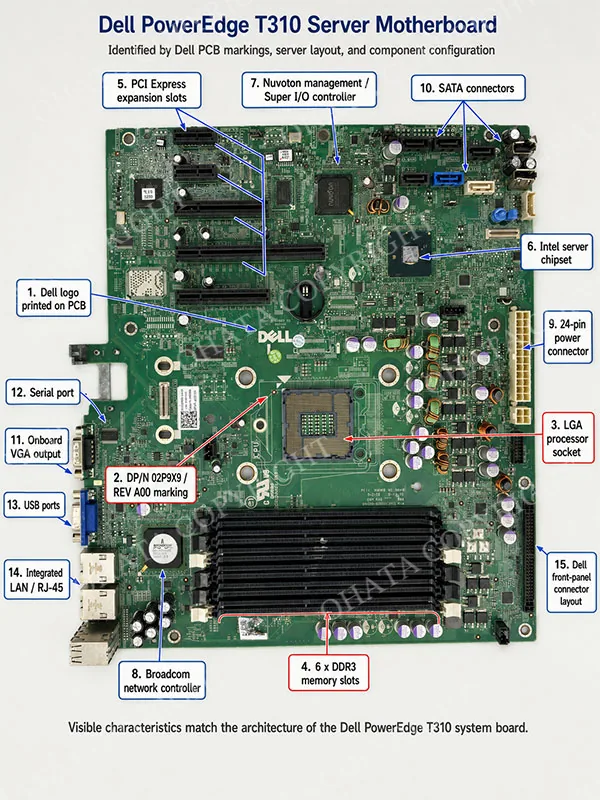
integrated Broadcom network controller, Nuvoton management or Super I/O controller, Intel server chipset, onboard VGA output, serial port, USB ports, SATA connectors, and Dell-specific front-panel connector layout all match the architecture of the Dell PowerEdge T310 system board.
This motherboard was released around the 2009–2011 period, during the Intel Nehalem and Lynnfield server platform generation. The Dell PowerEdge T310 was an entry-level tower server intended for offices and small businesses that required better reliability than a standard desktop computer. The motherboard was designed to support one Intel LGA1156 processor, ECC DDR3 memory, multiple PCI Express expansion devices, onboard server management functions, and storage connections suitable for a tower server chassis.
The CPU socket is Intel LGA1156, also known as Socket H. This socket uses 1,156 land-grid contacts and accepts compatible Intel Xeon 3400 series processors, along with selected Intel Core i3, Pentium, and Celeron processors supported by the PowerEdge T310 BIOS and chipset. The physical CPU package size for LGA1156 processors is approximately 37.5 mm × 37.5 mm. The socket itself is a metal load-plate LGA design with a locking lever, and the processor makes contact through the socket lands rather than pins on the CPU package. From a recycling perspective, the LGA socket is valuable because it contains a dense array of gold-plated contact points. When a compatible CPU is installed, the total recycling value increases because the CPU contributes additional semiconductor material, gold-plated contact surfaces, copper, nickel, and silicon.
The primary processor families associated with this motherboard include Intel Xeon X3400 series and L3400 series CPUs, such as the Xeon X3430, X3440, X3450, X3460, X3470, X3480, and low-power Xeon L3426. Depending on configuration, selected Intel Core i3 processors from the early LGA1156 generation may also be supported. These CPUs generally use Intel’s first-generation Core microarchitecture family and support DDR3 memory through an integrated memory controller. Typical thermal design power ranges from low-power server models around 45 W to higher-performance Xeon models around 95 W. The board’s voltage regulation section, visible beside the CPU socket, uses multiple MOSFETs, inductors, driver ICs, and solid capacitors to provide stable processor power.
The memory subsystem is one of the strongest identifying features of this board. It contains six DDR3 DIMM slots positioned along the lower portion of the motherboard. These slots support server memory rather than ordinary consumer memory only. The PowerEdge T310 platform commonly supports DDR3 ECC UDIMM and DDR3 ECC RDIMM memory, depending on CPU and BIOS configuration. Supported operating frequencies are typically 800 MHz, 1066 MHz, and 1333 MHz, with the final speed determined by processor, module type, rank configuration, and population rules. RDIMM and UDIMM types should not be mixed in the same system. The six-slot layout gives the board a much stronger server identity than ordinary microATX or ATX desktop boards from the same era.
For graphics, the Dell PowerEdge T310 motherboard is not designed as a gaming or workstation graphics platform. It normally uses basic onboard video for server console output, typically through a VGA port on the rear I/O section. The board also provides PCI Express expansion slots, allowing the installation of compatible low-profile or server-approved PCIe cards, such as RAID controllers, network adapters, storage controllers, or basic graphics cards. However, high-end gaming GPUs are not the intended use because the PowerEdge T310 chassis, power supply, BIOS, airflow design, and PCIe power delivery were engineered for server expansion rather than enthusiast graphics performance.
Several major electronic components define this motherboard’s recycling value. The Intel server platform chipset is located near the upper-middle section of the board and is responsible for I/O control, storage, PCI Express communication, USB, system management, and platform coordination. The Broadcom network controller provides integrated Ethernet connectivity and contains recoverable semiconductor material. The Nuvoton controller handles system monitoring, Super I/O, fan control, legacy I/O, or server board management support. The BIOS flash chip stores platform firmware. The VRM section contains copper-rich inductors, MOSFETs, driver ICs, and capacitors. The six DDR3 memory slots contain gold-plated internal contacts. PCI Express expansion slots also contain gold-plated contacts. Rear I/O ports, SATA connectors, USB ports, serial port, VGA connector, and power connectors contribute copper, nickel, steel, brass, and small amounts of precious metal plating.
The main recoverable material in this motherboard is copper. Copper is present in the internal PCB layers, power planes, signal traces, ground layers, CPU voltage regulation circuit, inductors, transformer windings, connector assemblies, and rear I/O structures. Gold is mainly found in the LGA1156 CPU socket contacts, DDR3 memory slot contacts, PCI Express slot contacts, integrated circuit bond wires, network connector contacts, and selected plated connector areas. Silver may be present in solder alloys and selected electrical contacts. Palladium may be present in multilayer ceramic capacitors. Nickel appears in connector plating, shielding, and contact finishes.
Because this board is a complete Dell server motherboard, its value is higher when the CPU remains installed. A bare board with the CPU removed still contains recoverable materials, but a complete board with the processor, chipset, sockets, memory slots, and connectors intact is more attractive for electronic recycling. Missing CPU and removed chipset ICs reduce the board’s total recoverable material value and may also make grading less favorable.
Why the T310 Is A Grade
Under the Ohata Board Scrap Classification System, this Dell PowerEdge T310 motherboard should be classified as Ohata A Grade Board Scrap, assuming the board includes the CPU by default. The most important reason is that it is a large single-socket server motherboard with a complete LGA1156 CPU socket, six DDR3 ECC memory slots, enterprise chipset architecture, server I/O design, PCI Express expansion support, and moderate-to-high integrated circuit density. Within the Ohata classification structure, large single-socket server motherboards fall within the A Grade category rather than ordinary desktop motherboard categories.
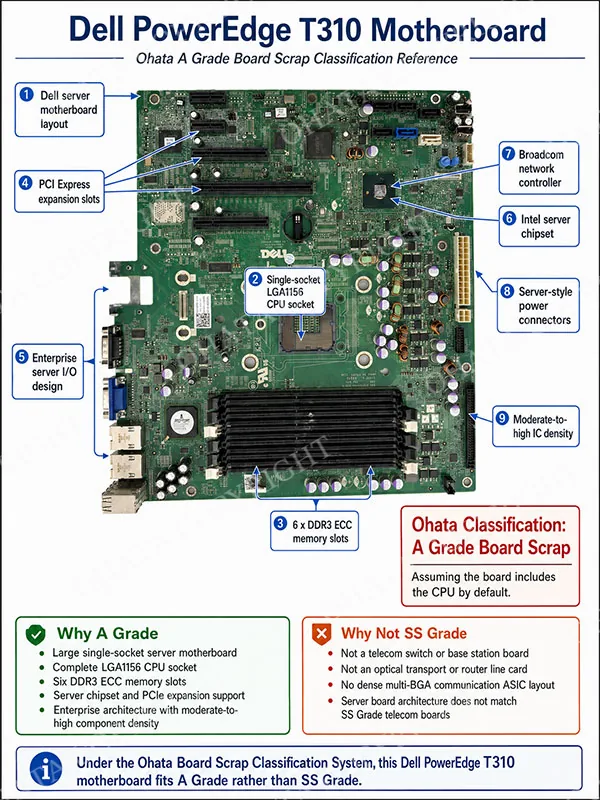
This board should not be classified as SS Grade because it is not a telecommunications switch board, cellular base station board, optical transport board, enterprise router line card, or dense server backplane with heavy communication ASIC coverage. It contains a server chipset and network controller, but it does not have the extremely dense multi-BGA communication processor layout typical of SS Grade telecom or enterprise networking boards.
It should not be classified as S Grade because it does not contain three or more ceramic CPUs and it is not a legacy high-gold computer board from the older ceramic processor generation. It uses a modern metal-load-plate LGA1156 socket and belongs to the first-generation Intel Xeon 3400 server era.
It should not be classified as A+ Grade because it is not a large multi-socket server motherboard, industrial automation controller, PLC CPU board, CNC control board, robotics control board, advanced medical control board, or Apple logic board. Although it is a server motherboard and has higher value than most ordinary desktop boards, its single-socket architecture and moderate component density place it more accurately in A Grade.
It should not be classified as B Grade when the CPU is assumed installed and the board remains complete. B Grade may include some medium-grade desktop motherboards, entry-level server boards, or lower-grade server boards, but the Dell PowerEdge T310 board has stronger enterprise characteristics than typical B Grade material. Its large server form factor, ECC memory support, LGA1156 server CPU socket, Broadcom network controller, PCIe expansion structure, and Dell PowerEdge application support A Grade classification.
This motherboard is not an Apple logic board. Apple logic boards are typically compact, high-density boards from MacBook, iMac, Mac mini, Mac Studio, or Mac Pro systems, often classified differently because of their dense BGA components and Apple-specific architecture. The Dell PowerEdge T310 motherboard is a server system board used in Dell PowerEdge tower servers. However, the comparison is useful because it explains why the board is not placed into the Apple logic board subgroup. It has a larger PCB area, socketed CPU design, DIMM-based memory architecture, server expansion slots, and tower-server I/O layout, while Apple logic boards normally use compact layouts with soldered processors, compact memory designs, and dense proprietary connector structures.
The identification process should focus on the following board features:
Dell brand marking on the PCB confirms the manufacturer.
The DP/N marking 02P9X9 identifies the Dell system board part family.
The LGA1156 socket confirms the Intel Xeon 3400 generation platform.
The six DDR3 DIMM slots confirm server memory architecture.
The PCI Express slots confirm expansion-card support for server add-in cards.
The Broadcom controller confirms onboard Ethernet capability.
The Nuvoton controller confirms system I/O or board management support.
The Intel chipset confirms the platform generation and server I/O architecture.
The Dell proprietary power and front-panel connectors confirm that the board was designed for a Dell server chassis rather than standard personal computer assembly.
This board was normally installed in the Dell PowerEdge T310 tower server. It may also be used by computer hobbyists, repair technicians, homelab builders, and server enthusiasts for personal assembly projects, but it is not a standard DIY ATX motherboard. Enthusiasts may reuse it for a custom home server, storage server, firewall, virtualization lab, or retro enterprise computing project, but they must account for Dell’s proprietary chassis wiring, power connections, cooling design, BIOS compatibility, and front-panel connector requirements.
Compared with ordinary desktop LGA1156 motherboards, the Dell PowerEdge T310 motherboard has several unique characteristics. It supports ECC server memory, uses a server-oriented Intel chipset, provides enterprise expansion slots, includes server management circuitry, and was built for 24/7 reliability. A consumer LGA1156 board may include more multimedia ports or gaming features, but it usually lacks the same server memory validation, management design, and enterprise platform stability. Compared with larger dual-socket PowerEdge boards, the T310 board is simpler and lower in total component density, but it remains valuable because it is complete, large, and server-grade.
Condition Rules and Buying Link
The Dell PowerEdge T310 motherboard contains many recoverable materials commonly targeted in professional electronics recycling. The most important recoverable metal by weight is copper. Copper appears in the internal PCB layers, CPU power delivery section, inductors, power planes, signal traces, memory slot connections, rear I/O ports, and power connectors. Because server boards are designed to handle stable power delivery and continuous operation, they often contain strong copper distribution compared with smaller consumer control boards.
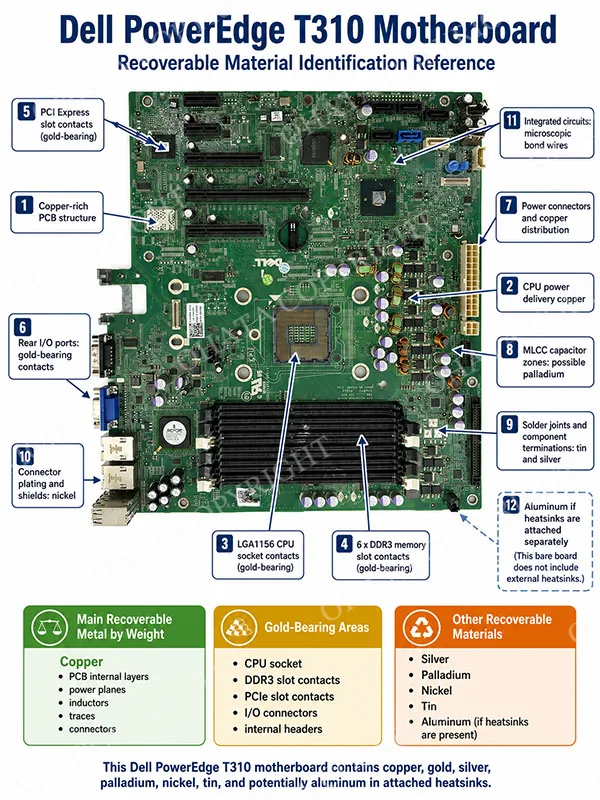
Gold-bearing areas include the LGA1156 CPU socket contacts, DDR3 memory slot contacts, PCI Express slot contacts, Ethernet connector contacts, USB connector contacts, serial and VGA interface contacts, selected internal headers, and microscopic bond wires inside integrated circuits. Gold content is not as high as in SSS, SS, or S Grade boards, but it remains meaningful in large recycling volumes, especially when the board is complete and includes the CPU.
Silver may be recovered from solder alloys, selected contacts, and certain electronic component structures. Palladium may be present in multilayer ceramic capacitors distributed around the CPU socket, memory area, chipset, and power management circuits. Nickel is present in connector plating, shielding, and contact surfaces. Tin is present in solder. Aluminum may be present if heatsinks are attached, although external heatsinks are usually treated separately from the board itself.
The CPU is especially important for value. When a compatible Intel Xeon or Intel Core processor remains installed in the LGA1156 socket, the board becomes more desirable. The CPU contains a silicon die, package substrate, nickel-plated heat spreader, internal bonding materials, and contact pads. Even if the system no longer functions, the presence of the CPU improves the overall recycling value. For Ohata grading, this article assumes the board includes the CPU by default.
The motherboard should remain complete and structurally intact. The best recycling condition is a clean, dry board with the CPU socket intact, chipset present, memory slots present, PCIe slots present, rear I/O ports present, power connectors present, and major ICs still attached. Minor dust, normal cosmetic scratches, or age-related discoloration usually do not prevent recycling. However, the board must not be stripped of its main electronic components.
Ohata buying standards for this board should emphasize completeness. The following conditions help preserve A Grade value:
The CPU should remain installed when possible.
The LGA1156 socket should not be damaged.
The Intel chipset should not be removed.
The Broadcom network controller should remain attached.
The Nuvoton controller and BIOS chip should remain attached.
The DDR3 memory slots should not be cut off.
The PCI Express slots should remain intact.
The rear I/O connectors should remain attached.
The PCB should not be broken, burned, heavily corroded, or contaminated.
Certain attachments may be removed without seriously harming the board grade. These include loose cables, plastic housings, steel chassis pieces, external brackets, cooling fans, and large removable aluminum heatsinks. Removing bulky non-board material can improve shipping efficiency and inspection accuracy. However, removing IC chips, sockets, connectors, or gold-bearing parts directly reduces material value.
Not accepted conditions include empty PCB boards, boards with removed chipset ICs, boards contaminated with hazardous materials, and severely burned boards. An empty PCB board is not equivalent to a complete server motherboard because the gold-bearing connectors, IC packages, and semiconductor materials have been removed. A board with missing chipset ICs cannot be graded the same way as a complete Dell PowerEdge T310 board because the high-value semiconductor packages are part of the grading basis. Boards contaminated with oil, chemicals, mud, hazardous residues, battery leakage, or unknown industrial waste may be rejected or heavily downgraded. Severely burned boards may lose identifiable features and contain oxidation, ash, and damaged materials that reduce recovery efficiency.
Several conditions may cause value downgrading rather than full rejection. Broken corners, missing small connectors, light corrosion, missing heatsinks, removed CMOS battery, or missing memory modules may reduce value slightly but may not eliminate the board’s classification if the motherboard remains complete overall. More serious downgrading occurs when the CPU socket is damaged, the CPU is missing, chipset ICs are removed, large PCIe or memory connectors are cut off, the PCB is cracked through major circuit areas, or the board is mixed with lower-grade appliance boards and unsorted scrap.
Mixed miscellaneous loads reduce recycling value because they require extra sorting time. A clean lot of Dell server motherboards can be inspected and graded more efficiently than a mixed load containing appliance boards, power supply boards, low-grade automotive boards, plastic housings, wires, batteries, and broken fragments. Mixed material may be downgraded because the buyer must account for labor, contamination risk, and inconsistent recovery value. For best results, this board should be separated from low-grade appliance boards, power supply boards, dirty boards, and unrelated mixed e-waste.
This motherboard is valuable even when it no longer works. Functional testing is not normally required for scrap recycling because the board is purchased for recoverable materials rather than reuse. However, physical condition matters. A non-working but complete Dell PowerEdge T310 motherboard with CPU installed can retain strong A Grade scrap value. A working board may have additional resale or refurbishment value, but scrap grading focuses on component completeness, material content, and board classification.
Final T310 Classification
The Dell PowerEdge T310 motherboard occupies an important middle-high position among computer motherboard scrap. It is more valuable than most standard consumer desktop motherboards because it is a server board with ECC memory support, a large PCB, enterprise chipset architecture, multiple expansion slots, and stronger power regulation. It is also more valuable than low-grade appliance boards, power supply boards, and simple control boards because it contains higher integrated circuit density, more gold-plated connectors, a full CPU socket, and server-grade electronic construction.
Compared with ordinary LGA1156 desktop boards, the PowerEdge T310 board has a more business-oriented design. A consumer board from the same era may include audio jacks, consumer graphics options, and standard ATX connectors for personal computers. The Dell server board instead prioritizes ECC memory, server stability, integrated management, storage expandability, and long-duty operation. This difference makes it more suitable for A Grade classification than standard consumer boards.
Compared with large dual-socket or quad-socket server motherboards, the T310 board is lower in total processor count and memory bandwidth. Large multi-socket server boards may qualify for A+ Grade when they contain two or more CPU sockets, dense memory banks, larger chipsets, and higher enterprise complexity. The T310 remains a single-socket server board, which is why A Grade is the more accurate classification.
Compared with SS Grade telecom boards, this motherboard has less specialized communication hardware. SS Grade boards often contain multiple large networking ASICs, optical communication interfaces, dense BGA processors, and carrier-grade routing or switching architecture. The T310 includes Ethernet and server expansion capability, but it is not a telecom switch controller or optical communication board. Therefore, it should remain in A Grade rather than SS Grade.
Compared with S Grade legacy ceramic CPU boards, the T310 has a newer LGA socket and does not contain multiple ceramic processors. S Grade is often associated with boards that contain three or more ceramic CPUs, older premium computer boards, or non-SATA hard drive controller boards with high precious metal value. The T310 is a modern server board from the Xeon 3400 era, so it does not fit the S Grade legacy ceramic CPU profile.
Compared with Apple logic boards, the T310 is much larger and less compact. Apple boards often contain soldered BGA processors, compact high-density layouts, and proprietary notebook or all-in-one structures. The Dell board uses a socketed CPU, six full-size DIMM slots, PCIe expansion slots, and tower-server I/O. Both types can be valuable, but their classification basis is different.
Official Ohata classification for this board:
Brand: Dell
Model: Dell PowerEdge T310 Server Motherboard
Dell Part Number: DP/N 02P9X9
PCB Revision: REV A00
Computer Type: Tower server motherboard, not laptop motherboard
Typical System: Dell PowerEdge T310
Release Period: Approximately 2009–2011
CPU Socket: Intel LGA1156 / Socket H
CPU Package Size: Approximately 37.5 mm × 37.5 mm
Supported CPU Family: Intel Xeon 3400 series, selected Intel Core i3, Pentium, and Celeron LGA1156 processors depending on BIOS support
Memory Type: DDR3 ECC UDIMM or DDR3 ECC RDIMM
Memory Slots: Six DDR3 DIMM slots
Graphics Support: Basic onboard VGA for server display; PCI Express expansion for compatible add-in cards
Main Chipset: Intel server platform chipset for the Xeon 3400 generation
Network Controller: Broadcom Ethernet controller
Management / I/O Controller: Nuvoton controller
Expansion: Multiple PCI Express slots for server expansion cards
Storage Interfaces: SATA connectors and server storage support through onboard or add-in controller configuration
Ohata Classification: A Grade Board Scrap
Classification Assumption: CPU installed by default
Value Condition: Highest when complete, clean, dry, and not stripped
The final classification is Ohata A Grade Board Scrap. This classification is based on its identity as a large single-socket Dell server motherboard with LGA1156 CPU support, six DDR3 ECC memory slots, enterprise chipset architecture, multiple PCI Express expansion slots, onboard server I/O, and complete recoverable electronic construction. The board should be purchased and handled as A Grade when it remains complete and includes the CPU. Missing CPU, removed chipset ICs, broken PCB sections, severe contamination, heavy corrosion, burn damage, or mixed miscellaneous scrap may reduce its value or cause rejection depending on severity.
For recycling, this Dell PowerEdge T310 motherboard should be kept intact, sorted separately from lower-grade electronic boards, and protected from moisture, dirt, and physical damage. Its best value comes from complete server construction, installed CPU, intact LGA1156 socket, full memory connector set, PCIe slots, chipset ICs, network controller, and power regulation components. When properly sorted and preserved, it represents a strong A Grade server motherboard within the Ohata Board Scrap Classification System.
Ohata MotherBoard Scrap Wiki Claim
The Ohata Wiki is an educational knowledge base developed and maintained by Ohata to provide information on electronic scrap identification, recycling technologies, material classification, and sustainable resource recovery. The content published in the Ohata Wiki is based on Ohata's operational experience, research, and educational objectives. It is intended to assist recyclers, businesses, researchers, students, and the public in understanding electronic materials and recycling practices.
The Ohata Wiki is designed as an educational reference only. It does not replace professional technical advice, engineering analysis, laboratory testing, or official industry standards.
Ohata MotherBoard Classification Claim
The Ohata MotherBoard Classification System is a proprietary educational classification created by Ohata based on the company's internal recycling knowledge and operational experience. It is intended solely for educational and identification purposes. It is not an international standard, government specification, or universally accepted industry grading system. Classification methods, purchasing requirements, and recycling practices may differ among companies, regions, and markets.
Ohata MotherBoard Scrap Wiki Page Copyright
© 2026 Ohata. All Rights Reserved.
Confirm the Dell DP/N, keep the CPU socket and major ICs intact, and separate the board from lower-grade mixed scrap. Check the current Dell PowerEdge T310 buying price and acceptance conditions before delivery