

Canada | How to Identify Server Motherboards for Recycling in Vancouver
Good morning, I’m Han Han. Today is August 20, 2026.
If you have ever opened an old server and looked at the large green board inside, you may have wondered, “Is this really a server motherboard, and how should I sort it for recycling?”
You do not need to be a server technician to make a useful first identification. A few visible clues—CPU sockets, memory slots, expansion slots, major chips, and overall condition—can tell you a lot.
Vancouver is having pleasant late-summer weather today, with partly sunny conditions and temperatures reaching the mid-20s Celsius. It is a good reminder to keep any circuit boards you are sorting somewhere dry and protected from moisture.
There is also something familiar coming up on Vancouver’s summer calendar: the 2026 PNE Fair runs from August 22 through September 7. citeturn491028search5turn491028search16
Today, though, let’s look at something you may find during a server-room cleanout: a dual-socket server motherboard.
What Does a Server Motherboard Look Like?
When I identify a server motherboard, I usually start with the processor area.
A normal desktop motherboard commonly has one CPU socket. A server motherboard may have two or more, along with many memory slots and several expansion-card positions.
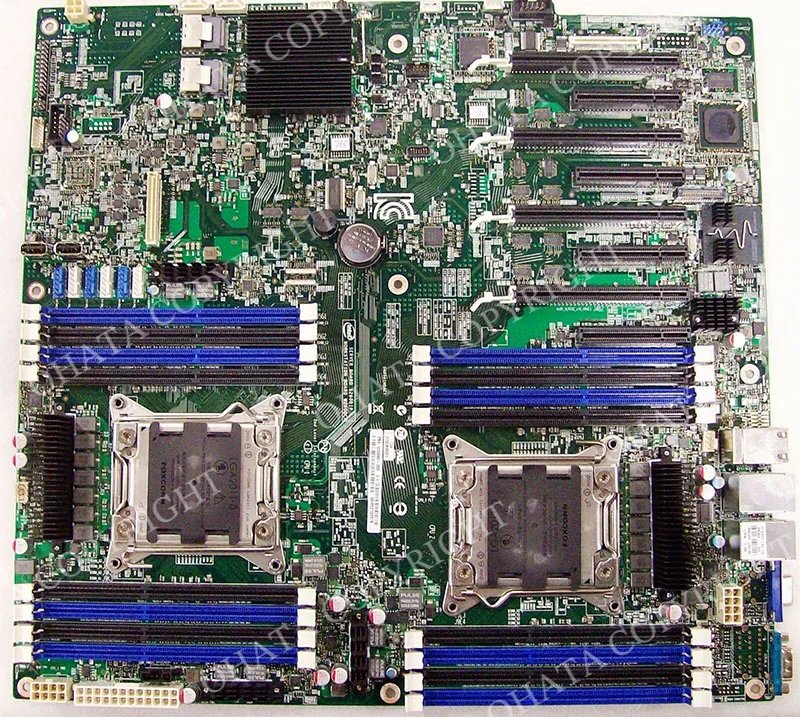
The board in today’s photo gives us several useful clues right away. You can see two large CPU sockets, several rows of memory slots, multiple PCIe positions, large heatsinks, and dense server-oriented circuitry.
If you are new to electronic scrap sorting, you do not need to recognize every small component. Start with these larger visual features first.
[Original Photo 2 – Add an original back-side photo or a close-up photo of the CPU socket and memory-slot area before publishing]
Recommended Alt Text: Close-up of server motherboard CPU sockets and DIMM slots used to identify a server board for recycling in Vancouver.
What Did Ohata AI Identify?
I also submitted the board image to Ohata.AI Vision for a preliminary identification.
The system recognized the item as a Motherboard (Server) and identified Intel as the manufacturer. It suggested that the visible layout is consistent with the Intel Server Board S2600IP family.
That is a reasonable family-level identification. Intel’s S2600IP family includes dual-processor server boards supporting two Xeon E5-2600-family CPUs and 16 DIMM slots, which matches several of the major features visible here. citeturn491028search0turn491028search1
Still, I would not use one photograph to guarantee an exact model or SKU. A label may be hidden, and similar boards can share very similar layouts.
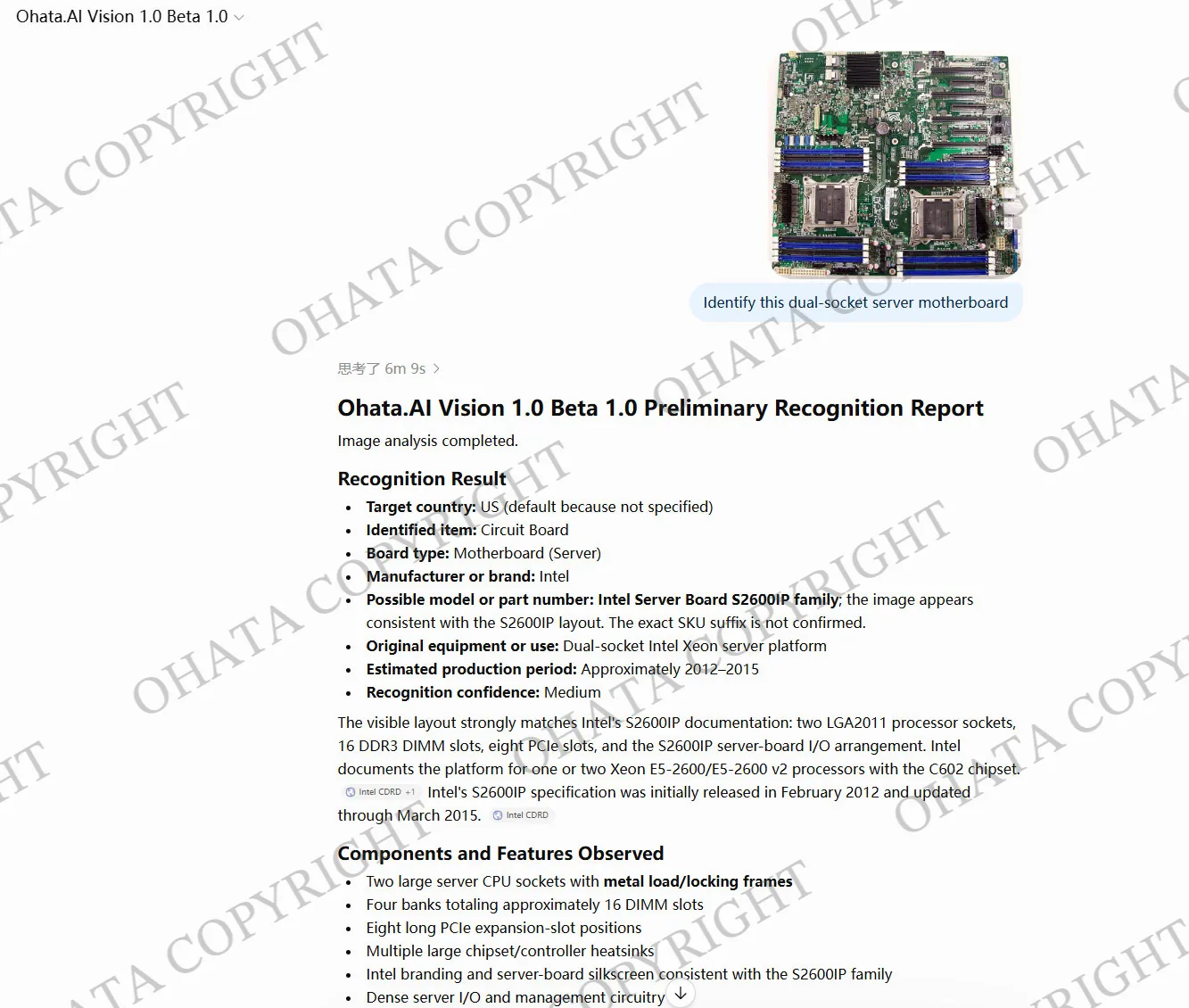
That is how I like to use AI for e-scrap identification: as a helpful first step, followed by a closer look at the actual board.
Five Easy Clues for Identifying a Server Motherboard
If you have several unknown circuit boards in front of you, here are five things I would check.
1. CPU sockets
Two or more large processor sockets are a strong server-board clue. The socket design can also matter later when the board is graded.
2. Memory slots
Server boards often have many DIMM slots arranged around each processor because enterprise systems are designed to support larger amounts of memory.
3. Expansion slots
Multiple PCIe positions may be used for network cards, storage controllers, and other server hardware.
4. Server I/O and controller chips
Look for dense network, storage, and system-management circuitry rather than only the familiar connectors found on a home PC.
5. Overall board size and layout
Server motherboards are often larger and more densely populated than ordinary desktop boards.
The key is to look at the whole layout instead of relying only on the manufacturer’s logo.
Why Is This Server Motherboard D Grade?
This is the part that often surprises people.
At first glance, today’s motherboard looks substantial. It has two CPU sockets, many memory slots, expansion positions, and plenty of circuitry. So it is understandable to assume that a large server board must automatically belong to a high recycling grade.
But that is not how the Ohata classification works.
For this board, the important detail is the metal CPU retention frame.
Under the Ohata server-motherboard classification, server motherboards with metal-framed CPU sockets are placed in D Grade. fileciteturn1file2L435-L456
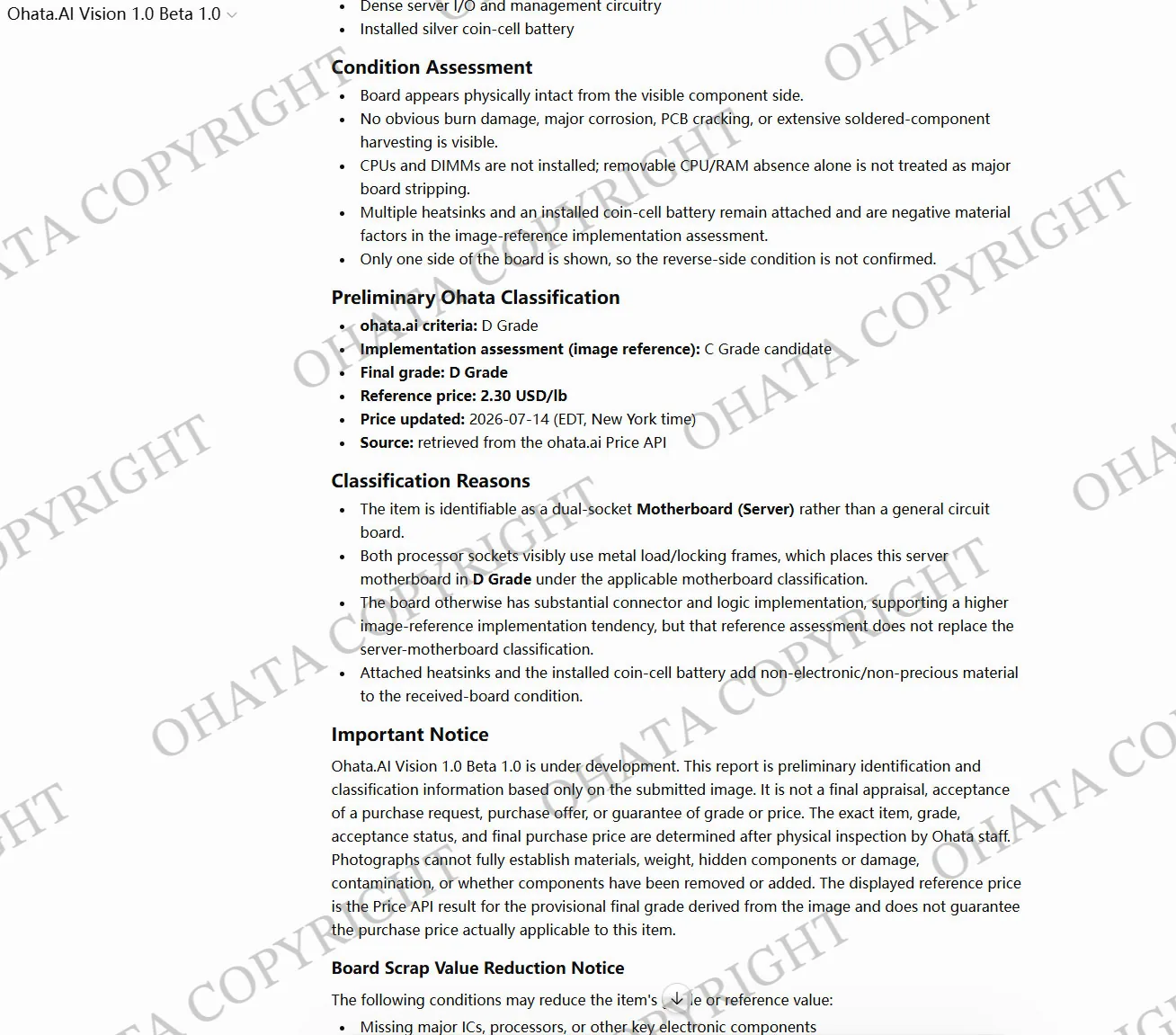
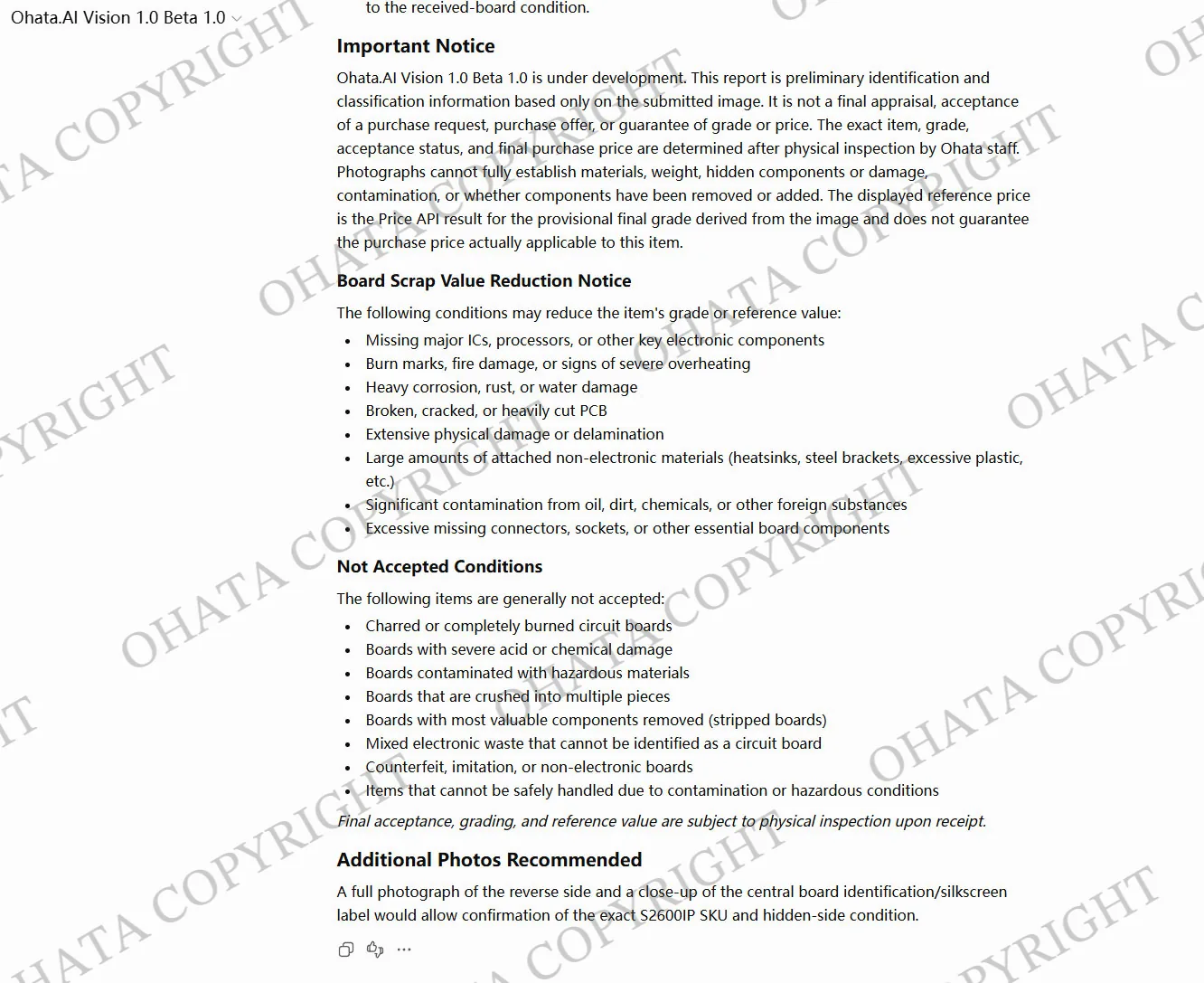
This does not mean the board has no recycling value. D Grade is simply the category used for this type of motherboard under the Ohata system.
You can compare different grades in the Ohata Board Scrap Classification Guide and the D Grade Circuit Board Guide.
Which Components Are Worth Looking At?
When I inspect a server motherboard, I focus on the parts that tell me whether the board is complete and what type of board it is.
The main areas include the CPU sockets, DIMM slots, large controller ICs, chipsets, PCIe connectors, and server I/O.
The PCB itself also contains copper and other recoverable materials. Some contacts and connectors may contain precious-metal-bearing materials as well.
However, a gold-colored connector does not tell us exactly how much recoverable gold is inside a board. Actual recovery depends on the board’s construction and the downstream refining process.
That is why visual identification is useful for sorting, but it should not be used to make unsupported claims about exact precious-metal content.
Complete vs. Damaged or Stripped Boards
A server motherboard does not need to have its removable CPU and RAM installed to remain a reasonably complete motherboard.
What I look for instead is whether the board’s main soldered components and structures are still present.
Examples of conditions that can affect evaluation include:
major ICs removed from the PCB
missing CPU sockets or major connectors
cut or broken PCB sections
severe corrosion
heavy burn damage
chemical or oil contamination
extensive component stripping
The visible side of today’s board appears fairly complete, without obvious severe burning or major PCB breakage.
But there is an important limitation: we only have a clear photo of one side.
That is why the second original photo should ideally show the back of the motherboard. It can reveal corrosion, repaired areas, physical damage, or missing parts that may not be visible from the front.
How Should You Prepare Server Motherboards for Recycling?
My advice is simple: sort carefully, but do not over-dismantle.
Keep server motherboards separate from ordinary desktop motherboards, power-supply boards, cables, steel chassis parts, and household appliance circuit boards.
If CPUs, RAM, HDD controller boards, or expansion cards have already been removed, keep those items in separate groups. They may belong to different recycling categories.
Avoid cutting the motherboard or prying off soldered chips. Removing important components can make the board harder to identify and may affect its evaluation.
Also keep the boards dry. Corrosion caused by moisture is one of the easiest problems to avoid.
Many motherboards also contain a coin-cell battery. Do not crush, puncture, or intentionally damage the battery during sorting.
Server Motherboard Recycling in Vancouver and Richmond
For Vancouver-area sellers, Ohata Resource Canada Inc. operates its Canadian receiving location in Richmond.
If you are preparing server motherboards or other electronic scrap, checking the latest receiving information before visiting is a good idea—especially if you have a larger commercial quantity.
Useful internal resources include:
Before visiting, I recommend having a few clear photos and an approximate quantity or weight ready.
That makes the first conversation much easier.
Our Service Area
Ohata Resource Canada Inc. serves customers across Vancouver, Richmond, Burnaby, and Surrey, as well as other communities throughout Metro Vancouver. If you are preparing server motherboards, CPUs, RAM, network boards, or other electronic scrap in these areas, clear photos and basic sorting information can help make the initial identification and inspection process easier.
FAQ: Server Motherboard Recycling in Vancouver
1. How can I quickly tell a server motherboard from a desktop motherboard?
Start with the CPU sockets and memory layout. Two processor sockets, many DIMM slots, several PCIe positions, and dense server circuitry are useful clues.
2. Is every dual-socket server motherboard high grade?
No. The number of CPU sockets is only one factor. Socket construction, board design, components, completeness, and condition all matter.
3. Why is this motherboard D Grade?
Its CPU sockets use large metal retention frames. Under the Ohata server-motherboard rules, server boards with metal-framed CPU sockets fall into D Grade. fileciteturn1file2L454-L456
4. Does missing RAM mean the motherboard has been stripped?
Not necessarily. RAM is designed to be removable. Missing soldered chips, sockets, or major board components is more important when checking whether a board has been heavily stripped.
5. Should I remove CPUs before recycling the motherboard?
CPUs may have their own recycling category. If you are unsure how to separate them, take photos first rather than removing components unnecessarily.
6. Can a damaged server motherboard still be recycled?
Possibly. Minor wear is very different from severe burns, heavy corrosion, broken PCB sections, or contamination. Final acceptance depends on the actual condition.
7. Can Ohata AI identify an exact server motherboard from one photo?
It can provide a useful preliminary result, but front and back photos plus a clear model-number photo are better for confirming an identification.
8. Does the AI result guarantee the final purchase price?
No. AI recognition and grading are preliminary references. Final classification and purchasing value depend on physical inspection, condition, completeness, weight, attached materials, and current purchasing conditions.
One Last Tip
If you are new to server-board recycling, you do not need to memorize every motherboard model or every grade.
Start by looking at the CPU sockets, memory slots, main chips, and overall condition, then take clear photos of both sides.
For today’s example, the visible features support a preliminary identification as a dual-socket Intel server motherboard, likely from the S2600IP family. The metal CPU retention frames are the key feature behind its preliminary D Grade classification under the Ohata system.
Even a lower-grade server motherboard can contain recoverable copper and other electronic materials. Keeping these boards out of general waste and directing them into an appropriate recycling stream helps recover useful resources and reduce unnecessary electronic waste in Metro Vancouver.
Keep your boards dry, complete, and separated by category.
And if you are not sure what you have, a couple of clear photos are usually the best place to start.

Comments
0 comments