

C Grade vs D Grade — Scrap Identification & Recycling Guide
Overview
This grading system is not an internationally standardized classification. It is the Ohata company pricing grade standard for recycled circuit boards. Other recyclers may use different names, specifications, or purchasing rules for similar material. A board identified as C Grade under the Ohata system may therefore receive a different description elsewhere.
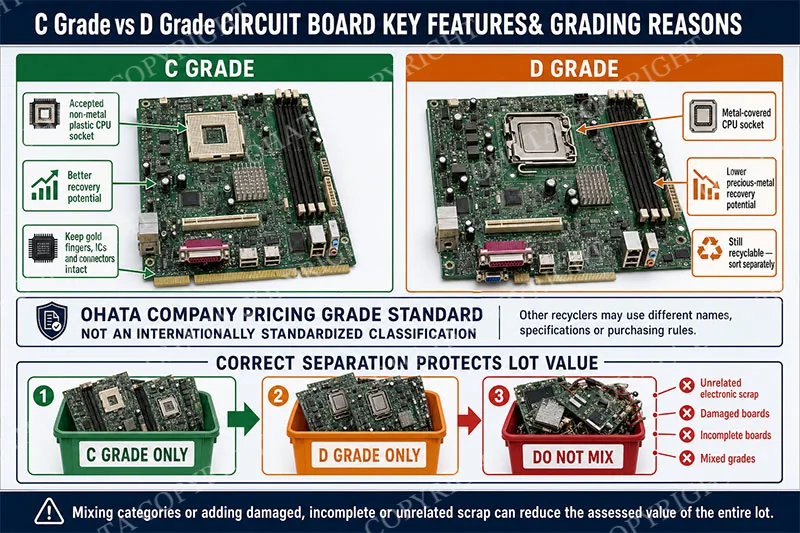
Correct separation is important because C Grade boards normally offer better recovery potential than D Grade boards. Mixing the two categories, adding unrelated electronic scrap, or delivering damaged and incomplete boards can reduce the assessed value of the entire lot.
C Grade Definition
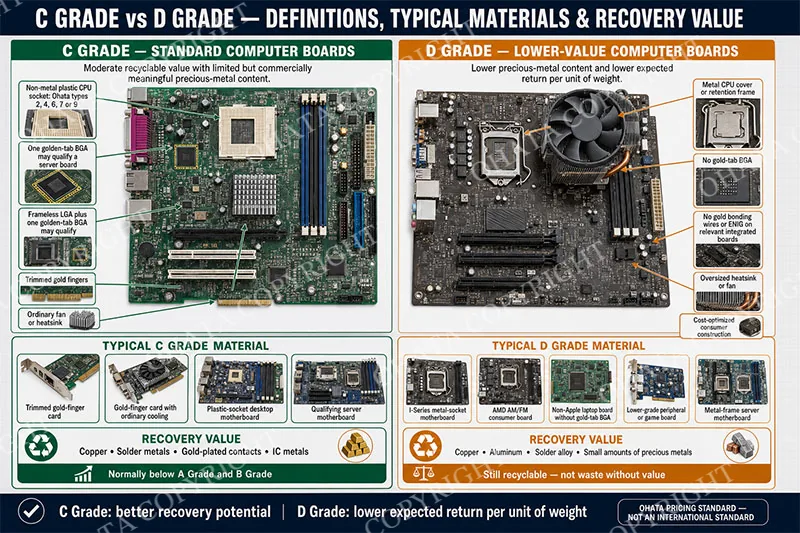
C Grade covers standard computer boards with moderate recyclable value and a limited but commercially meaningful concentration of precious metals. These boards are below higher computer-board grades because they generally have smaller or less valuable processor interfaces, fewer premium semiconductor packages, shorter gold fingers, or cooling assemblies that add non-valuable weight.
Typical C Grade material includes:
Trimmed gold-finger expansion cards.
Gold-finger cards with ordinary fans or heatsinks still attached.
Desktop motherboards fitted with non-metal plastic CPU sockets identified in the Ohata system as socket types No. 2, 4, 6, 7, or 9.
Server motherboards containing one golden-tab BGA processor.
Server motherboards with one frameless LGA CPU position and one golden-tab BGA processor.
C Grade remains useful for the recovery of copper, solder metals, gold-plated contact material, and metals contained in integrated circuits. However, its recoverable precious-metal concentration is normally lower than that of A Grade or B Grade computer boards.
D Grade Definition
D Grade consists of lower-value computer motherboards and peripheral boards designed with smaller quantities of recoverable precious metals. These products often come from newer, cost-optimized consumer computers or from peripheral equipment in which large cooling parts occupy substantial space and weight.
Typical D Grade material includes:
Integrated motherboards without gold bonding wires or an ENIG surface finish.
I-Series desktop motherboards whose CPU socket has a metal cover and locking lever.
Desktop motherboards with metal CPU sockets or metal retention frames.
AMD AM- and FM-platform consumer motherboards when their socket and construction correspond to the lower-value category.
Gold-finger cards carrying oversized heatsinks, cooling assemblies, or large fans.
Lower-grade peripheral boards.
Non-Apple laptop motherboards without a gold-tab BGA package.
Lower-value family game machine boards.
Server motherboards with metal CPU retention frames.
D Grade boards are still recyclable. They frequently contain worthwhile quantities of copper, aluminum, solder alloy, and small amounts of precious metals. Their lower classification does not mean that they are waste without value; it means that their expected return per unit of weight is below that of C Grade boards.
Principal Identification Difference
The most important dividing line between C Grade and D Grade is the design of the CPU socket and the presence of identifiable gold-bearing components.
A desktop motherboard with an accepted non-metal plastic socket type—specifically No. 2, 4, 6, 7, or 9 in the Ohata reference system—normally belongs to C Grade. If the desktop board instead uses a metal-covered socket, a metal lever assembly, or a substantial metal retention frame, it normally belongs to D Grade.
For server boards, a golden-tab BGA processor can support C Grade classification. A server motherboard with one golden-tab BGA CPU may qualify as C Grade, as may a board with one frameless LGA CPU position accompanied by one golden-tab BGA CPU. If the server motherboard has a metal socket frame, it belongs to D Grade under this comparison.
Cooling equipment also affects identification. A gold-finger card with a normal fan or heatsink can remain within C Grade. When the fan, heatsink, or cooling assembly is oversized and represents a large portion of the material, the card is normally D Grade. The added aluminum, steel, or plastic increases gross weight without providing the same precious-metal return as the underlying circuit board.
Common Sources of C Grade Boards
C Grade boards mainly originate from conventional desktop computers, older office systems, standard servers, and reusable computer expansion hardware. Common sources include business desktop computers, school computer rooms, office equipment replacement programs, repair shops, data-processing equipment, and dismantled computer towers.
Trimmed expansion cards may come from graphics adapters, network cards, sound cards, storage controllers, modem cards, and other computer interfaces. Their original gold-plated connector edge may have been shortened or partially removed, which prevents the card from qualifying for a higher grade.
C Grade server material usually comes from older rack servers, storage appliances, communication computers, or specialized workstations. The board must retain the qualifying processor-related components. A server board that has been stripped of its golden-tab BGA package may no longer meet the C Grade requirement.
Common Sources of D Grade Boards
D Grade boards commonly come from modern consumer desktops, entry-level business computers, mass-produced home PCs, low-cost workstations, and later-generation systems using metal-covered processor sockets. I-Series motherboards are frequent examples because their sockets generally include a metal load plate and lever.
Other sources include economical laptop computers, gaming machines, graphics cards with large cooling systems, low-grade interface devices, and integrated computer platforms. Many of these products were engineered to reduce manufacturing cost and therefore contain less gold plating, fewer gold bonding wires, or less valuable semiconductor packaging.
D Grade server motherboards are often identified by metal CPU retention structures. Even when the board is physically large, size alone does not create a higher grade. A large board with extensive metal framing and relatively low valuable-component density may return less refining value than a smaller, component-rich C Grade board.
Electronic Component Differences
C Grade boards generally retain a better balance between circuit-board weight and recoverable electronic content. Desirable features may include:
A qualifying non-metal plastic CPU socket.
One golden-tab BGA processor on an eligible server board.
A frameless LGA position accompanied by a golden-tab BGA processor.
Integrated circuits distributed across the board.
Gold-plated edge contacts or connector pins.
Copper-rich multilayer PCB construction.
Memory, controller, chipset, and interface components.
Moderate-sized heatsinks or fans that do not dominate the board.
D Grade boards more commonly show:
Metal CPU covers, load plates, levers, or retention frames.
Integrated designs with fewer separate high-value chips.
BGA packages without gold tabs.
Little or no visible gold-bearing contact material.
No gold bonding wires or no ENIG finish in the relevant integrated-board design.
Oversized aluminum heatsinks and heavy cooling fans.
Large areas with low component density.
Lower-value connectors and peripheral circuitry.
No single visible feature should be considered in isolation. The entire board must be examined, including its socket, processors, BGA packages, edge contacts, heatsinks, component density, and physical condition.
Relative Recycling Value
C Grade normally has a higher purchase value than D Grade because it offers a better expected yield of gold-bearing contacts, integrated-circuit material, and recoverable copper relative to its total weight. Qualifying golden-tab BGA components and accepted plastic CPU sockets are especially important indicators.
D Grade has a lower expected precious-metal yield. Heavy metal sockets and oversized cooling parts may increase the weight of a shipment while contributing mainly steel or aluminum rather than concentrated precious-metal material. Nevertheless, D Grade should be collected separately and recycled because its copper and other metals still have commercial value.
Actual pricing may change with commodity markets, refining costs, shipment quantity, contamination, and inspection results. The grade identifies a purchasing category; it does not guarantee a permanent price.
Board Integrity and Required Components
Boards should be delivered as intact as reasonably possible. Broken, cut, cracked, drilled, or incomplete boards have lower recycling value. Removing valuable components can eliminate the characteristics required for the original grade.
For the best possible valuation, C Grade boards should retain:
The complete PCB body.
The qualifying plastic CPU socket.
Golden-tab BGA processors where required.
Main chipsets and integrated circuits.
Gold-finger connector sections.
Gold-plated ports, pins, and board connectors.
Memory and controller chips soldered to the board.
Original electronic components used to establish component density.
D Grade boards should also remain complete. Although they are lower in value, removing chips, connector ends, copper-rich sections, or gold-bearing contacts can further reduce their price. Ordinary dismantling of an external case is acceptable, but destructive stripping of the circuit board is not recommended.
Gold fingers must not be cut away unless the resulting trimmed card is intentionally being sold under the appropriate trimmed-card category. CPUs, BGA packages, and high-value integrated circuits should not be pried off. Damage caused by rough dismantling can make identification unreliable and may lead to a downgrade.
Conditions That Can Cause Downgrading
A motherboard may be downgraded when it lacks the features required for C Grade or when lower-value construction becomes dominant. Common downgrade conditions include:
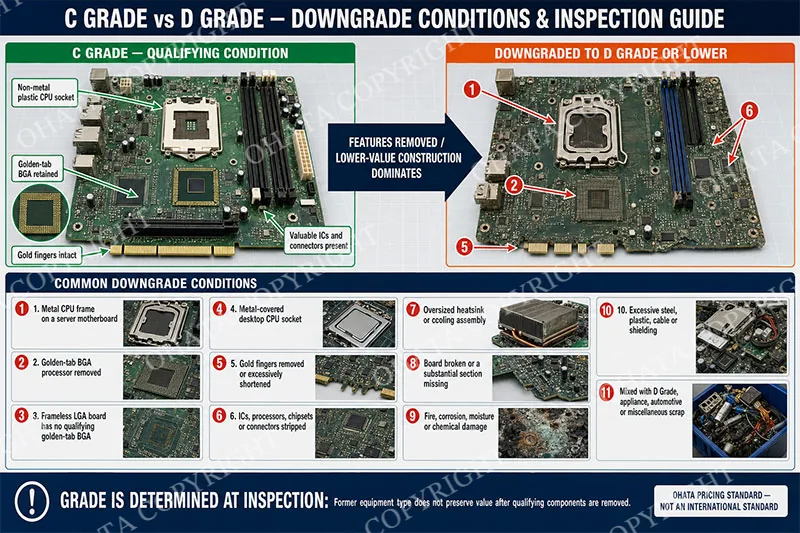
A server motherboard has a metal CPU frame.
A C Grade server board no longer retains its golden-tab BGA processor.
A frameless LGA server board has no qualifying golden-tab BGA component.
A desktop motherboard uses a metal-covered socket instead of an accepted non-metal plastic socket.
The gold-finger section has been removed or excessively shortened.
Valuable ICs, processors, chipsets, or connectors have been stripped.
A cooling assembly is so large that the card fits the D Grade oversized-heatsink description.
The board is broken into pieces or a substantial section is missing.
Fire, corrosion, moisture, or chemical exposure has damaged the electronic material.
Excessive steel, plastic, cable, shielding, or non-board attachments remain in the lot.
C Grade boards are mixed with D Grade, appliance boards, automotive boards, or miscellaneous electronic scrap.
A board originally produced in a potentially higher-value form is graded according to its condition and remaining components at the time of inspection. Its former equipment type does not preserve its value after qualifying material has been removed.
Rejection Conditions
Some motherboards may be refused rather than merely downgraded. Potential rejection conditions include severe burning, heavy oil contamination, hazardous chemical residue, radioactive contamination, excessive moisture, mold, embedded batteries, leaking capacitors, or unsafe dismantling debris.
Loads may also be rejected when they contain excessive non-PCB material, unidentified mixed waste, household rubbish, loose steel, plastic housings, glass, dirt, or unrelated appliance scrap. Counterfeit descriptions, concealed low-grade material, and loads that cannot be safely or consistently inspected may also be refused.
Lithium batteries, swollen batteries, mercury-containing parts, and other hazardous items should be removed and handled through an appropriate waste channel before shipment. Battery removal must be performed without damaging the motherboard or stripping its valuable electronic components.
Final acceptance remains subject to Ohata’s inspection, purchasing requirements, safety rules, and the actual composition of the shipment.
Sorting and Delivery Guidance
C Grade and D Grade should be packed in separate, clearly identified containers. Do not combine them with Appliance Board A, Appliance Board B, power-supply boards, automotive boards, loose wires, transformers, bare metal, or general dismantling residue.
Mixed miscellaneous material lowers recycling value. When different grades are combined, the shipment may be priced according to its lowest significant grade because accurate sorting requires additional labor and creates uncertainty about the recoverable yield.
Boards should be kept dry and protected from saltwater, rain, mud, and corrosive chemicals. Stack them carefully to limit breakage. Remove loose external cases and clearly non-electronic bulk attachments when permitted, but keep the motherboard, qualifying sockets, BGAs, ICs, gold fingers, and important connectors intact.
Summary
Under the Ohata pricing system, C Grade represents standard electronic boards with moderate recovery potential, while D Grade represents lower-value computer boards with less precious-metal content or more non-valuable structural weight.
C Grade is commonly associated with specified non-metal plastic desktop CPU sockets, trimmed gold-finger cards, normally cooled expansion cards, and certain server boards retaining golden-tab BGA processors. D Grade is associated with metal-framed CPU sockets, I-Series and similar consumer motherboards, non-gold-tab laptop boards, oversized cooling assemblies, and low-density integrated designs.
Classification depends on what remains on the board at inspection. Complete boards with their qualifying sockets, BGA processors, integrated circuits, gold fingers, and connectors preserve the strongest recycling value. Broken, incomplete, stripped, contaminated, or mixed material will be downgraded and may be rejected. Separating C Grade from D Grade and miscellaneous scrap is therefore essential for consistent identification, safer handling, and fair recycling valuation.