

Introduction, Construction, Components, and Recycling Value
Introduction
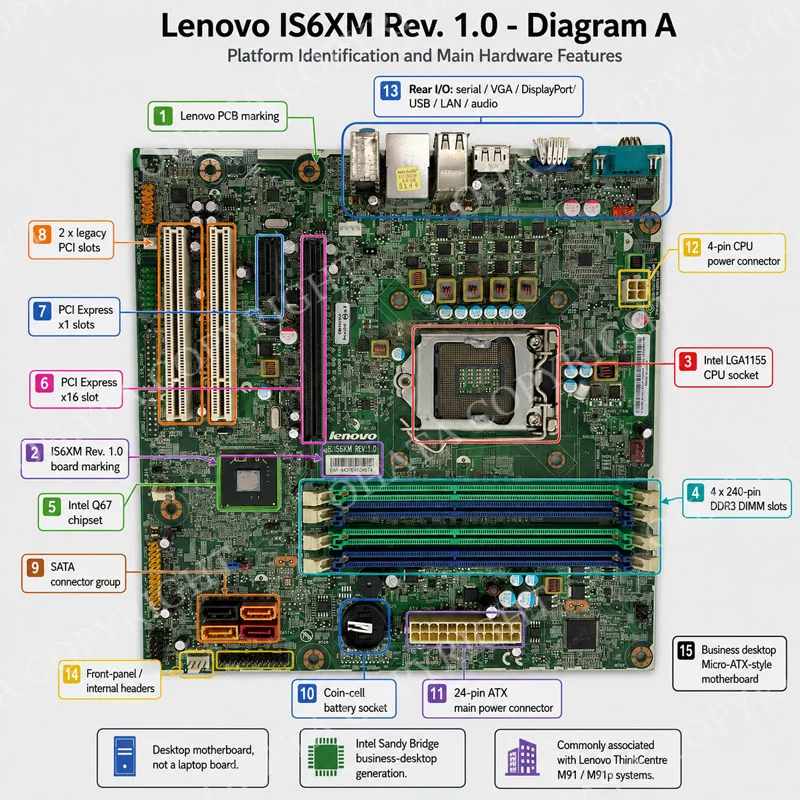
Locate the “IS6XM Rev. 1.0” silkscreen and Lenovo FRU label before using the slot layout to identify this board. The LGA1155 socket, four full-size DDR3 slots, Q67-era rear I/O and Lenovo-specific headers point to the ThinkCentre M91/M91p family, but the FRU and machine type are needed to confirm chassis compatibility.
The board is visually identified by the Lenovo PCB marking, IS6XM Rev. 1.0 text, four DDR3 DIMM slots, LGA1155 CPU socket, Intel Q67 chipset platform, one PCI Express x16 slot, smaller PCI Express expansion, two legacy PCI slots, SATA connector group, coin-cell battery socket, rear serial / VGA / DisplayPort / USB / LAN / audio I/O arrangement, and OEM Lenovo connector layout. The visible form and connector mix match the Lenovo ThinkCentre M91 / M91p small-form-factor and tower-generation platform. Lenovo ThinkCentre M91p documentation describes the system as using an LGA1155 processor socket, Intel Q67 Express chipset, PC3-10600 DDR3 memory, four 240-pin DIMM sockets, Intel HD Graphics in the processor, VGA and DisplayPort outputs, SATA storage, Realtek ALC662 audio, Intel 82579 Ethernet, and PCI Express / PCI expansion.
From a recycling perspective, the IS6XM is a modern Intel i-series OEM desktop motherboard. Its value is based on the assumed installed CPU, LGA1155 socket contacts, DDR3 memory-slot contacts, PCI Express and PCI slot contacts, Intel Q67 chipset package, onboard audio and LAN circuits, BIOS flash, voltage-regulation components, copper layers inside the PCB, solder alloys, nickel-plated connector shells, MLCCs, and limited gold-bearing contact structures. It is not an enterprise telecom board, industrial controller, Apple logic board, laptop motherboard, large server board, or military/aerospace board.
Brand and Typical Computer Use
The IS6XM board is normally used in Lenovo ThinkCentre M91 / M91p desktop computers. Lenovo’s ThinkCentre M91p reference lists business-desktop configurations using Intel Core i5-2400 and Core i7-2600 processors, Intel Q67 chipset, Intel HD Graphics 2000 in the processor, DDR3 1333 MHz memory, SATA storage, and business-management features such as Intel vPro / Intel AMT.
This is an OEM Lenovo motherboard, meaning it was originally designed to operate inside specific Lenovo desktop chassis families. Unlike a retail ASUS, MSI, or Gigabyte board, it may use Lenovo-specific front-panel wiring, BIOS restrictions, fan-control behavior, and chassis connectors. However, computer hobbyists can still use the board for personal assembly, testing, repair, or custom desktop projects. Practical hobby use requires the correct LGA1155 CPU, compatible DDR3 memory, an appropriate power supply, correct front-panel wiring, a compatible cooler, and awareness that BIOS support may be limited to the processor families approved for the original Lenovo platform.
For recycling classification, the original computer brand matters less than the physical board construction. The board is classified by socket type, chipset platform, component density, board completeness, connector value, CPU presence, and overall recoverable material value.
CPU Socket and CPU Package Size
The CPU interface is Intel LGA1155, also known as Socket H2. In this socket type, the motherboard socket contains the spring contacts, while the CPU package has flat conductive lands. The socket uses a metal load plate and lever to clamp the processor into place. This metal-load-plate design is a key visual indicator for sorting this board under Ohata’s D Grade category, because the Board Grade Class explicitly includes i-series motherboards where the CPU socket has a metal cover and lever in D Grade.
Lenovo ThinkCentre M91p documentation states that the processor is implemented in an LGA1155 socket, and Intel’s Core i5-2500 specification lists LGA1155 as the supported socket. The compatible CPU package size is 37.5 mm × 37.5 mm, as listed in Intel’s package specification for LGA1155 processors.
Typical compatible CPUs for this board family are Intel 2nd-generation Core processors used in ThinkCentre M91 / M91p systems. Lenovo’s M91p reference specifically lists examples such as Intel Core i5-2400 and Core i7-2600, with integrated Intel HD Graphics 2000 and dual-channel DDR3 memory controller functions in the processor.
For scrap buying, CPU presence is very important. A CPU-installed IS6XM motherboard is more valuable than a CPU-missing board because the CPU contributes semiconductor die material, package substrate, contact lands, internal metal layers, heat-spreader metal, and precious-metal-bearing internal structures. If the CPU is missing, the motherboard remains recyclable, but the purchase value should be lower. If the LGA1155 socket is bent, broken, burned, corroded, contaminated, or removed, the loss is more serious because the recoverable socket contact field is also affected.
Chipset and Platform Architecture
The chipset is Intel Q67 Express. Lenovo’s ThinkCentre M91p reference identifies the platform as using Intel Q67 Express and describes the platform controller hub as handling PCI Express 2.0 x1, Ethernet MAC, PCI, and USB functions.
Intel Q67 was a business-oriented chipset for LGA1155 systems. In this platform generation, many major functions moved into the CPU package, including the memory controller and integrated graphics engine. The motherboard chipset and supporting controllers therefore contain fewer separate support ICs than older desktop generations. This integration improves system efficiency but reduces the number of discrete valuable chips on the motherboard, which is one reason the board fits D Grade rather than a higher computer-board category.
The visible chipset package should remain attached. If the chipset has been removed, scraped, cracked, burned, or heavily corroded, the board loses a major semiconductor component and should be downgraded.
Graphics Configuration
The board’s graphics output is processor-dependent. Lenovo’s ThinkCentre M91p reference describes Intel HD Graphics in the processor, using system memory and supporting VGA and DisplayPort outputs. This means the board does not contain a separate removable graphics card. The rear video ports are part of the motherboard I/O, while the graphics engine is inside the installed Intel LGA1155 CPU.
If a discrete PCI Express graphics card is installed in the full-length PCIe x16 slot, that card should be removed and graded separately. The motherboard itself remains a desktop motherboard. The presence of VGA / DisplayPort-style output does not make it a graphics card and does not raise the board above D Grade.
Memory Subsystem
The IS6XM board has four full-size DDR3 240-pin DIMM sockets. Lenovo’s ThinkCentre M91p reference lists 16 GB maximum memory, PC3-10600 1333 MHz DDR3, UDIMM, and four 240-pin DIMM sockets. These are desktop memory slots, not laptop SO-DIMM slots.
Memory slots are important for recycling value because each connector contains many plated contacts, solder joints, and copper alloy structures. If DDR3 memory modules are present, they are normally sorted separately as RAM scrap. The motherboard itself should retain the DIMM sockets. Broken, removed, burned, cracked, or heavily corroded memory slots reduce connector completeness and can lower the board’s buying value.
Expansion, Storage, and I/O
The board has a desktop expansion layout. Lenovo’s ThinkCentre M91p reference lists one PCI Express 2.0 x16 slot, one PCI Express 2.0 x1 slot, and two 32-bit PCI 2.3 slots in the system’s expansion description. The board image shows the same general desktop expansion pattern: a long PCIe graphics slot, smaller PCIe expansion, and legacy PCI slots.
The storage area includes SATA connectors. Lenovo’s M91p reference describes SATA 3.0 Gb/s and SATA 6.0 Gb/s support integrated in the chipset, RAID 0/1 support, and SATA connector availability on the system planar. On the board, the SATA connector group is located near the lower-right edge. These connectors contain metal contacts, solder joints, and plastic housings. They add recovery value and should remain attached.
Rear I/O includes business-desktop connectors. Lenovo’s reference lists rear USB 2.0, serial, Ethernet, VGA, DisplayPort, and rear audio ports. The board also contains front-panel headers, internal USB headers, fan connectors, power connectors, and service headers. These connector systems provide copper, nickel-plated metal, solder, and limited gold-bearing surfaces.
Audio, LAN, BIOS, and Security Components
Lenovo’s M91p reference lists Realtek ALC662 high-definition audio and Intel 82579 Gigabit Ethernet with Wake on LAN support. These are standard business-desktop controller components. They contribute integrated circuit packages, support components, and connector systems, but they do not make the board telecom-grade or enterprise network hardware.
The board also includes a BIOS flash device, Super I/O circuitry, fan-control circuits, voltage-regulation controller circuits, crystal oscillators, capacitors, inductors, MOSFETs, and passive component networks. Lenovo’s M91p reference also identifies a TPM security chip in the system configuration. These parts improve board completeness and contribute to the recoverable electronic material profile.
Recycling Value Overview
The Lenovo IS6XM Rev. 1.0 contains meaningful recoverable material, but its precious-metal concentration is modest compared with older high-value computer boards, laptop motherboards, Apple logic boards, industrial controllers, telecom boards, and server boards. Its value comes from a balanced combination of base metals and limited precious-bearing parts rather than from exceptionally dense IC coverage.
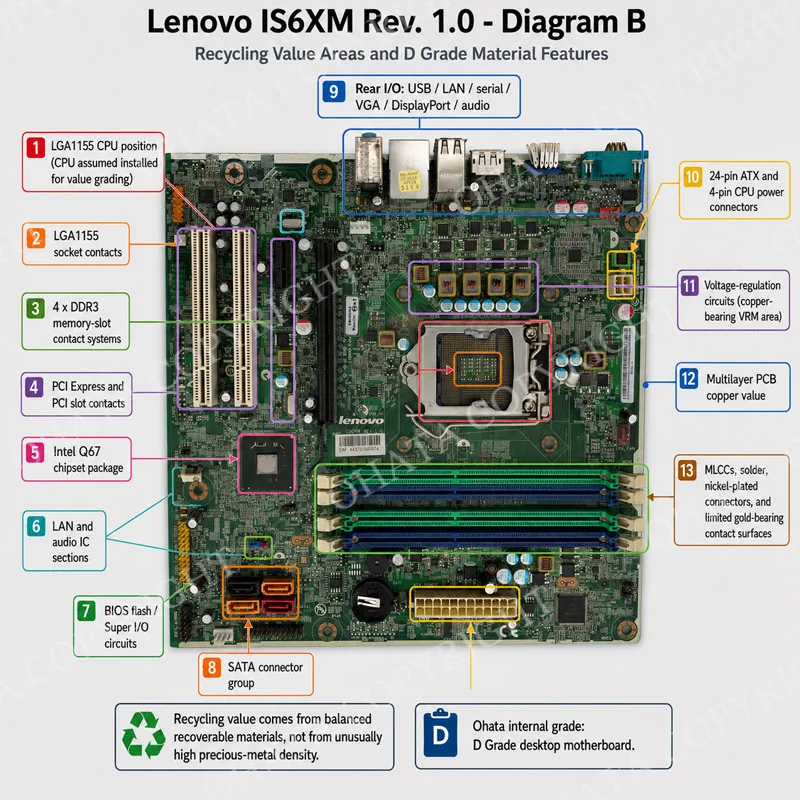
Important value areas include:
Installed LGA1155 CPU.
LGA1155 socket contacts.
Four DDR3 memory-slot contact systems.
PCI Express and PCI slot contacts.
Intel Q67 chipset package.
LAN and audio ICs.
BIOS flash and Super I/O circuits.
SATA connector group.
USB, LAN, serial, VGA, DisplayPort, and audio rear I/O.
24-pin ATX and CPU power connectors.
Copper-bearing voltage-regulation circuits.
Multilayer PCB copper.
MLCCs, solder, nickel-plated connectors, tin, and limited gold-bearing contact surfaces.
Under Ohata’s internal grading system, this board is a D Grade desktop motherboard because it is a modern Intel i-series LGA motherboard with a metal socket cover/lever and cost-efficient business-desktop construction.
Ohata D Grade Classification, Identification Guide, and Apple Logic Board Types
Official Ohata D Grade Classification
The official Ohata classification for the Lenovo IS6XM Rev. 1.0 motherboard is:
Ohata Board Scrap Classification: D Grade Board Scrap
This classification assumes a compatible LGA1155 CPU is installed and the board remains complete, clean, dry, and structurally intact.
The general Ohata Board Grade Class places i-series motherboards with metal CPU socket covers and levers, desktop motherboards with metal sockets, integrated motherboards, peripheral lower-grade boards, and similar low-grade computer boards in D Grade. The detailed D Grade standard explains that D Grade represents the entry-level computer-board category for lower-value computer motherboards, later-generation Intel desktop boards, modern consumer boards, and other cost-efficient computer hardware with lower recoverable precious-metal concentration than C, B, A, A+, S, SS, or SSS Grade material.
The Lenovo IS6XM Rev. 1.0 matches D Grade because it has:
Intel i-series LGA1155 metal socket.
Modern Intel Q67 platform architecture.
Integrated CPU graphics support through the processor.
Four DDR3 slots.
Standard desktop PCI Express and PCI expansion.
Standard audio and LAN controller sections.
Cost-efficient OEM desktop motherboard construction.
Moderate but not premium IC density.
No laptop, Apple, industrial, server, telecom, or military characteristics.
Why This Board Is Not C Grade
C Grade includes standard desktop motherboards, trimmed expansion cards, connector-end boards, graphics cards, interface cards, and consumer electronic boards with moderate recoverable value. The Lenovo IS6XM has several standard desktop-board features, including a CPU socket, memory slots, expansion slots, storage connectors, LAN, audio, and rear I/O. However, Ohata’s D Grade rule is more specific for this board type: later Intel i-series metal-socket desktop motherboards belong in D Grade.
The board also has a cost-optimized business-desktop design. Many functions are consolidated into the CPU and Q67 chipset, reducing the number of discrete support ICs compared with older C Grade desktop boards. This lower semiconductor density and later-generation integrated platform construction support D Grade rather than C Grade.
Why This Board Is Not B Grade
B Grade is a medium-grade category for boards with stronger component density or medium-value CPU socket designs, including certain desktop motherboards, lower-grade telecom boards, embedded controller boards, and entry-level server-style boards. The IS6XM is not a server board, telecom board, industrial embedded controller, or high-end workstation motherboard. It is a Lenovo OEM business desktop board using standard Intel Q67 / LGA1155 construction.
A CPU-installed board is more valuable than a CPU-missing board, but the installed CPU does not change the platform category. The board remains D Grade under the Ohata internal rule for i-series metal-socket desktop motherboards.
Why This Board Is Not A Grade or A+ Grade
A Grade includes non-Apple laptop motherboards, large single-socket server motherboards, clean gold-finger expansion cards, optical-drive controller boards, enterprise backplanes, and selected high-grade computer boards. The Lenovo IS6XM is not a laptop motherboard, not a server motherboard, not a clean expansion card with a long gold-finger edge connector, and not an enterprise backplane.
A+ Grade includes Apple logic boards, industrial control boards, PLC CPU modules, CNC controller boards, robotics controllers, medical boards, industrial communication boards, and large multi-socket enterprise server motherboards. The IS6XM has none of these A+ characteristics.
Why This Board Is Not S, SS, or SSS Grade
S Grade is associated with premium legacy boards, multiple ceramic CPU boards, non-SATA hard drive boards, and older high-value computer hardware. The IS6XM uses a modern organic Intel LGA1155 CPU platform and does not contain multiple ceramic CPUs.
SS Grade is used for enterprise networking, telecom switching, optical communication boards, server backplanes, smartphone logic boards, and high-density communication systems. The IS6XM has ordinary desktop Gigabit Ethernet and no carrier-grade network-switching architecture.
SSS Grade is reserved for military, aerospace, satellite, radar, defense, scientific, and mission-critical electronics with exceptionally high gold content, ceramic packages, and premium connectors. The IS6XM is a mass-produced OEM desktop board and does not match SSS construction.
Identification Guide
Step 1 – Confirm Desktop Form Factor
Check for desktop features: LGA1155 metal socket, full-size DDR3 DIMM slots, PCI Express and PCI expansion slots, SATA connectors, ATX-style power connectors, and rear desktop I/O. These features confirm that the board is a desktop motherboard, not a laptop motherboard.
Step 2 – Confirm Lenovo IS6XM Marking
Look for the Lenovo marking and IS6XM Rev. 1.0 PCB mark. The layout should match the Lenovo ThinkCentre M91 / M91p generation with Intel Q67 chipset, LGA1155 CPU socket, four DDR3 DIMM slots, PCIe x16, PCIe x1, PCI slots, and business desktop I/O.
Step 3 – Confirm LGA1155 CPU Socket
The socket should be Intel LGA1155 with a metal load plate and lever. Intel’s LGA1155 processor specification lists the socket as LGA1155 and the package size as 37.5 mm × 37.5 mm.
Step 4 – Confirm Intel Q67 Platform
The system platform should be Intel Q67. Lenovo’s ThinkCentre M91p reference lists Intel Q67 Express Chipset and describes the platform controller hub functions.
Step 5 – Confirm DDR3 Memory Layout
The board should have four 240-pin DDR3 DIMM slots. Lenovo’s M91p reference lists PC3-10600 1333 MHz DDR3, UDIMM, and four 240-pin DIMM sockets.
Step 6 – Confirm Expansion and I/O
The board should show one PCIe 2.0 x16 slot, one PCIe 2.0 x1 slot, two PCI slots, SATA connectors, VGA, DisplayPort, serial, USB, LAN, and audio ports. Lenovo’s M91p reference lists these platform-level slots and rear I/O features.
Apple Logic Board Types Comparison
Apple logic boards are not part of this board’s identity. Apple MacBook logic boards are compact, high-density laptop boards with dense BGA packages, fine-pitch connectors, proprietary board shapes, and much higher component density per unit area. Ohata’s Apple logic-board guide treats genuine Apple laptop logic boards as A+ Grade material because of their dense semiconductor coverage, premium construction, and high-value connector systems.
The Lenovo IS6XM Rev. 1.0 is a desktop motherboard with full-size DDR3 DIMM slots, PCI Express / PCI expansion slots, ATX-style power connectors, and an LGA1155 desktop CPU socket. It should not be mixed with Apple logic board scrap.
Recoverable Materials, Buying Standards, and Handling
Recoverable Materials
The Lenovo IS6XM Rev. 1.0 contains the typical material profile of Ohata D Grade desktop motherboard scrap. D Grade boards have lower precious-metal concentration than higher computer, telecom, industrial, and Apple logic-board grades, but they remain recyclable because they contain copper, socket contacts, memory-slot contacts, expansion-slot contacts, integrated circuits, solder, nickel-plated connectors, MLCCs, and limited gold-bearing material.
Copper is the largest recoverable metal by weight. It is present in internal PCB layers, CPU voltage-regulation paths, ground planes, power planes, signal traces, inductors, chokes, memory routing, PCI Express routing, SATA routing, USB routing, Ethernet magnetics, and ATX connector pathways.
Gold appears in limited but important areas. Gold-bearing locations may include CPU package structures, LGA1155 socket contacts, DDR3 memory-slot contacts, PCI Express slot contacts, PCI contacts, USB connector contacts, LAN connector contacts, test pads, and gold bond wires inside integrated circuits.
Silver may be present in selected contacts, solder materials, and semiconductor structures.
Palladium may be present in multilayer ceramic capacitors distributed across the board.
Tin and nickel are found in solder alloys, component leads, connector plating, socket underplating, rear I/O shielding, and plated contact surfaces.
Aluminum may be recovered from heatsinks if present, but heatsinks do not define the circuit-board grade.
Buying Standards
A preferred D Grade Lenovo IS6XM Rev. 1.0 motherboard should have:
Compatible LGA1155 CPU installed when CPU-included material is required.
LGA1155 socket intact.
Intel Q67 chipset package present.
Four DDR3 DIMM slots present.
PCI Express and PCI slots present.
SATA connectors present.
BIOS flash present.
Audio and LAN controller sections intact.
Rear serial, VGA, DisplayPort, USB, LAN, and audio connectors present.
ATX main power and CPU power connectors present.
Front-panel, fan, and USB headers present.
PCB structurally complete.
Board dry and reasonably clean.
No severe corrosion.
No burn damage.
No water damage.
No battery leakage.
No heavy component harvesting.
No oil, adhesive, paint, chemical residue, excessive thermal paste, or heavy dust contamination.
No mixed low-grade material attached to the board lot.
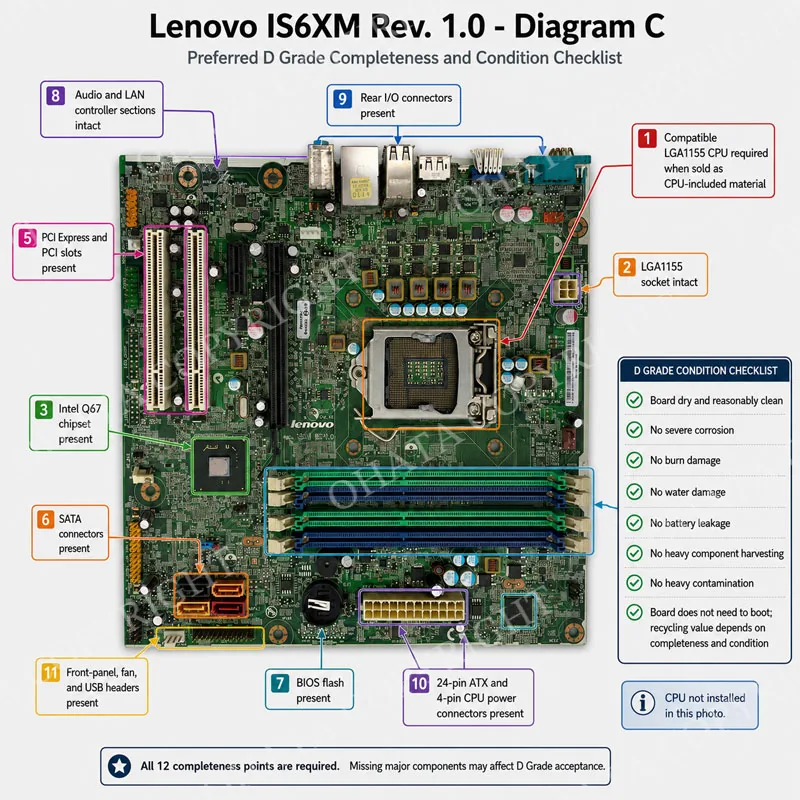
The board does not need to boot or operate. Recycling value is based on physical materials, CPU presence, component completeness, connector condition, and contamination level.
Importance of CPU Completeness
The CPU should remain installed whenever the board is purchased as desktop motherboard with CPU material. The compatible CPU package is Intel LGA1155, 37.5 mm × 37.5 mm.
A CPU-installed board is more valuable because the processor contributes recoverable semiconductor material, package substrate, internal metal layers, contact lands, heat-spreader metal, and precious-metal-bearing internal structures. If the CPU is missing, the board remains D Grade motherboard scrap but should be purchased at a lower value. If the LGA1155 socket is damaged or removed, the downgrade is more severe because the board loses the socket contact field as well.
Installing or retaining the CPU improves value within D Grade. It does not raise the board into C Grade, B Grade, A Grade, or A+ Grade because the board remains a modern Intel i-series metal-socket desktop motherboard under Ohata’s internal standard.
Acceptable Removals
The following removals usually do not change the D Grade identity if permanent electronics remain attached:
CPU heatsink.
CPU cooling fan.
Chipset heatsink, if the chipset remains undamaged.
Loose DDR3 memory modules.
Loose graphics card.
Loose PCI or PCI Express cards.
I/O shield.
Case screws and brackets.
External cables.
Plastic case parts.
Non-electronic accessories.
The detailed D Grade standard allows removal of non-electronic accessories such as heatsinks, fans, brackets, plastic housings, and loose cables, while processors, chipsets, sockets, connectors, and voltage-regulation circuits should remain attached because they contribute directly to recoverable value.
Conditions That Reduce Value
The following conditions reduce buying value:
CPU missing when CPU-installed boards are expected.
LGA1155 socket contacts bent or broken.
CPU socket removed.
Intel Q67 chipset removed or damaged.
DDR3 slots removed or cracked.
PCI Express or PCI slots harvested.
SATA connectors removed.
BIOS chip removed.
LAN or audio controller sections harvested.
Rear I/O ports broken or missing.
ATX power connector removed.
PCB cracked, drilled, cut, snapped, or missing sections.
Coin-cell battery leakage.
Heavy oxidation or corrosion.
Burned or carbonized PCB areas.
Water damage or PCB delamination.
Oil, adhesive, paint, chemical residue, excessive thermal paste, or heavy dirt contamination.
Mixed loads containing appliance boards, wire, batteries, plastic, steel, power-supply boards, or unrelated scrap.
The D Grade standard notes that missing processors, removed chipsets, broken PCB sections, heavy corrosion, burn damage, water intrusion, battery leakage, oil contamination, and large cut sections may reduce grade or buying value.
Rejection Conditions
A board may be rejected from sorted D Grade motherboard buying or moved to a lower mixed-PCB category when the expected recoverable structure cannot be inspected. Severe rejection or downgrade conditions include:
Board cut into multiple pieces.
CPU socket removed.
Main chipset package removed.
Heavy IC harvesting.
Severe fire damage.
Severe corrosion across the CPU, memory, chipset, or expansion areas.
PCB swelling or delamination from water damage.
Battery leakage destroying traces.
Heavy chemical contamination.
Mixed trash load where the motherboard cannot be separated.
A clean, complete, CPU-installed Lenovo IS6XM Rev. 1.0 is D Grade Board Scrap. A stripped, CPU-missing, broken, corroded, contaminated, or mixed board has lower value.
Handling and Storage
Store the motherboard flat, dry, and separated from heavy scrap. Do not crush it under power supplies, transformers, motors, steel, batteries, or mixed e-waste. Moisture should be avoided because it attacks LGA1155 socket contacts, DDR3 contacts, PCI Express contacts, PCI contacts, SATA contacts, USB contacts, LAN contacts, solder joints, chipset pads, and exposed copper.
CPU-installed boards should be separated from CPU-missing boards. D Grade desktop motherboards should be separated from B Grade desktop boards, C Grade standard boards, A Grade laptop boards, A+ Apple logic boards, appliance boards, power-supply boards, batteries, wires, plastics, and mixed low-grade material. Proper sorting protects value and prevents an otherwise acceptable board from being averaged down in a mixed lot.
Comparison, and Official Ohata Classification
Comparison with Laptop Motherboards
Laptop motherboards usually use SO-DIMM slots, flat-flex display connectors, battery charging circuits, compact BGA packages, and irregular notebook shapes. Non-Apple laptop motherboards are generally A Grade under Ohata because of their compact multilayer construction and higher component density. The Lenovo IS6XM Rev. 1.0 is a desktop motherboard with full-size DDR3 slots, PCI Express and PCI slots, ATX-style power connectors, SATA connectors, and rear desktop I/O.
Comparison with Apple Logic Boards
Apple logic boards are typically A+ Grade because they have dense semiconductor coverage, compact proprietary layouts, BGA processor packages, fine-pitch connectors, and premium multilayer construction. The Lenovo IS6XM is an OEM desktop board and must not be mixed with Apple logic-board scrap.
Comparison with B Grade Boards
B Grade includes medium-grade boards with better component density, stronger connector value, or medium-value CPU socket designs, as well as some lower-grade telecom, embedded, and server-type boards. The IS6XM has an LGA1155 i-series metal socket, but Ohata’s Board Grade Class specifically places this socket style and later Intel desktop platform type in D Grade.
Comparison with Appliance Boards
Appliance boards are designed for motors, relays, compressors, pumps, heaters, sensors, and appliance user interfaces. The IS6XM is a digital computing board with CPU socket, DDR3 memory, PCI Express expansion, Intel Q67 chipset, BIOS, SATA, USB, LAN, audio, VGA, DisplayPort, and ATX-style power architecture. It should not be sorted as Appliance Board A or Appliance Board B.
Official Ohata Classification Claim
The Lenovo IS6XM Rev. 1.0 / ThinkCentre M91-M91p Intel Q67 LGA1155 desktop motherboard is classified as:
Ohata Board Scrap Classification: D Grade Board Scrap
This classification is based on the following confirmed characteristics:
Desktop computer motherboard.
Lenovo IS6XM Rev. 1.0 board marking.
Lenovo ThinkCentre M91 / M91p platform association.
Intel LGA1155 / Socket H2 CPU interface.
Metal CPU socket load plate and lever.
37.5 mm × 37.5 mm compatible CPU package size.
Assumed compatible LGA1155 CPU installed.
Intel Q67 Express Chipset.
Intel HD Graphics function in the installed CPU.
VGA and DisplayPort-style motherboard display outputs.
Four 240-pin DDR3 DIMM sockets.
PC3-10600 1333 MHz DDR3 memory support in the Lenovo reference configuration.
PCI Express x16 expansion.
PCI Express x1 expansion.
Two legacy PCI slots.
SATA storage connector group.
Realtek ALC662 HD audio.
Intel 82579 Gigabit Ethernet.
Rear serial, USB, VGA, DisplayPort, LAN, and audio I/O.
ATX-style desktop power connector layout.
Cost-efficient modern Intel i-series OEM desktop motherboard construction.
D Grade metal-socket desktop motherboard characteristics under Ohata guidance.
Recoverable copper, CPU socket contacts, memory connector contacts, PCI Express contacts, PCI contacts, IC bond-wire material, solder, nickel-plated connectors, MLCC-related palladium, and limited gold-bearing contact surfaces.
The D Grade classification assumes that the motherboard is complete, clean, dry, structurally intact, and includes the CPU. If the CPU is missing, the Intel Q67 chipset is removed, the LGA1155 socket is damaged, major connectors are harvested, the PCB is cracked, or the board is corroded, burned, water damaged, chemically contaminated, or mixed with miscellaneous scrap, the buying value may be reduced or the board may be rejected from the sorted D Grade motherboard category.
The Ohata Board Scrap Classification System is an internal Ohata value-identification and sorting method for electronic scrap purchasing, warehouse grading, and recycling education. It is not an international standard, government regulation, ISO standard, or universally accepted industry classification. Final grade depends on physical inspection, CPU presence, board completeness, contamination level, and actual recoverable material condition.
Ohata MotherBoard Scrap Wiki Claim
The Ohata Wiki is an educational knowledge base developed and maintained by Ohata to provide information on electronic scrap identification, recycling technologies, material classification, and sustainable resource recovery. The content published in the Ohata Wiki is based on Ohata's operational experience, research, and educational objectives. It is intended to assist recyclers, businesses, researchers, students, and the public in understanding electronic materials and recycling practices.
The Ohata Wiki is designed as an educational reference only. It does not replace professional technical advice, engineering analysis, laboratory testing, or official industry standards.
Ohata MotherBoard Classification Claim
Record the FRU, machine type, CPU presence, socket condition and missing OEM hardware before grading. A working board with its original connectors and accessories may be more useful for ThinkCentre repair than immediate recycling; otherwise apply the current D Grade conditions and link to the live price page.